Carbon Capture and Storage is necessary to keep global warming below 2°C(cicero.oslo.no)
cicero.oslo.no
Carbon Capture and Storage is necessary to keep global warming below 2°C
https://cicero.oslo.no/no/posts/nyheter/carbon-capture-and-storage-is-necessary-to-keep-global-warming-below-2c
25 comments
Keep in mind that this simulator is very focused on status-quo. It's not even possible to simulate an exponential curve for solar or a methane catastrophe.
You can change the assumptions under top menu Simulation->Assumptions. Some of them determine how quickly can a technology come to market, how much it makes future improvements cheaper etc. Also here are more detailed explanations and examples of how the model works: https://docs.climateinteractive.org/projects/en-roads/en/lat...
Cool, I missed that menu at the time this as posted on HN. One can probably manage to get solar to behave exponentially with this. One can also use it to limit the availability of fossil fuels into more realistic numbers, and increase the effectivity of capture to something that reflects people at least trying.
That does allow one to fix the largest issues. But one still has to fix it.
That does allow one to fix the largest issues. But one still has to fix it.
That looks like a powerful tool! I've been on the lookout for something interactive like that for awhile, only saw desktop-based simulators. Nice find, curious where you came across it.
It's also the third generation of their simulator - they've been collecting data and creating tools like this for a bunch of years now: https://www.climateinteractive.org/tools/
I just randomly found it in some article about a month ago.
I just randomly found it in some article about a month ago.
People are missing the fact that the oil and gas industry is strongly in favour of CCS for 2 main reasons:
1. It makes extracting and burning oil not so bad - no need to make rules limiting oil extraction, we can simply start some CCS projects.
2. Injecting CO2 into deep oil wells actually helps get more oil out of them. Get the government to pay for CCS, while the oil company profits off increased yields.
1. It makes extracting and burning oil not so bad - no need to make rules limiting oil extraction, we can simply start some CCS projects.
2. Injecting CO2 into deep oil wells actually helps get more oil out of them. Get the government to pay for CCS, while the oil company profits off increased yields.
This is actually an important point. It doesn't remove the need for CCS though.
I think people advocating for CCS should be careful what they ask for. Reasonable things to do would be:
a) CCS should be confined to areas where no feasible technical alternative exists (e.g. cement) and to negative emissions.
b) No support for CCS as in Enhanced Oil Recovery. This is creating more emissions than it avoids.
I think people advocating for CCS should be careful what they ask for. Reasonable things to do would be:
a) CCS should be confined to areas where no feasible technical alternative exists (e.g. cement) and to negative emissions.
b) No support for CCS as in Enhanced Oil Recovery. This is creating more emissions than it avoids.
What is the reference to cement supposed to indicate here?
Cement releases CO2 as part of it's chemical curing process. It contributes to about 8% of worldwide emissions.
Another industry where CO2 as a chemical byproduct is vented at a massive scale in the atmosphere is with the steel industry.
Both are good targets for carbon capture at the source.
Another industry where CO2 as a chemical byproduct is vented at a massive scale in the atmosphere is with the steel industry.
Both are good targets for carbon capture at the source.
> Cement releases CO2 as part of it's chemical curing process. It contributes to about 8% of worldwide emissions.
Just to nitpick here, but I think this is crucial to understand: 8% is more plausibly a number for the total emissions of cement, including energy emissions. The chemical emissions are more in the range of 4%.
Just to nitpick here, but I think this is crucial to understand: 8% is more plausibly a number for the total emissions of cement, including energy emissions. The chemical emissions are more in the range of 4%.
I'm not sure it would even be practical to capture the carbon emitted during the curing process as this is happening at it's final destination rather than during manufacture.
AFAIK the usual cement types do not release CO₂ during curing, though a significant amount of CO₂ is released from the ingredients while baking. Sometimes the released CO₂ is reabsorbed when curing (lime).
What type of cement are you talking about?
Reference: http://matse1.matse.illinois.edu/concrete/prin.html
What type of cement are you talking about?
Reference: http://matse1.matse.illinois.edu/concrete/prin.html
From what I've read about carbon-negative cement, idea is not to capture the carbon released during curing, but to make concrete that later, over years, chemically reacts and captures the carbon from the air. Because concrete is porous to the depth of 20+ inches, it has a very large surface that can slowly extract more CO2 from air than it initially had released.
That’s not how CCS or net carbon works. CO2 is basically fungible. You can release it today in Australia and capture it yesterday or tomorrow in Canada to offset, it basically makes no appreciable difference.
I think the biggest reason for capturing at source is the concentration of the gas. Capturing CO2 when it's in atmosphere at 0.04% is much more energy intensive than capturing at source where concentrations could be many orders of magnitude higher.
Cement releases CO2 when lime is made from limestone. The curing of cement absorbs CO2 (less than was released in making the lime).
> Cement releases CO2 as part of it's chemical curing process. It contributes to about 8% of worldwide emissions.
There are 2 sources of CO2 during cement manufacture. One is from the decomposition of lime, the other is from the energy production needed to make the process work. The latter could be avoided by electrical heating, a solar furnace or other renewable heat sources. The decomposition part can be compensated by newer cement chemistries that reabsorb most of the CO2 during the curing process.
So there are alternatives, carbon capture is not the only solution.
There are 2 sources of CO2 during cement manufacture. One is from the decomposition of lime, the other is from the energy production needed to make the process work. The latter could be avoided by electrical heating, a solar furnace or other renewable heat sources. The decomposition part can be compensated by newer cement chemistries that reabsorb most of the CO2 during the curing process.
So there are alternatives, carbon capture is not the only solution.
Could you point me to any of the newer cement chemistries?
silicate and magnesium oxide based ones.
https://en.wikipedia.org/wiki/Sorel_cement https://www.solidiatech.com/solutions.html
https://en.wikipedia.org/wiki/Sorel_cement https://www.solidiatech.com/solutions.html
Do you roughly know the relative ratios of emission for the sources?
Our local cement factory (huge, and one of the top polluters in California) burns coal on site as a source of heat. So there's that, too.
Cement also typically covers a large square footage area of natural carbon absorbing material. So on top of the carbon required in the manufacturing/installation of the cement, the amount of trees cleared should be accounted as well since the cement does not absorb carbon.
Not that I'm a fan of the oil/gas industry, but the beneficial effects of cheap energy (virtually free in the case of natural gas in the US) shouldn't be overlooked, particularly if we can offset their negative consequences.
Climate change must be addressed and I'm all for clean energy (as in a significant portion of my portfolio is in clean energy ETFs, and I'm actually shorting oil and natural gas producers for the moment) but let's not kill a potential golden goose on principle. Decades of cheap energy could help lead to a rebirth of the American manfacutring sector.
Climate change must be addressed and I'm all for clean energy (as in a significant portion of my portfolio is in clean energy ETFs, and I'm actually shorting oil and natural gas producers for the moment) but let's not kill a potential golden goose on principle. Decades of cheap energy could help lead to a rebirth of the American manfacutring sector.
> Decades of cheap energy could help lead to a rebirth of the American manfacutring sector.
Energy is cheap in the USA (and has been for decades). Let’s not kid ourselves, energy costs aren’t the reason the USA exported ~all its manufacturing jobs.
(Remember to exclude subsidies in your comparisons, as that’s a matter of policy and, for example, the USA could choose to implement them today if it wanted.)
Energy is cheap in the USA (and has been for decades). Let’s not kid ourselves, energy costs aren’t the reason the USA exported ~all its manufacturing jobs.
(Remember to exclude subsidies in your comparisons, as that’s a matter of policy and, for example, the USA could choose to implement them today if it wanted.)
Probably better return on the investment if other parts of the world were to implement them:
https://waqi.info/
https://waqi.info/
If the rise of Trump, Sanders and Warren is any indication the USA does want to implement policy to retain manufacturing, even if it doesn't have a good plan to do so right now. Given the rising cost of labor in the developing world, increased automation and moves toward protectionism on both sides of the aisle, not to mention the cultural/geopolitical headaches in dealing with authoritarian dictatorships, it's plausible that super-cheap energy could be a deciding factor.
Germany figured it out, and their energy costs are roughly double ours.
Germany figured it out, and their energy costs are roughly double ours.
So what? I thought the goal was to solve climate change, not to spite the oil companies.
You've struck on something, here. For a lot of people, those two are tied up together, to the point that there are people more concerned with punishing oil companies than solving climate change.
Doesn’t seem like an unreasonable position to take. If someone murders a bunch of people, then trains as a trauma surgeon likely capable of saving a bunch of lives, the expectation is that we collectively shrug our shoulders and everything’s fine because it’s likely the final count will come out neutral?
Nah. We consider companies to be people in a legal sense and they should face justice in that same sense. Asset seizure, restorative justice, and incarceration all have suitable analogues that can be applied to these companies.
But back to the main point, that the two issues are often conflated by people? Also a reasonable position. Where has the profit been sought in extraction of non-renewables and release of CO2? Where should the capital for carbon re-capture and environmental restoration be drawn? The argument is that these two places are one and the same, and this idea has merit.
Nah. We consider companies to be people in a legal sense and they should face justice in that same sense. Asset seizure, restorative justice, and incarceration all have suitable analogues that can be applied to these companies.
But back to the main point, that the two issues are often conflated by people? Also a reasonable position. Where has the profit been sought in extraction of non-renewables and release of CO2? Where should the capital for carbon re-capture and environmental restoration be drawn? The argument is that these two places are one and the same, and this idea has merit.
The trap is anthropomorphizing oil companies with some sort of intent beyond making money. It's entirely a supply-side issue of people wanting to buy oil, and as a society, we have to deal with the consequences. Blaming oil companies is a cop-out for failed public policy.
3. The oil and gas industry is well placed to provide CCS services from an engineering perspective. Even without your second point it would be a commercial opportunity for them.
The oil and gas industry might well go bankrupt in the next decade as investors start to anticipate the huge cost of running declining businesses (with declining yields), and account for the trillions of stranded assets. Also, government will ask these companies to pay for the health and environmental cost of all their emissions. The insurance industry will also refuse to support them at some point. Why expect such a failing industry to provide these services?
Have you not been paying attention to the shape boom? The US is now a net exporter of oil and we have more natural gas than we know what to do with, and it'll likely stay that way for at least the next 70 years. I'm not sure where you're getting "declining yields" from.
There is still money to be made in declining industries, tobacco is a good example.
And the oil is still useful as chemical feedstock even if we stopped burning it.
If they can run their industry without destroying the world in the process, then is there still a reason for antagonism?
The problem is if they create the illusion of not destroying the world while continuing to do so. Which is really a key issue in the CCS debate.
That's a big "if" though. "If" our infrastructure is good enough that oil+CCS is more efficient and no more destructive than alt energy methods, then is there still a need for alt energy?
> That's a big "if" though.
No, that's pretty much how the CCS debate has been going. Norway announced a big project to cleanup a gas plant with CCS used for an oil refinery. The plant was built, but without CCS.
When Germany built its last wave of new coal power plants a common argument was that "the CO2 emissions are no big problem, we'll add CCS later". Which never happened.
The promise of CCS as an excuse for continued fossil fuel use without actually buildling it is a recurring theme in the debate.
No, that's pretty much how the CCS debate has been going. Norway announced a big project to cleanup a gas plant with CCS used for an oil refinery. The plant was built, but without CCS.
When Germany built its last wave of new coal power plants a common argument was that "the CO2 emissions are no big problem, we'll add CCS later". Which never happened.
The promise of CCS as an excuse for continued fossil fuel use without actually buildling it is a recurring theme in the debate.
I always wonder how one could enforce CCS via forestation. How can you be sure that the forest won't be cut down and never replanted? After all the idea behind capture certificates is to buy and forget.
This is definitely an issue with reforestation initiatives right now and (IMO) another form of green washing.
You can see a lot of examples where the planting is managed forestry that will be re-harvested. As long as it wasn’t recently a forested area, then it’s still a valid long-term carbon store for as long as the re-planting never stops or the final harvest is not taken. That’s a pretty big ‘if’ though, and the commercial interest that sits atop the arrangement is not aligned with a positive outcome. You’d also have to account for the output production of the felled wood to be sure of the benefit/cost to carbon capture. If a significant portion of the logged timber survives in some manufactured form for a long time that nudges the dial in a positive direction.
Also monoculture forests, characteristic of commercial interest, are a problem in terms of the multi-faceted nature of the climate change we’re attempting to halt/reverse. One of the big impacts of climate change is loss of biodiversity, but monoculture forestry does little to support nature and in many ways is akin to concreting over the area. Diverse native plantings that support wildlife and promote humus buildup is far more desirable to reclaim carbon AND provide much-needed refuge to threatened species.
You can see a lot of examples where the planting is managed forestry that will be re-harvested. As long as it wasn’t recently a forested area, then it’s still a valid long-term carbon store for as long as the re-planting never stops or the final harvest is not taken. That’s a pretty big ‘if’ though, and the commercial interest that sits atop the arrangement is not aligned with a positive outcome. You’d also have to account for the output production of the felled wood to be sure of the benefit/cost to carbon capture. If a significant portion of the logged timber survives in some manufactured form for a long time that nudges the dial in a positive direction.
Also monoculture forests, characteristic of commercial interest, are a problem in terms of the multi-faceted nature of the climate change we’re attempting to halt/reverse. One of the big impacts of climate change is loss of biodiversity, but monoculture forestry does little to support nature and in many ways is akin to concreting over the area. Diverse native plantings that support wildlife and promote humus buildup is far more desirable to reclaim carbon AND provide much-needed refuge to threatened species.
That's a stretch. There's still pipelines, oil spills, chemical processing, etc to deal with even beyond the CO2 cost. Oil isn't going to be the least env destructive option for quite some time.
Plus there's the political cost. Oil is in the ground. So wars are fought over it and rich nations exploit poor nations to their own advantage without considering the human toll. If alt energy makes nations more self-sufficient then that can only be a good thing.
Plus there's the political cost. Oil is in the ground. So wars are fought over it and rich nations exploit poor nations to their own advantage without considering the human toll. If alt energy makes nations more self-sufficient then that can only be a good thing.
Yes. Oil will continue to be harder to get over time, and makes some nations dependent on other nations they'd rather not be.
Wind isn't going anywhere, the sun isn't going anywhere.
Wind isn't going anywhere, the sun isn't going anywhere.
You're right. Somewhere around 2023 Fox News is going to do a complete about-face on global warming, aggressively urging taxpayers to fund these initiatives, conveniently forgetting everything they ever said on the topic, and watchers will somehow make sense of it.
And if that happens, are you going to take the win, or are you going to cut off your nose to spite your face?
Oh, I'm sure liberals will gloat and be happy the grumpy conservatives are at the table, and everyone will agree on the importance of the problem. Then both sides will fight over who funds the solution. Liberals say big oil creates the problem and must fund the solution, conservatives will say the public demands the oil and is affected by the problem and must fund the solution. Nobody will agree to anything and the world will burn anyway.
Most of the CO2 is produced in China and India so I doubt the conversation in the USA will be even relevant.
Whenever this point is brought up it’s suspiciously blind to the concept of per-capita emissions.
China and India have enormous populations. Their per-capita emissions are low.
Unless you’re arguing a position that some folks in the world are inherently more deserving of a better quality of their life beyond mere circumstance, it doesn’t make sense to raise the ‘per-nation’ measure of emissions over the per-person measure.
There is greatest scope for emissions reduction in nations where per-capita emissions are highest. American citizens need to be converned primarily about how to reduce America’s emissions. Chinese citizens need to be concerned primarily about how to reduce China’s emissions. Everyone is already best placed to exert political pressure and carry out grassroots change on their respective home turf.
Targets for nations have already been established in inter-governmental negotiations and re-litigating the basic figures in individual citizen discussion is pointless at best, actively distracting at worst.
“First, pluck the beam from your own eye”
China and India have enormous populations. Their per-capita emissions are low.
Unless you’re arguing a position that some folks in the world are inherently more deserving of a better quality of their life beyond mere circumstance, it doesn’t make sense to raise the ‘per-nation’ measure of emissions over the per-person measure.
There is greatest scope for emissions reduction in nations where per-capita emissions are highest. American citizens need to be converned primarily about how to reduce America’s emissions. Chinese citizens need to be concerned primarily about how to reduce China’s emissions. Everyone is already best placed to exert political pressure and carry out grassroots change on their respective home turf.
Targets for nations have already been established in inter-governmental negotiations and re-litigating the basic figures in individual citizen discussion is pointless at best, actively distracting at worst.
“First, pluck the beam from your own eye”
There are also issues of how to account for the same set of carbon emissions.
Suppose a Chinese factory uses electricity supplied by coal to manufacture a product. The product is shipped to the United States aboard a Korean container ship before being shipped by diesel train to Seattle, where it is delivered to a retailer by truck, purchased, plugged into the wall and powered by a combination of hydroelectric and natural gas energy. In this scenario, many of the carbon emissions can be counted as Korean or Chinese even though the end consumer is American.
The flip side of this is that the United States can also directly affect Chinese carbon emissions by simply buying fewer Chinese products.
Edit: Also, since China is a totalitarian dictatorship, it’s not like Chinese people can pressure their government very much.
Suppose a Chinese factory uses electricity supplied by coal to manufacture a product. The product is shipped to the United States aboard a Korean container ship before being shipped by diesel train to Seattle, where it is delivered to a retailer by truck, purchased, plugged into the wall and powered by a combination of hydroelectric and natural gas energy. In this scenario, many of the carbon emissions can be counted as Korean or Chinese even though the end consumer is American.
The flip side of this is that the United States can also directly affect Chinese carbon emissions by simply buying fewer Chinese products.
Edit: Also, since China is a totalitarian dictatorship, it’s not like Chinese people can pressure their government very much.
For sure, and ‘emitter pays’ is difficult to account since monitoring is required and not really feasible.
It works if everyone is honest, but when there’s financial incentive at local and global level to be dishonest, the outcome is predictable.
It works if everyone is honest, but when there’s financial incentive at local and global level to be dishonest, the outcome is predictable.
CO2 doesn't decay in the short term so talking about current production is meaningless. You have to consider cumulative emissions [0] if you want to talk about fairness.
[0] https://ourworldindata.org/uploads/2019/10/Cumulative-CO2-tr...
[0] https://ourworldindata.org/uploads/2019/10/Cumulative-CO2-tr...
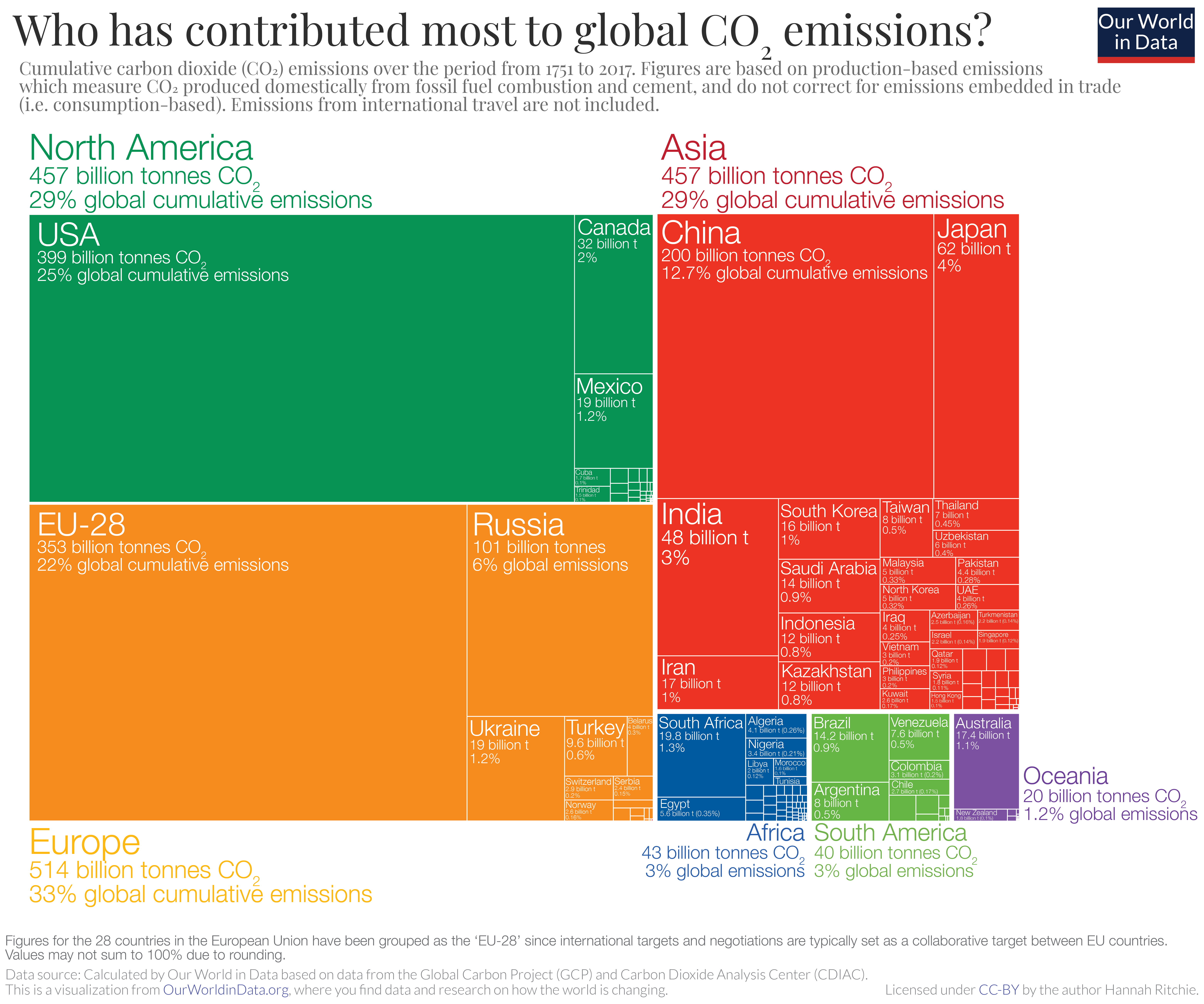
These are cumulative figures since 1751. In other words over 200 years of emissions before anyone knew what the consequences would be, and decades after that when the consequences weren’t widely understood. At least current figures are fair in the sense of accounting for who’s making it worse.
I was going to come back and change "conservatives will say the public" to "conservatives will say the public and other countries", but you beat me to it.
[deleted]
Enhanced recovery isn't carbon sequestration. You're not actually sequestering that much carbon with a C02 flood. That's not why oil companies tend to support CCS.
CO2 is only useful for enhanced recovery in a few scenarios. It only works in non-water-wet reservoirs, which are fairly rare. You wouldn't use it in other cases even if someone was paying you to. (You'd lose vastly more money in lowered recovery factor compared to optimal methods for the reservoir than you'd get paid. Better to use the correct methods and inject C02 into something you're not producing from.)
Big oil companies are in favor of CCS because they're the ones who can do it most effectively and have invested the most R&D in carbon sequestration strategies.
Like it or not, big oil isn't some evil mustache twirling villain. Yes, Exxon has taken some dicey moves with lobbying, but most of the oil industry has been very aware of climate change for quite awhile now and has been heavily investing in ways of tackling it (or at least they were ten years ago when I worked in oil - I assume that's still the case). They're basically waiting on regulatory changes to make it profitable.
The technical challenge right now is efficient C02 capture. We've largely shown that long-term C02 sequestration should work. However, we still don't have a ton of ways to capture carbon at scale that don't involve significant energy expenditures. The whole system needs to be carbon negative to work, and the methods we currently have don't scale terribly well in that regard. (i.e. Carbon capture is most feasible right now during electricity generation and other industrial processes that produce high concentrations of C02. To have a global impact we need to get it to work at atmospheric concentrations.) That's something that actually is a fairly tractable problem, it just needs large scale focus. To get that in our current system, you need to make it economic to capture and sequester carbon.
We, as a society, are still dependent on hydrocarbons for lots of things. We really still can't easily replace them -- we're structured around cheap fuel with a very high energy density. Electric cars certainly help, but they can only replace some uses. We just don't have the technology to replace a large chunk of our current hydrocarbon uses. It's an energy density problem.
You want to change something, change the regulatory system. Regulate C02 as a pollutant, sure. You have to be careful how you implement that, though, or you'll most heavily impact the most venerable portion of the population with price increases. For that reason, cap and trade is also a good approach. So are many of the carbon market strategies. Yeah, some of those ideas come from the conservative side politically -- it doesn't make them ineffective.
Vilifying oil companies just demonstrates ignorance of both the problem and the solutions. Big oil is part of the solution as well.
CO2 is only useful for enhanced recovery in a few scenarios. It only works in non-water-wet reservoirs, which are fairly rare. You wouldn't use it in other cases even if someone was paying you to. (You'd lose vastly more money in lowered recovery factor compared to optimal methods for the reservoir than you'd get paid. Better to use the correct methods and inject C02 into something you're not producing from.)
Big oil companies are in favor of CCS because they're the ones who can do it most effectively and have invested the most R&D in carbon sequestration strategies.
Like it or not, big oil isn't some evil mustache twirling villain. Yes, Exxon has taken some dicey moves with lobbying, but most of the oil industry has been very aware of climate change for quite awhile now and has been heavily investing in ways of tackling it (or at least they were ten years ago when I worked in oil - I assume that's still the case). They're basically waiting on regulatory changes to make it profitable.
The technical challenge right now is efficient C02 capture. We've largely shown that long-term C02 sequestration should work. However, we still don't have a ton of ways to capture carbon at scale that don't involve significant energy expenditures. The whole system needs to be carbon negative to work, and the methods we currently have don't scale terribly well in that regard. (i.e. Carbon capture is most feasible right now during electricity generation and other industrial processes that produce high concentrations of C02. To have a global impact we need to get it to work at atmospheric concentrations.) That's something that actually is a fairly tractable problem, it just needs large scale focus. To get that in our current system, you need to make it economic to capture and sequester carbon.
We, as a society, are still dependent on hydrocarbons for lots of things. We really still can't easily replace them -- we're structured around cheap fuel with a very high energy density. Electric cars certainly help, but they can only replace some uses. We just don't have the technology to replace a large chunk of our current hydrocarbon uses. It's an energy density problem.
You want to change something, change the regulatory system. Regulate C02 as a pollutant, sure. You have to be careful how you implement that, though, or you'll most heavily impact the most venerable portion of the population with price increases. For that reason, cap and trade is also a good approach. So are many of the carbon market strategies. Yeah, some of those ideas come from the conservative side politically -- it doesn't make them ineffective.
Vilifying oil companies just demonstrates ignorance of both the problem and the solutions. Big oil is part of the solution as well.
"The technical challenge right now is efficient C02 capture. We've largely shown that long-term C02 sequestration should work. However, we still don't have a ton of ways to capture carbon at scale that don't involve significant energy expenditures. The whole system needs to be carbon negative to work ..."
Thank you for this interesting contribution ... I agree that the full-lifecycle accounting of CO2 and the requirement that the entire cycle come out carbon negative is the really challenging part.
I would go a step further: I am skeptical of carbon sequestration in gaseous form. Call me timid, but I wouldn't want to make high stakes bets on gas staying in the places where we put it. Instead, I would like to see a reaction that converts the CO2 to a solid form (chalk ?) that is stable in physical form.
I believe that weird seed-the-oceans-with-iron-dust proposal accomplishes, roughly, the same thing - carbon sequestered in a solid, stable form.
Thank you for this interesting contribution ... I agree that the full-lifecycle accounting of CO2 and the requirement that the entire cycle come out carbon negative is the really challenging part.
I would go a step further: I am skeptical of carbon sequestration in gaseous form. Call me timid, but I wouldn't want to make high stakes bets on gas staying in the places where we put it. Instead, I would like to see a reaction that converts the CO2 to a solid form (chalk ?) that is stable in physical form.
I believe that weird seed-the-oceans-with-iron-dust proposal accomplishes, roughly, the same thing - carbon sequestered in a solid, stable form.
You don't actually sequester C02 in gaseous form when you do geologic carbon sequestration.
First off, even the simplest methods wind up with it dissolved in water. You basically can't just inject gaseous C02 into the ground and have it remain a gas. The rocks you're injecting it into are filled with water and it's highly soluble in water. Under certain conditions, you can inject liquid C02 and actually displace the water already there. However, that's mostly not what's being proposed.
Geologic carbon sequestration can take a handful of different approaches. The two you'll hear talked about the most are: 1) Inject it into a reservoir where you expect it to react with something and eventually form carbonate minerals (in-situ mineral sequestration, or mineral trapping). 2) Inject it into a very deep reservoir where it will dissolve into the brine already there and/or is unable to find a way back out again due to the geometry of the reservoir. (Solubility trapping and/or residual trapping)
The first method is preferable, but actually hard to guarantee in practice. The second may sound more risky, but we're actually pretty good at identifying regions that can store a buoyant phase over geologic time -- it's exactly what we do in hydrocarbon exploration. Both are being actively explored along with several others. There's a lot of geologic research being done on carbon sequestration right now (and has been for quite awhile, actually, though the government funded it well before industry started to).
The risk of the "seed the oceans" approaches (or the olivine beach proposals as well) are the environmental side effects. Altering ocean chemistry _will_ have significant effects. Similarly, putting olivine on beaches will result in a lot of heavy metal contamination (you can't get pure olivine -- you're going to have a lot of chromite and fun other odds and ends in ultramafic rocks).
I'd argue we're better off impacting the deep underground where more or less nothing lives than we are altering the oceans.
First off, even the simplest methods wind up with it dissolved in water. You basically can't just inject gaseous C02 into the ground and have it remain a gas. The rocks you're injecting it into are filled with water and it's highly soluble in water. Under certain conditions, you can inject liquid C02 and actually displace the water already there. However, that's mostly not what's being proposed.
Geologic carbon sequestration can take a handful of different approaches. The two you'll hear talked about the most are: 1) Inject it into a reservoir where you expect it to react with something and eventually form carbonate minerals (in-situ mineral sequestration, or mineral trapping). 2) Inject it into a very deep reservoir where it will dissolve into the brine already there and/or is unable to find a way back out again due to the geometry of the reservoir. (Solubility trapping and/or residual trapping)
The first method is preferable, but actually hard to guarantee in practice. The second may sound more risky, but we're actually pretty good at identifying regions that can store a buoyant phase over geologic time -- it's exactly what we do in hydrocarbon exploration. Both are being actively explored along with several others. There's a lot of geologic research being done on carbon sequestration right now (and has been for quite awhile, actually, though the government funded it well before industry started to).
The risk of the "seed the oceans" approaches (or the olivine beach proposals as well) are the environmental side effects. Altering ocean chemistry _will_ have significant effects. Similarly, putting olivine on beaches will result in a lot of heavy metal contamination (you can't get pure olivine -- you're going to have a lot of chromite and fun other odds and ends in ultramafic rocks).
I'd argue we're better off impacting the deep underground where more or less nothing lives than we are altering the oceans.
In general, agreed, though our deep underground storage is limited.
We could create more such sites at great expense after we run out of natural sites and abandoned mines.
Have to be also very careful to not break underground water reservoirs.
We could create more such sites at great expense after we run out of natural sites and abandoned mines.
Have to be also very careful to not break underground water reservoirs.
CCS is absolutely going to be necessary. So is nuclear.
What is the renewable alternative for the cement, steel, shipping, and aviation industries?
Environmentalists need to get out of their own way and stop treating good as the enemy of perfect. Some progress is better than no progress. All technologies and approaches will be required.
https://mobile.twitter.com/Peters_Glen/status/11948866002552...
What is the renewable alternative for the cement, steel, shipping, and aviation industries?
Environmentalists need to get out of their own way and stop treating good as the enemy of perfect. Some progress is better than no progress. All technologies and approaches will be required.
https://mobile.twitter.com/Peters_Glen/status/11948866002552...
This is true.
We should be able to reach net-zero emissions in the energy industry by around 2040 (optimistic, but realistic target), and even produce enough clean electricity to power clean electric solutions in transport/agriculture/industrial/appliance sectors (which are the other main contributors to net GHG emissions).
The only problem is that a lot of this technology is still missing / not adopting fast enough. Electric cars and cleaner farming will probably get there in time, as well as lots of electric appliances and clean steel.
I'm worried about these though:
- Cement/concrete
- Aviation (electric is on the way [1], but maybe growing too slow)
- Livestock (synthetic meat promising, but once again maybe progress too slow)
- Shipping
- Appliances/civilian buildings: long lifespan to replace systems with electric alternatives, people won't just throw away a working heating system / stove etc
For those, we need CCS or reforestation efforts to be accelerated.
Our best bet in my view is to focus most investment in nuclear energy short term, with large minorities in CCS and transport+industrial electrification, and get electricity prices super low (and TPES super high)
Once we have abundant, clean energy worldwide, we will be able to easily reach net-zero emissions and even induce net cooling if we feel we have overshot the ideal atmospheric carbon level.
(In fact, we should be able to move it either way depending on our needs)
Net zero goal isn't about stopping climate change, it's about putting the control in our hands and having the ability to shift temperatures and GHG levels in the optimal direction in perpetuity.
[1] https://heartaerospace.com (YC-backed)
We should be able to reach net-zero emissions in the energy industry by around 2040 (optimistic, but realistic target), and even produce enough clean electricity to power clean electric solutions in transport/agriculture/industrial/appliance sectors (which are the other main contributors to net GHG emissions).
The only problem is that a lot of this technology is still missing / not adopting fast enough. Electric cars and cleaner farming will probably get there in time, as well as lots of electric appliances and clean steel.
I'm worried about these though:
- Cement/concrete
- Aviation (electric is on the way [1], but maybe growing too slow)
- Livestock (synthetic meat promising, but once again maybe progress too slow)
- Shipping
- Appliances/civilian buildings: long lifespan to replace systems with electric alternatives, people won't just throw away a working heating system / stove etc
For those, we need CCS or reforestation efforts to be accelerated.
Our best bet in my view is to focus most investment in nuclear energy short term, with large minorities in CCS and transport+industrial electrification, and get electricity prices super low (and TPES super high)
Once we have abundant, clean energy worldwide, we will be able to easily reach net-zero emissions and even induce net cooling if we feel we have overshot the ideal atmospheric carbon level.
(In fact, we should be able to move it either way depending on our needs)
Net zero goal isn't about stopping climate change, it's about putting the control in our hands and having the ability to shift temperatures and GHG levels in the optimal direction in perpetuity.
[1] https://heartaerospace.com (YC-backed)
> and even produce enough clean electricity to power clean electric solutions in transport/agriculture/industrial/appliance sectors
The agriculture part is overly optimistic. Agriculture entails GHG emissions from deforestation, fertilizer production, ruminant methane, NOx emissions, soil carbon depletion and other secondary effects. It's not like we can solve our problems by electrifying tractors.
The agriculture part is overly optimistic. Agriculture entails GHG emissions from deforestation, fertilizer production, ruminant methane, NOx emissions, soil carbon depletion and other secondary effects. It's not like we can solve our problems by electrifying tractors.
> deforestation
There isn't net deforestation globally, though.
> ruminant methane
Yeah, this is one of the hardest ones to fix, but I think lab grown meat will get there eventually. Like I said, I'm not optimistic animal agriculture will have sufficient technology to eliminate most of its emissions in time - that's why we need CCS in the meantime.
My point is, the energy industry will be ready with extra capacity to power clean agriculture solutions when they are ready.
> It's not like we can solve our problems by electrifying tractors.
I don't think that's the route we should go.
Primarily indoor farming seems to be a much better long term route for plants, I prefer if we eventually get rid of most rural farmland and slowly shift it back to nature.
Cover our flat city rooftops with small farms and trees, and produce most plant agriculture indoor very close to the consumer in indoor vertical farms. Controlled environment + indoor climate, more resource efficiency, almost no risk of infections, no need for most of the chemicals we use today.
There isn't net deforestation globally, though.
> ruminant methane
Yeah, this is one of the hardest ones to fix, but I think lab grown meat will get there eventually. Like I said, I'm not optimistic animal agriculture will have sufficient technology to eliminate most of its emissions in time - that's why we need CCS in the meantime.
My point is, the energy industry will be ready with extra capacity to power clean agriculture solutions when they are ready.
> It's not like we can solve our problems by electrifying tractors.
I don't think that's the route we should go.
Primarily indoor farming seems to be a much better long term route for plants, I prefer if we eventually get rid of most rural farmland and slowly shift it back to nature.
Cover our flat city rooftops with small farms and trees, and produce most plant agriculture indoor very close to the consumer in indoor vertical farms. Controlled environment + indoor climate, more resource efficiency, almost no risk of infections, no need for most of the chemicals we use today.
Indoor farms only work for greens and veggies, not for calorie crops. It's hard to beat free sunlight. Rooftops are not sufficient area, difficult to access and also compete for space with PV.
> There isn't net deforestation globally, though.
That would be news to me, afaik this is just a goal and hasn't been achieved yet. And as far as carbon footprint goes net zero deforestation still can release carbon overall since new forests won't be as good a carbon store as old growth forest is for a long time.
> lab grown meat
That may be useful from an ethical point of view, but has anyone shown that this can be done with a lower GHG footprint? After all those cell cultures need to be supplied with nutrients too.
If you want meat then switching from bovines to chicken is a thing you can do today. Chicken doesn't release methane, has a lower overall land and carbon footprint. Still less efficient than staple crops of course.
> There isn't net deforestation globally, though.
That would be news to me, afaik this is just a goal and hasn't been achieved yet. And as far as carbon footprint goes net zero deforestation still can release carbon overall since new forests won't be as good a carbon store as old growth forest is for a long time.
> lab grown meat
That may be useful from an ethical point of view, but has anyone shown that this can be done with a lower GHG footprint? After all those cell cultures need to be supplied with nutrients too.
If you want meat then switching from bovines to chicken is a thing you can do today. Chicken doesn't release methane, has a lower overall land and carbon footprint. Still less efficient than staple crops of course.
> compete for space with PV
PV << Fission in cities, so this doesn't matter. My hope is all green rooftops whenever possible. (I should note that this isn't trying to replace actual agriculture - it would be a small minority, the main purpose is to make cities nicer and do something with the wasted surface area.)
> That would be news to me
It's actually not news at all, we've been having net forest cover growth since we began recording it centuries ago. There's never been any long term deforestation trends on net.
(This is not to say that there haven't been awful local deforestation periods, and you're right about old forest vs. new forest, but globally it has always gone up since pre-industrial time)
> has anyone shown that this can be done with a lower GHG footprint?
It's a more physically efficient process. Why grow the whole cow and have it run around losing heat for months when you can just grow the meat you want in the end?
> Chicken doesn't release methane, has a lower overall land and carbon footprint. Still less efficient than staple crops of course.
This is all true but you can't really just replace red meat with white meat or vegetarian diet. Some try but it will never work globally.
PV << Fission in cities, so this doesn't matter. My hope is all green rooftops whenever possible. (I should note that this isn't trying to replace actual agriculture - it would be a small minority, the main purpose is to make cities nicer and do something with the wasted surface area.)
> That would be news to me
It's actually not news at all, we've been having net forest cover growth since we began recording it centuries ago. There's never been any long term deforestation trends on net.
(This is not to say that there haven't been awful local deforestation periods, and you're right about old forest vs. new forest, but globally it has always gone up since pre-industrial time)
> has anyone shown that this can be done with a lower GHG footprint?
It's a more physically efficient process. Why grow the whole cow and have it run around losing heat for months when you can just grow the meat you want in the end?
> Chicken doesn't release methane, has a lower overall land and carbon footprint. Still less efficient than staple crops of course.
This is all true but you can't really just replace red meat with white meat or vegetarian diet. Some try but it will never work globally.
>even induce net cooling if we feel we have overshot the ideal atmospheric carbon level.
We’re currently at ~415ppm and that this is the highest the atmospheric level has been in the entire history of humankind. Not human civilisation; humankind.
There’s no future scenario where we achieve neutrality and decide the atmospheric co2 concentration is ‘ideal’.
Apologies for sniping a single snippet of your post, but this bit stuck out to me.
We’re currently at ~415ppm and that this is the highest the atmospheric level has been in the entire history of humankind. Not human civilisation; humankind.
There’s no future scenario where we achieve neutrality and decide the atmospheric co2 concentration is ‘ideal’.
Apologies for sniping a single snippet of your post, but this bit stuck out to me.
I appreciate the passion in your view but this is not a wise way to think about it.
Currently, the science is not settled on whether warming has so far been net-good or net-bad.
Everything in life is a trade-off: when the temperature rises, there are more deaths due to extremely high temperatures, but less deaths due to extremely low temperatures. (This is just an analogy, there are countless actual examples of trade-offs in this case)
It may very well be that warming has up until this point, and perhaps even for a little longer, has been and will be a good thing overall. The world has been a lot warmer and a lot colder in relatively recent times.
I'm far more concerned about the effects of air pollution, acidification etc than a slight increase in temperatures (do not misinterpret: I say more concerned, both are concerning)
> You understand that we’re currently at ~415ppm and that this is the highest the atmospheric level has been in the entire history of humankind?
This is also highly misleading. We were well above 500ppm for the entirety of 50mya - 250mya.
Homo sapiens is extremely young, we are born of an ice age. 415ppm is among the lowest CO2 concentrations of all time, ever.
Currently, the science is not settled on whether warming has so far been net-good or net-bad.
Everything in life is a trade-off: when the temperature rises, there are more deaths due to extremely high temperatures, but less deaths due to extremely low temperatures. (This is just an analogy, there are countless actual examples of trade-offs in this case)
It may very well be that warming has up until this point, and perhaps even for a little longer, has been and will be a good thing overall. The world has been a lot warmer and a lot colder in relatively recent times.
I'm far more concerned about the effects of air pollution, acidification etc than a slight increase in temperatures (do not misinterpret: I say more concerned, both are concerning)
> You understand that we’re currently at ~415ppm and that this is the highest the atmospheric level has been in the entire history of humankind?
This is also highly misleading. We were well above 500ppm for the entirety of 50mya - 250mya.
Homo sapiens is extremely young, we are born of an ice age. 415ppm is among the lowest CO2 concentrations of all time, ever.
>Currently, the science is not settled on whether warming has so far been net-good or net-bad.
When you only have a single Petri dish in which to make observations, and you also happen to eat your lunch out of that same dish, waiting for the science to lock into even greater certainty than that which has been established over the last fifty years or so is a less wise way to approach the matter. Observations of biodiversity loss are, for me, sufficient to move beyond the debating and towards the changing phase.
>I'm far more concerned about the effects of air pollution, acidification etc than a slight increase in temperatures (do not misinterpret: I say more concerned, both are concerning)
Also greatly concerning, but elements of the same whole which needs to be addressed. I think we’re on the same page here - my overall position is that singular focus on targeted solutions for only one aspect of the problem ignores the wider picture and will likely lead to second-order effects which cannot be foreseen.
CO2 as far as air pollution goes it is a nasty topic also. We’re starting to understand the impact of CO2 on human cognition at the local scale. If we consider that the removal of lead from petrol was linked to a significant down-turn in human aggression, what’s the world going to look like if the entire population runs 24/7 with the equivalent of a morning headache, effectively dropping the global IQ by a significant amount?
> Homo sapiens is extremely young, we are born of an ice age. 415ppm is among the lowest CO2 concentrations of all time, ever.
From an anthropogenic POV I’m not sure how this is a good thing. It’s higher than its ever been in the period that allowed humans to develop.
That’s assuming we’re talking about humankind and society as the thing we’re really seeking to save here.
We could also talk about biodiversity, but then the rate of change is probably a more significant element than the resting level. We’re spiking the level at a rate only previously seen during mass extinction events, and it follows that if we did want to draw back down to a lower level again for the purpose of allowing life to flourish again it probably couldn’t be at the same rate.
When you only have a single Petri dish in which to make observations, and you also happen to eat your lunch out of that same dish, waiting for the science to lock into even greater certainty than that which has been established over the last fifty years or so is a less wise way to approach the matter. Observations of biodiversity loss are, for me, sufficient to move beyond the debating and towards the changing phase.
>I'm far more concerned about the effects of air pollution, acidification etc than a slight increase in temperatures (do not misinterpret: I say more concerned, both are concerning)
Also greatly concerning, but elements of the same whole which needs to be addressed. I think we’re on the same page here - my overall position is that singular focus on targeted solutions for only one aspect of the problem ignores the wider picture and will likely lead to second-order effects which cannot be foreseen.
CO2 as far as air pollution goes it is a nasty topic also. We’re starting to understand the impact of CO2 on human cognition at the local scale. If we consider that the removal of lead from petrol was linked to a significant down-turn in human aggression, what’s the world going to look like if the entire population runs 24/7 with the equivalent of a morning headache, effectively dropping the global IQ by a significant amount?
> Homo sapiens is extremely young, we are born of an ice age. 415ppm is among the lowest CO2 concentrations of all time, ever.
From an anthropogenic POV I’m not sure how this is a good thing. It’s higher than its ever been in the period that allowed humans to develop.
That’s assuming we’re talking about humankind and society as the thing we’re really seeking to save here.
We could also talk about biodiversity, but then the rate of change is probably a more significant element than the resting level. We’re spiking the level at a rate only previously seen during mass extinction events, and it follows that if we did want to draw back down to a lower level again for the purpose of allowing life to flourish again it probably couldn’t be at the same rate.
> Observations of biodiversity loss are, for me, sufficient to move beyond the debating and towards the changing phase.
There's a lot wrong here.
(a) Over the past two centuries, we've been doing hundreds of crazy new things we've never done before. Correlation =/= causation: you can't just assume biodiversity loss is mostly caused by atmospheric carbon (btw: it's not)
(b) You're painting me as a caricature that has no link to reality. I'm not "waiting for science to lock" and spending my time "debating" instead of taking action, I've been working on clean energy development&commercialization for almost my entire career, and it is my primary long term focus in life.
That being said, I think there's very good reason for other people to spend time debating these issues instead of just rallying for radical political fixes to CO2 emissions. Like I've been trying to explain, the science is not at all settled on the subtleties of what we should do long term.
-
> Also greatly concerning, but elements of the same whole which needs to be addressed. I think we’re on the same page here - ... effects which cannot be foreseen.
I completely agree with you here - you're absolutely right.
You also bring up very good points about why increased CO2 is nasty - these are accurate and CO2 is fundamentally a toxic gas so of course I'm also leaning towards the "the ideal level is probably below today's level" side - but I don't know yet. With so many different factors to consider, we can't just look at any one thing like human cognition and ignore the other pros / cons.
> That’s assuming we’re talking about humankind and society as the thing we’re really seeking to save here.
I don't think we need to "save" humankind or society (or the planet) - all three of those things are extremely resilient. Some portion of humans will survive just about anything with maybe the exception of a nasty gamma ray blast.
My concern is that GHG emissions will probably cause countless millions of avoidable deaths, negatively affect billions of human lives and cost us trillions of dollars long term in addition to ruining the natural environment and biodiversity.
This is, however, a slow process compared to a human lifetime. It's a really slow, big problem that will do a lot of damage if we don't focus on solving it before it becomes even worse.
> We could also talk about biodiversity
I'm very unsure whether GHG emissions are a leading cause of biodiversity loss in recent years. We do so much other bullshit (global shipping alone basically destroyed the natural barriers between ecosystems) and have already plunged nature into a mass extinction before the industrial revolution even began iirc
There's a lot of things humans do that cause extinctions. We should probably be addressing all of them.
There's a lot wrong here.
(a) Over the past two centuries, we've been doing hundreds of crazy new things we've never done before. Correlation =/= causation: you can't just assume biodiversity loss is mostly caused by atmospheric carbon (btw: it's not)
(b) You're painting me as a caricature that has no link to reality. I'm not "waiting for science to lock" and spending my time "debating" instead of taking action, I've been working on clean energy development&commercialization for almost my entire career, and it is my primary long term focus in life.
That being said, I think there's very good reason for other people to spend time debating these issues instead of just rallying for radical political fixes to CO2 emissions. Like I've been trying to explain, the science is not at all settled on the subtleties of what we should do long term.
-
> Also greatly concerning, but elements of the same whole which needs to be addressed. I think we’re on the same page here - ... effects which cannot be foreseen.
I completely agree with you here - you're absolutely right.
You also bring up very good points about why increased CO2 is nasty - these are accurate and CO2 is fundamentally a toxic gas so of course I'm also leaning towards the "the ideal level is probably below today's level" side - but I don't know yet. With so many different factors to consider, we can't just look at any one thing like human cognition and ignore the other pros / cons.
> That’s assuming we’re talking about humankind and society as the thing we’re really seeking to save here.
I don't think we need to "save" humankind or society (or the planet) - all three of those things are extremely resilient. Some portion of humans will survive just about anything with maybe the exception of a nasty gamma ray blast.
My concern is that GHG emissions will probably cause countless millions of avoidable deaths, negatively affect billions of human lives and cost us trillions of dollars long term in addition to ruining the natural environment and biodiversity.
This is, however, a slow process compared to a human lifetime. It's a really slow, big problem that will do a lot of damage if we don't focus on solving it before it becomes even worse.
> We could also talk about biodiversity
I'm very unsure whether GHG emissions are a leading cause of biodiversity loss in recent years. We do so much other bullshit (global shipping alone basically destroyed the natural barriers between ecosystems) and have already plunged nature into a mass extinction before the industrial revolution even began iirc
There's a lot of things humans do that cause extinctions. We should probably be addressing all of them.
With you on all points. Sorry for the caricature, wasn't intended as a personal judgement.
Thanks! I think we've reached a productive agreement.
I do share your frustration with skeptics in life who just debate, I think this is a natural frustration for people who have an action bias and prefer to make things happen.
The world will always need those kinds of people, though, to keep us on the right track.
I do share your frustration with skeptics in life who just debate, I think this is a natural frustration for people who have an action bias and prefer to make things happen.
The world will always need those kinds of people, though, to keep us on the right track.
> What is the renewable alternative for the cement, steel, shipping, and aviation industries?
For steel the possibilities are hydrogen or electrolysis, both are being tested by some companies. You need the political will to price emissions to make it profitable though.
For everything fuel-based synthetic power-to-x-based fuels are a (costly, but CCS isn't cheap either) alternative.
Cement is the biggest "we don't really have any good alternative, at least not any time soon"-issue.
I agree that there's a role for CCS to play, but I think it's not helping that its advocates have played the "we need CCS for X"-cards a bit more often than justifiable.
For steel the possibilities are hydrogen or electrolysis, both are being tested by some companies. You need the political will to price emissions to make it profitable though.
For everything fuel-based synthetic power-to-x-based fuels are a (costly, but CCS isn't cheap either) alternative.
Cement is the biggest "we don't really have any good alternative, at least not any time soon"-issue.
I agree that there's a role for CCS to play, but I think it's not helping that its advocates have played the "we need CCS for X"-cards a bit more often than justifiable.
> For steel the possibilities are hydrogen or electrolysis, both are being tested by some companies.
We already have steel recycling plants today that shift ~100% of emissions to thermal energy source, with a hot enough nuclear reactor (G4 MSR, maybe something in fast spectrum, maybe fusion) you can effectively eliminate the majority of steel emissions globally.
> Cement is the biggest "we don't really have any good alternative, at least not any time soon"-issue.
Bill Gates posted about this recently [1,2]
[1] https://www.gatesnotes.com/Energy/Buildings-are-good-for-peo...
[2] https://www.carboncure.com/
We already have steel recycling plants today that shift ~100% of emissions to thermal energy source, with a hot enough nuclear reactor (G4 MSR, maybe something in fast spectrum, maybe fusion) you can effectively eliminate the majority of steel emissions globally.
> Cement is the biggest "we don't really have any good alternative, at least not any time soon"-issue.
Bill Gates posted about this recently [1,2]
[1] https://www.gatesnotes.com/Energy/Buildings-are-good-for-peo...
[2] https://www.carboncure.com/
The expensive alternative to concrete would be to switch to epoxide resin bonded concrete. Use natural plastics. The formulations exist already and are comparable.
The main downside in some cases is they're harder, so post machining is also harder and more expensive.
It works with sea sand too.
https://www.ncbi.nlm.nih.gov/pmc/articles/PMC6416622/
The main downside in some cases is they're harder, so post machining is also harder and more expensive.
It works with sea sand too.
https://www.ncbi.nlm.nih.gov/pmc/articles/PMC6416622/
>cement, steel
Beats me. I think we'll just have to just stop using so much of it.
There is likely a decent amount of buildings being completely unused that could be turned into housing. Turn most office jobs into remote jobs. Turn most office buildings into apartments.
>shipping, and aviation
These options absolutely exist. For aviation, we could simply stop traveling so much and establish a network of electric cars to move people (coordinating tens of drivers in Uber/Lyft fashion with electric vans to move a family across CONUS is easily doable with our current technology). Nuclear cruise ships could replace trans-continental flights but you'll likely want to keep those flights for a while so the public gets used to the idea of "nuclear" and "cruise ships" in their vacations.
Replacing shipping means nuclear, which means yeeting a bunch of 2nd/3rd world nations' current ships and incomes.
All of this of course requires a much more authoritarian stance than current world politics tolerates (and guaranteeing that the leader doesn't start purging people). Unfortunately, climate change isn't as dramatic as a meteor headed toward Earth. It's very difficult to sell the complete destruction of major industries and companies to anyone, even though dealing with an economic armageddon is obviously easier to deal with than a planetary climate armageddon.
Beats me. I think we'll just have to just stop using so much of it.
There is likely a decent amount of buildings being completely unused that could be turned into housing. Turn most office jobs into remote jobs. Turn most office buildings into apartments.
>shipping, and aviation
These options absolutely exist. For aviation, we could simply stop traveling so much and establish a network of electric cars to move people (coordinating tens of drivers in Uber/Lyft fashion with electric vans to move a family across CONUS is easily doable with our current technology). Nuclear cruise ships could replace trans-continental flights but you'll likely want to keep those flights for a while so the public gets used to the idea of "nuclear" and "cruise ships" in their vacations.
Replacing shipping means nuclear, which means yeeting a bunch of 2nd/3rd world nations' current ships and incomes.
All of this of course requires a much more authoritarian stance than current world politics tolerates (and guaranteeing that the leader doesn't start purging people). Unfortunately, climate change isn't as dramatic as a meteor headed toward Earth. It's very difficult to sell the complete destruction of major industries and companies to anyone, even though dealing with an economic armageddon is obviously easier to deal with than a planetary climate armageddon.
[deleted]
Laminated timber can replace a lot of the uses of cement and steel in buildings.
For steel, it's hydrogen direct reduction.
https://www.sciencedirect.com/science/article/pii/S095965261...
https://www.sciencedirect.com/science/article/pii/S095965261...
That process is entirely electric and so the benefits depend completely on the energy provider, is 10 years away from actually-maybe happening, and requires CCS to be carbon neutral. The last bit is the most relevant to this particular discussion.
> requires CCS to be carbon neutral
Why would that be? Hydrogen doesn't contain any carbon. If you produce the hydrogen from electrolysis and the electricity from renewables the process would be carbon free. (You can still argue that there are emissions in construction and such, but I don't think that's what you meant.)
Why would that be? Hydrogen doesn't contain any carbon. If you produce the hydrogen from electrolysis and the electricity from renewables the process would be carbon free. (You can still argue that there are emissions in construction and such, but I don't think that's what you meant.)
There are other metals and materials involved. It’s a partial solution. We really aren’t even close to a truly carbon neutral steel production. Maybe by 2100.
10 years? SSAB say they'll be selling steel made by this method by 2026.
https://www.ssab.com/company/newsroom/media-archive/2019/11/...
https://www.ssab.com/company/newsroom/media-archive/2019/11/...
This is the aluminum issue. Creation of new requires a ridiculous amount of electrify.
So... Aluminum ore is shipped from all around the world to Iceland where electrify is super cheap. There it’s smelted and processed.
Then it’s shipped mostly back around the world to China where its processed alloy and sponge, then around the world again if it isn’t rolled, extruded, forged, etc.
So... forgive me, but any process that revolves around adding electricity to a process like this, makes me think “another aluminum”. Where everything side looks over the true costs of shipping things around the world a couple times before they end up in a landfill.
So... Aluminum ore is shipped from all around the world to Iceland where electrify is super cheap. There it’s smelted and processed.
Then it’s shipped mostly back around the world to China where its processed alloy and sponge, then around the world again if it isn’t rolled, extruded, forged, etc.
So... forgive me, but any process that revolves around adding electricity to a process like this, makes me think “another aluminum”. Where everything side looks over the true costs of shipping things around the world a couple times before they end up in a landfill.
Boston Metal has a new steel process without the carbon emissions, molten oxide electrolysis which uses electricity for energy input. Steel generates about 7 to 9% of carbon globally.
https://www.bostonmetal.com/
https://www.bostonmetal.com/
I very much doubt nuclear is going to be necessary, or even viable. And this is particularly the case if CCS is viable, because that means we can keep pairing renewables, plus fossil (with CCS) to fill in the gaps.
Nuclear is already viable in countries with sane regulatory environments (France, and hopefully China, given how fast they’re ramping up).
The fact that the US market structure and regulators led to unsafe and unprofitable power plants has little to do with the underlying technology.
The fact that the US market structure and regulators led to unsafe and unprofitable power plants has little to do with the underlying technology.
> Nuclear is already viable in countries with sane regulatory environments (France, and hopefully China, given how fast they’re ramping up).
France: https://en.wikipedia.org/wiki/Flamanville_Nuclear_Power_Plan... "A third reactor at the site, an EPR unit, began construction in 2007 with its commercial introduction scheduled for 2012. As of 2019 the project is three times over budget and years behind schedule."
China: https://en.wikipedia.org/wiki/Nuclear_power_in_China "Nuclear power contributed 4.2% of the total Chinese electricity production in 2018" "China was planning to have 58 GW of capacity by 2020.[3] However, few plants have commenced construction since 2015, and it is now unlikely that this target will be met."
It seems reality doesn't match your beliefs.
France: https://en.wikipedia.org/wiki/Flamanville_Nuclear_Power_Plan... "A third reactor at the site, an EPR unit, began construction in 2007 with its commercial introduction scheduled for 2012. As of 2019 the project is three times over budget and years behind schedule."
China: https://en.wikipedia.org/wiki/Nuclear_power_in_China "Nuclear power contributed 4.2% of the total Chinese electricity production in 2018" "China was planning to have 58 GW of capacity by 2020.[3] However, few plants have commenced construction since 2015, and it is now unlikely that this target will be met."
It seems reality doesn't match your beliefs.
> It seems reality doesn't match your beliefs.
France is about 75% nuclear, Germany is about 10%
French electricity is about 2x cheaper than German, and they have much lower emissions.
Since Germany has shut down nuclear plants in favor of renewables, it has been forced to increase coal and has actually increased total emissions and accident deaths significantly.
Ontario, Canada is about 60% nuclear and its electricity prices off-peak are about 10x lower than German, on-peak about 5x lower.
Nuclear is the safest, most efficient, and more reliable energy source all nations that have it and those who have more have more affordable energy. Reality has shown this consistently for now almost 80 years.
France is about 75% nuclear, Germany is about 10%
French electricity is about 2x cheaper than German, and they have much lower emissions.
Since Germany has shut down nuclear plants in favor of renewables, it has been forced to increase coal and has actually increased total emissions and accident deaths significantly.
Ontario, Canada is about 60% nuclear and its electricity prices off-peak are about 10x lower than German, on-peak about 5x lower.
Nuclear is the safest, most efficient, and more reliable energy source all nations that have it and those who have more have more affordable energy. Reality has shown this consistently for now almost 80 years.
> reality
Between 1975 and 1988 the world added 250 GW of carbon-free nuclear generation. That's 20 GWe/year.
https://www.iaea.org/resources/databases/power-reactor-infor...
Between 1975 and 1988 the world added 250 GW of carbon-free nuclear generation. That's 20 GWe/year.
https://www.iaea.org/resources/databases/power-reactor-infor...
phaemon(1)
Nuclear is viable in non-competitive markets where saps can be forced to pay for it. In competitive markets anywhere in the world, it is a failure.
The blaming of regulators is mere excuse making.
The blaming of regulators is mere excuse making.
It's worth pointing out the "omg" math moment in this paper. According to various mitigation scenarios modelled, the amount of CCS required (in addition to other mitigating approaches) requires the construction of an "average typical" CCS facility at a rate of between one a week, and one a day, until 2050.
I'm not sure how to describe how this makes me feel, other than "ill".
I'm not sure how to describe how this makes me feel, other than "ill".
Another thing is where will all that energy required to break down CO2 come from. It's so bizarre that you hear so little about that, almost like nobody can do simple accounting on Joules:
https://en.m.wikipedia.org/wiki/World_energy_consumption
https://en.m.wikipedia.org/wiki/World_energy_consumption
Binding carbon from CO2 does not necessarily cost energy. The reactions CaO -> CaCO3 is exothermic, and the same is true for the equivalent reaction for magnesium, and the reactions forming carbonates from the silicates of those metals. Eroding volcanic rock naturally pulls CO2 out of the atmosphere, as erosion slowly reveals metals that were reduced by the volcanic heat. This process is naturally quite slow, but it can be sped up, for example, by fracking basaltic rocks and feeding carbonated water in them.
The pilot project for was ran in Iceland and was successful enough to lead to both constructing a full-scale plant and scaling the process out to multiple different locations in Europe. The current main open problem is substituting seawater for fresh water for the process (Using a lot of fresh water is not exactly a problem in Iceland, but presents challenges for scaling the process out).
The pilot project for was ran in Iceland and was successful enough to lead to both constructing a full-scale plant and scaling the process out to multiple different locations in Europe. The current main open problem is substituting seawater for fresh water for the process (Using a lot of fresh water is not exactly a problem in Iceland, but presents challenges for scaling the process out).
This relies on the right sort of rock. Is it ubiquitous enough that we can account for meaningful amounts of carbon sequestration?
Yes, by many orders of magnitude, to capture not just all existing emissions but the emissions that results from burning of all the fossil fuels on the planet.
By available, do you mean 'It exists on the planet crust', or 'It can be accessed at a significantly lower cost than the forward (breakdown, e.g. the cost of equivalent oil) energy cost?'[1], and if so, do you have sources to back that up?
[1] If it costs more, or even not significantly (an order of magnitude at least) less than the cost of oil for equivalent emissions, than the economic proposition is dire. Solutions so far have those economic difficulties afaik, and we're still at a stage where we have easily available capture resources (i.e. we haven't depleted or saturated a number of them) -- we're talking about a planetary scale solution here
[1] If it costs more, or even not significantly (an order of magnitude at least) less than the cost of oil for equivalent emissions, than the economic proposition is dire. Solutions so far have those economic difficulties afaik, and we're still at a stage where we have easily available capture resources (i.e. we haven't depleted or saturated a number of them) -- we're talking about a planetary scale solution here
The first definitely, the second remains to be proven. You can find most of the relevant scientific articles by searching for 'carbfix' on sciencedirect.
The current results are promising, but there are still challenges to overcome. Notably, the system they run in Iceland absolutely guzzled fresh water, and while this is not a problem in Iceland, it would prevent the scaling up of this project to a true planetary-scale solution. Work is ongoing for figuring out if saltwater would clog up the wells too badly, and how this can be mitigated.
Also, as the carbfix project took in CO2 and H2S as highly concentrated gases, as the direct problem was to get rid of the emissions of a geothermal plant. To scale up to carbon capture from the atmosphere, they'd have to either set up their system to use less concentrated input gases, or figure out a cost-effective method of separating and concentrating CO2 from the atmosphere.
Not saying this is necessarily a silver bullet for all our emissions, just saying that the original concern of the poster I replied to about where the energy to split CO2 it going to come from is not actually as big of a deal as it seems.
The current results are promising, but there are still challenges to overcome. Notably, the system they run in Iceland absolutely guzzled fresh water, and while this is not a problem in Iceland, it would prevent the scaling up of this project to a true planetary-scale solution. Work is ongoing for figuring out if saltwater would clog up the wells too badly, and how this can be mitigated.
Also, as the carbfix project took in CO2 and H2S as highly concentrated gases, as the direct problem was to get rid of the emissions of a geothermal plant. To scale up to carbon capture from the atmosphere, they'd have to either set up their system to use less concentrated input gases, or figure out a cost-effective method of separating and concentrating CO2 from the atmosphere.
Not saying this is necessarily a silver bullet for all our emissions, just saying that the original concern of the poster I replied to about where the energy to split CO2 it going to come from is not actually as big of a deal as it seems.
Have you read about this! Curious about what others think!
CaO is created by frying CaCO3, typically heated with coal. You can then mix it with water to get cement. At least that's what I learned in school.
How would you like to create CaO without providing energy if the reverse reaction is exothermic?
Or am I missing the fact that there's a lot of unbound CaO in rocks?
Also, production of cement is one of the major sources of CO2 emissions.
How would you like to create CaO without providing energy if the reverse reaction is exothermic?
Or am I missing the fact that there's a lot of unbound CaO in rocks?
Also, production of cement is one of the major sources of CO2 emissions.
The volcano did the frying, and the result was trapped into bubbles of rock where it could not come into contact with CO2 from the air.
Although most of it is not directly as oxides but some form of silicates. (This forces the use of lots of water in the process -- you can go from CaO -> CaCO3 without much water, but to dissolve silicates you need the CO2 dissolved in water.)
Although most of it is not directly as oxides but some form of silicates. (This forces the use of lots of water in the process -- you can go from CaO -> CaCO3 without much water, but to dissolve silicates you need the CO2 dissolved in water.)
The exothermic reactions involved in mineral carbonation are silicates + CO2 => carbonates + SiO2. These reactions mimic those that naturally extract CO2 from the atmosphere over geologic time, but greatly accelerated.
Planting trees is a possibility too.
Very true. I may email the researchers of this report about this, surely they've spent time thinking about this.
(More recent stats)
https://yearbook.enerdata.net/total-energy/world-energy-prod...
https://yearbook.enerdata.net/total-energy/world-consumption...
(More recent stats)
https://yearbook.enerdata.net/total-energy/world-energy-prod...
https://yearbook.enerdata.net/total-energy/world-consumption...
Isn't the lack of that energy the reason for proposing storage in the first place?
It has been widely reported than China is to build a Coronavirus treatment hospital in Wuhan in six days to manage the treatment of people with said virus.
This article is suggesting that we ought to treat climate change with a similar degree of alarm and urgency. This is not happening, therefore we should start preparing for the probable scenarios, not the improbable ones.
“To get to net-zero emissions, the residual emissions must be counteracted by CO2 removal to achieve net zero emissions (dark green). Most models do this with afforestation or bioenergy with CCS (BECCS). Non-CO2 greenhouse gas emissions (such as methane) add to the residual emissions (not shown).”
I'm all for massive afforestation programs, I'm less for BECCS – fight nature with nature I say.
This article is suggesting that we ought to treat climate change with a similar degree of alarm and urgency. This is not happening, therefore we should start preparing for the probable scenarios, not the improbable ones.
“To get to net-zero emissions, the residual emissions must be counteracted by CO2 removal to achieve net zero emissions (dark green). Most models do this with afforestation or bioenergy with CCS (BECCS). Non-CO2 greenhouse gas emissions (such as methane) add to the residual emissions (not shown).”
I'm all for massive afforestation programs, I'm less for BECCS – fight nature with nature I say.
In 2019 we built ~500 large renewable energy projects. Total 180GW, or about 2 per day.
We can and should built about x2-x3 more. Current bottlenecks is NIMBY, competing fossil assets, and transmission.
It will be hard, so feel "ill but hopeful".
We can and should built about x2-x3 more. Current bottlenecks is NIMBY, competing fossil assets, and transmission.
It will be hard, so feel "ill but hopeful".
The numbers were referring to carbon capture and sequestration projects, not renewable energy projects. Both help with getting carbon out of the atmosphere. But they are not the same thing.
Energy projects generally produce or help deliver energy for the locale that creates and funds them. That means there is political will for them, locally.
CCS projects benefit the global climate, but not the local taxpayers directly. I’m all for them but your average climate denier is not going to be onboard. It’s way beyond being a hard sell. Hopeful is not the feeling that naturally arises here.
Energy projects generally produce or help deliver energy for the locale that creates and funds them. That means there is political will for them, locally.
CCS projects benefit the global climate, but not the local taxpayers directly. I’m all for them but your average climate denier is not going to be onboard. It’s way beyond being a hard sell. Hopeful is not the feeling that naturally arises here.
[deleted]
What does a "renewable energy project" means?
180GW / 500 = 360 megawatts average, does that help set the scale?
[deleted]
Is that 180GW of capacity or of generation? With renewables these values are often different by ~4x due to intermittency.
I think looking at the total rate is naturally going to feel heavy.
Instead, consider this: per country on average, that rate is between one every 4 years, and 2 every year, until 2050.
That's not bad at all.
Instead, consider this: per country on average, that rate is between one every 4 years, and 2 every year, until 2050.
That's not bad at all.
Presuming every country has the same ability to pay. Once you get outside the G20, or top 40, you may well be asking the impossible.
Of course I don't mean to suggest we should actually split it up by country - it's just a nice mental model that splits by ~40 million person groups.
Depends whether you are China or Vatican. Perhaps a per-capita calculation would be more appropriate:
1/day global = 1/day / 7000·1Mp = 1/20y per 1M people; 5/1y per 100M. USA should do a lot more, Africa can get a pass.
1/day global = 1/day / 7000·1Mp = 1/20y per 1M people; 5/1y per 100M. USA should do a lot more, Africa can get a pass.
> Africa can get a pass.
As an African I disagree w/ this.
But you're right, global powers like the US/EU/China should and will likely contribute the most.
As an African I disagree w/ this.
But you're right, global powers like the US/EU/China should and will likely contribute the most.
Having seen the effect of China and India getting a pass in the UN Climate summits -- because of where they were 30 years ago, no one should get a pass. Otherwise it'll be a source of much future regret.
I agree completely.
We are all responsible as consumers, in every country.
People like to blame the western world or "corporations" - no, it is your (our) fault as individuals. Corporations only emit when consumers demand their product/service.
We are all humans: anyone who can help make the future better, should.
We are all responsible as consumers, in every country.
People like to blame the western world or "corporations" - no, it is your (our) fault as individuals. Corporations only emit when consumers demand their product/service.
We are all humans: anyone who can help make the future better, should.
> blame the western world or "corporations" - no, it is your (our) fault as individuals.
Hmm, here I diverge. I can demand a long lasting, repairable, sustainable appliance (and most products) until I am blue in the face, no corporation is willing to make and sell me one. In fact they're going the opposite way and products are less sustainable, shorter lasting, and subject to far more "fashion" replacement than ever. As companies have become global, and got ever larger the sole focus on profit, particularly that going to the execs has pushed out everything else -- fair pay and working conditions, pensions, long term jobs, environment, local community, etc.
We can all do our bit, and should, as far as we're able, but it requires government to regulate to get corporations to all do their bit. Without strong regulation and suitably targeted taxation you get a select few, and an awful lot of greenwashing.
Lets also not forget that the vast majority of the current consumer boom and demand for far too much stuff is pushed, via advertising, not pulled, from need. To get you unhappy with your looks, weight, fitness, kitchen, lifestyle, status, status compared to your neighbour, all in the name of selling you an expensive solution, that rarely improves anything, and frequently makes you feel worse.
Hmm, here I diverge. I can demand a long lasting, repairable, sustainable appliance (and most products) until I am blue in the face, no corporation is willing to make and sell me one. In fact they're going the opposite way and products are less sustainable, shorter lasting, and subject to far more "fashion" replacement than ever. As companies have become global, and got ever larger the sole focus on profit, particularly that going to the execs has pushed out everything else -- fair pay and working conditions, pensions, long term jobs, environment, local community, etc.
We can all do our bit, and should, as far as we're able, but it requires government to regulate to get corporations to all do their bit. Without strong regulation and suitably targeted taxation you get a select few, and an awful lot of greenwashing.
Lets also not forget that the vast majority of the current consumer boom and demand for far too much stuff is pushed, via advertising, not pulled, from need. To get you unhappy with your looks, weight, fitness, kitchen, lifestyle, status, status compared to your neighbour, all in the name of selling you an expensive solution, that rarely improves anything, and frequently makes you feel worse.
> I can demand a long lasting, repairable, sustainable appliance (and most products) until I am blue in the face, no corporation is willing to make and sell me one.
I can't tell if this is ideology or a mistake, but this is not true. Firstly, if you demand something that can be reasonably built, somebody will sell it to you for the right price. Remember: corporations are just regular folk trying to make money, like everyone else in modern society.
Second, if your argument is "Well, it would be so much more expensive" then this is kind of your own problem, not theirs. Corporations have achieved incredibly affordable production through economies of scale in massive markets. They cater to the demands of large groups of consumers who are willing to pay what it takes for their needs and luxuries. If nobody else wants what you want, nobody will build it for you except you.
Claiming that corporations won't make you a 'long lasting, repairable, sustainable appliance' means (a) you haven't asked or looked, or (b) you aren't willing to pay for the qualities you demand.
> it requires government to regulate to get corporations to all do their bit.
I agree with you here.
> Lets also not forget ... makes you feel worse.
I agree here too - you're right. Advertising is awful, and I don't know what we should do about it, I haven't put enough thought into that issue.
I can't tell if this is ideology or a mistake, but this is not true. Firstly, if you demand something that can be reasonably built, somebody will sell it to you for the right price. Remember: corporations are just regular folk trying to make money, like everyone else in modern society.
Second, if your argument is "Well, it would be so much more expensive" then this is kind of your own problem, not theirs. Corporations have achieved incredibly affordable production through economies of scale in massive markets. They cater to the demands of large groups of consumers who are willing to pay what it takes for their needs and luxuries. If nobody else wants what you want, nobody will build it for you except you.
Claiming that corporations won't make you a 'long lasting, repairable, sustainable appliance' means (a) you haven't asked or looked, or (b) you aren't willing to pay for the qualities you demand.
> it requires government to regulate to get corporations to all do their bit.
I agree with you here.
> Lets also not forget ... makes you feel worse.
I agree here too - you're right. Advertising is awful, and I don't know what we should do about it, I haven't put enough thought into that issue.
> I can't tell if this is ideology or a mistake, but this is not true.
Neither I hope, just hard won experience of 40 years of buying stuff, getting things repaired (or not) and talking to the repair people, trying to buy sustainable products, trying to prefer locally made where possible, comparing the product or appliance I bought 35 years ago with its modern equivalent etc. Thankfully for much of that time I've not needed to care too much about price in what I choose, so I tend to prefer the best end of the market -- in search of better quality, which is an increasingly futile expectation as even most premium brands now cut costs to barely better than mid-market.
> Corporations have achieved incredibly affordable production ... Claiming that corporations won't make you ...
Wrong on both a) and b) as it goes. Some searches have been particularly extensive.. :)
This rather comes across as ideology actually, or you're over playing the counterpoint just a little :) There's some very significant downsides to globalisation and the resulting changes in companies. Especially of the huge globalised corporations today who hold portfolios of well known brands, that have no connection at all to their original founders, unique selling points, quality or aspiration. Very different to when those 20 brands were 15 or 20 companies, all competing, most retaining a sense of place, and customer needs were far higher up the priority lists.
I can think of lots of examples, but I'll offer just two that I hope give a representative idea. Obviously there's some generalising here. First something really simple: A kettle.
In 1980 there wasn't as much choice "only" 10 or 20 to choose from in most shops -- no LEDs or internet connections and other pointless gimmicks. Yet at the same time that was a benefit. A company would change the kettle when they had something new -- a better filter, a longer lasting element, etc and only rarely updating for style with new colour or shape options. The shop you bought it from would have the exact same models potentially for years, so they were happy to always carry spare filters, elements (these were usually changeable, even most of the flat base ones -- though that type was still uncommon), and seals at tiny prices. Very good chance most would be made in your home country and only one or two super-cheap imports.
In 2020 there's loads of choice -- every single one of them a short life model, probably changed every year for no reason other than making it look a bit different, and changing the shape of all parts. No shop will carry spares, none still give the option of replacing element, a replacement filter will be offered online or direct from manufacturer for 1/3 to 1/2 the price of the new kettle. The water boils no faster, it pours no better, but it has no chance of lasting a decade or two. When the element goes, throw it away, it's your only option.
Something complex: A fridge and ignoring the switch from CFCs, which was regulated.
The 1970 or 1980 fridge-freezer probably made more noise when running, was unlikely to be frost free. If it was a decent one almost certainly had more insulation than now, so it would warm up far slower, and need to run the less efficient cooler much less often. Overall using the same, or less electric than today, it would no doubt get a terrible rating on the modern efficiency sticker though! Components were discrete so could be replaced individually, and usually quite general to apply to multiple models. Few repairs would need a re-gas, which generally wasn't ever worth it. On the few frost free models, the heater and fan were discrete, and replacing a defrost element was a simple 30 minute repair job and a £5 part. They were apparently built to last forever, including interior drawers and storage, gaining only a mid-life rattle or three.
The 2020 fridge has less insulation, warms faster in the event of fault or power cut, has lots of electronics, but usually with more precise temperature controls. The interiors are better laid out, with a better selection of drawers and storage reflecting our changed habits, but mostly using much more fragile plastics. The compressor will be quieter. BUT... Led particularly by Samsung (who the repair fellow seemed to think the absolute worst for this) are aiming to be entirely un-repairable. As the most extreme example of this, Samsung and others have combined the defrost element (a consumable) into a non-separable unit with the cooling coils. To replace the defrost element, once £5 and 30 min or an hour labour and dead easy to do yourself, is now a £400+ part, several hours of labour, and a re-gas. On a £1,500 fridge-freezer.
Even the once better thought of AEG, Liebherr, Miele, Neff, Stoves etc have cut their products from premium and well made, to mid market or even low end quality -- they just have more features for the premium prices. Maybe, if you're really lucky, they'll last a little longer. They'll not be any more repairable. They'll undoubtedly be playing the same "let's make it a single unit and unrepairable" game. Fair chance they'll also be in a portfolio of dozen brands unconnected with the original factories and retained knowledge. Several decades of reliable use with slim chance of a simple repair visit or two? Pretty much forget it.
Similar applies to just about every category of stuff. Some are worse than others, but the direction is clear, and near universal. The exceptions are becoming very rare, but seem to be those who didn't get the memo to consolidate, globalise, offshore and hold a portfolio of dozens of brands, but just stick to making their core products well. Just as they always did. Maybe adding a few offshored relative cheapies to fill in the gap below their usual high end.
Neither I hope, just hard won experience of 40 years of buying stuff, getting things repaired (or not) and talking to the repair people, trying to buy sustainable products, trying to prefer locally made where possible, comparing the product or appliance I bought 35 years ago with its modern equivalent etc. Thankfully for much of that time I've not needed to care too much about price in what I choose, so I tend to prefer the best end of the market -- in search of better quality, which is an increasingly futile expectation as even most premium brands now cut costs to barely better than mid-market.
> Corporations have achieved incredibly affordable production ... Claiming that corporations won't make you ...
Wrong on both a) and b) as it goes. Some searches have been particularly extensive.. :)
This rather comes across as ideology actually, or you're over playing the counterpoint just a little :) There's some very significant downsides to globalisation and the resulting changes in companies. Especially of the huge globalised corporations today who hold portfolios of well known brands, that have no connection at all to their original founders, unique selling points, quality or aspiration. Very different to when those 20 brands were 15 or 20 companies, all competing, most retaining a sense of place, and customer needs were far higher up the priority lists.
I can think of lots of examples, but I'll offer just two that I hope give a representative idea. Obviously there's some generalising here. First something really simple: A kettle.
In 1980 there wasn't as much choice "only" 10 or 20 to choose from in most shops -- no LEDs or internet connections and other pointless gimmicks. Yet at the same time that was a benefit. A company would change the kettle when they had something new -- a better filter, a longer lasting element, etc and only rarely updating for style with new colour or shape options. The shop you bought it from would have the exact same models potentially for years, so they were happy to always carry spare filters, elements (these were usually changeable, even most of the flat base ones -- though that type was still uncommon), and seals at tiny prices. Very good chance most would be made in your home country and only one or two super-cheap imports.
In 2020 there's loads of choice -- every single one of them a short life model, probably changed every year for no reason other than making it look a bit different, and changing the shape of all parts. No shop will carry spares, none still give the option of replacing element, a replacement filter will be offered online or direct from manufacturer for 1/3 to 1/2 the price of the new kettle. The water boils no faster, it pours no better, but it has no chance of lasting a decade or two. When the element goes, throw it away, it's your only option.
Something complex: A fridge and ignoring the switch from CFCs, which was regulated.
The 1970 or 1980 fridge-freezer probably made more noise when running, was unlikely to be frost free. If it was a decent one almost certainly had more insulation than now, so it would warm up far slower, and need to run the less efficient cooler much less often. Overall using the same, or less electric than today, it would no doubt get a terrible rating on the modern efficiency sticker though! Components were discrete so could be replaced individually, and usually quite general to apply to multiple models. Few repairs would need a re-gas, which generally wasn't ever worth it. On the few frost free models, the heater and fan were discrete, and replacing a defrost element was a simple 30 minute repair job and a £5 part. They were apparently built to last forever, including interior drawers and storage, gaining only a mid-life rattle or three.
The 2020 fridge has less insulation, warms faster in the event of fault or power cut, has lots of electronics, but usually with more precise temperature controls. The interiors are better laid out, with a better selection of drawers and storage reflecting our changed habits, but mostly using much more fragile plastics. The compressor will be quieter. BUT... Led particularly by Samsung (who the repair fellow seemed to think the absolute worst for this) are aiming to be entirely un-repairable. As the most extreme example of this, Samsung and others have combined the defrost element (a consumable) into a non-separable unit with the cooling coils. To replace the defrost element, once £5 and 30 min or an hour labour and dead easy to do yourself, is now a £400+ part, several hours of labour, and a re-gas. On a £1,500 fridge-freezer.
Even the once better thought of AEG, Liebherr, Miele, Neff, Stoves etc have cut their products from premium and well made, to mid market or even low end quality -- they just have more features for the premium prices. Maybe, if you're really lucky, they'll last a little longer. They'll not be any more repairable. They'll undoubtedly be playing the same "let's make it a single unit and unrepairable" game. Fair chance they'll also be in a portfolio of dozen brands unconnected with the original factories and retained knowledge. Several decades of reliable use with slim chance of a simple repair visit or two? Pretty much forget it.
Similar applies to just about every category of stuff. Some are worse than others, but the direction is clear, and near universal. The exceptions are becoming very rare, but seem to be those who didn't get the memo to consolidate, globalise, offshore and hold a portfolio of dozens of brands, but just stick to making their core products well. Just as they always did. Maybe adding a few offshored relative cheapies to fill in the gap below their usual high end.
I find it fascinating. Now I know why the Easter Islanders were building statutes burning up all the trees.
The world has gone insane and I'm along for a ride I don't want to be on.
The world has gone insane and I'm along for a ride I don't want to be on.
CCS technology is uneconomic. Like incredibly uneconomic. Like, the last thing you would pay for after doing all other possible things. https://scholar.harvard.edu/files/stock/files/gillingham_sto...
https://ourworldindata.org/how-much-will-it-cost-to-mitigate...
That is an important point that struck home with me when I came to realize just how minuscule the amount of carbon dioxide is in the air relative to other gases: it's nigh-on a rounding error.
I think many of us just haven't internalized the percentages of gasses, and probably, like myself, often have it all backwards. An alien doing a fly-through of our solar system would describe our planet as a nitrogen atmosphere.
In descending order:
I think many of us just haven't internalized the percentages of gasses, and probably, like myself, often have it all backwards. An alien doing a fly-through of our solar system would describe our planet as a nitrogen atmosphere.
In descending order:
  Nitrogen: 78 percent
  Oxygen: 21 percent
  Argon: .9 percent
  CO2: a measly 0.04 percent
> and also gives one an appreciation of just how powerful of a greenhouse gas CO2 is
It should also be noted that the total atmosphere (dry + water) is about 3% water vapor by weight and H2O makes up the majority of the greenhouse effect.
CO2 isn't a problem because it's the biggest greenhouse gas, it's a problem because it's the one (the biggest anthroprogenic one) pushing us over the equilibrium where net warming is zero.
It should also be noted that the total atmosphere (dry + water) is about 3% water vapor by weight and H2O makes up the majority of the greenhouse effect.
CO2 isn't a problem because it's the biggest greenhouse gas, it's a problem because it's the one (the biggest anthroprogenic one) pushing us over the equilibrium where net warming is zero.
>It should also be noted that the total atmosphere (dry + water) is about 3% water vapor by weight and H2O makes up the majority of the greenhouse effect.
This is actually an incredibly important point, because higher temperatures mean more water vapor in the atmosphere. However, that also means more clouds, which counteracts warming to some degree.
The impact of clouds on climate change is one of the biggest difficulties in modeling climate change. The IPCC report goes into it a bit. My understanding is that computationally it's a bit like predicting the weather into the future - a lot of uncertainty due to the chaotic nature of the system.
This is actually an incredibly important point, because higher temperatures mean more water vapor in the atmosphere. However, that also means more clouds, which counteracts warming to some degree.
The impact of clouds on climate change is one of the biggest difficulties in modeling climate change. The IPCC report goes into it a bit. My understanding is that computationally it's a bit like predicting the weather into the future - a lot of uncertainty due to the chaotic nature of the system.
AFAIK one of the biggest problem in numeric simulations is critical phenomena, where depending on a tiny difference in current state, something either happens or doesn't happen. Critical phenomena include phase changes such as water freezing or condensing (clouds). Obviously that's a problem for weather forecasts.
For a long-term climate model, it might work to average out (over space and time) some critical phenomema and assume a steady function from e.g. average air temperature to ice cap size and cloud cover.
(source: wrote some homework-grade numerical simulations, physics major.)
For a long-term climate model, it might work to average out (over space and time) some critical phenomema and assume a steady function from e.g. average air temperature to ice cap size and cloud cover.
(source: wrote some homework-grade numerical simulations, physics major.)
As a handwavy intuition pump, water expands 1,000 times when it boils and turns to steam. Boil 1 litre of water, get 1,000 litres of steam. To go backwards here means sucking in 1,000 litres of pure steam and paying the cost of chilling it to condense it and get 1 litre of water back out. After that, air is not pure steam, it's about 4% water vapour, or 25x less concentrated. To go from air to water means sucking in 25,000 litres of air, and paying the cost of chilling it, to have enough air going through to contain 1,000 litres of water vapour, to get 1 litre of liquid water back out.
Carbon is not 4% of the air, it's 0.04%, a thousand times less concentrated again. To get "1 litre of carbon solid"[1] out means sucking in and paying the cost of processing 2,500,000 litres of air.
[1] as if that means anything sensible here, lol.
Carbon is not 4% of the air, it's 0.04%, a thousand times less concentrated again. To get "1 litre of carbon solid"[1] out means sucking in and paying the cost of processing 2,500,000 litres of air.
[1] as if that means anything sensible here, lol.
I don’t think this is a relevant point. It is after all used for photosynthesis despite the low concentration. The low concentration is an advantage in one way, because you have to remove a relatively small amount.
The low concentration means CCS will be slow. However, we can’t drop CO2 to pre-industrial levels in a week, that would probably cause significant climate instability. The logical thing to do would be to drop the levels at around the same rate as we have increased them. That may be too slow to prevent significant climate change in the meantime. Perhaps the rate could be adapted to how bad things seem.
The low concentration means CCS will be slow. However, we can’t drop CO2 to pre-industrial levels in a week, that would probably cause significant climate instability. The logical thing to do would be to drop the levels at around the same rate as we have increased them. That may be too slow to prevent significant climate change in the meantime. Perhaps the rate could be adapted to how bad things seem.
Nitpicking, but it's 0.04%, sadly.
dumb question but like, 100 years, was it 0.03% and little by little it has crept up to 0.04% due to "humanity" lately?
It's not a dumb question. You're right. It was just below 300ppm a century ago, and it's a bit over 410ppm now. https://climate.nasa.gov/news/2915/the-atmosphere-getting-a-... is a good overview.
The NOAA has a station on Mauna Loa in Hawaii. It has been continuously collecting CO2 data since 1958 and CO2 has gone from just over 300ppm to the current 414ppm.
The NOAA has a station on Mauna Loa in Hawaii. It has been continuously collecting CO2 data since 1958 and CO2 has gone from just over 300ppm to the current 414ppm.
How much carbon capture would it take to get from 414ppm to 300ppm? Or is the new goal to just stay at/around 414ppm and not go backwards?
Thanks for the correction! Fixed.
Indeed, CCS is the inherently, a-priori, the least efficient possible way to prevent carbon from being in the atmosphere. That's basic thermodynamics.
But things are sounding really bad and carbon capture technologies may be necessary once ordinary methods of reducing carbon production are exhausted.
But geeks getting excited about carbon capture now reminds me of a guy eating a burger and saying "sure, the cholesterol is bad but I can just get heart bypass".
But things are sounding really bad and carbon capture technologies may be necessary once ordinary methods of reducing carbon production are exhausted.
But geeks getting excited about carbon capture now reminds me of a guy eating a burger and saying "sure, the cholesterol is bad but I can just get heart bypass".
A better analogy would be this. You have very limited mobility, your head is immovable, and your feed is a conveyor belt which slowly brings to your mouth hamburger pieces. You've been doing this for a while. Your hands have some mobility, so you can affect what's on the conveyor, but rather slowly.
In this situation you suddenly realize that cholesterol is bad. Remember, you've been doing this feeding for quite a while and, while knowing about cholesterol, weren't that concerned - things didn't notably change for you. Now you start feeling some inconveniences and decide to do something about the cholesterol, as doctors recommended. Now you still have to eat regularly, and can't stop the conveyor, and can change what's on the conveyor only rather slowly - so what would you do?
Among other things you'd probably think "sure, the cholesterol is bad but if things would go too bad I can at least get a heart bypass". I think it's a usable model of the current situation.
In this situation you suddenly realize that cholesterol is bad. Remember, you've been doing this feeding for quite a while and, while knowing about cholesterol, weren't that concerned - things didn't notably change for you. Now you start feeling some inconveniences and decide to do something about the cholesterol, as doctors recommended. Now you still have to eat regularly, and can't stop the conveyor, and can change what's on the conveyor only rather slowly - so what would you do?
Among other things you'd probably think "sure, the cholesterol is bad but if things would go too bad I can at least get a heart bypass". I think it's a usable model of the current situation.
Well, there is a problem becoming evident with any further "we'll take action once the situation proves itself so bad that action is unambiguously necessary".
That problem is that human civilization is becoming less rational in response to the stresses of the situation.
The degree to which a country or the entire world has ever able to act "selflessly" or broadly altruistically has always been limited but some things have happened - banning Ozone destroying chemicals was an action. Wars have shown change (negative change but change) can happen quickly if a society needs it. I don't think there's a fundamental technological barrier to forcing a lessening of green house gas production. Rather, it's a loss of capital investment barrier. The forces arrayed to prevent oil assets from losing value are huge. Maybe a fund could just buy these assets and let them wind-down or maybe we're all doomed or maybe there's another escape.
I'm not sure but I think pushing for quick, not slow action, is appropriate, whatever one think is realist (the end of the human race looks realistic, certainly but I don't see a reason to simply accept it).
That problem is that human civilization is becoming less rational in response to the stresses of the situation.
The degree to which a country or the entire world has ever able to act "selflessly" or broadly altruistically has always been limited but some things have happened - banning Ozone destroying chemicals was an action. Wars have shown change (negative change but change) can happen quickly if a society needs it. I don't think there's a fundamental technological barrier to forcing a lessening of green house gas production. Rather, it's a loss of capital investment barrier. The forces arrayed to prevent oil assets from losing value are huge. Maybe a fund could just buy these assets and let them wind-down or maybe we're all doomed or maybe there's another escape.
I'm not sure but I think pushing for quick, not slow action, is appropriate, whatever one think is realist (the end of the human race looks realistic, certainly but I don't see a reason to simply accept it).
> The higher the bar, the greater the cost. McKinsey’s analysis defines an upper cost threshold of €60 per tonne avoided (i.e. the chart only shows alternatives that are ‘cheaper’ than €60 per tonne).
60 Euros per ton doesn't seem terribly bad. Burning a gallon of gas generates about 20 pounds of CO2 (hydrogen from the gas bonds with oxygen from the air, resulting in CO2 emissions that weight about 3 times as much as the weight of the original gasoline). So, every time you refill a 15 gallon gas tank, that's about 300 pounds of CO2. I'm not sure if the chart uses metric tons (about 2200 pounds, let's say it does.
It looks like most of the CCS options on that chart are in the range of about 40 to 60 euros per ton. 60 euros * (300 pounds / 2200 pounds) is about 8.18 euros, or about 9 US dollars. That's significant; people would complain. It's not insurmountable though. People would still keep driving.
It's worth noting that the carbon capture options listed are specifically carbon capture from existing fossil fuel power plants. There may well be other carbon capture options that are cheaper, like sequestering carbon from plant biomass. (I didn't read the paper, maybe it goes into that.)
60 Euros per ton doesn't seem terribly bad. Burning a gallon of gas generates about 20 pounds of CO2 (hydrogen from the gas bonds with oxygen from the air, resulting in CO2 emissions that weight about 3 times as much as the weight of the original gasoline). So, every time you refill a 15 gallon gas tank, that's about 300 pounds of CO2. I'm not sure if the chart uses metric tons (about 2200 pounds, let's say it does.
It looks like most of the CCS options on that chart are in the range of about 40 to 60 euros per ton. 60 euros * (300 pounds / 2200 pounds) is about 8.18 euros, or about 9 US dollars. That's significant; people would complain. It's not insurmountable though. People would still keep driving.
It's worth noting that the carbon capture options listed are specifically carbon capture from existing fossil fuel power plants. There may well be other carbon capture options that are cheaper, like sequestering carbon from plant biomass. (I didn't read the paper, maybe it goes into that.)
It might make sense as a way to spend excess energy from renewables on days where they produce more than we need due to weather (very sunny or windy). You could incentivize it via credits that only work when utilities’ dynamic pricing dips to very low $/MWh
CCS is definitely less economic that not putting the carbon into the air in the first place.
The problem is that we can't pass an arbitrary policy and expect it to be dutifully followed from day one. So, economists would put a cost on a policy - say, how much money would some oil user require so he'd stop polluting? Remember if you just order him to stop, he can vote you out of policymaking. Or he may happen to live in a jurisdiction where your order turns into something more optional.
Taking that into account, I think CCS considerations make a lot of sense.
The problem is that we can't pass an arbitrary policy and expect it to be dutifully followed from day one. So, economists would put a cost on a policy - say, how much money would some oil user require so he'd stop polluting? Remember if you just order him to stop, he can vote you out of policymaking. Or he may happen to live in a jurisdiction where your order turns into something more optional.
Taking that into account, I think CCS considerations make a lot of sense.
3 degrees of warming turning into 7 degrees of warming because of the chain effect is probably a bit less economical than tackling the problem.
But I'll be dead so whatever. Live your best life.
But I'll be dead so whatever. Live your best life.
Plug for Project Vesta [1], which I donate to. It's the only energy-practical proposal I've seen so far for real carbon capture aside from replanting a million acres of trees and hoping people don't burn them... again.
[1] https://projectvesta.org/
[1] https://projectvesta.org/
Project Vesta seems too good to be true (planet-scale CO2 removal at $10/ton that also de-acidifies the oceans, and it is already scaling up(?)).
Have any reputable third parties validated their claims?
Have any reputable third parties validated their claims?
I was quite curious about this project a while back. But I later talked to an academic, a friend who happens to be an expert in the kinds of reaction kinetics the project relies on. His view was that they are not using the correct reaction rates in their calculations. He said they were linearly extrapolating existing data, when in reality it is a non-linear relationship. So my understanding is that their reaction rates still need to be empirically validated. Disappointingly, my friend had no faith that this would ever work - although academics have of course been wrong before. Regardless, I'm very interested to see how this project plays out.
Hi Funklute, most of the models out there for dissolution kinetics and weathering rates are a type called "shrinking core models" such as those used in analysis by Hangx and Spiers (2009). Those models definitely do not take into account the effect of grain-on-grain collisions, surface abrasion, the constant refreshing of warm, acidic water, and/or fauna such as lugworms[1]. For example, the constant collisions chip off fine fractions of olivine that themselves weather rapidly. And the constant grinding removes a silica coating that dramatically slows the weathering rate of stationary olivine. Lugworm digestion can speed up the weathering rate by 100x-1000x, etc.
Ask your friend if he knows of any models that take even some of these considerations into account, as all of them will be present in the coastal environment and contribute to our accelerated weathering rates. Also, please show him these simple desktop shaker experiments here [2] and here [3], that show the rates are much higher than the core shrinking models calculate when the olivine is in motion (and these experiments are in fairly cold water compared to the tropics). This is the type of research that we base our calculations on. That said, we are in agreement that we need the rates to be empirically validated. So, first we are going to deploy a Phase Ia Safety Pilot Study, and once that is on the beach we will begin work on our Phase Ib Speed Pilot Study to demonstrate the accelerated rates. Thank you for your optimism for the project, we welcome feedback and hope to help spread the understanding of the underlying processes that make the project viable :)
[1] https://projectvesta.org/science/#dflip-df_88/1/ [2] https://projectvesta.org/science/#dflip-df_67/4/ [3] https://projectvesta.org/science/#dflip-df_90/9/
Ask your friend if he knows of any models that take even some of these considerations into account, as all of them will be present in the coastal environment and contribute to our accelerated weathering rates. Also, please show him these simple desktop shaker experiments here [2] and here [3], that show the rates are much higher than the core shrinking models calculate when the olivine is in motion (and these experiments are in fairly cold water compared to the tropics). This is the type of research that we base our calculations on. That said, we are in agreement that we need the rates to be empirically validated. So, first we are going to deploy a Phase Ia Safety Pilot Study, and once that is on the beach we will begin work on our Phase Ib Speed Pilot Study to demonstrate the accelerated rates. Thank you for your optimism for the project, we welcome feedback and hope to help spread the understanding of the underlying processes that make the project viable :)
[1] https://projectvesta.org/science/#dflip-df_88/1/ [2] https://projectvesta.org/science/#dflip-df_67/4/ [3] https://projectvesta.org/science/#dflip-df_90/9/
Hi mdorazio, thank you for mentioning our project! We are around HN and have some notification for mentions, so feel free to call us in whenever :) Have some updates coming soon, will maybe submit a link tomorrow with an update from our latest poster with our plan for deployment of of Phase Ia Safety Pilot Project. Let us know if you have any questions.
It doesn’t take a person. Forests burn, it’s part of their natural lifecycle. Lightning is one of the biggest starters (once you pull out mankind).
CC will probably never happen on the large scale. It is inherently inefficient and a final, last resort.
Preventing emissions: Renewable electricity. EVs. Hydrogen. Synthetic food stuffs. Etc
Handling the last 5%-10%: tax carbon, and allow nature to recover (rain forests, fisheries, natural bio-mass, etc).
The idea of carbon capture while some developing country is cutting down forests is bizarre. Luckily population is stabilizing, and the world is getting richer and urbanized.
Preventing emissions: Renewable electricity. EVs. Hydrogen. Synthetic food stuffs. Etc
Handling the last 5%-10%: tax carbon, and allow nature to recover (rain forests, fisheries, natural bio-mass, etc).
The idea of carbon capture while some developing country is cutting down forests is bizarre. Luckily population is stabilizing, and the world is getting richer and urbanized.
We are at the point of last resort. There is no viable way to solve the distributed problem of carbon emission. People can argue all they want about renewables and regulation. Half the world won't give a damn, and we'll be left where we are.
Carbon capture is a much more centralized response. It actually might be possible for a few rich nations to get together and implement systems to drive it at scale. Unfortunately, we are already at a point where there might be no other mechanism to intentionally modulate the climate.
Carbon capture is a much more centralized response. It actually might be possible for a few rich nations to get together and implement systems to drive it at scale. Unfortunately, we are already at a point where there might be no other mechanism to intentionally modulate the climate.
No viable way? All it takes is a single generation to have 50% less children to cut the world population (and therefore carbon emissions) in half.
Not only is it viable, it the solution that will be forced upon humanity if humanity doesn't embrace it on its own terms.
Not only is it viable, it the solution that will be forced upon humanity if humanity doesn't embrace it on its own terms.
> All it takes is a single generation to have 50% less children to cut the world population (and therefore carbon emissions) in half.
This is not how demography works. Even an instant and global halving of the birthrate, holding all else equal, would not even begin to reduce total population. In 2016, global birthrate exceeded deathrate by a factor of ~2.4 (https://en.wikipedia.org/wiki/Birthrate).
There is also serious inertia involved when reducing natality to balance mortality. Exponential population growth has momentum. Population leveling could take decades to manifest.
"...there is a large time lag between the point at which the fertility rate falls to the replacement level and the point at which the population stops rising." (https://en.wikipedia.org/wiki/Zero_population_growth)
And in any case, it's by no means obvious that population and total carbon emissions are directly proportional.
I don't disagree that population reduction will likely be forced upon us by ecological and concomitant socio-political crises: e.g., water/food shortages, extreme weather, war, etc. Does that really deserve to be called a solution, though?
This is not how demography works. Even an instant and global halving of the birthrate, holding all else equal, would not even begin to reduce total population. In 2016, global birthrate exceeded deathrate by a factor of ~2.4 (https://en.wikipedia.org/wiki/Birthrate).
There is also serious inertia involved when reducing natality to balance mortality. Exponential population growth has momentum. Population leveling could take decades to manifest.
"...there is a large time lag between the point at which the fertility rate falls to the replacement level and the point at which the population stops rising." (https://en.wikipedia.org/wiki/Zero_population_growth)
And in any case, it's by no means obvious that population and total carbon emissions are directly proportional.
I don't disagree that population reduction will likely be forced upon us by ecological and concomitant socio-political crises: e.g., water/food shortages, extreme weather, war, etc. Does that really deserve to be called a solution, though?
Holy nitpick, batman.
It's an outcome. "Solution" depends on the goal. If the goal is to have a planet so choked with humanity that almost everything else dies, then no, it's not a solution.
It's an outcome. "Solution" depends on the goal. If the goal is to have a planet so choked with humanity that almost everything else dies, then no, it's not a solution.
A 50% reduction in CO2 isn’t enough, and even if it were, over half the earth’s population would need to die by ~2030 for that plan to work on time.
> There is no viable way to solve the distributed problem of carbon emission
We haven't even tried. Tax all products, in particular imports (China etc) based on their CO2 emissions. The Western worlds (EU + US + a few others) still represents the majority of consumption / buying power, and has the option of enforcing standards on cheap-labour producing countries. We just have to have the will to do it. I hope Trump's anti-China stance (albeit for the wrong reasons) might spur other countries into thinking in this direction.
Edit: I'm also terribly annoyed by these stupid "pop-interventions" like "eat less meat" and "use paper straws". I don't want the government to tell me what to do (that's totalitarian and completely unacceptable from my perspective), the government should instead adjust the incentives so that all externalities are properly accounted for; then I'm free to drive less (or buy a Tesla) and eat more meat, whereas someone else (with the same budget but different preferences) can instead adopt a vegan diet and go on frequent roadtrips.
We haven't even tried. Tax all products, in particular imports (China etc) based on their CO2 emissions. The Western worlds (EU + US + a few others) still represents the majority of consumption / buying power, and has the option of enforcing standards on cheap-labour producing countries. We just have to have the will to do it. I hope Trump's anti-China stance (albeit for the wrong reasons) might spur other countries into thinking in this direction.
Edit: I'm also terribly annoyed by these stupid "pop-interventions" like "eat less meat" and "use paper straws". I don't want the government to tell me what to do (that's totalitarian and completely unacceptable from my perspective), the government should instead adjust the incentives so that all externalities are properly accounted for; then I'm free to drive less (or buy a Tesla) and eat more meat, whereas someone else (with the same budget but different preferences) can instead adopt a vegan diet and go on frequent roadtrips.
We're at historically normal levels of warming. We are cooler now as a planet than we were during the early Neolithic (early Holocene from 10K to 5.5K years ago. Eventually we'll plunge into another glacial period, and no amount of CO2 will stop it.
> We're at historically normal levels of warming.
Misleading. You have to appeal to pre-history to find temperature levels similar to current.
> Eventually we'll plunge into another glacial period, and no amount of CO2 will stop it.
Eventually, i.e. 10's or 100's of thousands of years, if CO2 levels revert to preindustrial.
You are appealing to timescales of thousands of years, but the timescale relevant to the problem and our response is years and decades. Is your comment intended to minimise the problem of current warming? If so why?
Misleading. You have to appeal to pre-history to find temperature levels similar to current.
> Eventually we'll plunge into another glacial period, and no amount of CO2 will stop it.
Eventually, i.e. 10's or 100's of thousands of years, if CO2 levels revert to preindustrial.
You are appealing to timescales of thousands of years, but the timescale relevant to the problem and our response is years and decades. Is your comment intended to minimise the problem of current warming? If so why?
The early Holocene does predate the alphabet, but it's only 6,000 years ago, a blink of an eye geologically speaking. There were also several cooling and warming episodes in the interim since then, with the Minoan, Roman, and Medieval Warm periods all exceeding modern temperatures. Historically, warm climate has correlated with boom times for civilization and cold periods have brought famine. See research below:
(Note: CO2 was at least 100 ppm lower than today yet the Arctic hit much higher temps and had to lose much of its ice as a result)
"Peak warmth occurred ~10 ka BP, with temperatures 7 °C warmer than today due to high radiative forcing and intensified inflow of warm Atlantic waters."
https://agupubs.onlinelibrary.wiley.com/doi/full/10.1029/201...
(Note: CO2 was at least 100 ppm lower than today yet the Arctic hit much higher temps and had to lose much of its ice as a result)
"Peak warmth occurred ~10 ka BP, with temperatures 7 °C warmer than today due to high radiative forcing and intensified inflow of warm Atlantic waters."
https://agupubs.onlinelibrary.wiley.com/doi/full/10.1029/201...
Global average temperatures 6000 years ago were 0.5 °C warmer than baseline (1961-1990 average), now it's 1.1 °C. Historical warm periods were local, and global average temps did not exceed current temperatures. (Also, modern is a weasel word here -- you could pick e.g. 1920 and be correct).
Even if warming stopped now, Arctic and Antarctic would continue to melt for decades to come. Rate of change is key.
Your reference is also local (to the arctic), not global.
Again, what argument are you making here?
Is it: 1: It was warmer in the past / 1a: but nothing bad happened / 1b: therefore current warming is not due to human activity / 2: therefore there is no need to reduce CO2 levels.
Even if warming stopped now, Arctic and Antarctic would continue to melt for decades to come. Rate of change is key.
Your reference is also local (to the arctic), not global.
Again, what argument are you making here?
Is it: 1: It was warmer in the past / 1a: but nothing bad happened / 1b: therefore current warming is not due to human activity / 2: therefore there is no need to reduce CO2 levels.
From the abstract:
During peak warmth, summer temperatures were 7 °C warmer than today as more solar radiation and warm water reached the Arctic. However, Early Holocene warming was much slower than today.
We're past the point of last resort by about 20 years.
It's just that no one noticed.
It's just that no one noticed.
Regardless of the method priority rank, all carbon emissions should be taxed starting yesterday. If an imported item can not be proven to be carbon taxed already then tax it in customs.
The taxation should be revenue neutral, that is every cent gained is redistributed to the people, or some part of it to carbon capturing projects.
The taxation should be revenue neutral, that is every cent gained is redistributed to the people, or some part of it to carbon capturing projects.
> The taxation should be revenue neutral, that is every cent gained is redistributed to the people,
It definitely should not, for almost every such cent is unavoidably re-used in buying something else (and thus keeps on feeding the crazy economic machine), which ends up in energy consumption and carbon emission in a way or another.
It definitely should not, for almost every such cent is unavoidably re-used in buying something else (and thus keeps on feeding the crazy economic machine), which ends up in energy consumption and carbon emission in a way or another.
Not nessicarily. If the amounts turn out to be so large as to possibly increase consumption even more, well then some percentage of people might just reduce their work by a bit and spend more time with their family or do self-sustaining things.
But a large part of why everyone should be demanding a revenue neutral carbon tax is because it neutralizes any objection that is justified by any version of a small-government theory.
But a large part of why everyone should be demanding a revenue neutral carbon tax is because it neutralizes any objection that is justified by any version of a small-government theory.
> It is inherently inefficient and a final, last resort.
There's an entire horror cabinet of last resorts that people don't even want to discuss yet, carbon capture is merely a plan C.
There's an entire horror cabinet of last resorts that people don't even want to discuss yet, carbon capture is merely a plan C.
I think carbon capture is the way, I will soon do a show hn of our little company called carbonHarvester, we have as per as I know the cheapest technology of capturing the CO2 out of thin air, our aim is to enable anyone using an air conditioner to harvest CO2 from thin air with a little additional energy bill, and we can regenerate the captured CO2 cheaply.
Nice! Add your company to AirMiners, the largest index of companies mining carbon fro the air:
http://airminers.org
We'll feature it on the top of the list.
We'll feature it on the top of the list.
Hey, thanks for putting this list together.
Is anyone actively curating it one level down: Current $/ton, predicted $/ton, total feasible scale, third party (preferably peer reviewed) vetting for scams, etc?
Is anyone actively curating it one level down: Current $/ton, predicted $/ton, total feasible scale, third party (preferably peer reviewed) vetting for scams, etc?
I would love to add this info! Any suggestions how to pull this data or how to display it?
[email protected]
[email protected]
Neat! Not sure how useful it would be to others, but the first thing I tried to do was sort the list by country.
This article has some good charts and visualizations. Just to add one for context, this is from the IPCC SR15 report 2 years ago:
https://www.ipcc.ch/site/assets/uploads/sites/2/2019/02/SPM3...
The yellow sections are BECCS, which is basically burning biosmass for energy and then using CCS to capture the co2 from it. That is to say, CCS has already been factored into the models as a necessary assumption for a long time now.
Keep in mind this is completely distinct from using CCS for continued burning of coal/gas/oil, and absolutely not about using it for enhanced oil recovery. Using CCS in those scenarios is like losing money on every unit sold and trying to make it up in volume, its simply bad math.
https://www.ipcc.ch/site/assets/uploads/sites/2/2019/02/SPM3...
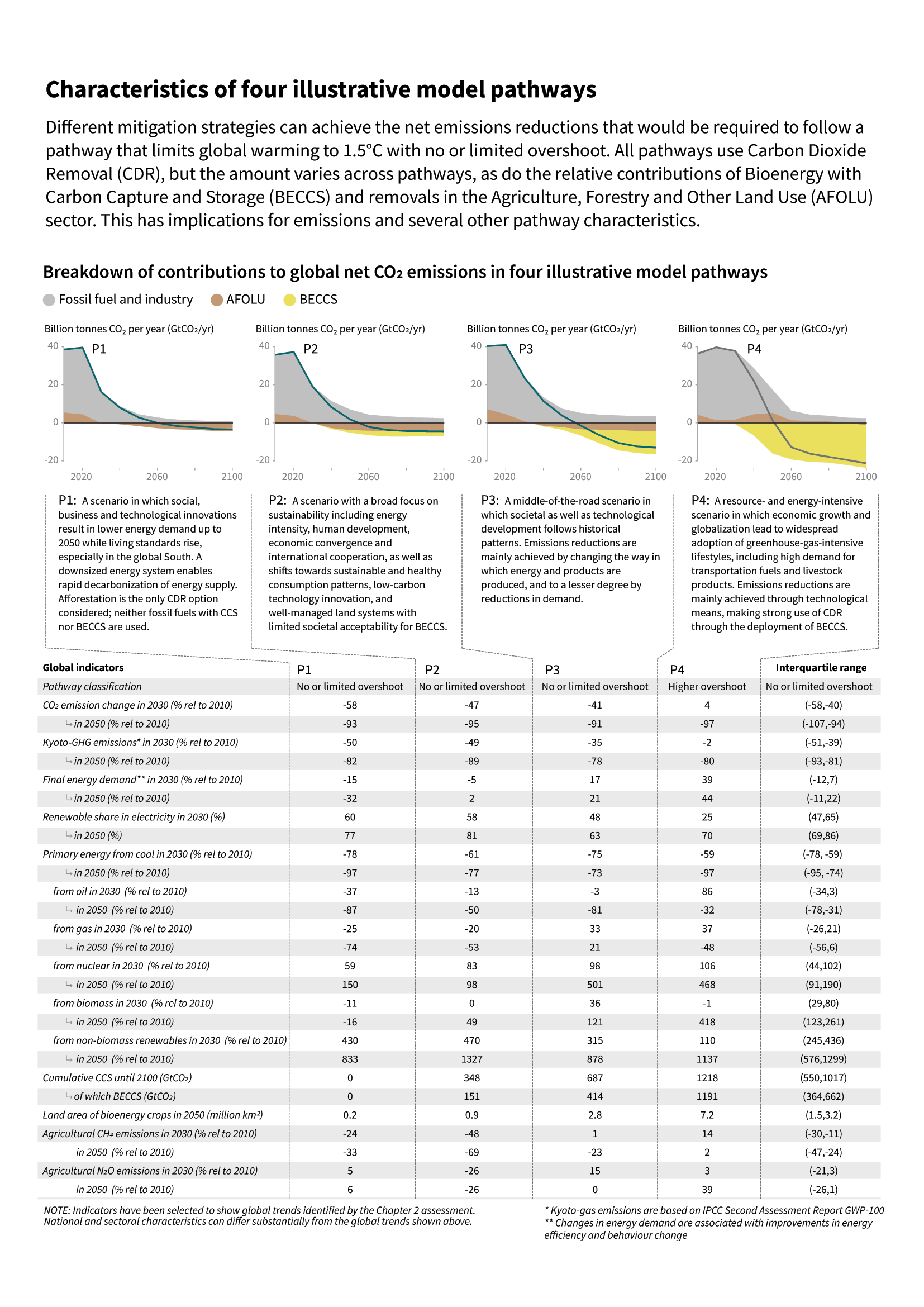
The yellow sections are BECCS, which is basically burning biosmass for energy and then using CCS to capture the co2 from it. That is to say, CCS has already been factored into the models as a necessary assumption for a long time now.
Keep in mind this is completely distinct from using CCS for continued burning of coal/gas/oil, and absolutely not about using it for enhanced oil recovery. Using CCS in those scenarios is like losing money on every unit sold and trying to make it up in volume, its simply bad math.
Surprising they include Direct Air Capture as CCS.
Here's the more detailed 32 page PDF that accompanies the linked CCS article: https://pub.cicero.oslo.no/cicero-xmlui/bitstream/handle/112...
I publish a weekly newsletter on carbon removal: http://bit.ly/carbon-updates
Here's the more detailed 32 page PDF that accompanies the linked CCS article: https://pub.cicero.oslo.no/cicero-xmlui/bitstream/handle/112...
I publish a weekly newsletter on carbon removal: http://bit.ly/carbon-updates
Highly recommend reading sustainable energy without the hot air by the late David MacKay. Even though dated, he really puts numbers behind every broad stroke assumption that causes pause
So who pays? Government isn't going to convince people to do it, or else they would have just implemented carbon taxes to begin with.
CCS can be a way to keep using fossil fuels for dispatchable supply, in a way that meshes nicely with renewables.
In particular: make hydrogen from the fossil fuel 24/7, store the hydrogen, sequester the CO2, and when needed burn the hydrogen in power plants (or other uses).
In particular: make hydrogen from the fossil fuel 24/7, store the hydrogen, sequester the CO2, and when needed burn the hydrogen in power plants (or other uses).
My intuition is that it would be almost always cheaper to pay e.g. Norway and Saudi Arabia to not pump out the captured carbon (in form of fossilized plant matter) in the first place, instead of pumping it out in the form of oil, burning it, then capturing the CO2, liquifying it and finally pumping it back underground where hopefully it doesn't bubble up again. But that would be the problem a world-wide carbon emission trade/carbon tax would solve...
Weirdly, I always see oil nations such as Norway here or Saudi Arabia pushing for CCS, as if this solution would be in their interest... while really reducing CO2 emmissions for them would be as simple as pushing a stop button.
Weirdly, I always see oil nations such as Norway here or Saudi Arabia pushing for CCS, as if this solution would be in their interest... while really reducing CO2 emmissions for them would be as simple as pushing a stop button.
I mean it actually isn’t that simple. In a market with significant inelasticity in demand you’d certainly see the price rise if they pressed the stop button, but the decline in consumption in the short term wouldn’t be as severe. As long as there’s other places to get the product the market would adjust to meet that demand.
Granted in the long term higher prices would help a lot, but a tax at the point of demand/consumption would likely work a whole lot more cleanly.
Granted in the long term higher prices would help a lot, but a tax at the point of demand/consumption would likely work a whole lot more cleanly.
Yeah, everything every individual or even individual country does doesn't matter in the grand scheme. That's kind of the problem (tragedy of the commons). One way to break the tragedy of commons is to lead by example, take the societal high ground, pressure others to join and finally shun everybody that doesn't participate.
E.g. Norway could press the stop button, they'd be poorer (but other countries aren't lucky and don't have any oil) it wouldn't reduce CO2 output much over the short term, but maybe that would put other countries on the path to do it as well.
In general the more upstream the taxation the easier to implement (it would be easy to simply tax the oil an oil rig produces), while the tax income would be probably fairer distributed if the tax is at the more consumption level/downstream.
In general the more upstream the taxation the easier to implement (it would be easy to simply tax the oil an oil rig produces), while the tax income would be probably fairer distributed if the tax is at the more consumption level/downstream.
[deleted]
That is interesting explanation, any references about inelasticity ?
Who’s going to pay them?
The best and cheapest way to capture carbon is to plant trees. Lots of them.
That’s true for the next year or so, but it only will push the clock back a few years. At that point, we run out of land.
I’m not arguing against it — every bit helps. However, something better needs to come along, and we need to invest in that thing.
I’m not arguing against it — every bit helps. However, something better needs to come along, and we need to invest in that thing.
a hectare of trees captures 1 to 10 tonnes of CO2 per year (http://www.sicirec.org/definitions/carbon-capture). That's about 7500 square meters of forest per person (assuming 11 tons per person per year). It's theoretically doable, but would require enormous forests.
Title: "Carbon Capture and Storage is necessary to keep global warming below 2°C"
In the article: "There are at least some scenarios that can meet the Paris goals without CCS."
WTF ?!!
WTF ?!!
Perhaps we can reconsider recycling of paper products as a first step?
If you send a paper bag to the landfill it’s buried in the ground (sequester), a tree is cut down to make a new paper bag, and a new tree is planted to make new material for more bags. Thus carbon is continuously captured from the air and buried deep.
If you recycle a bag then the old tree dies of old age and decomposes releasing the captured carbon back into the air. The new tree repeats the cycle, with no net carbon capture.
If you send a paper bag to the landfill it’s buried in the ground (sequester), a tree is cut down to make a new paper bag, and a new tree is planted to make new material for more bags. Thus carbon is continuously captured from the air and buried deep.
If you recycle a bag then the old tree dies of old age and decomposes releasing the captured carbon back into the air. The new tree repeats the cycle, with no net carbon capture.
Not sure if you’re joking or not, but that is not how it works at all.
https://ensia.com/features/methane-landfills/
https://ensia.com/features/methane-landfills/
I’m not joking and my observation does not square with your link.
A close friend has taken a tour of a local landfill in WA state and was shown a perfectly preserved months-old banana that was dug out by the presenter from the landfill. Apparently the landfills, at least here, are completely sealed. If a banana stays “fresh” for months a sheet of paper will stay fresh for a century.
And be that as it may, suppose we create special landfill for paper - that one can easily be made completely sealed and good for a thousand years.
A close friend has taken a tour of a local landfill in WA state and was shown a perfectly preserved months-old banana that was dug out by the presenter from the landfill. Apparently the landfills, at least here, are completely sealed. If a banana stays “fresh” for months a sheet of paper will stay fresh for a century.
And be that as it may, suppose we create special landfill for paper - that one can easily be made completely sealed and good for a thousand years.
Modern landfills have pumps to push oxygen into the garbage to accelerate decomposition.
Without them, newspaper takes >> 50 years to decompose.
Diverting waste paper to a sealed dump would definitely sequester carbon. (But you need to make sure the production of new paper is carbon neutral vs recycling for this to work out).
Without them, newspaper takes >> 50 years to decompose.
Diverting waste paper to a sealed dump would definitely sequester carbon. (But you need to make sure the production of new paper is carbon neutral vs recycling for this to work out).
How can production be not carbon neutral? When trees are cut new trees grow in their place, unless the place is used as a construction site or something.
https://www.treehugger.com/sustainable-product-design/mass-t...
https://www.treehugger.com/sustainable-product-design/mass-t...
Energy is used to make fresh products. This is the main reason recycling is better from a climate change point of view. As long as we're burning fossil fuels to produce new paper, the energy savings of recycling are going to translate into lower carbon emissions.
Is there even just a small scale production implementation of carbon capture? Last I checked it wasn't even working in the lab beyond trivial scale.
Plant a billion trees; problem solved.
[deleted]
ci5er(1)
If you say so (and I am not saying that you are wrong), but the cost of mining coal and oil and the cost of digging and refining those Li-whatevers, can not be ignored.
Pease and love
Pease and love
It's not impossible to create solutions that don't require carbon capture, but those tend to have the uncomfortable side effect of raising electricity prices two- or three-fold in the next 20 years. But here is one that I created which keeps the prices stable and also achieves 2 degrees: https://en-roads.climateinteractive.org/scenario.html?p1=-1&...