There are countless precedents where disaster strikes and humans have worked together to help each other; including people they don’t know at all.
„Common wisdom“ dictates that humans are wild animals, and the only thing keeping us from tearing ourselves apart is a thin layer of civilization. This is sometimes called the „veneer theory“.
That theory is wrong.
It’s also very important to powerful people that you believe that the theory is right; because why else would you allow eg. an autocracy to exist?
So, to answer your questions:
> Were the European colonialists nice to the people in Africa or South America or the settlers in North America to the natives?
> I can't understand why anyone expects things like civil rights, property, the rule of law, nuclear deterrence, democracy, etc to survive when human beings no longer need each other.
What’s your source on this? When humans have no obligations they usually turn around to be super nice to each other. Humans are social animals and they really really want everyone they know to do well.
I swear to god there is not one single thread on HN about Germany where nuclear reactors aren’t brought up.
Nuclear reactors are not solving this problem. Period. The technology is too expensive, building them is too slow, and no one wants them.
It’s a smoke screen (that I think is) set up by big oil to distract the focus from renewables, which are cheaper, scale better, and actually endanger their business model.
Have an EV in Germany, charging is a non-issue. The stations are everywhere to the point that it’s easier to get a parking spot with an EV than without.
That’s incorrect, in fact, fairness and equality is one of the few universal social contracts that are valued in every culture on earth (though lived/implemented differently).
And I would argue that’s one of the key differences that separates humans from animals. Humans have an intrinsic desire for things to be fair.
What’s baffling to me about all this is that Meta/Facebook (like all big tech) seems to be completely insulated from their failures.
Take a look at their product line up and tell me one thing that they did really well in the last, IDK, 10 years? And now we also read (and probably have suspected) that their employees are treated terribly too.
And yet, they continue to be one of the most „successful“ (as defined by market cap) companies on the planet. How is that possible?
This just shows that the current indicators for success/how well a company does/how well the economy does are severely misinterpreted.
I encourage everybody to try this, if they have an iPhone. If you’re like me and don’t have the time to tinker with the latest and greatest all the time; this app lowers the barrier to entry significantly and provides a glimpse into what’s possible locally, on device.
Honestly, I was extremely impressed by the speed and quality of the answers considering this thing runs on a phone. It honestly makes me want to sit down and spin up my own homegrown AI setup to go fully independent. Crazy.
Don’t get cynic. The good news is: the worse it gets, the more impact every single .1 degree of prevented climate change has.
I’m with you in the billionaires. Research has shown again and again that people do care about climate change and want it to be stopped - but only if they have the socioeconomic status to actually care.
If, as so many people on this planet, you are living paycheck to paycheck, and the social security nets are being dismantled by the uber rich, you instead switch into a „protect what’s mine“ mindset. This further exacerbates the tragedy of the commons.
So I am of the following opinion: fix wealth inequality; which will give people their actual lives back; and will reduce the political power of the sociopathic billionaire class.
Please. The establishment is dying to capitalize on it, and puts out one ridiculous anti-immigration measure after the next. And all it does is that it simply boosts far right parties even more.
It’s completely obvious to me (and often supported by exit polls) that people who are voting far right aren’t actually against immigration - only on the surface. Once you dig just a little bit deeper, often socioeconomic struggles surface. The working class has been taking a beating since the what, 1980s now? And it’s not like there’s any sort of legislature on the horizon that would fix their predicament.
So people look for a scapegoat. The far right gives them a scapegoat goat, and the enlightened center doesn’t know how to handle it.
I would agree with you, except that the government (eg. in Germany) even battle climate tech when it’s good for the country and the economy. WHO wouldn’t want to be energy independent?
And yet, the Conservative Party in germany once killed the entire solar industry (who then moved to china); and is about to do it again, now! Both times we are losing about 50k jobs in that sector.
The question is: why would they do that, if the economy is oh so important to the conservatives?
Why not just … sell the gold? What good is gold to a society anyway, regardless of where it is placed?
Instead of drawing the anger of the US, just .. slowly over time, sell all the gold off, and move the money back. And use it to build infrastructure or something. Much better than gold.
3) theoretically people could own via the state: if the state has resources (eg. hospital buildings, schools) that benefits all people ~uniformly. However, due to privatization more and more government wealth is also sold off.
Wealth redistribution is the only way the living standards of ordinary families will improve. I’m just hoping we can skip the war part, this time. I think its possible.
> The president who is willing to fix this will have to bend the knee.
A similar instance of this is happening currently in the talks between EU/UK — The EU is demanding a „Farage“ clause. They want a guarantee that the damages are paid for in case Farage becomes prime minister and will roll back all treaties and trade deals and what not.
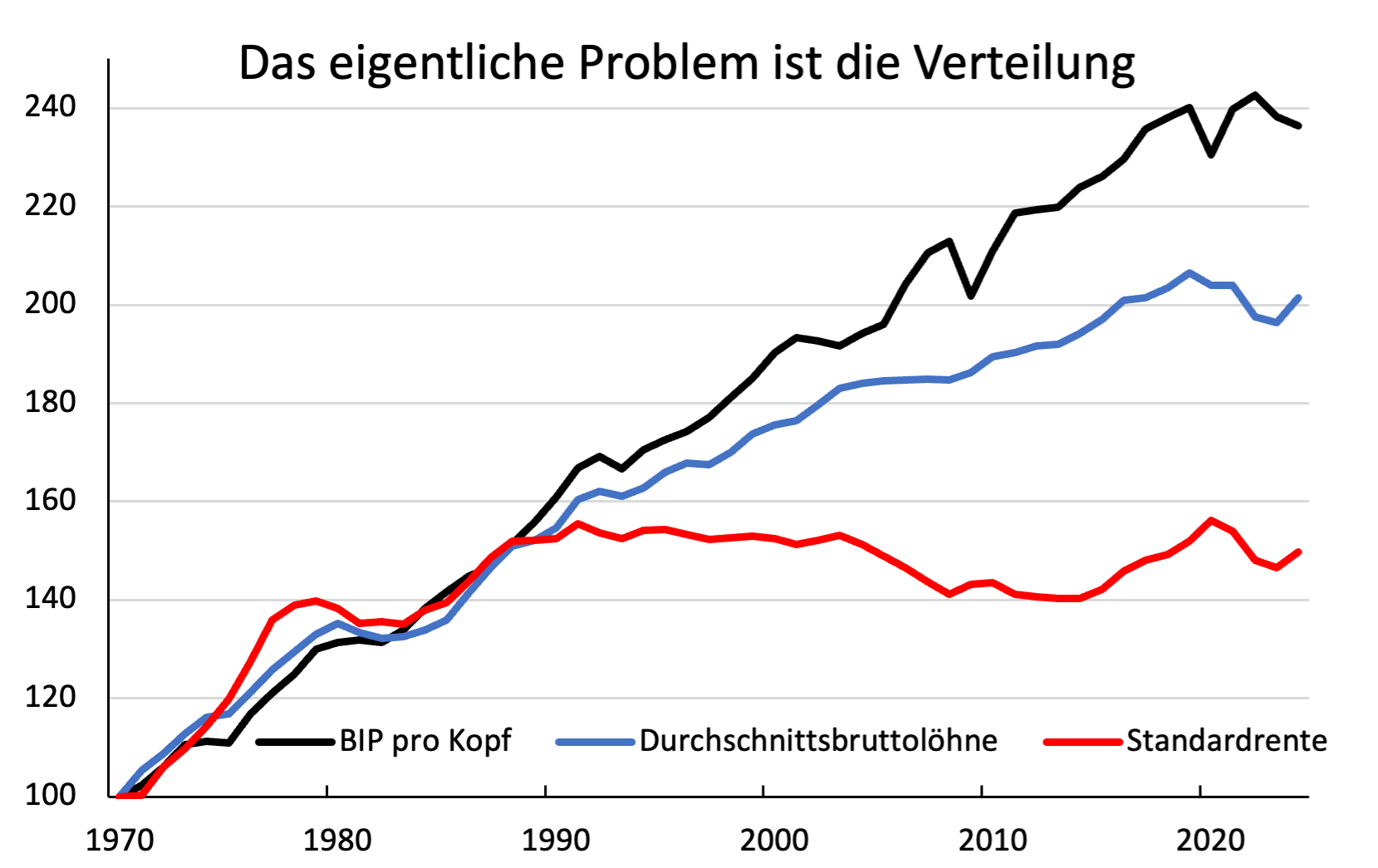
This apparent conundrum breaks away if you consider who holds the wealth now vs. in the 60s. In the 60s-70s, there was a wealth tax in Germany. Shortly after WW2, a law was drafted to redistribute wealth: All individuals and companies whose assets remained largely intact were required to pay 50% of their net wealth (as assessed on the day of the 1948 currency reform).
This means that the working class had immense wealth and so simple jobs could support a family on a single income, buy a house, etc.
Compare that to today — the two richest families in Germany hold more wealth than the bottom 50% COMBINED.
It is no wonder that normal families cannot afford to buy property anymore; and are forced to rent. This further exacerbates the wealth gap.
(Black line - GDP, blue line - avg comp; red line - avg pension)
In short - the productivity increased; but ordinary people are being squeezed out of the gains regardless. No wonder that everyone turns sour at some point.
No. Mass building (while not touching inequality) will NOT solve the issue.
It’s easy to see why: there already IS enough housing around for everybody. If there wasn’t, you would see a massive amount of homeless people. And even in the US where that might be the case - the amount of empty real estate is larger than the amount of homeless people. You could easily house them if you wanted. It’s a question of distribution.
The other reason to see why this doesn’t work is: there is no country that managed to do it. Miraculously, the housing crisis has hit all (western) countries on the planet. All of them try to build their way out of it, no one succeeds. Why?
If you just mass build, the new units will be bought immediately by the rich, and the working people will have no housing still.