i think there's ample evidence to suggest that we're growing closer (3-5 year timeline?) to replacement-level knowledge workers in targeted fields with limited scope. i don't know that i would call that AGI? but i think it's fair to call it close.
thing is that has value, but compute ain't cheap and the value prop there is more of reducing payroll rather than necessarily scaling business ops. this move to me looks like a recognition that generalized AI on it's own isn't a force multiplier as long as you have bottlenecks that make it too pricey to scale activity by an order of magnitude or more.
And that haircut won't be fun for many but I think the balance sheet had them at around $200 billion in deposits with $175 billion in assets. Obviously the question now becomes liquidity but I think the sky is not yet falling (unless more dominos start to tumble)
Main reason to make the distinction is that most systems that parade themselves as "low-code" today are IME indistinguishable to high-code development to your average joe.
Even taking this example, the level of value totally depends on the degree of abstraction you can trust the computer to perform for you. There is a tremendous amount of nuance to human language and while we've come a very long way in that field of study, it's still a hard nut to crack.
As of September 20, 2020, the following transactions are prohibited:
1. Any provision of service to distribute or maintain the WeChat or TikTok mobile applications, constituent code, or application updates through an online mobile application store in the U.S.;
2. Any provision of services through the WeChat mobile application for the purpose of transferring funds or processing payments within the U.S.
As of September 20, 2020, for WeChat and as of November 12, 2020, for TikTok, the following transactions are prohibited:
1. Any provision of internet hosting services enabling the functioning or optimization of the mobile application in the U.S.;
2. Any provision of content delivery network services enabling the functioning or optimization of the mobile application in the U.S.;
3. Any provision directly contracted or arranged internet transit or peering services enabling the function or optimization of the mobile application within the U.S.;
4.Any utilization of the mobile application’s constituent code, functions, or services in the functioning of software or services developed and/or accessible within the U.S.
---
That last piece especially is quite concerning, and seems like a clear overreach of federal authority, no? Don't know that I've ever seen execution of software alone as an enforceable offense, and as written it seems to outlaw even opening up the app if you previously have it downloaded.
Fully agreed - and the necessity for the client here can't be overstated: was doing some research into nearby apartment buildings and searching the exact name of the building I was looking for returned an ad with their neighboring competitor as the top result, above the site of the building I was looking for.
Honestly a ferry across the Potomac could make a lot of sense if it runs frequently enough. Could be a release valve for a lot of that Metro congestion, and otherwise the 14th St bridge would be nightmarish for 4+ hours a day.
The next paragraph outlined a federal tax of 100 percent on subsidies that don't lead to taxpayer benefit (like infrastructure improvements to accommodate 50k+ new residents).
The two also don't have to be mutually exclusive. You can look at what Amazon did and say "That's not a business practice that should be followed," while still saying "State and Local governments shouldn't be allowed to offer funds in this manner."
EDIT: Didn't realize you were referring specifically to the sneaky pop-up. Agree with you on that one.
From a brief reading of it the other day, it seems data that is necessary to provide a contracted service (like, say, providing access to a cellular network) has a specific exemption to express consent.
Check out items 1a & 1b in Article 6 of Chapter 2[1]:
"1Processing shall be lawful only if and to the extent that at least one of the following applies:
A: the data subject has given consent to the processing of his or her personal data for one or more specific purposes;
B: processing is necessary for the performance of a contract to which the data subject is party or in order to take steps at the request of the data subject prior to entering into a contract;"
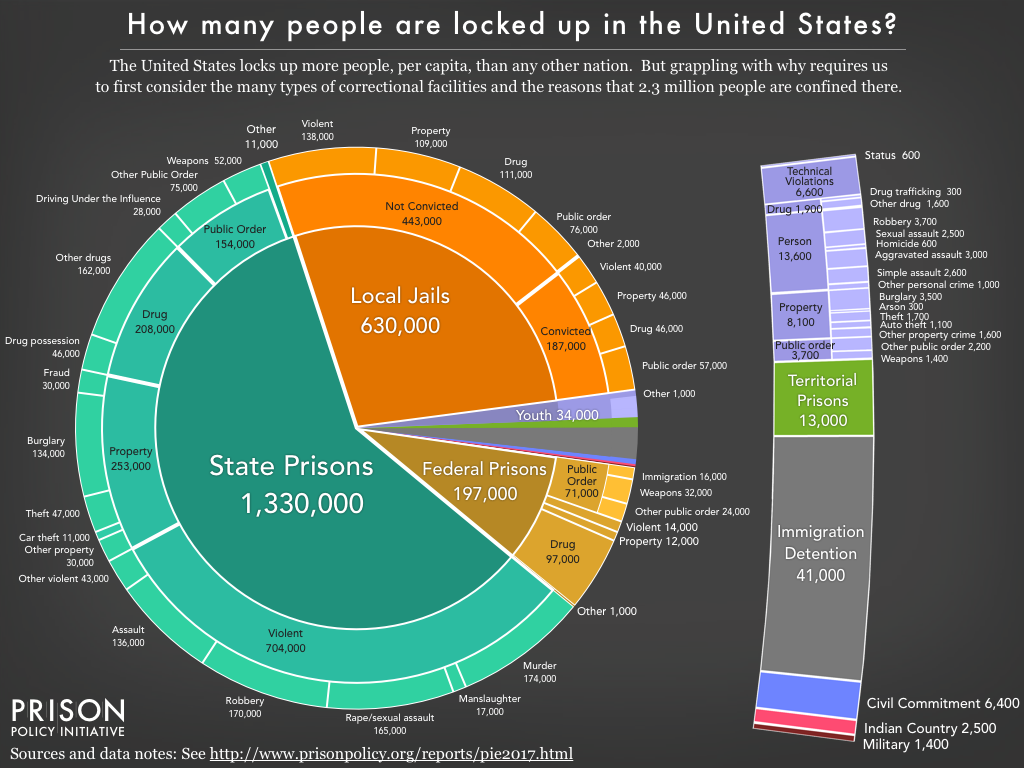
I don't think anyone is saying that prison labor is in any way reintroducing the economic impact of 18-19th century slave trade. But, as a country, the US:
1) Incarcerates people at a higher rate than any country besides Seychelles
2) Abolished slavery for all persons except prisoners:
"Neither slavery nor involuntary servitude, except as a punishment for crime whereof the party shall have been duly convicted..."
Between local, state, and federal prisons, we're looking at roughly 500,000 imprisoned for drug-related offenses[1]. Yes, the labor of these people is a trivial portion of the overall economy, but it still produces huge profit for those running the show: CoreCivic has a market cap of ~$2.6 billion. They exist to extract value from the lives and labors of the people who their institutions keep under lock and key.
There is a direct incentive for these corporations to increase the number of prisoners in the system, and they leverage their power to pursue that incentive, lobbying for and even drafting legislation that enforces three strike and mandatory minimum rules.[2] They are actively pushing governments to imprison more people, and profiting from the resulting state sanctioned slavery.
> Whether to call it a back door / flaw / trade-off is just quarreling over semantics
I think this is writing off a significant portion of the meta-story here, semantics matter very much in journalism. While the technical nuances of trust are important, they won't be understood or digested by the average reader. What will be remembered is the headline, which doesn't say "Whatsapp is as secure as iMessage" it just says "Whatsapp has a backdoor".
The story you tell is framed by the audience that's listening, and the framing the Guardian chose unfairly paints Whatsapp as not just secure, but less secure than alternatives by singling them out. That's not an accurate story.
Anyone have experience with this program without an academic CS background?
As someone with a BS in Materials Science & Engineering (at best a tangentially related field via sparse EE coursework) who does some level of programming at a tech job now, I'm curious what my prospects for admission would be. I'm confident I could handle the coursework, provided I could get my foot in the door.
As a related question, they mention taking courses to fill holes - are they receptive to Coursera offerings?
i think there's ample evidence to suggest that we're growing closer (3-5 year timeline?) to replacement-level knowledge workers in targeted fields with limited scope. i don't know that i would call that AGI? but i think it's fair to call it close.
thing is that has value, but compute ain't cheap and the value prop there is more of reducing payroll rather than necessarily scaling business ops. this move to me looks like a recognition that generalized AI on it's own isn't a force multiplier as long as you have bottlenecks that make it too pricey to scale activity by an order of magnitude or more.