John Gruber’s hypocritical and off-base Google attack(theorangeview.net)
theorangeview.net
John Gruber’s hypocritical and off-base Google attack
http://theorangeview.net/2011/03/john-grubers-hypocritical-and-off-base-google-attack/
18 comments
How is he hypocritical? The problem here is Google employees have consistently and constantly pushed that Android is open and thus inherently more pure than iOS (see Vic's behavior last Google IO, Andy Rubin's infamous 'definition of open' tweet). Apple has never claimed to be open or anything, Google has, and they're not.
Did you even read the article?
In last year's statement he says that there are different shades of "open", and this year he all-of-a-sudden decides that there's only one exact kind of open. Which conveniently happened only days after Google decided not to be as open just yet with their latest version of the Android OS.
Gruber changes definitions of terms to suit his pro-Apple and anti-Google agenda whenever he sees fit. It's dead obvious to anyone that isn't a blatant fanboy for either side (which is hard for many of the traditionally pro-Apple HN reader-base).
In last year's statement he says that there are different shades of "open", and this year he all-of-a-sudden decides that there's only one exact kind of open. Which conveniently happened only days after Google decided not to be as open just yet with their latest version of the Android OS.
Gruber changes definitions of terms to suit his pro-Apple and anti-Google agenda whenever he sees fit. It's dead obvious to anyone that isn't a blatant fanboy for either side (which is hard for many of the traditionally pro-Apple HN reader-base).
> [Gruber] says that there are different shades of "open"
And Google stated their definition of open (http://twitter.com/#!/arubin/status/27808662429) only to turn their backs on it (if only for the moment).
And Google stated their definition of open (http://twitter.com/#!/arubin/status/27808662429) only to turn their backs on it (if only for the moment).
They've always delayed the Open-Sourcing of their Android versions until a bit after the commercial release of a phone with that version on it. With Honeycomb, it'll be a slightly longer wait.
Can you magically not do those commands in that tweet now? No, you still can. Does it suck that you can't checkout the latest files just yet? Yes. Is this delay being completely blown out of proportion? You betcha. But that won't stop pundits like Gruber from pouncing on every silly opportunity to discredit the competitor of their fanboy company.
Can you magically not do those commands in that tweet now? No, you still can. Does it suck that you can't checkout the latest files just yet? Yes. Is this delay being completely blown out of proportion? You betcha. But that won't stop pundits like Gruber from pouncing on every silly opportunity to discredit the competitor of their fanboy company.
>Can you magically not do those commands in that tweet now? No, you still can. Does it suck that you can't checkout the latest files just yet? Yes. Is this delay being completely blown out of proportion? You betcha.
Uh, actually, you can't do those commands in the tweet if you own a Xoom, and want the source for it. You can own a device that is running an Linux-based open source OS, but can't get the code that's running on it.
As far as I can tell, most of the delays for Android versions were on the order of a week or two after the SDK was released. That's a pretty acceptable delay because someone needs to go through Google's private branch, do a little cleanup, and commit the files to the public git repository.
This isn't a "slightly longer wait". This is Google not upholding their commitment to the project. I'm actually surprised that the FSF isn't going after them for this, since the Linux core is GPL, and that means that the code needs to be released...
Uh, actually, you can't do those commands in the tweet if you own a Xoom, and want the source for it. You can own a device that is running an Linux-based open source OS, but can't get the code that's running on it.
As far as I can tell, most of the delays for Android versions were on the order of a week or two after the SDK was released. That's a pretty acceptable delay because someone needs to go through Google's private branch, do a little cleanup, and commit the files to the public git repository.
This isn't a "slightly longer wait". This is Google not upholding their commitment to the project. I'm actually surprised that the FSF isn't going after them for this, since the Linux core is GPL, and that means that the code needs to be released...
It's a slightly longer wait. Instead of a few weeks it's a few months.
Whatever clever rewording you want to do to "spin" it your way, at the end of the day it's just a bit more time to wait for them to open source the code, with good reason. You want the source code to work on for your tablet device? Just ask Google, they said they'll hand it right over. It's just not quite ready for the public to start hacking it on to phones.
Whatever clever rewording you want to do to "spin" it your way, at the end of the day it's just a bit more time to wait for them to open source the code, with good reason. You want the source code to work on for your tablet device? Just ask Google, they said they'll hand it right over. It's just not quite ready for the public to start hacking it on to phones.
>And Google stated their definition of open
Which has nothing to do with Gruber's definition of open. If Gruber has his own definition of 'open' then it's that definition which matters when assessing whether he's being hypocritical or not.
Which has nothing to do with Gruber's definition of open. If Gruber has his own definition of 'open' then it's that definition which matters when assessing whether he's being hypocritical or not.
How is he hypocritical?
How about claiming he saw the bait-and-switch coming when he's a professional pundit and all he ever said while commenting on it was a) open is bad for consumers and b) Android isn't open.
Note that even a) and b) don't even make sense together, so the fact that he's revised history yet again to claim that he always thought they were open, but only so they could later become closed is even more laughable.
How about claiming he saw the bait-and-switch coming when he's a professional pundit and all he ever said while commenting on it was a) open is bad for consumers and b) Android isn't open.
Note that even a) and b) don't even make sense together, so the fact that he's revised history yet again to claim that he always thought they were open, but only so they could later become closed is even more laughable.
He's been pretty consistent in calling out the OEMs and carriers as incompetents who won't produce phones in Google's best interests. And jumping on how useless all their 'added value' has been.
Simultaneously he's been suggesting Google needs to make its own devices to really push a compelling Android experience. And he's been saying that for ... christ, about as long as Android has even been publicly around.
He's never really said "Google's going to give up on this 'Open Source' thing" that I recall, but he's been terribly consistent in saying things like this:
Android, on the other hand, strikes me as needing a course correction. There’s a separation between the software and hardware, and to date the hardware vendors are letting the platform down. It’s unproven whether this model can even work in the long run (where by "work" I mean "produce a phone and software platform with a state-of-the-art user experience"). http://daringfireball.net/2009/08/android_opportunity_addend...
Simultaneously he's been suggesting Google needs to make its own devices to really push a compelling Android experience. And he's been saying that for ... christ, about as long as Android has even been publicly around.
He's never really said "Google's going to give up on this 'Open Source' thing" that I recall, but he's been terribly consistent in saying things like this:
Android, on the other hand, strikes me as needing a course correction. There’s a separation between the software and hardware, and to date the hardware vendors are letting the platform down. It’s unproven whether this model can even work in the long run (where by "work" I mean "produce a phone and software platform with a state-of-the-art user experience"). http://daringfireball.net/2009/08/android_opportunity_addend...
He has never said open is bad for consumers as far as I understand it, I'd like to see where you think he has so we can discuss it though, I'm sure he must have said something that we both interpreted diffrently.
As to your last paragraph: he's not claiming he always thought they were open. He's claiming that he knew all along they weren't - i.e. they were only allowing free run on the source code and everything as long as it benefited them. Which is what happened here.
As to your last paragraph: he's not claiming he always thought they were open. He's claiming that he knew all along they weren't - i.e. they were only allowing free run on the source code and everything as long as it benefited them. Which is what happened here.
Android is more open than iOS. It is less open than Ubuntu. We just saw a story today about Google playing favorites with access to early releases of operating system code; when you're shipping multi-billion-dollar SKUs based on that code, this isn't a minor detail. The fact is, Android is "open" to end-users, but not completely "open" to vendors.
It's frustrating to watch people try to reconcile this, because not only is everyone using different definitions of the word "open", but they change definitions from day to day.
Meanwhile: this is second-order punditry. It's a critique of a pundit. And it's a pundit who wears his bias on his sleeve. It's boring. People don't read Gruber for the unvarnished truth about the mobile market. If you want to right whatever wrong you feel is being committed because a gifted writer has overtly taken Apple's side (gasp!), write an excellent blog advocating for the Google ecosystem. But don't waste our time litigating against Gruber. Nobody cares!
It's frustrating to watch people try to reconcile this, because not only is everyone using different definitions of the word "open", but they change definitions from day to day.
Meanwhile: this is second-order punditry. It's a critique of a pundit. And it's a pundit who wears his bias on his sleeve. It's boring. People don't read Gruber for the unvarnished truth about the mobile market. If you want to right whatever wrong you feel is being committed because a gifted writer has overtly taken Apple's side (gasp!), write an excellent blog advocating for the Google ecosystem. But don't waste our time litigating against Gruber. Nobody cares!
Android is "open" to end-users, but not completely "open" to vendors
If they can't get the next revision of the OS on the same terms as their competitors, it's not open for them. I think you're glossing over the practical realities of shipping products that will cost hundreds of millions of dollars to launch.
If you want to assert that it's not open for end-users either, I won't argue, but I'm not sold on that.
If you want to assert that it's not open for end-users either, I won't argue, but I'm not sold on that.
I'll agree that Google is taking steps to make Android less open for vendors, but it's still more open for vendors than it is for end users (largely because of vendors putting restrictions on the devices they sell).
"With the exception of Honeycomb..."
Which fallacy is that, again?
http://en.wikipedia.org/wiki/Overwhelming_exception
Which fallacy is that, again?
http://en.wikipedia.org/wiki/Overwhelming_exception
"With notably rare exceptions..."
http://crookedtimber.org/2011/03/30/with-notably-rare-except...
http://crookedtimber.org/2011/03/30/with-notably-rare-except...
And yet, there are devices sold that don't have to be rooted, which you can't say about iOS.
True, but iOS isn't involved here. What's involved is that Google has repeatedly promoted Android as an 'open' platform, but now has decided that actually being open is no longer in their interest.
I don't think there's any platform that can be used as a distribution medium and that doesn't come with strings attached. Even stuff licensed under GPL comes with strings attached.
And there are inherent disadvantages to being open, which Google is trying to mitigate here, and they have been doing this ever since Android launched (people have short memories or simply bad attitudes -- Android's source code wasn't released from the start).
If anything Google's behavior is actually consistent.
And there are inherent disadvantages to being open, which Google is trying to mitigate here, and they have been doing this ever since Android launched (people have short memories or simply bad attitudes -- Android's source code wasn't released from the start).
If anything Google's behavior is actually consistent.
Google's behavior is consistent with their past behavior, but not consistent with what their words. That's pretty much the definition of hypocrisy.
Bullshit -- define "open".
Also, when referring to "their words" some references are required ;)
Also, when referring to "their words" some references are required ;)
    the definition of open: "mkdir android ; cd android ; repo init -u
    git://android.git.kernel.org/platform/manifest.git ; repo sync ; make"
http://twitter.com/Arubin/status/27808662429
Since when did it stop building?
Can you build Honeycomb?
No. I can build whatever is on version control. They didn't release Honeycomb as open-source yet, just like they don't release beta software - mind you, there is no such thing as an Android daily build. The only thing new is that you can buy a device with pre-release Honeycomb software.
I am not overly enthusiastic about that.
I am not overly enthusiastic about that.
Here:
"We wanted to make sure that there was no central point of failure, so that no industry player can restrict or control the innovations of any other. That's why we created Android, and made its source code open."
(from: http://source.android.com/)
Are you seriously going to pretend that Google is not now restricting or controlling the innovations of any other industry players?
"We wanted to make sure that there was no central point of failure, so that no industry player can restrict or control the innovations of any other. That's why we created Android, and made its source code open."
(from: http://source.android.com/)
Are you seriously going to pretend that Google is not now restricting or controlling the innovations of any other industry players?
Well yes, I'm going to pretend just that :)
If Google never releases Honeycomb, then I'll agree; until then ...
Any other industry player can take Gingerbread and create its own Honeycomb, while keeping compatibility and totally being able to take the market by storm.
That's the very definition of open-source -- when unhappy with a project's governance, you can fork ; and you can fork Gingerbread, or Honeycomb when it will get released. You don't have to trust the company, just the source-code / license of the last release.
So what stops you or any industry players from just doing that? Lunch not free anymore?
If Google never releases Honeycomb, then I'll agree; until then ...
Any other industry player can take Gingerbread and create its own Honeycomb, while keeping compatibility and totally being able to take the market by storm.
That's the very definition of open-source -- when unhappy with a project's governance, you can fork ; and you can fork Gingerbread, or Honeycomb when it will get released. You don't have to trust the company, just the source-code / license of the last release.
So what stops you or any industry players from just doing that? Lunch not free anymore?
Well you said it: Lunch isn't free anymore.
The point is that Google is using Android to do precisely what they claimed they stood against - which is to control other players in the industry. That's what makes it hypocrisy.
I assume you'd agree that someone who forked a months old version would be at an extraordinary disadvantage against a competitor who had access to the current source and ongoing contributions from Google.
The point is that Google is using Android to do precisely what they claimed they stood against - which is to control other players in the industry. That's what makes it hypocrisy.
I assume you'd agree that someone who forked a months old version would be at an extraordinary disadvantage against a competitor who had access to the current source and ongoing contributions from Google.
>Are you seriously going to pretend that Google is not now restricting or controlling the innovations of any other industry players?
Huh? How is delaying the source code release of an incremental update such a big deal? Innovate all you want on top of 2.3(which is barely a few months old), make it tablet friendly or whatever and port it to whatever hardware you build.
Haven't you heard of the concept of forking?
Huh? How is delaying the source code release of an incremental update such a big deal? Innovate all you want on top of 2.3(which is barely a few months old), make it tablet friendly or whatever and port it to whatever hardware you build.
Haven't you heard of the concept of forking?
Do you really think that people who have to fork a months old version are at no disadvantage to those who have access to the current source?
I am so sorry for those (Dell, Acer) who didn't get what Google built for free when other partners got involved early on. Having to develop your own software and not getting it for free certainly sucks.
If they are so disappointed, they can always launch Windows Phone 7 devices.
If they are so disappointed, they can always launch Windows Phone 7 devices.
[deleted]
The post begins:
'It is getting tiresome to hear Apple fans, having long bashed Google's Android because "open" was bad, now bash Google for being somewhat less "open."'
But Gruber didn't say "open" was bad, did he? He (and others) argue that "open" is used as a synonym for "good", a virtue of itself, but that in the end you don't get something that's either "open" or "good" for pretty much any definition of "open" or "good".
Open would mean I can do anything I like to the OS (update it, customize it, replace it). In most cases I can't.
Good would mean I can have the latest OS on my phone if I want it. In most cases I can't.
Open would mean I can easily get access to the complete source code for my phone if I want it. In most cases I can't.
Seriously -- for what values of open or good do we get a big fat green tick?
It's not like Gruber is biased and other people aren't. Everyone is biased. Argue the evidence.
'It is getting tiresome to hear Apple fans, having long bashed Google's Android because "open" was bad, now bash Google for being somewhat less "open."'
But Gruber didn't say "open" was bad, did he? He (and others) argue that "open" is used as a synonym for "good", a virtue of itself, but that in the end you don't get something that's either "open" or "good" for pretty much any definition of "open" or "good".
Open would mean I can do anything I like to the OS (update it, customize it, replace it). In most cases I can't.
Good would mean I can have the latest OS on my phone if I want it. In most cases I can't.
Open would mean I can easily get access to the complete source code for my phone if I want it. In most cases I can't.
Seriously -- for what values of open or good do we get a big fat green tick?
It's not like Gruber is biased and other people aren't. Everyone is biased. Argue the evidence.
>Seriously -- for what values of open or good do we get a big fat green tick?
Open and good in the sense developers don't have to go through a App Store with capricious restrictions and a forced 30% cut. You can either publish on your own or go to alternate stores like Amazon App Store which will try to attract you with better terms.
Open and good in the sense that subscription providers don't have to pay a toll of 30% to Apple for nothing. Even WP7 is 'Open' in this sense.
Open and good in the sense of the variety of hardware. Eg. If you like hardware keyboards on phones you have no choice in Apple land. Even WP7 is 'Open' in this sense.
Open and good in the sense you can install whatever normal apps you want without jailbreaking. (AT&T phones are locked to the Android Market, but Android apps don't have to go through an Approval process).
Open and good in the sense developers don't have to go through a App Store with capricious restrictions and a forced 30% cut. You can either publish on your own or go to alternate stores like Amazon App Store which will try to attract you with better terms.
Open and good in the sense that subscription providers don't have to pay a toll of 30% to Apple for nothing. Even WP7 is 'Open' in this sense.
Open and good in the sense of the variety of hardware. Eg. If you like hardware keyboards on phones you have no choice in Apple land. Even WP7 is 'Open' in this sense.
Open and good in the sense you can install whatever normal apps you want without jailbreaking. (AT&T phones are locked to the Android Market, but Android apps don't have to go through an Approval process).
I think the word "open" is now just too overloaded. What does open mean ? Does it mean that I can read the source? Does it mean I can read the source in a timely fashion as soon as the product is available? Does it mean that I have the right to modify and execute the source? Does it mean that there are reasonably good chances that if I make a valid and valued change to the code it will be integrated upstream? While Gruber has a biased take on things, there is some truth to the fact that there are definitions of open by which Android is not an open system.
I find it hard to come up with a definition by which Android is an open system. It seems to pretty much boil down to:
Some of the time, some people can see some of the source, but some of those people may be restricted in what they can do by licenses'.
If that's what passes as 'open' we need a new word.
Some of the time, some people can see some of the source, but some of those people may be restricted in what they can do by licenses'.
If that's what passes as 'open' we need a new word.
By the same metric, we need new definitions for what Apple is doing. For example, the forced 30% cut of all subscription content. That isn't 'closed' anymore, like we say 'Windows is closed'. Maybe 'Locked down' is more like it?
This isn't about Apple, as has been pointed out repeatedly. There are a lot of criticisms about iOS which are valid, however I don't recall them ever claiming their platform was even remotely open.
If "Open" is now a convoluted word, we have Google to thank for that, because that's what happens when you launch an entire marketing campaign around a single term.
If "Open" is now a convoluted word, we have Google to thank for that, because that's what happens when you launch an entire marketing campaign around a single term.
>..you launch an entire marketing campaign around a single term.
They did? Maybe I was the only one who missed it. Links?
Android is definitely way more "Open" than iOS, by almost any metric, even with the latest changes. Care to dispute that?
And it's not helping that Apple is going to even more closed via forced cut of subscriptions.
They did? Maybe I was the only one who missed it. Links?
Android is definitely way more "Open" than iOS, by almost any metric, even with the latest changes. Care to dispute that?
And it's not helping that Apple is going to even more closed via forced cut of subscriptions.
You can watch this video for starters: http://www.youtube.com/watch?v=89xc_1Vv69k
(Google IO 2010 Android Keynote)
One selected quote:
1.) "So if you believe in openness, if you believe in choice, if you believe in innovation from everyone†, then welcome to Android."
† Everyone, depending on where the innovation is, being Google employees, and select partners who are given access to the Android source before public release.
One selected quote:
1.) "So if you believe in openness, if you believe in choice, if you believe in innovation from everyone†, then welcome to Android."
† Everyone, depending on where the innovation is, being Google employees, and select partners who are given access to the Android source before public release.
That seems pretty true compared to the alternate platform which results in things like this http://blog.robrhyne.com/post/659211315/almost-on-the-app-st... and this http://www.computerworld.com/s/article/9207641/Apple_rejects...
And it seems like nothing has changed with the latest changes to Android. Care to elaborate?
Edit: And how is a IO keynote 'an entire marketing campaign' ?
And it seems like nothing has changed with the latest changes to Android. Care to elaborate?
Edit: And how is a IO keynote 'an entire marketing campaign' ?
Apple has been upfront from the get-go that their platform isn't open (they say that people who want to do things openly on iOS are free to make web apps; which I guess is nice, but sort of a brush-off).
I don't like the position Apple has taken. I agree that it's their prerogative to do so, and they argue that their position leads to a better product.
I've used several Android phones, and now an iPhone 4, and I think that they're right...and I hate that. I don't want them to be right, I want them to be proven wrong.
I think Android has absolutely worked to position themselves as a friend to "open" (with bullshit nebulously defined definitions of what "open" means). The entire content of that keynote is a gushing plea to friends of the open source movement (that you have an alternative to iOS).
And I think that Google's position of "open" since the launch of Android has been shitty (so yeah, I guess nothing has changed with the latest changes to Android), except that this yet another bullet point on the side against open.
Development on Android has always occurred in the dark, without feedback or input from the community at large. When a release is "ready", it's open-sourced, and then people are free to take the parts of Android which are included in that open release and do what they want with them. This is of course, long after Google's partners have had access to the source, so that they can prepare their phones for release.
I'd like for "open" to mean an open playground, where everyone is equal (and technology can compete on merits). Not where "everyone is equal, but some are more equal than others". But like Apple, Google is free to do this (I don't think they're in violation of any licenses with the way they release their code).
But I think it sucks, and I think it's crazy that I have to long for an actual "open" alternative to the supposedly "open" alternative to iOS.
I don't like the position Apple has taken. I agree that it's their prerogative to do so, and they argue that their position leads to a better product.
I've used several Android phones, and now an iPhone 4, and I think that they're right...and I hate that. I don't want them to be right, I want them to be proven wrong.
I think Android has absolutely worked to position themselves as a friend to "open" (with bullshit nebulously defined definitions of what "open" means). The entire content of that keynote is a gushing plea to friends of the open source movement (that you have an alternative to iOS).
And I think that Google's position of "open" since the launch of Android has been shitty (so yeah, I guess nothing has changed with the latest changes to Android), except that this yet another bullet point on the side against open.
Development on Android has always occurred in the dark, without feedback or input from the community at large. When a release is "ready", it's open-sourced, and then people are free to take the parts of Android which are included in that open release and do what they want with them. This is of course, long after Google's partners have had access to the source, so that they can prepare their phones for release.
I'd like for "open" to mean an open playground, where everyone is equal (and technology can compete on merits). Not where "everyone is equal, but some are more equal than others". But like Apple, Google is free to do this (I don't think they're in violation of any licenses with the way they release their code).
But I think it sucks, and I think it's crazy that I have to long for an actual "open" alternative to the supposedly "open" alternative to iOS.
>Edit: And how is a IO keynote 'an entire marketing campaign' ?
How is the text on http://source.android.com/ not?
How is the text on http://source.android.com/ not?
A web page on the internet is an entire marketing campaign?
What percentage of Android users even visited that page in their lifetime, forget about being swayed by that statement on it? 0.005%?
What percentage of Android users even visited that page in their lifetime, forget about being swayed by that statement on it? 0.005%?
[deleted]
Claiming it's 'more' open just begs a Godwin conclusion.
Why? Aren't there discernible differences in the openness of Android and iOS regarding the hardware, app stores and subscriptions?
I'm guessing you don't understand the Godwin reference.
I think the word "open" is now just too overloaded.
I agree with this. Some time ago, the word "free" became overloaded, so today we talk about "Freedom zero," "Free as in beer," "Free as in speech," and so on. I think there's a general understanding that the word "free" is not specific enough.
It seems we're at that place with "open" as well. Good call.
I agree with this. Some time ago, the word "free" became overloaded, so today we talk about "Freedom zero," "Free as in beer," "Free as in speech," and so on. I think there's a general understanding that the word "free" is not specific enough.
It seems we're at that place with "open" as well. Good call.
This is so true. "Open" has become a software-politics analog of "freedom" in ordinary politics. An undefinable, but very good, thing. (Freedom from taxes? Freedom from poverty?)
One point of clarity, however, regarding these recent statements is that Andy Rubin helpfully gave his definition of the term:
http://twitter.com/Arubin/status/27808662429
This definition allows much less wiggle room! It's wiggle room that Google wants back now. ;-)
One point of clarity, however, regarding these recent statements is that Andy Rubin helpfully gave his definition of the term:
http://twitter.com/Arubin/status/27808662429
This definition allows much less wiggle room! It's wiggle room that Google wants back now. ;-)
It is sad that many use it in open as in license terms, while true openness of a platform is a lot more:
http://bergie.iki.fi/blog/open_source-free_software-what_we_...
http://bergie.iki.fi/blog/open_source-free_software-what_we_...
> Android is "open" to end-users
Android absolutely isn't "open" to end-users. It's not as bad as iOS, but it definitely isn't good, and it's far more open to vendors (of all stripes) than to end-users so far.
Android absolutely isn't "open" to end-users. It's not as bad as iOS, but it definitely isn't good, and it's far more open to vendors (of all stripes) than to end-users so far.
Isn't this recent move about changing that around?
It might be, but so far I see it mostly as platform re-consolidation (/protection) and branding defense, the pushback on honeycomb source release goes the other way as well.
So if I go read a couple weeks worth of daring fireball, I'm not going to find any posts disagreeing with something another pundit has written?
In my experience pundits spend the majority of their time explaining their agreement or disagreement with the arguments of other pundits, so it seems odd to define that as second-order punditry.
The author of the OP probably included some overdramatic language, but I thought the meat of the post was about why he disagreed with Gruber on a specific point. That may not be interesting to you, but I don't think it is categorically a waste of time either.
In my experience pundits spend the majority of their time explaining their agreement or disagreement with the arguments of other pundits, so it seems odd to define that as second-order punditry.
The author of the OP probably included some overdramatic language, but I thought the meat of the post was about why he disagreed with Gruber on a specific point. That may not be interesting to you, but I don't think it is categorically a waste of time either.
If second-order punditry is so worthless, why are we content to spout third-order punditry here?
[deleted]
this is second-order punditry. It's a critique of a pundit. And it's a pundit who wears his bias on his sleeve. It's boring.
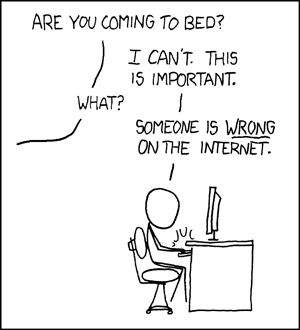
But... But... Someone is WRONG on the Internet!
http://xkcd.com/386/
But... But... Someone is WRONG on the Internet!
http://xkcd.com/386/
The annoying thing is, Gruber's not wrong. He's biased and he's going to adopt whatever findings of fact and findings of analysis are most favorable to Apple, but he's been doing this for 10+ years and he's not simply going to make things up. Which makes it especially dumb to get into a blogfight with him. Because it's never going to end.
There is still a case to be made for Android over iOS based on openness. People should make that case. But what are they saying when they make a case for Android based on Gruber? Is that the best they've got? That an Apple advocate is advocating Apple?
There is still a case to be made for Android over iOS based on openness. People should make that case. But what are they saying when they make a case for Android based on Gruber? Is that the best they've got? That an Apple advocate is advocating Apple?
he's been doing this for 10+ years and he's not simply going to make things up. Which makes it especially dumb to get into a blogfight with him. Because it's never going to end.
As the old saying goes, never argue with someone who buys their ink by the barrel. And I agree that Gruber is not wrong. "Biased" does not mean wrong, it means consistently interpreting the facts to favour certain interpretations or disfavour others.
In my opinion, it is very healthy to consider biased opinions when trying to understand an issue:
http://raganwald.posterous.com/bias
But no, Gruber is not wrong. It's just that some people think he's wrong and are compelled to argue with him personally rather than either (a) identify which facts he is wrongly reporting, or (b) give their own alternate interpretation of the same facts.
As you can tell I completely agree that calling Gruber out because someone disagrees with his opinion is adding an unnecessary level of indirection to the debate.
As the old saying goes, never argue with someone who buys their ink by the barrel. And I agree that Gruber is not wrong. "Biased" does not mean wrong, it means consistently interpreting the facts to favour certain interpretations or disfavour others.
In my opinion, it is very healthy to consider biased opinions when trying to understand an issue:
http://raganwald.posterous.com/bias
But no, Gruber is not wrong. It's just that some people think he's wrong and are compelled to argue with him personally rather than either (a) identify which facts he is wrongly reporting, or (b) give their own alternate interpretation of the same facts.
As you can tell I completely agree that calling Gruber out because someone disagrees with his opinion is adding an unnecessary level of indirection to the debate.
>But no, Gruber is not wrong. It's just that some people think he's wrong and are compelled to argue with him personally rather than either (a) identify which facts he is wrongly reporting, or (b) give their own alternate interpretation of the same facts.
The problem is there are lots of other people who take his fawning writing as the gospel truth and mindlessly upvote any posts in favor while downvoting any that are against.
>are compelled to argue with him personally rather than either (a) identify which facts he is wrongly reporting, or (b) give their own alternate interpretation of the same facts
You forgot (c) Get mercilessly downvoted and/or watch nonsense rebuttal replies get upvoted.
This is the real reason that the discussions around Apple on tech sites are so polarizing, the disconnect with reality and objectivity.
There are even a bunch of people who have left HN in disgust over this prevalent practice of Apple worship over proper discussion on here.
The problem is there are lots of other people who take his fawning writing as the gospel truth and mindlessly upvote any posts in favor while downvoting any that are against.
>are compelled to argue with him personally rather than either (a) identify which facts he is wrongly reporting, or (b) give their own alternate interpretation of the same facts
You forgot (c) Get mercilessly downvoted and/or watch nonsense rebuttal replies get upvoted.
This is the real reason that the discussions around Apple on tech sites are so polarizing, the disconnect with reality and objectivity.
There are even a bunch of people who have left HN in disgust over this prevalent practice of Apple worship over proper discussion on here.
mindlessly upvote any posts in favor while downvoting any that are against.
How exactly do you judge which upvotes are mindless and which are the result of someone who disagrees with a post but thinks it's insightful or valuable or otherwise a positive contribution to Hacker News?
What parameters do you use to judge which upvotes are mindless and which are the result of people who weigh the issues and then come to a conclusion that differs from yours?
Some time ago, I decided that I liked using Macintoshes and disliked using PCs. I also noticed that there were 19 PCs for every Macintosh. What would you have said if I'd suggested that all the people buying PCs were "mindless drones" instead of deciding that they were people who, given the information in front of them, came to a different conclusion for themselves than the one I had come to for myself?
proper discussion
Here's my definition of a proper discussion: No ad hominem arguments and no ad hominem abuse. What's yours?
How exactly do you judge which upvotes are mindless and which are the result of someone who disagrees with a post but thinks it's insightful or valuable or otherwise a positive contribution to Hacker News?
What parameters do you use to judge which upvotes are mindless and which are the result of people who weigh the issues and then come to a conclusion that differs from yours?
Some time ago, I decided that I liked using Macintoshes and disliked using PCs. I also noticed that there were 19 PCs for every Macintosh. What would you have said if I'd suggested that all the people buying PCs were "mindless drones" instead of deciding that they were people who, given the information in front of them, came to a different conclusion for themselves than the one I had come to for myself?
proper discussion
Here's my definition of a proper discussion: No ad hominem arguments and no ad hominem abuse. What's yours?
Well, see point #3 here. http://mattmaroon.com/2010/11/23/i-quit-hacker-news/
And here: http://news.ycombinator.com/item?id=1800253
The comments and the moderation are extremely predictable in most cases regardless of technical merits of the discussion. A casual or statistical observation would easily reveal the prevalent biases, even amongst the crowd that prides itself on being objective.
And here: http://news.ycombinator.com/item?id=1800253
The comments and the moderation are extremely predictable in most cases regardless of technical merits of the discussion. A casual or statistical observation would easily reveal the prevalent biases, even amongst the crowd that prides itself on being objective.
Does HN pride itself on being objective? This seems like wishful thinking. HN is supposed to favour hacking software, hardware, and the ultimate in social and business hacking, disruptive startups. I would call that being biased.
If we were "objective" about everything, we wouldn't actually have any culture. It's our lack of objectivity that makes us cohesive. To put it another way, "biased" can often mean the same thing as "opinionated." Sometimes that is annoying if you have a different opinion. Sometimes it is refreshing.
So what I will say in response is that without agreeing or disagreeing about whether HN is biased in favour of or against Apple and/or Gruber's writing, we should be careful to distinguish "bias" from "mindlessness." I do know what you mean, humans have a tendency towards groupthink and conformity. Voting a certain way solely because you observe other people voting that way is mindless in the sense you are using, and that dynamic has been seen on HN.
But the other thing that takes place on HN is bias that is not based on conformity, the bias that comes from a set of people with similar values tending to interpret objective facts in similar subjective ways. If what you want is to reduce the conformity and deaden the echo-chamber effect, you have my support. I'm only cautioning against assuming that all bias--especially bias towards disagreeing with you--comes from the same place.
p.s. Please don't think I'm arguing with you. It would be ironic indeed if I were to argue that bias is acceptable and healthy yet tell you that you are wrong to have a different interpretation of HN's behaviour that I have :-)
If we were "objective" about everything, we wouldn't actually have any culture. It's our lack of objectivity that makes us cohesive. To put it another way, "biased" can often mean the same thing as "opinionated." Sometimes that is annoying if you have a different opinion. Sometimes it is refreshing.
So what I will say in response is that without agreeing or disagreeing about whether HN is biased in favour of or against Apple and/or Gruber's writing, we should be careful to distinguish "bias" from "mindlessness." I do know what you mean, humans have a tendency towards groupthink and conformity. Voting a certain way solely because you observe other people voting that way is mindless in the sense you are using, and that dynamic has been seen on HN.
But the other thing that takes place on HN is bias that is not based on conformity, the bias that comes from a set of people with similar values tending to interpret objective facts in similar subjective ways. If what you want is to reduce the conformity and deaden the echo-chamber effect, you have my support. I'm only cautioning against assuming that all bias--especially bias towards disagreeing with you--comes from the same place.
p.s. Please don't think I'm arguing with you. It would be ironic indeed if I were to argue that bias is acceptable and healthy yet tell you that you are wrong to have a different interpretation of HN's behaviour that I have :-)
> HN is supposed to favour hacking software, hardware, and the ultimate in social and business hacking, disruptive startups. I would call that being biased.
Except when it's Apple and then people lose all sense of objectivity and perspective and support the locking down of platforms so that things are not hackable anymore. Example: http://blog.robrhyne.com/post/1015614125/google-voice-says-h...
And people envisage in grand terms about a Post-PC world with devices such as these which is very alarming given the potential for abuse(which is already happening). There is barely a protest but there is certainly a lot of fawning over the choice of chair in the latest Apple conference. :)
Anyone pointing out any fact that can be construed as critical to Apple is usually downvoted to obscurity.
The downvotes are even more reflective of the community because of the high karma threshold needed to downvote.
Regardless of the origin, the end result is still the same, the bias is harmful because it drowns out alternate views, and most of the people affected either leave or are forced to conform.(see the HN comment link in my comment in a parent post in this thread).
Except when it's Apple and then people lose all sense of objectivity and perspective and support the locking down of platforms so that things are not hackable anymore. Example: http://blog.robrhyne.com/post/1015614125/google-voice-says-h...
And people envisage in grand terms about a Post-PC world with devices such as these which is very alarming given the potential for abuse(which is already happening). There is barely a protest but there is certainly a lot of fawning over the choice of chair in the latest Apple conference. :)
Anyone pointing out any fact that can be construed as critical to Apple is usually downvoted to obscurity.
The downvotes are even more reflective of the community because of the high karma threshold needed to downvote.
Regardless of the origin, the end result is still the same, the bias is harmful because it drowns out alternate views, and most of the people affected either leave or are forced to conform.(see the HN comment link in my comment in a parent post in this thread).
You've linked to two comments there, both o which complain of downvotes, both of which are upvoted. Even so, those are just people who agree with you, that doesn't do anything to strengthen your argument.
Are you sure people aren't just over reacting?
Are you sure people aren't just over reacting?
Gruber doesn't need to make things up, he just links to half-baked stories as long they fit his "Google is evil" frame and doesn't bother to go back and correct them when there's been time for the real story to come out. This is likely yet another of these occasions.
It's similar to making things up when you are linking to small sections of an article and trying to paint a narrow view of an argument. His commentaries are also incredibly horrible.
tangental, but the actual source of that comic: http://xkcd.com/386/ or http://imgs.xkcd.com/comics/duty_calls.png
The whole 'more open' thing leads straight to Godwin's law.
If "open" is now a marketing term to be defined individually by each entity that's exploiting it, than Google and their supporters should stop using it, because it's ultimately meaningless.
The spirit of open source is supposed to be that you have access to the Android source at all times and can do what you want with it. However, it's not an open platform if Google retains final approval over source changes by licensees and is holding up phones that just so happen to use a rival search engine like Bing. It's not an open platform if they're withholding source except to their privileged partners who get early access while others don't.
I just don't understand why so much faith is placed in this multi-billion dollar advertising company. Google is not really an open source company--their core business is a closed source, proprietary content-indexing platform that just happens to be backed by open source software.
The spirit of open source is supposed to be that you have access to the Android source at all times and can do what you want with it. However, it's not an open platform if Google retains final approval over source changes by licensees and is holding up phones that just so happen to use a rival search engine like Bing. It's not an open platform if they're withholding source except to their privileged partners who get early access while others don't.
I just don't understand why so much faith is placed in this multi-billion dollar advertising company. Google is not really an open source company--their core business is a closed source, proprietary content-indexing platform that just happens to be backed by open source software.
It is getting tiresome to hear Apple fans, having long bashed Google's Android because "open" was bad, now bash Google for being somewhat less "open."
From my admittedly Apple-fanboy perspective, I always thought the argument wasn't that open = bad, just that that Google shouldn't use it as a marketing point if they're not 100% open.
And Apple makes just as big a deal about the advantages of iOS being closed as Google does about the openness of Android.
Right, but with Apple closed means closed. No one says that Apple is a "almost closed" and argues they should be totally closed. Google is half-assing their definition of open — which is fine, do what you want — but people are calling BS and rightfully so. The argument should be what is better: 100% closed or less than 100% open? This is where the shades of grey come in.
From my admittedly Apple-fanboy perspective, I always thought the argument wasn't that open = bad, just that that Google shouldn't use it as a marketing point if they're not 100% open.
And Apple makes just as big a deal about the advantages of iOS being closed as Google does about the openness of Android.
Right, but with Apple closed means closed. No one says that Apple is a "almost closed" and argues they should be totally closed. Google is half-assing their definition of open — which is fine, do what you want — but people are calling BS and rightfully so. The argument should be what is better: 100% closed or less than 100% open? This is where the shades of grey come in.
It is getting tiresome to hear Apple fans, having long bashed Google's Android because "open" was bad, now bash Google for being somewhat less "open."
From my admittedly Apple-fanboy perspective, I always thought the argument wasn't that open = bad, just that that Google shouldn't use it as a marketing point if they're not 100% open.
Here's my admittedly Apple-fanboy perspective: Apple took a "closed" approach which helped in quality control. Google took an "open" approach which allowed others to add or modify their OS in ways that did not benefit the consumer, or just plain sucked. This resulted in multiple products that either simply lack polish or just stink to use. Google found this out the hard way and is now trying to tighten their control, and Apple's approach is being entirely vindicated.
From my admittedly Apple-fanboy perspective, I always thought the argument wasn't that open = bad, just that that Google shouldn't use it as a marketing point if they're not 100% open.
Here's my admittedly Apple-fanboy perspective: Apple took a "closed" approach which helped in quality control. Google took an "open" approach which allowed others to add or modify their OS in ways that did not benefit the consumer, or just plain sucked. This resulted in multiple products that either simply lack polish or just stink to use. Google found this out the hard way and is now trying to tighten their control, and Apple's approach is being entirely vindicated.
I agree partly, but not entirely. Some lock down is good, such as preventing the modifications from carriers that usually users don't like (from what I've seen, at least) and delay updates. However, allowing the user choice to apply their own modifications like custom homescreens and skins is a good thing, and has actually improved the default product for me. Some control is good, but I think Apple takes it too far.
> "I always thought the argument wasn't that open = bad"
That's my view of things as well. The closest the arguments got to "open=bad" was: open has an increasingly-poor track record as projects trend away from tools for technical users and toward products for average consumers.
And that's certainly not to say that all Open source projects are doomed or that Android couldn't succeed; it was just an observation of results. Something proponents of Open should be familiar with. (i.e. "closed source tends to be less secure")
That's my view of things as well. The closest the arguments got to "open=bad" was: open has an increasingly-poor track record as projects trend away from tools for technical users and toward products for average consumers.
And that's certainly not to say that all Open source projects are doomed or that Android couldn't succeed; it was just an observation of results. Something proponents of Open should be familiar with. (i.e. "closed source tends to be less secure")
I think Gruber's point is spot-on. A lot of people prefer Android because they want it to be open and open-source, and Android companies market to the public on this specific point.
So I don't think it's off-base to point out discrepancies between the ideology and the reality. Gruber would absolutely like Apple to be more open. However, in this case, it is Google that contradicted itself with words vs deeds.
So I don't think it's off-base to point out discrepancies between the ideology and the reality. Gruber would absolutely like Apple to be more open. However, in this case, it is Google that contradicted itself with words vs deeds.
That's not really spot-on. Most Android users would rather see Google put a stop to deep skins and doing gross things like the carriers are doing with the Android phones by not letting you uninstall their apps, or charging you for features already built-in, and so on.
Are you saying most Android users don't want it to be open?
A more charitable interpretation is that most developers would like Google to protect the Android trademark a little better, perhaps by tightening up on what modifications of Android are still eligible to be called "Android", so that both users and developers could count on more consistency when hearing the name.
The way this was set up with MeeGo is that there is a formal compliance process backed up by the trademark (owned by Linux Foundation).
If you make a product based on MeeGo you can add whatever you want. As long as it passes compliance, you can call it MeeGo.
http://wiki.meego.com/Quality/Compliance
If you make a product based on MeeGo you can add whatever you want. As long as it passes compliance, you can call it MeeGo.
http://wiki.meego.com/Quality/Compliance
May be few percent of customers care about Android 'openness'. Majority of people just don't care. They see android is from a trusted brand called Google and believe in the product.
Openness is indeed a continuum and different degrees of it make sense for different people and different situations. The problems arise when you claim to be more open than you are or become less open than you were. Apple is clear that it offers proprietary platforms; Google claims Android is open but isn't acting accordingly.
It's not so clear on Apple's side either. They can be even more closed if they want to, and they proved it recently with the subscription tax, which also wasn't in place since the the beginning when those developers made their apps for iOS.
A fair observer might allow that "Android" is still an Open source project, but only inasmuch as they explicitly identify Honeycomb as currently a closed-source fork of Android. Honeycomb may become open, but to discount the facts of today involves assumptions about future.
If our hypothetical fair observer were to disregard the assumed future altogether, things lean more toward Gruber than Google.
Google has gone out of their way to disavow pre-Honeycomb releases on tablets, and is withholding Honeycomb to only those tablet-makers who sign their agreements. They're currently doing exactly what Gruber asserts will become SOP and what they're currently doing with Honeycomb simply doesn't fit any fair definition of "Open Source" development. Not even their own.
If our hypothetical fair observer were to disregard the assumed future altogether, things lean more toward Gruber than Google.
Google has gone out of their way to disavow pre-Honeycomb releases on tablets, and is withholding Honeycomb to only those tablet-makers who sign their agreements. They're currently doing exactly what Gruber asserts will become SOP and what they're currently doing with Honeycomb simply doesn't fit any fair definition of "Open Source" development. Not even their own.
Gruber is an Apple fundamentalist, preaching to the choir. There is only one true way and all facts will be interpreted or ignored in favour of that way.
Dissension is not allowed in his church, if you disagree with what he says then do so elsewhere.
If you need an analysis of what Apple is doing, or where they are going then he might be good at that (I don't know, I don't care) but you absolutely cannot rely on him for unbalanced coverage on anything else.
Arguing about whether google marketing is deceptive is a waste of time. ALL marketing is deceptive. Go watch an Apple keynote for example.
Arguing about whether android is "open" is also a waste of time. Open is not a bool, it's a float. If Linux is 100% and Windows is 0% then Android is maybe 60% and ios is somewhere in the single digits.
In the past 14 months, I have used WM6.5, ios, Android and Win Phone 7. The only reason I could use Android is that it is open enough that it could be installed on my HD2, a WM6.5 phone.
Dissension is not allowed in his church, if you disagree with what he says then do so elsewhere.
If you need an analysis of what Apple is doing, or where they are going then he might be good at that (I don't know, I don't care) but you absolutely cannot rely on him for unbalanced coverage on anything else.
Arguing about whether google marketing is deceptive is a waste of time. ALL marketing is deceptive. Go watch an Apple keynote for example.
Arguing about whether android is "open" is also a waste of time. Open is not a bool, it's a float. If Linux is 100% and Windows is 0% then Android is maybe 60% and ios is somewhere in the single digits.
In the past 14 months, I have used WM6.5, ios, Android and Win Phone 7. The only reason I could use Android is that it is open enough that it could be installed on my HD2, a WM6.5 phone.
You can attack Gruber's position as an Apple advocate if you want, but that doesn't really address his points about Google. The thing I've taken away from this is that Android advocates are now defining openness in terms of degrees. It's no longer about being open; it's about being "more open," a vague idea that only gets to be defined by Google, the gatekeepers of Android.
Requiring licensees to agree to "non-fragmentation clauses" that give Google final approval over source changes is against the spirit of open source.
Requiring licensees to agree to "non-fragmentation clauses" that give Google final approval over source changes is against the spirit of open source.
Personally, I'm not an android, or open source, advocate. I don't use it at the moment and I wouldn't necessarily recommend it to someone else. All the phone oses I have have used are flawed to some extent and picking one is a matter of deciding which flaws you can tolerate or not notice.
Gruber doesn't care about openness either, he uses an iPhone. His argument is is simply a way to bash android without addressing anything that is substantive to most people.
Last month he was trolling that android wasn't open because motorola hadn't provided a froyo update to an older phone, completely ignoring the fact that the comunity had already provided multiple updates.
Next month he will be complaining that android isn't open because google hasn't provided the source to something else.
To most people, it doesn't matter if android is 65% or 70% open. What matters is how well it meets their needs. If openness helps meet those needs then it's important, if it doesn't then it's irrelevant.
Finally, if Gruber was interested in openness, he would allow comments on his blog. Without that, he is just a troll with a pulpit.
Gruber doesn't care about openness either, he uses an iPhone. His argument is is simply a way to bash android without addressing anything that is substantive to most people.
Last month he was trolling that android wasn't open because motorola hadn't provided a froyo update to an older phone, completely ignoring the fact that the comunity had already provided multiple updates.
Next month he will be complaining that android isn't open because google hasn't provided the source to something else.
To most people, it doesn't matter if android is 65% or 70% open. What matters is how well it meets their needs. If openness helps meet those needs then it's important, if it doesn't then it's irrelevant.
Finally, if Gruber was interested in openness, he would allow comments on his blog. Without that, he is just a troll with a pulpit.
The problem here is that Google used the word "open" as a feature of Android and marketing term against iOS/Apple. But don't forget that a lot of parts of iOS are open source and several parts of Android are closed (Google branded apps). Does the percentage of opennes matter?
Gruber might be biased but that doesn't mean he is wrong or off-base.
Gruber might be biased but that doesn't mean he is wrong or off-base.
I think the most annoying thing about Gruber is that he mixes fantastic insights with near-propaganda. He's also got a razor-honed voice.
Generally I tend to pay close attention to him when he writes about Apple products, eco-system, and culture, and ignore him when he writes about anything else, especially Google or Android.
Generally I tend to pay close attention to him when he writes about Apple products, eco-system, and culture, and ignore him when he writes about anything else, especially Google or Android.
"The biggest joke is that the Businessweek article ends with a quote from Nokia CEO and former Microsoftie Stephen Elop saying that Android is no longer open and that's why he chose the more open Windows Phone 7. YIKES! Not good company, Mr. Gruber."
All good and well, but this is just guilt by association. Very bad way to end a fairly good article.
All good and well, but this is just guilt by association. Very bad way to end a fairly good article.
If you want a tl;dr of the article, take the last bit:
Both approaches have their merits and their failings. How about we focus on that instead of which system is open or closed?
What is he referring to when he says "both approaches"? He's talking about open versus closed.
Both approaches have their merits and their failings. How about we focus on that instead of which system is open or closed?
What is he referring to when he says "both approaches"? He's talking about open versus closed.
>Any fair observer would have to conclude that Android is still "open."
In my opinion, any fair observer would have to conclude that Android is still about as open as it always was. This isn't necessarily hypocritical; I have never viewed Android as "open".
Now, personally, I think that it's more customizable and flexible because it isn't mature enough as a platform to be able to afford to lock down APIs. Not that I think that the end result of an API should be to lock it down, but orthogonality in a SDK can be very beautiful, as it is with Cocoa touch.
In my opinion, any fair observer would have to conclude that Android is still about as open as it always was. This isn't necessarily hypocritical; I have never viewed Android as "open".
Now, personally, I think that it's more customizable and flexible because it isn't mature enough as a platform to be able to afford to lock down APIs. Not that I think that the end result of an API should be to lock it down, but orthogonality in a SDK can be very beautiful, as it is with Cocoa touch.
Google: "We wanted to make sure that there was no central point of failure, so that no industry player can restrict or control the innovations of any other. That's why we created Android, and made its source code open."
The fact that they're now restricting and controlling the innovations of other industry players by keeping the source code closed seems pretty much like the definition of hypocrisy.
The fact that they're now restricting and controlling the innovations of other industry players by keeping the source code closed seems pretty much like the definition of hypocrisy.
You are still free to fork any code that was previously released under a free license. All of the source code they release can be used.
How is that relevant when they are giving the latest source to people they approve?
It's their source. You are free to pick the last released version and improve it yourself.
The source they didn't release may not be completely theirs (we can't know this because we don't have it) and before releasing it under an open source license they may be required to clean it up.
The source they didn't release may not be completely theirs (we can't know this because we don't have it) and before releasing it under an open source license they may be required to clean it up.
If it's not theirs, how can they give it to some of their approved partners?
Android is Google's. They don't have to release anything except the kernel (which is a lot already). They can give it to whoever they think will improve it and make it more popular. The kernel is GPL, but the rest is Apache. Google can keep it to themselves and their preferred partners forever. It's their software and they own it.
Exactly - they own it, and they are free to give it to whoever they like and withhold it from whoever they like.
What part of that isn't about controlling other players?
What part of that isn't about controlling other players?
Are you under the impression Google can take 2.3 away from anyone? They own it and they can't. What they are doing is saying they won't release 3.x for now source and not really disclosing the reasons. Anything can be behind that decision, including the inclusion of non-Google code in the specific products.
I prefer to think along those lines.
I prefer to think along those lines.
I'm not under that impression. I am under the impression that they have given the 3.x source to some people and not to others, thus choosing who gets to use it. Normally we refer to that as 'control'.
They didn't say Android 2.3 is open. They said that Android was open and the purpose was so that no one entity could control the innovation of other players, and yet that is exactly what they are doing.
You seem to be defending Google on the basis of their freedoms. If you read what I've written, you'll see that I haven't argued they don't have the right to do what they are doing. I haven't even argued that it's bad.
I am merely pointing out that they have gone back on what they said. You haven't said anything that refutes this.
They didn't say Android 2.3 is open. They said that Android was open and the purpose was so that no one entity could control the innovation of other players, and yet that is exactly what they are doing.
You seem to be defending Google on the basis of their freedoms. If you read what I've written, you'll see that I haven't argued they don't have the right to do what they are doing. I haven't even argued that it's bad.
I am merely pointing out that they have gone back on what they said. You haven't said anything that refutes this.
> they have gone back on what they said.
Point me, please, where did they say Honeycomb will not be opened. As it is now, it probably has some code that went in to meet launch deadlines and that prevents a full release. They may also want to tidy things up before pushing it out because if they push out a defective API (and there are lots of new APIs in HC) they will have a lot of heat when they fix it.
Point me, please, where did they say Honeycomb will not be opened. As it is now, it probably has some code that went in to meet launch deadlines and that prevents a full release. They may also want to tidy things up before pushing it out because if they push out a defective API (and there are lots of new APIs in HC) they will have a lot of heat when they fix it.
That has absolutely nothing to do with what I've said. I'll leave it to you to read the thread.
"We wanted to make sure that there was no central point of failure, so that no industry player can restrict or control the innovations of any other. That's why we created Android, and made its source code open."
How is Google not restricting or controlling* the innovations of other industry players?
http://source.android.com/
How is Google not restricting or controlling* the innovations of other industry players?
http://source.android.com/
Honeycomb isn't desert so named well by purpose -- Sweat honey is caged in honeycomb and protected.
John Gruber has a very specific audience: people that adore Apple products.
His narrative is extremely well tuned to please these people and to keep them coming back for more. I can't fault him for his success as a niche blogger, but his material is so predictable and formulaic that I stopped reading long ago.
His narrative is extremely well tuned to please these people and to keep them coming back for more. I can't fault him for his success as a niche blogger, but his material is so predictable and formulaic that I stopped reading long ago.
Google exploited the buzz of open source philosophy, so it's fascinating seeing the open source community's reaction to their stricter control over Android. Personally, I always saw the trumpeting of "openness" as an unrealistic marketing ploy.
Honest question: Why do people listen to and retweet Gruber? Everything I've read from him is pure biased hypocritical garbage.
His attack is hypocritical? Maybe.
Off base? I don't think so.
Yes, as the article says, Android is still far more open and customizable than iOS (and it's not that hard, actually).
Still there is another definition of open that matters to some people, and that definition applies less and less to Android, giving to all this a taste of bait and switch.
I know a lot of Android developers that believe in open software not on merely his advantage from a market point of view, but also from a philosophical one. These developers are all disappointed.
I am an iOS developer, I like Apple products, I agree with some of the arguments for a more closed system even if I disagree on a lot of Apple's decisions. I look at Android as a good competitor to iOS that keeps raising the bar and as a possible future market for what I do. I thought from the beginning that Android as a platform would have benefitted from a little more closed approach.
Still, I'm disappointed too, looking at Google's behavior. It angers me a little, even if I'm not an Android fan. Because I think about all those Android developers that now feel somewhat betrayed. This has a bitter taste not because Android is becoming more closed, but because this was not done from the beginning, luring people to the platform with different promises.
Am I an hypocrite too?