Ways to manage conflicts with cops in a medical emergency(ems1.com)
ems1.com
Ways to manage conflicts with cops in a medical emergency
http://www.ems1.com/ems-advocacy/articles/1476128-5-ways-to-manage-conflicts-with-cops-in-a-medical-emergency/
13 comments
Yeah, I've had a number of WWB/DWB stops, and in one case a cop pointed a gun at me and forced me to the ground. My crime, jogging in the majority white neighborhood I lived in (there was no active crime in progress, the cop decided that I was 'suspicious' and even after finding nothing on me (I was dressed in sneakers, shorts, t shirt since I was you know, jogging) he proceeded to run my license multiple times and ask me repeatedly what I was doing in the area (apparently 'I live here' and 'jogging' were not satisfactory answers). In the end I got my license thrown back at me with a sarcastic 'have a nice day'.
I have had very few police interactions where it was not clear that the cops viewed their role as dominating and using overwhelming force. U.S cops seem to have a very militaristic mindset which is really bizarre, considering compared to other jobs, being a cop is not that dangerous.In fact, the one case that stood out to me was one where a cop acted the way he should have. I got rear-ended on New Years Eve (as luck would have it, right in front of the State Trooper Barracks). The State Trooper who responded was amazing. He checked on everyone, found that the passenger of the idiot who rear ended me had a broken nose (she had no seatbelt on), called an ambulance, squared everything. He had a truly calming presence. That is how cops should be.
I have had very few police interactions where it was not clear that the cops viewed their role as dominating and using overwhelming force. U.S cops seem to have a very militaristic mindset which is really bizarre, considering compared to other jobs, being a cop is not that dangerous.In fact, the one case that stood out to me was one where a cop acted the way he should have. I got rear-ended on New Years Eve (as luck would have it, right in front of the State Trooper Barracks). The State Trooper who responded was amazing. He checked on everyone, found that the passenger of the idiot who rear ended me had a broken nose (she had no seatbelt on), called an ambulance, squared everything. He had a truly calming presence. That is how cops should be.
My wife and I have been in the US for 2.5 years and we had a surreal experience while taking a walk at night once. I must say, we were walking around late at night because we love being in a safe area were we can finally do that - back in our home country, we simply couldn't do that because of the absurd crime rate.
So we're walking around downtown just enjoying a nice summer night, when a police car shows up in a corner. No big deal, it's actually nice to see them around. We walk a block and there's the police car again... and it was like that for basically every block we walked until we got home. Fortunately we were not stopped, but we were definitely being followed and watched.
We come from Latin America but we're both white (German ancestry). I can't help but think the experience would likely have been a little worse if we had more typical Latino looks.
So we're walking around downtown just enjoying a nice summer night, when a police car shows up in a corner. No big deal, it's actually nice to see them around. We walk a block and there's the police car again... and it was like that for basically every block we walked until we got home. Fortunately we were not stopped, but we were definitely being followed and watched.
We come from Latin America but we're both white (German ancestry). I can't help but think the experience would likely have been a little worse if we had more typical Latino looks.
You were a white couple walking downtown at night. I want to live in the utopia of Star Trek, but the reality of our world is that you were probably being shadowed by the police because they were looking out for you. You likely experienced the reason many downtowns are so "safe" these days. I know many police officers personally because of my past in the military (guard), and this is not uncommon, for police to circle around if they see someone that looks like they're up to no good, or if they look like an inviting target. I really wish we could live in a world where racism wasn't so rampant, but...
Somehow Europe manages to have very safe cities without this sort of behaviour from the cops. I think the Americans have been slow-cooked into finding the police state apparatus to be normal and justifiable.
The U.S. has always been a fantastically more violent place than Europe (at least, than the UK), since long before the modern era of militarized police: http://ourworldindata.org/wp-content/uploads/2013/03/homicid....
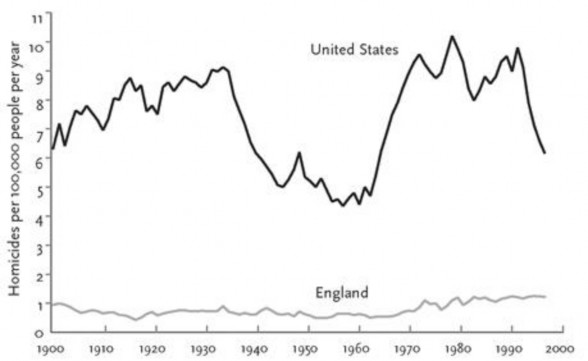
I travel to Europe often, and yes, it is a mentality. I think also the opposite is true, however: Criminals will not commit crime if they have the mindset that a police presence is particularly heavy in an area. Europeans don't need guns to keep them safe, but in America, we "need" our guns to keep us safe. It's absolutely a mindset, you're right. But that doesn't mean it doesn't work.
I'm not an American so I don't feel a gun will "keep me safe" i.e. I won't be attacked or house broken. Though when that happens I can defend myself much better than without.
Is it generally that people feel they won't be victims to crime if they're armed?
Is it generally that people feel they won't be victims to crime if they're armed?
Americans have a pithy sound-bite-style quote for that:
"When seconds count, the police are only minutes away."
This is a large and diverse country. There are significant areas of land where the median time until an emergency first-responder will appear is a multiple of the median duration of a typical criminal (or dangerous wildlife) encounter. With the right planning, I could probably walk coast to coast unarmed, without ever feeling unsafe. But if I took my hotel budget and bought a tent and sidearm instead, I wouldn't need to do nearly as much research ahead of time. Besides that, not all dangerous animals are human enough to know the law.
I don't typically go about armed, but several people that I know do. They consider it to not just be protection for themselves, but for their entire community, like vaccinations.
The weapon does not prevent the crime, but it does suggest a more favorable outcome.
"When seconds count, the police are only minutes away."
This is a large and diverse country. There are significant areas of land where the median time until an emergency first-responder will appear is a multiple of the median duration of a typical criminal (or dangerous wildlife) encounter. With the right planning, I could probably walk coast to coast unarmed, without ever feeling unsafe. But if I took my hotel budget and bought a tent and sidearm instead, I wouldn't need to do nearly as much research ahead of time. Besides that, not all dangerous animals are human enough to know the law.
I don't typically go about armed, but several people that I know do. They consider it to not just be protection for themselves, but for their entire community, like vaccinations.
The weapon does not prevent the crime, but it does suggest a more favorable outcome.
Not to discount your comment, but it's also probably worth mentioning that the NRA and gun manufacturers comprise a very large and politically influential lobby. Gun culture in the US is in some part manufactured and sustained by the interests of big business.
One could say the same about a lot of different businesses and industries. Profitable businesses spend money on advertising and lobbying to stay profitable. I mistrust people with vested interests on both sides.
In this particular instance, my opinion of the meaning of the 2nd Amendment to the U.S. Constitution is not clouded by any doubt.
The anecdotal facts I have at my disposal suggest that common gun ownership is neither necessary for public safety nor detrimental to it. The security of a people seems to be correlated more to the strength of their character than that of their arsenal.
In this particular instance, my opinion of the meaning of the 2nd Amendment to the U.S. Constitution is not clouded by any doubt.
The anecdotal facts I have at my disposal suggest that common gun ownership is neither necessary for public safety nor detrimental to it. The security of a people seems to be correlated more to the strength of their character than that of their arsenal.
Do you mean looking out in the sense that they were protecting them, or looking out in the sense that "white folks downtown must be here to buy drugs"?
What was it about your experience that made you assume negative intent? Have you considered that maybe their presence had nothing to do with you, or perhaps couples had been targeted by robbers in the area that night and they were merely ensuring you didn't become another crime statistic?
I dislike authority and cops more than most, but I also like evidence and I don't feel like this supports the implied harassment.
I dislike authority and cops more than most, but I also like evidence and I don't feel like this supports the implied harassment.
1) Everything I hear about American police in the news and from people I meet. Ever since I got here I'm amazed how much I hear the "never talk to the police" advice. I don't know how accurate that is but because I hear it so much I'm afraid of even greeting them when I'm walking around.
2) The whole thing made us feel very uncomfortable. Sure, they could have been looking out for us... But if that was the case, why didn't they just pull over and tell us that? Our relaxing evening walk became tense with us wondering why the police was watching us.
2) The whole thing made us feel very uncomfortable. Sure, they could have been looking out for us... But if that was the case, why didn't they just pull over and tell us that? Our relaxing evening walk became tense with us wondering why the police was watching us.
> Once I was illegally searched because the officer "smelled weed"
It's tacitly understood that "smelled weed" is one of several simply accepted pretenses that give an officer the ability manufacture probable cause out of thin air.
It's tacitly understood that "smelled weed" is one of several simply accepted pretenses that give an officer the ability manufacture probable cause out of thin air.
In Massachusetts the smell of marijuana isn't enough for police to search your car. This was changed recently (summer 2014).
http://www.bostonglobe.com/metro/2014/07/09/sjc-odor-unburnt...
http://www.bostonglobe.com/metro/2014/07/09/sjc-odor-unburnt...
I wonder what they'll switch to next when marijuana has been legalized.
There's a classic TV sketch on this topic: 'Constable Savage' from 'Not the 9 O'Clock News' circa 1980.
https://www.youtube.com/watch?v=BO8EpfyCG2Y
https://www.youtube.com/watch?v=BO8EpfyCG2Y
"You know what you did" is a common one I've had from cops (ex USSR States mostly) looking for a bribe that evidently works pretty well.
It's simply wrong that smelling something is probable cause because of the potential for abuse.
If there were a bunch of attacks in my area where someone is throwing bleach in people's eyes (this has happened), I'd want the police to be able to treat the smell of bleach as probable cause.
The problem is that marijuana shouldn't be illegal in the first place. But it is illegal, and it's also common enough that if a cop smells weed, it's believable. Part of the problem here is that we make too many things illegal, and since cops have some choice in which laws they enforce when, it gives cops far too much power.
The problem is that marijuana shouldn't be illegal in the first place. But it is illegal, and it's also common enough that if a cop smells weed, it's believable. Part of the problem here is that we make too many things illegal, and since cops have some choice in which laws they enforce when, it gives cops far too much power.
If you can't reasonably rely on the testimony of police officers, you have a really big problem.
Like, require they take photos and they can just plant the evidence before they take the photo.
Compare and contrast a dank whiff with gun fire. I'd like police to be able to respond to the sound of gun fire. I don't see how it is less problematic than responding to the smell of marijuana.
Like, require they take photos and they can just plant the evidence before they take the photo.
Compare and contrast a dank whiff with gun fire. I'd like police to be able to respond to the sound of gun fire. I don't see how it is less problematic than responding to the smell of marijuana.
> If you can't reasonably rely on the testimony of police officers, you have a really big problem.
Yeah, but, you know, we actually do have such a problem: http://en.wikipedia.org/wiki/Police_perjury
Yeah, but, you know, we actually do have such a problem: http://en.wikipedia.org/wiki/Police_perjury
Standards should be (and, I believe, usually are) different for crimes that pose an imminent danger to the public.
I read the concern to be with the reliability of their testimony. I'm fine with the idea that simply smelling marijuana should not be probable cause. I'm not fine with the idea that it should not be probable cause because it creates an avenue for abuse of power.
The checks on abuse of power should happen at a higher level in the system than making rules about what an officer can reliably testify about.
The checks on abuse of power should happen at a higher level in the system than making rules about what an officer can reliably testify about.
> The checks on abuse of power should happen at a higher level in the system than making rules about what an officer can reliably testify about.
Why should there even be such rules? An officer, like any witness, can testify about anything they observe that is relevant to the matter under consideration by the court, and not barred by any generally-applicable prohibition (e.g., hearsay, etc., to the extent that is barred.)
Whether such testimony is reliable is a matter for the court/jury receiving the testimony to consider, based on the statement, any evidence of bias of the witness, and any conflicting or corroborating evidence.
Treating cops as privileged witnesses in any domain makes no sense, and seems to be contrary to the whole thrust of the Constitutional constraints on the criminal justice system, which are to protect the individual from arbitrary action by the government or its agents.
Why should there even be such rules? An officer, like any witness, can testify about anything they observe that is relevant to the matter under consideration by the court, and not barred by any generally-applicable prohibition (e.g., hearsay, etc., to the extent that is barred.)
Whether such testimony is reliable is a matter for the court/jury receiving the testimony to consider, based on the statement, any evidence of bias of the witness, and any conflicting or corroborating evidence.
Treating cops as privileged witnesses in any domain makes no sense, and seems to be contrary to the whole thrust of the Constitutional constraints on the criminal justice system, which are to protect the individual from arbitrary action by the government or its agents.
Yes, I inferred the idea that there should be rules from the comment I replied to and replied in order to reject it.
I think I probably agree that police shouldn't base searches on smelling weed (I'd have to think about whether they should be able to stop a car and tell them to tone it down).
What I don't agree with is making that determination based on concerns about fabricated statements about smelling weed.
I think I probably agree that police shouldn't base searches on smelling weed (I'd have to think about whether they should be able to stop a car and tell them to tone it down).
What I don't agree with is making that determination based on concerns about fabricated statements about smelling weed.
> What I don't agree with is making that determination based on concerns about fabricated statements about smelling weed.
The concern about fabrication by the government underlies much of the Constitutional restriction on government power in the criminal domain. I'd say that restricting government based on that concern is generally legitimate, and has a strong tradition in the US.
The concern about fabrication by the government underlies much of the Constitutional restriction on government power in the criminal domain. I'd say that restricting government based on that concern is generally legitimate, and has a strong tradition in the US.
Isn't the whole idea of requiring probable cause to prevent abuse of power? If we fully trusted the police then we wouldn't bother with any of this stuff. We'd allow police to search people at any time for any reason. But we don't trust them that far, so we put limits on what they can do. They can't do some searches without probable cause. Others require a warrant.
The line shifts a bit in the case of imminent danger, because we prefer to take more of a risk with the cops than the criminals in that case. A smell of marijuana doesn't indicate a life-threatening situation so we're back to the whole abuse-of-power bit for why the police can't just search people entirely at will.
The line shifts a bit in the case of imminent danger, because we prefer to take more of a risk with the cops than the criminals in that case. A smell of marijuana doesn't indicate a life-threatening situation so we're back to the whole abuse-of-power bit for why the police can't just search people entirely at will.
Probable cause just outlines a set of situations where use of power is authorized. It is the line between authorized and unauthorized use of power more than it is a check on abuse. If an officer pulls someone over just for the heck of it, their lack of probable cause isn't going to stop them from illegally searching the vehicle.
I see what you are saying about limits on power and trust being mixed together, if someone is literally 100% trustworthy there is no need to limit their power. I still think it is reasonable to consider whether police can reliably testify that they smelled something (this should at least be a goal for a just system) separately from the question of whether they should be allowed to act upon smelling something.
I see what you are saying about limits on power and trust being mixed together, if someone is literally 100% trustworthy there is no need to limit their power. I still think it is reasonable to consider whether police can reliably testify that they smelled something (this should at least be a goal for a just system) separately from the question of whether they should be allowed to act upon smelling something.
Where's "testify" coming from? The only comments in the thread I see that mention testimony are from you. The question is about what's sufficient cause for a search, and why. And the reason an officer should be allowed to perform a search based on hearing gunfire but not based on smelling weed is because the latter isn't life-threatening. Testimony in any subsequent court case is a completely different matter.
What other potential for abuse does allowing the smell as probable cause introduce? As far as I see, a cop can be a bastard with or without it, but with it he can later say he based a search on the smell (whether it was present or not).
There's a lot of people that will be truthful about evidence, but lie about motivation. And gunfire is a lot harder to lie about.
Hell look at parallel construction.
Hell look at parallel construction.
I did a stint working in Virginia, used to walk a few miles out of town to home after a night's boozing, as unlike seemingly most Americans I won't get behind the wheel drunk, taxis were a rip-off at that time of night, and nothing like a five mile stroll to shake off a hangover.
Long story short, was there for two months, walked home maybe five times, got stopped and id'd twice. Both occasions they were really confused as to not only why someone would walk "so far" to get home, but how.
They were totally fine taking my student id as a drivers license when I got pulled over speeding though. Ho hum.
Long story short, was there for two months, walked home maybe five times, got stopped and id'd twice. Both occasions they were really confused as to not only why someone would walk "so far" to get home, but how.
They were totally fine taking my student id as a drivers license when I got pulled over speeding though. Ho hum.
I went for a walk late at night, trying to clear my head after a rough breakup. I was just wearing my pajamas, and was walking the sidewalks just a few blocks from home.
I turned down a nearby alley in order to head back home, and was half way down it when a creepy-looking car with no lights on squeaked to a stop and blocked off the end of the alley. I froze and looked at it, and that's when the spotlight came on, and I realized it was a cop.
Unfortunately, my thought process went "oh, I must look suspicious. But wait, I don't have any ID. Maybe they didn't see me yet...", so I hopped into a driveway, out of sight of the cop. Oops, bad move. They went full lights-and-siren, and burned rubber down the alley towards me.
I took off running towards my house, zigzagging between houses to break line of sight. When I got back home, I hopped my fence and went in the back door, just because it was the closest entrance.
Double-unfortunately, apparently the cops decided I was a serious threat, and several minutes later I looked out the window to a police car in my own alley, following a cop with a german shepherd. The dog circled my property, and then barked at the fence, so the cops kicked my gate down and searched my back yard. They jiggled the doors and windows, found them locked, and decided to call it a night.
I got up early the next morning to fix my gate, and my parents never found out about it.
I turned down a nearby alley in order to head back home, and was half way down it when a creepy-looking car with no lights on squeaked to a stop and blocked off the end of the alley. I froze and looked at it, and that's when the spotlight came on, and I realized it was a cop.
Unfortunately, my thought process went "oh, I must look suspicious. But wait, I don't have any ID. Maybe they didn't see me yet...", so I hopped into a driveway, out of sight of the cop. Oops, bad move. They went full lights-and-siren, and burned rubber down the alley towards me.
I took off running towards my house, zigzagging between houses to break line of sight. When I got back home, I hopped my fence and went in the back door, just because it was the closest entrance.
Double-unfortunately, apparently the cops decided I was a serious threat, and several minutes later I looked out the window to a police car in my own alley, following a cop with a german shepherd. The dog circled my property, and then barked at the fence, so the cops kicked my gate down and searched my back yard. They jiggled the doors and windows, found them locked, and decided to call it a night.
I got up early the next morning to fix my gate, and my parents never found out about it.
I was once stopped as a kid (age 12). I was going birdwatching that morning, and was up around 5am because the walk to the lagoon was a good 45 minutes from where I lived, and early morning is great for birding. I had a pair of binoculars, a field guide, and a lunch in my backpack.
Two obviously bored deputies stopped me, talked to me for about 60 minutes, checked my backpack and generally couldn't believe a kid would be out on his own free will at that early a time.
No probable cause, I wasn't trespassing (walked the entire way on the sidewalk), but stopped because I was out of the ordinary. This was in a sleepy coastal California town in the late '70s, no real crime to speak of, but no, these guys had to be dicks.
If they had been cool, they would have called my parents to see if I was a runaway, or at least given me a ride to the lagoon, but no, they just wanted to be dicks.
Two obviously bored deputies stopped me, talked to me for about 60 minutes, checked my backpack and generally couldn't believe a kid would be out on his own free will at that early a time.
No probable cause, I wasn't trespassing (walked the entire way on the sidewalk), but stopped because I was out of the ordinary. This was in a sleepy coastal California town in the late '70s, no real crime to speak of, but no, these guys had to be dicks.
If they had been cool, they would have called my parents to see if I was a runaway, or at least given me a ride to the lagoon, but no, they just wanted to be dicks.
I think we just have too many bored cops.
After crime fell dramatically in the US, we should have laid off a few. Instead we just hired more and more and more. Now we're seeing the effects of over-policing.
http://i.imgur.com/vjqZQO4.png
After crime fell dramatically in the US, we should have laid off a few. Instead we just hired more and more and more. Now we're seeing the effects of over-policing.
http://i.imgur.com/vjqZQO4.png

George: Cops. I don't even care about cops. I wanna see more garbage men. It's much more important. All I wanna see are garbage trucks, garbage cans and garbage men. You're never gonna stop crime, we should at least be clean.
Jerry: I tell you what they should do, they should combine the two jobs, make it one job, 'cop\garbage man'. I always see cops walking around with nothing to do. Grab a broom! Start sweeping. You sweep sweep sweep... catch a criminal, get right back to sweeping.
http://www.seinfeldscripts.com/TheChineseRestaurant.htm
Jerry: I tell you what they should do, they should combine the two jobs, make it one job, 'cop\garbage man'. I always see cops walking around with nothing to do. Grab a broom! Start sweeping. You sweep sweep sweep... catch a criminal, get right back to sweeping.
http://www.seinfeldscripts.com/TheChineseRestaurant.htm
I agree.
Police have too much free time. Basically, their career path requires that they bring in money or arrests and if crime is down, they'll find ways to meet the unofficial quotas that are held over them.
Crime is down. This is the predictable result of having more police officers to handle less crime. Add in other factors like increasing militarization of law enforcement and the disqualification of people with high IQs and we get the mess that we have today.
Police have too much free time. Basically, their career path requires that they bring in money or arrests and if crime is down, they'll find ways to meet the unofficial quotas that are held over them.
Crime is down. This is the predictable result of having more police officers to handle less crime. Add in other factors like increasing militarization of law enforcement and the disqualification of people with high IQs and we get the mess that we have today.
Disqualification of people with high IQs?
Yes. Sounds ridiculous, right?
Search for Jordan V. New London.
Search for Jordan V. New London.
What is this graph showing? Is it "Sworn officers per civilian"? Or is it absolute data, just from a single state?
It's interesting, for sure, but certainly difficult to understand or draw any conclusions from without further context.
It's interesting, for sure, but certainly difficult to understand or draw any conclusions from without further context.
Just from reading the graph:
Figure 1 -- This one I'm not too sure about. It says "Cumulative percent growth in number of full-time sworn personnel."
Figure 2 -- It says "Full-time state and local law enforcement employees, 1992-2008". Each bar has "Civilians" "Sworn Officers" and "Total". I'm guessing that this is the break-down of "Sworn Officers" vs "Civilians" from the pool of "Full-time state and local law enforcement employees." Not all of those employees are sworn officers.
Figure 3 -- Just like Figure 2, but the numbers are "per 100,000 residents."
Figure 1 -- This one I'm not too sure about. It says "Cumulative percent growth in number of full-time sworn personnel."
Figure 2 -- It says "Full-time state and local law enforcement employees, 1992-2008". Each bar has "Civilians" "Sworn Officers" and "Total". I'm guessing that this is the break-down of "Sworn Officers" vs "Civilians" from the pool of "Full-time state and local law enforcement employees." Not all of those employees are sworn officers.
Figure 3 -- Just like Figure 2, but the numbers are "per 100,000 residents."
You realize that the drop in crime may be related to increased policing.
A lot of things may factor into that. Even if the increased police numbers are 100% responsible, we would still have to have a discussion about the diminishing return on that investment in order to maximize social good.
For the future, or maybe you know by now, you are not required to carry an ID while walking anywhere in public. However, you are required to identify yourself in most places, if asked by an officer of the law, usually by giving your full name.
You are only required to identify yourself if they have reasonable suspicion that you've committed, or are about to commit, a crime. Of course, that all gets sorted out post-arrest if you don't cooperate, which sucks for us.
In the described event, particularly a person fleeing an officer before the officer even talks to them - I would not be surprised if they considered that reasonable suspicion.
Per the recent events in Baltimore, simply running from the police does not appear to be a reason for arrest (IANAL). However, it's probably a good enough reason for police to pursue and detain you for questioning.
Although N.B. that, per other recent events, there is apparently a risk you will be shot dead regardless.
Running from a cop is pretty much the worst choice you can make, whether you're doing anything wrong or not. Cops don't like running. If he has to chase you, chances are he's bringing an ass-kicking with him (thanks, Chris Rock)
Reference: https://youtu.be/QR465HoCWFQ
Also:
"Two things get your ass kicked faster than anything: one is making a cop run. If he catches you, you're 18 years old, you've got fucking Nikes, he’s got cop shoes, he's wearing a utility belt, if you fucking run and he catches you, you're gonna take some lumps. That’s always been part of the code. Rodney King could’ve quoted that much of it to you."
https://www.themarshallproject.org/2015/04/29/david-simon-on...
Also:
"Two things get your ass kicked faster than anything: one is making a cop run. If he catches you, you're 18 years old, you've got fucking Nikes, he’s got cop shoes, he's wearing a utility belt, if you fucking run and he catches you, you're gonna take some lumps. That’s always been part of the code. Rodney King could’ve quoted that much of it to you."
https://www.themarshallproject.org/2015/04/29/david-simon-on...
It may surprise you to know that cops often deal with truly violent, aggressive individuals and often place their lives in danger. Being assertive and controlling is a proven way to keep situations under control as much as possible when they don't know who they're dealing with. The cop-hate is really getting out of control. Inner-city blacks kill a lot more black people than cops do, yet we bend over backwards to not be judgemental of them. Yes racism is bad. But automatic hatred of cops is really driven by the same kind of thinking.
> It may surprise you to know that cops often deal with truly violent, aggressive individuals and often place their lives in danger.
Violent, aggressive EMTs trying to treat a patient?
And a huge portion of the people jailed in the US are jailed for non-violent crimes.
If you can't deal differently with violent, aggressive people than with people who are clearly non-violent and not aggressive, you have no fucking business being a cop.
Having lived and worked in some pretty nasty areas, I've dealt with some violent, aggressive individuals, yet every day I manage to restrain myself from wrongly accusing people of crimes and beating up innocent people. I'm not sure why you think this is hard.
> The cop-hate is really getting out of control.
I think I have a right to hate people who are violent and aggressive.
> Inner-city blacks kill a lot more black people than cops do, yet we bend over backwards to not be judgemental of them.
No, I hate inner-city blacks who kill people just as much as I hate cops who kill people. I just don't talk about it much, because we don't seem to have much problem giving inner-city blacks who kill people the jail time they deserve.
> But automatic hatred of cops is really driven by the same kind of thinking.
I don't automatically hate cops. It just so happens that cops frequently go out of their way to give me reason to hate them.
Violent, aggressive EMTs trying to treat a patient?
And a huge portion of the people jailed in the US are jailed for non-violent crimes.
If you can't deal differently with violent, aggressive people than with people who are clearly non-violent and not aggressive, you have no fucking business being a cop.
Having lived and worked in some pretty nasty areas, I've dealt with some violent, aggressive individuals, yet every day I manage to restrain myself from wrongly accusing people of crimes and beating up innocent people. I'm not sure why you think this is hard.
> The cop-hate is really getting out of control.
I think I have a right to hate people who are violent and aggressive.
> Inner-city blacks kill a lot more black people than cops do, yet we bend over backwards to not be judgemental of them.
No, I hate inner-city blacks who kill people just as much as I hate cops who kill people. I just don't talk about it much, because we don't seem to have much problem giving inner-city blacks who kill people the jail time they deserve.
> But automatic hatred of cops is really driven by the same kind of thinking.
I don't automatically hate cops. It just so happens that cops frequently go out of their way to give me reason to hate them.
> Inner-city blacks kill a lot more black people than cops do, yet we bend over backwards to not be judgemental of them.
I haven't encountered many, if any, people who bend over backwards to not be judgmental of inner city blacks who kill other black people, least of all the people who like to point to the number of inner city blacks who kill black people as a means of dismissing specific criticism aggressive behavior by cops.
I haven't encountered many, if any, people who bend over backwards to not be judgmental of inner city blacks who kill other black people, least of all the people who like to point to the number of inner city blacks who kill black people as a means of dismissing specific criticism aggressive behavior by cops.
Having lived in a few different (western, first world) countries, US cops have been by far and away the rudest, most aggressive and entitled I have encountered. It is possible to deal with truly violent and aggressive individuals without always being violent and aggressive yourself.
When you have cops on film choking a man to death for selling cigarettes, on film shooting a man in the back then planting evidence on him (and, worse, having his original lie backed up by his fellow officers), and so on, and so on, it's quite a stretch to say that the cop-hate is the thing that's out of control. It seems more like it's the cops.
Yes racism is bad. But...
Oh, yeah, there it is.
Yes racism is bad. But...
Oh, yeah, there it is.
Because it leads to another interesting police/EMS interaction, I'd like to shed a little light on how Eric Garner died. He was not 'choked' to death. The choke hold only lasted a second or two, and wasn't even really an effective choke hold.
He died because he was placed on his stomach, with his arms handcuffed behind his back. This, combined with the fact that he was overweight made it impossible for him to breath effectively [1].
The 'interesting' (and depressing) thing is that the EMS crew that responded should have recognized this and had the cops reposition him. Instead, they just went with the flow, and didn't intervene... The one positive that has come out of his death is that his case is now the go-to example used to show EMS students how not to handle situations like that, and how to be an advocate for their patients.
[1] It's actually a bit more complicated than that... if he were just 'resting' in that position, he likely would be fine, but his inability to breathe deeply prevented his body from being able to compensate for various processes that kicked into overdrive when he was resisting the cops, but the tl; dr; is that if he had been placed on his back, or sitting up, he would almost certainly still be alive. Placing him on his stomach was against NYPD policy, and both the cops and EMTs/paramedics should have known better.
He died because he was placed on his stomach, with his arms handcuffed behind his back. This, combined with the fact that he was overweight made it impossible for him to breath effectively [1].
The 'interesting' (and depressing) thing is that the EMS crew that responded should have recognized this and had the cops reposition him. Instead, they just went with the flow, and didn't intervene... The one positive that has come out of his death is that his case is now the go-to example used to show EMS students how not to handle situations like that, and how to be an advocate for their patients.
[1] It's actually a bit more complicated than that... if he were just 'resting' in that position, he likely would be fine, but his inability to breathe deeply prevented his body from being able to compensate for various processes that kicked into overdrive when he was resisting the cops, but the tl; dr; is that if he had been placed on his back, or sitting up, he would almost certainly still be alive. Placing him on his stomach was against NYPD policy, and both the cops and EMTs/paramedics should have known better.
In my experience, in countries with heavy firearm regulation, cops are more mellow. Maybe it's just a coincidence, but that's been my experience.
The aggressiveness in the police along with the adversarial attitude needs to change, it's been unhealthy for a while, on the other hand crime is down, but no one can agree why. Is it police aggressiveness, tougher sentencing, removal of pollutants from environment, aging population.... There are several explanations, but none are completely convincing.
I think some day we'll have to reconsider the interpretation of the second amendment, short of that, change people's perception of firearms. Households with firearms suffer more injury due to accidents than they prevent via deterrence. So, we need to change the attitude so that owning firearms are frowned upon as much as being a tax dodger is frowned upon.
It's hard to avoid feeling that being preemptively aggressive when you know there are people either crazy enough or desperate or foolish enough to use a firearm against a cop and that having your guard down can result in premature departure. But if the likelihood of guns circulating was low, you could give the public the benefit of doubt.
The aggressiveness in the police along with the adversarial attitude needs to change, it's been unhealthy for a while, on the other hand crime is down, but no one can agree why. Is it police aggressiveness, tougher sentencing, removal of pollutants from environment, aging population.... There are several explanations, but none are completely convincing.
I think some day we'll have to reconsider the interpretation of the second amendment, short of that, change people's perception of firearms. Households with firearms suffer more injury due to accidents than they prevent via deterrence. So, we need to change the attitude so that owning firearms are frowned upon as much as being a tax dodger is frowned upon.
It's hard to avoid feeling that being preemptively aggressive when you know there are people either crazy enough or desperate or foolish enough to use a firearm against a cop and that having your guard down can result in premature departure. But if the likelihood of guns circulating was low, you could give the public the benefit of doubt.
Per a recent NY Times article:
"No police officer in England has died from a weapon attack during the past two years, according to the most recent published data, and none have been involved in fatal shootings during that period."
http://www.nytimes.com/2015/05/05/us/police-start-to-reconsi...
"No police officer in England has died from a weapon attack during the past two years, according to the most recent published data, and none have been involved in fatal shootings during that period."
http://www.nytimes.com/2015/05/05/us/police-start-to-reconsi...
Households with firearms suffer more injury due to accidents than they prevent via deterrence.
I think you're mistaking correlation for causation.
Consider: a household that's more likely to be in danger is also more likely to have a gun. For example, a drug dealer is frequently in dangerous situations, and so is likely to have a gun. He's also more likely to be injured or killed than your or I. Is that because he owns that gun? It seems unlikely. Many more legitimate professions and activities carry risks like that.
So simply showing that correlation isn't anywhere near sufficient to demonstrate that the gun owner would be safer without his gun.
I think you're mistaking correlation for causation.
Consider: a household that's more likely to be in danger is also more likely to have a gun. For example, a drug dealer is frequently in dangerous situations, and so is likely to have a gun. He's also more likely to be injured or killed than your or I. Is that because he owns that gun? It seems unlikely. Many more legitimate professions and activities carry risks like that.
So simply showing that correlation isn't anywhere near sufficient to demonstrate that the gun owner would be safer without his gun.
"Stopping medical professionals from doing their jobs puts the lives of civilians in danger."
One of the first, and most important things we can do is to change the language we are using. Above, you spoke of civilians as different from - separate from - police officers.
Please stop doing this. All police officers are civilians - just like you and I.[1]
If you are not in the process of being arrested you are the peer in every way of the police officer. Don't forget it.
[1] With the obvious exception of the reader of this comment who is an active duty soldier/sailor.
One of the first, and most important things we can do is to change the language we are using. Above, you spoke of civilians as different from - separate from - police officers.
Please stop doing this. All police officers are civilians - just like you and I.[1]
If you are not in the process of being arrested you are the peer in every way of the police officer. Don't forget it.
[1] With the obvious exception of the reader of this comment who is an active duty soldier/sailor.
Civilians just like you and I, but with elevated rights to carry firearms and demonstrable bias in their favour in the legal system.
The concept of what you're saying is nice, but I don't know if I agree. In an ideal society, yes, cops would just be other citizens. But talking about cops as if we existed in that ideal world doesn't do anything to move us toward that ideal world. The fact is, cops are largely above the law and incarcerate thousands of people annually, disproportionately along racial and economic lines, and frequently for non-violent crimes. An average citizen can't walk up to another person and put them in jail, basically at will. A cop can: all it takes is planting a little evidence. Cops in America aren't ordinary citizens, they're threats to ordinary citizens, and speaking wishfully about them isn't going to fix that.
I like your distinction, and for the same reason think that there shouldn't be separate laws for the assault of a police officer -- there should just be laws for assault.
Dejure you are correct, but not defacto. The ability of an officer to arrest someone and openly carry firearms (Canadian) sets them apart even if they're not using them, particularly as they can abuse their powers.
Police should be held to a higher standard to compensate for this, and the civilian legal system is poorly equipped to handle them.
Police should be held to a higher standard to compensate for this, and the civilian legal system is poorly equipped to handle them.
I'm a paramedic. The scenario described in the article is pretty rare... There are certainly various anecdotes to be shared, but this is not some systemic issue. Cops generally see EMS (and, by and large, Fire/Rescue) as being 'on the same team'. I have never once had a cop question my judgement... I would be completely flabbergasted if it ever happened.
I agree. I'm a fireman with the FDNY and cops absolutely are on our side (and the same side as EMS as well).
In the past 12 years there only was one time where I even witnessed tension between us and them (an elevator emergency with victims, where ESU (New York's SWAT equivalent) and FDNY had overlapping jurisdictions). The bench-clearing hockey game brawls are the stuff of TV.
Cops are by and large professionals, who get shot in the face while protecting the same community that vilifies them for a few bad apples.
In the past 12 years there only was one time where I even witnessed tension between us and them (an elevator emergency with victims, where ESU (New York's SWAT equivalent) and FDNY had overlapping jurisdictions). The bench-clearing hockey game brawls are the stuff of TV.
Cops are by and large professionals, who get shot in the face while protecting the same community that vilifies them for a few bad apples.
> vilifies them for a few bad apples.
What is that saying about "a few bad apples" again?
What is that saying about "a few bad apples" again?
For those who are unfamiliar what this is referring to, the full saying is "A few bad apples spoils the bunch." This refers to the fact that overly ripe apples give off a chemical that speeds the ripening process of other apples, so a few bad apples among many good ones can destroy them all.
The same thing can apply to people. The fact that there are bad police out there is only to be expected, just like you'd expect to find a few rotten apples in a large bunch of them. But just like the apples, you have to remove them, or the rot will spread. Bad police don't seem to get removed nearly often enough.
The same thing can apply to people. The fact that there are bad police out there is only to be expected, just like you'd expect to find a few rotten apples in a large bunch of them. But just like the apples, you have to remove them, or the rot will spread. Bad police don't seem to get removed nearly often enough.
And often, they don't get removed because the "good" police protect them with a thin blue line of silence. Those "good" police aren't really good the very instant they protect the bad.
Police are under constant pressure from the public. Everybody they arrest is indignant, angry and certain the policeman is just hassling them.
So the police develop a thick skin, and close ranks to protect one another. They couldn't exist otherwise. Its understandable. But it leads to problems when things like police hazing perps is tolerated. It leads to deaths in custody etc.
I blame the leadership, which tolerated hazing and mistreatment. That has to be squelched instantly, or it grows without bound until somebody is seriously injured or dies.
So the police develop a thick skin, and close ranks to protect one another. They couldn't exist otherwise. Its understandable. But it leads to problems when things like police hazing perps is tolerated. It leads to deaths in custody etc.
I blame the leadership, which tolerated hazing and mistreatment. That has to be squelched instantly, or it grows without bound until somebody is seriously injured or dies.
> They couldn't exist otherwise.
Policing in other western countries indicates otherwise. For example, if police were held personally liable, as a strict matter of law, for the cost of their mistakes (just as individuals in the private sector bear the cost of their mistakes), they would tend to act more responsibly. Britain is an example of this.
Policing in other western countries indicates otherwise. For example, if police were held personally liable, as a strict matter of law, for the cost of their mistakes (just as individuals in the private sector bear the cost of their mistakes), they would tend to act more responsibly. Britain is an example of this.
Those "good" police are just more bad apples.
Cops are by and large professionals, who get shot in the face...
... at about the same rate as pizza delivery drivers.
... at about the same rate as pizza delivery drivers.
thats a fantastically interesting response, nice. Are tehre statistics for these sorts of things, i think that'd be a really interesting article on its own, comparison of violent crime rates against various occupations.
I don't know if anyone breaks it down crimewise, but the US Bureau of Labor Statistics keeps track of the "most dangerous jobs" in terms of injuries and deaths from all causes, updated on an annual basis. Law enforcement often doesn't even make the top 10, but you'd never know that from all the whining they do.
One source: http://www.forbes.com/sites/jacquelynsmith/2013/08/22/americ...
One source: http://www.forbes.com/sites/jacquelynsmith/2013/08/22/americ...
Yeah... The ESU/FDNY Rescue pissing matches are really the only example I can think of where there is somewhat regular tension between cops and other emergency services.
What's the deal with ESU, anyway? Does it really make sense to have a parallel rescue company? Seems like I only hear horror stories (like when they dropped a car on that motorcyclist...)
EDIT: Also... "large professionals" indeed ;)
What's the deal with ESU, anyway? Does it really make sense to have a parallel rescue company? Seems like I only hear horror stories (like when they dropped a car on that motorcyclist...)
EDIT: Also... "large professionals" indeed ;)
I'm not sure whose call it was for ESU to have these duties, but it probably was sold as increased neighborhood coverage, the same way engines do CFR until the real experts show up.
Though I've had good experiences with them, I imagine there could be a lot of problems if their books assign them different tasks that conflict with us (I don't know what they learn). As far as the "car dropping" goes, there's no excuse for that ;).
Though I've had good experiences with them, I imagine there could be a lot of problems if their books assign them different tasks that conflict with us (I don't know what they learn). As far as the "car dropping" goes, there's no excuse for that ;).
On your side? Against who?!
Don't read too much into that... He just meant that Law/Fire/EMS are not on different sides. Saying that people are not on different sides does not imply another side even exists in the first place.
The fact is that emergency responders _do_ end up getting attacked/assaulted/etc on a surprisingly regular basis. I can't remember the last time I didn't get at least verbally assaulted by someone at least once a week. Physical confrontations are all too common, and having law enforcement there when someone takes a swing at you is a very helpful thing... While there doesn't have to be two sides, that doesn't stop some idiots from choosing to make up their own side... When that happens, I'm glad to have someone with a taser and a gun on my 'side'.
The fact is that emergency responders _do_ end up getting attacked/assaulted/etc on a surprisingly regular basis. I can't remember the last time I didn't get at least verbally assaulted by someone at least once a week. Physical confrontations are all too common, and having law enforcement there when someone takes a swing at you is a very helpful thing... While there doesn't have to be two sides, that doesn't stop some idiots from choosing to make up their own side... When that happens, I'm glad to have someone with a taser and a gun on my 'side'.
It's not necessarily a 'bad' thing. It's an acknowledgment that we're often "forced" to be in situations with aggressive people where cops have defense mechanisms, tools, and we only have our wits. It's a "I've got your back" thing, not in the 'thin blue line' sense, but more "You take a swing at me, I have a taser. You take a swing at the paramedic, you're going to jail."
People are vilified for breaking the law. Wearing a blue shirt doesn't change that.
youAreFullOf(4)
[deleted]
I was just going to say... in ten years on the streets, I don't think I've ever had an interaction like this. If anything, I'd say they are more likely to refuse to take a "suspect" and have us take him or her as a "patient", regardless of presence or absence of existing or suspected medical problems.
"Cops generally see EMS (and, by and large, Fire/Rescue) as being 'on the same team'."
Gotta agree here. The last time I was a first responder (RTA), the Police and Ambos arrived in unison. In Aus the Ambo service often follow-up for operational reasons (security and job over-lap) ~ https://www.flickr.com/photos/bootload/7949327460
Gotta agree here. The last time I was a first responder (RTA), the Police and Ambos arrived in unison. In Aus the Ambo service often follow-up for operational reasons (security and job over-lap) ~ https://www.flickr.com/photos/bootload/7949327460
The cops here are also the fire and rescue (they are public safety officers). I think this is fairly common in smaller jurisdictions that are big enough to warrant more than a volunteer fire department.
While that's not unheard of, it's not especially common. Firefighting, Rescue, EMS, and law enforcement are all specialized tasks, and some degree of cross-training makes sense (for instance, I'm a firefighter/paramedic, with some specialized rescue training), a 'one size fits all' approach where one person is trained to do everything often results in someone who does none of them well.
A much larger and more frequent issue than police/emt conflict over the handling of medical emergencies is police being dispatched to medical emergencies as sole or first responders and handling it like... police.
There have been dozens of cases in the past few years in which police have been sent to medical emergencies and responded with unwarranted and fatal violence towards the people they should have been helping. That's not even counting cases like Kenneth Chamberlain Sr, in which there was no emergency, officers were notified of this shortly after arriving, and they proceeded to assault and murder a man who had done nothing wrong in his own home anyway.
Calling 911 for assistance for a mentally ill family member can literally be a death sentence, and that is an intolerable state of affairs.
There have been dozens of cases in the past few years in which police have been sent to medical emergencies and responded with unwarranted and fatal violence towards the people they should have been helping. That's not even counting cases like Kenneth Chamberlain Sr, in which there was no emergency, officers were notified of this shortly after arriving, and they proceeded to assault and murder a man who had done nothing wrong in his own home anyway.
Calling 911 for assistance for a mentally ill family member can literally be a death sentence, and that is an intolerable state of affairs.
I absolutely understand what you're saying, and this is not an attempt to justify the cases you've described.
However... Attacks on EMS workers are also a real problem, and I am glad for the presence of law enforcement on the scene of my EMS calls on a very regular basis. It is also common practice for EMS to wait for police to arrive and 'secure' a scene if the nature of the call sounds like there is a chance the encounter could turn violent (or that we could be walking into an already violent encounter).
However... Attacks on EMS workers are also a real problem, and I am glad for the presence of law enforcement on the scene of my EMS calls on a very regular basis. It is also common practice for EMS to wait for police to arrive and 'secure' a scene if the nature of the call sounds like there is a chance the encounter could turn violent (or that we could be walking into an already violent encounter).
That's absolutely a decision I would rather leave to EMS workers rather than cops.
In most cases it's up to the dispatcher, or, more likely, the dispatching software (if the call meets XYZ criteria, dispatch police).
I volunteer in EMS and I've only once encountered a similar situation where the police officer disagreed with our judgment to transport a patient, but before I could even grab my medic, the cop got chewed out by his sergeant.
I have run across a couple police officers wanting to clear lanes of traffic on the highway faster than we were comfortable with (when responding to a car accident), but our first responders (fire department, usually dispatched to most car accidents to provide initial medical care, extrication, scene protection etc) have always been good with maintaining scene safety.
I have run across a couple police officers wanting to clear lanes of traffic on the highway faster than we were comfortable with (when responding to a car accident), but our first responders (fire department, usually dispatched to most car accidents to provide initial medical care, extrication, scene protection etc) have always been good with maintaining scene safety.
> Police officers are trained to be aggressive, assertive, controlling, and correct in all situations
No, not in all situations.
When they see other cops doing clearly illegal things they don't do a damn thing.
That needs to completely change.
No, not in all situations.
When they see other cops doing clearly illegal things they don't do a damn thing.
That needs to completely change.
All my interactions with law enforcement have been exceedingly positive and very polite (all in NC), modulo the local rural county where I grew up, where it was common for at least one of them to follow you driving home for 20 minutes home from school to see if you ever committed a traffic violation. I'm guessing that guy is retired now.
Assuming the police are up to no good going into a situation will make things end badly, and creates a toxic culture.
That being said, recent events make it clear that monitoring is a very good thing, and I think would be widely welcomed from both sides of the coin.
I think it's fair to say there are bad apples, and I greatly support the body camera plan for dealing with it and making it possible to request review when someone thinks they are treated unfairly, and this also prevents them from being treated unfairly in false claims.
Assuming the police are up to no good going into a situation will make things end badly, and creates a toxic culture.
That being said, recent events make it clear that monitoring is a very good thing, and I think would be widely welcomed from both sides of the coin.
I think it's fair to say there are bad apples, and I greatly support the body camera plan for dealing with it and making it possible to request review when someone thinks they are treated unfairly, and this also prevents them from being treated unfairly in false claims.
That's a sad story, but a very interesting case I hadn't considered.
The techniques are useful here in software, too: build a report, don't always go head-to-head, bring in an outside authority, etc. Technical types tend to approach things in technical ways that non-technical types cannot appreciate.
The techniques are useful here in software, too: build a report, don't always go head-to-head, bring in an outside authority, etc. Technical types tend to approach things in technical ways that non-technical types cannot appreciate.
given what they do in such situations involved people, it is no wonder when a police officer would not let owner to take his dog wounded by the police to the vet for an hour
http://www.11alive.com/story/news/local/2014/07/25/police-sh...
http://www.11alive.com/story/news/local/2014/07/25/police-sh...
Don’t waste your breath telling them how much they don’t know or why they are wrong. Instead, calmly remind them of the liability they are inviting and accepting by not allowing you to do your job.
What liability? We don't hold cops responsible for jack shit in America. Unless they are literally filmed in the act of murder, the worst consequence they'll ever see is a paid vacation.
What liability? We don't hold cops responsible for jack shit in America. Unless they are literally filmed in the act of murder, the worst consequence they'll ever see is a paid vacation.
I've worked EMS in lots of urban and rural areas. Have never experienced conflict between EMS and LE. Would not want provide EMS without Police involvement - the two roles go hand-in-hand.
> After a long and complicated trial, the jury agreed that my client was not at fault.
The client EMS is as much at fault as the police officer.
He let someone whom he knew in his medical opinion to be having a serious medical problem go to jail because he was intimidated.
If he's not at fault, no medic ever is at fault for anything, even those who are present and supervise torture and police brutality, because "oh I'm sorry I was intimidated."
The client EMS is as much at fault as the police officer.
He let someone whom he knew in his medical opinion to be having a serious medical problem go to jail because he was intimidated.
If he's not at fault, no medic ever is at fault for anything, even those who are present and supervise torture and police brutality, because "oh I'm sorry I was intimidated."
Did you read the article? The patient did not go to jail. There was a 10 minute delay in care, until the patient became unresponsive and was transported to the hospital.
Do you really see no difference in culpability between someone standing by and allowing torture to happen, vs someone who attempts to argue with, but eventually concedes to a guy carrying a gun?
Do you really see no difference in culpability between someone standing by and allowing torture to happen, vs someone who attempts to argue with, but eventually concedes to a guy carrying a gun?
> Did you read the article?
Yes.
> The patient did not go to jail.
The patient was almost taken to jail. The EMS left him there to be transported to jail.
> There was a 10 minute delay in care, until the patient became unresponsive and was transported to the hospital.
Please don't be apologetic for other people's screw ups. We have enough of that everywhere already.
"Oh it was just 10 minutes more of stroking and stuff. No biggie." It's a stroke, you die in that 10 minutes.
> Do you really see no difference in culpability between someone standing by and allowing torture to happen, vs someone who attempts to argue with, but eventually concedes to a guy carrying a gun?
No.
We are talking about the legal system, where such cases can be used as precedents.
When you are an EMS or physician otherwise, you were at fault, and it is pardoned because "I was so very much intimidated oh my," it will be pardoned as long as you can prove you were "intimidated."
"Oh judge it was a CIA agent, I was intimidated so I stayed and supervised it."
I find it disturbing and disgusting that (1) the defense attorney is using that as an excuse, and (2) the EMS allows his defense attorney to do that.
And where is the lawsuit against the cop for intimidation (civil) and misconduct (criminal)?
Yes.
> The patient did not go to jail.
The patient was almost taken to jail. The EMS left him there to be transported to jail.
> There was a 10 minute delay in care, until the patient became unresponsive and was transported to the hospital.
Please don't be apologetic for other people's screw ups. We have enough of that everywhere already.
"Oh it was just 10 minutes more of stroking and stuff. No biggie." It's a stroke, you die in that 10 minutes.
> Do you really see no difference in culpability between someone standing by and allowing torture to happen, vs someone who attempts to argue with, but eventually concedes to a guy carrying a gun?
No.
We are talking about the legal system, where such cases can be used as precedents.
When you are an EMS or physician otherwise, you were at fault, and it is pardoned because "I was so very much intimidated oh my," it will be pardoned as long as you can prove you were "intimidated."
"Oh judge it was a CIA agent, I was intimidated so I stayed and supervised it."
I find it disturbing and disgusting that (1) the defense attorney is using that as an excuse, and (2) the EMS allows his defense attorney to do that.
And where is the lawsuit against the cop for intimidation (civil) and misconduct (criminal)?
I'm not excusing a 10 minute delay. I am just describing what happened, and that the patient did not, in fact, go to jail. In the case of a stroke every second matters. "Time is brain" as the saying goes...
The paramedic absolutely screwed up. He should have called his supervisor, or his medical control physician. He was inexperienced and let himself get pushed around and eventually backed down when he should have stood up for his patient. I still don't see how you can remotely compare that to being a willing participant in a crime.
The paramedic absolutely screwed up. He should have called his supervisor, or his medical control physician. He was inexperienced and let himself get pushed around and eventually backed down when he should have stood up for his patient. I still don't see how you can remotely compare that to being a willing participant in a crime.
The police officer is 100% at fault here. The paramedic has medical equipment. The cop has weapons.
> The police officer is 100% at fault here. The paramedic has medical equipment. The cop has weapons.
This is not a zero-sum game. They can be (and, I think, are) 100% at fault.
The paramedic has a medical responsibility to ensure the medical safety of the patient. He abandoned his job because he got afraid / didn't know better. These are not valid excuses.
This is not a zero-sum game. They can be (and, I think, are) 100% at fault.
The paramedic has a medical responsibility to ensure the medical safety of the patient. He abandoned his job because he got afraid / didn't know better. These are not valid excuses.
You talk like you'd have any chance at standing up to an _ARMED MAN_ when you have little other than a stethoscope. I doubt you've ever had any interaction with the police but I can assure you they are some of the least pleasant times of my life, and they can be _VERY_ intimidating, especially if you disagree with them. In this situation, the medic was opposing a trained, armed person who could not be convinced he was wrong, if he had not backed down the officer may have become violent endangering both the patient and the medic.
Precisely.
I suspect the previous commenter has never encountered such a police officer. I have seen how they behave when their authority is challenged.
Right, wrong or otherwise; police officers won't admit to being wrong unless ordered to do so by a superior.
I suspect the previous commenter has never encountered such a police officer. I have seen how they behave when their authority is challenged.
Right, wrong or otherwise; police officers won't admit to being wrong unless ordered to do so by a superior.
Was the police officer in the original story sued or prosecuted out of interest? Because he should be.
I'd be so angry if one of my family members died because a cop thought he was a more qualified paramedic than a trained paramedic.
I'd be so angry if one of my family members died because a cop thought he was a more qualified paramedic than a trained paramedic.
Frankly I am flabgastered as to why the EMT in the story convinced the jury too. You don't go against medical advice. Arrest the guy in the hospital if need be.
I'm an EMS professional and am very fortunate to work in an area where the local culture prevents much of this from happening. While it's primarily rural, we do mutual aid in the larger nearby cities ( around 10-90k people in each) and the culture is the same there. The cops respect the opinions of the EMS and Fire professionals in every case I can remember, and at the same time we rely on them for safety and respect their opinion in that regard.
This is still fantastic advice however.
This is still fantastic advice however.
I immediately thought..."you must work in Vermont, Oregon, or a blue part of the Midwest, or some place like that." Judging from your profile, looks like I was right. I wish this mentality and culture were more pervasive across the United States.
EDIT: My point above was less about a specific "culture of respect for EMS workers", and more about a "culture of respect for non-law enforcement" in general that law enforcement does not always seem to have in the United States. Rethinking, it might not be the red/blue state divide as responders have pointed out. I still do think that there's a geographic component to law enforcement culture. I completely agree that urban areas, though a blue general population, regularly show instances of oppressive police culture. With the above, I was more trying to point out that in those areas there are generally less reports of oppressive and abusive police behavior. However, maybe the effect that I am trying to point out is an illusion of sample size. Either way, I think we would all be in a better place could we extrapolate the small-town police vibe to large urban areas. Yes, it's idealistic, but removing the adversarial relationship between big city PDs and their populations is something worth striving for.
https://xkcd.com/1138/
EDIT: My point above was less about a specific "culture of respect for EMS workers", and more about a "culture of respect for non-law enforcement" in general that law enforcement does not always seem to have in the United States. Rethinking, it might not be the red/blue state divide as responders have pointed out. I still do think that there's a geographic component to law enforcement culture. I completely agree that urban areas, though a blue general population, regularly show instances of oppressive police culture. With the above, I was more trying to point out that in those areas there are generally less reports of oppressive and abusive police behavior. However, maybe the effect that I am trying to point out is an illusion of sample size. Either way, I think we would all be in a better place could we extrapolate the small-town police vibe to large urban areas. Yes, it's idealistic, but removing the adversarial relationship between big city PDs and their populations is something worth striving for.
https://xkcd.com/1138/
"blue part of the Midwest"
I'm in a red part of the Midwest and the cops I know (many friends from HS or cycling in as security at the local workplaces) know when an EMT says "transport", thats it. It helps that some of the EMT's are former cops, but they know the story.
I'm in a red part of the Midwest and the cops I know (many friends from HS or cycling in as security at the local workplaces) know when an EMT says "transport", thats it. It helps that some of the EMT's are former cops, but they know the story.
Hilarious that rmxt thinks the police could only be professional in a liberal-leaning area.
You know, like the extremely professional folks in Seattle PD, which is also in a blue city in a blue state.
http://en.wikipedia.org/wiki/Government_and_politics_of_Seat...
Oh wait, I was completely wrong about that.
http://www.seattlepi.com/local/article/Feds-findings-in-Seat...
That's not to say that all the people who work for Seattle PD are bad apples that need to be fired. But I'm sure a few of them are, if the whole department is getting investigated by the Justice Department.
You know, like the extremely professional folks in Seattle PD, which is also in a blue city in a blue state.
http://en.wikipedia.org/wiki/Government_and_politics_of_Seat...
Oh wait, I was completely wrong about that.
http://www.seattlepi.com/local/article/Feds-findings-in-Seat...
That's not to say that all the people who work for Seattle PD are bad apples that need to be fired. But I'm sure a few of them are, if the whole department is getting investigated by the Justice Department.
That Seattle PI article is from 2011; so if the justice department is still investigating.. They need to hurry the hell up.
Also, Washington is only a blue state because of Seattle. It would be a swing state at best. You can see the evidence in its state legislature, where it has been in a near state of paralysis for years trying to figure out a budget that will satisfy "starve the beast" conservatives and Seattle's infrastructure needs.
Also, Washington is only a blue state because of Seattle. It would be a swing state at best. You can see the evidence in its state legislature, where it has been in a near state of paralysis for years trying to figure out a budget that will satisfy "starve the beast" conservatives and Seattle's infrastructure needs.
Maybe I shouldn't have included the "blue" remark in my original comment. Perhaps it's not a red/blue issue, but I do think that there's a geographic component to it. I completely agree that unprofessionalism can and does rear it's head in otherwise quite "blue" urban areas. Maybe it's a mere function of there being more cops in urban areas, and it's just that the bad apples stand out. (i.e., https://xkcd.com/1138/)
I think it's more an issue of incentives than political inclination or geography. The police have a lot of power. Any investigations into officer misconduct (at least prior to widespread cellphones) generally resulted in the officer being cleared. That means that there's little/no incentive NOT to do something bad; the odds you get caught are minuscule.
Even if there are no truly evil, bad actors the lack of a restraining force means that even with random events and outcomes, officers will tend to behave worse and worse on average. Initially bad events are outliers but as more happen with no repercussions the average slowly creeps towards "worse" and what used to be rare becomes commonplace.
So to me it's clear that the police need better management from folks who really get a kick out of putting very, very bad guys behind bars. If a normal person murders someone they get the full force of the justice system against them. If an officer does so, currently they tend to get white glove treatment.
We're seeing that the trend might be changing a little in Baltimore, but we won't know for sure until the trial is done. They don't have to be convicted in order to know that the trend has changed, but they need to be VIGOROUSLY prosecuted for what happened.
Even if there are no truly evil, bad actors the lack of a restraining force means that even with random events and outcomes, officers will tend to behave worse and worse on average. Initially bad events are outliers but as more happen with no repercussions the average slowly creeps towards "worse" and what used to be rare becomes commonplace.
So to me it's clear that the police need better management from folks who really get a kick out of putting very, very bad guys behind bars. If a normal person murders someone they get the full force of the justice system against them. If an officer does so, currently they tend to get white glove treatment.
We're seeing that the trend might be changing a little in Baltimore, but we won't know for sure until the trial is done. They don't have to be convicted in order to know that the trend has changed, but they need to be VIGOROUSLY prosecuted for what happened.
I don't think it has anything to do with politics. While Oregon itself is a blue state and Portland is a liberal Mecca, the place i'm talking about is 45 miles of I5, solidly in conservative country. I don't think politics dictates police culture, I would guess it's mainly regional in nature.
Seems like it would be the opposite. Red-leaning areas tend to be more white and I'd imagine there's more of a "good ol boy" mentality instead of the adversarial situation between cops and citizens that you see predominantly black or latino areas (which are generally more liberal-leaning).
Red-leaning areas tend to be more white
Red-leaning areas tend to be in the southern US where there is a large minority population of african americans and latinos. There are a few exceptions (Wyoming), but I think your statement doesn't make that much sense.
Red-leaning areas tend to be in the southern US where there is a large minority population of african americans and latinos. There are a few exceptions (Wyoming), but I think your statement doesn't make that much sense.
And, even with all the scrutiny, Seattle police are still showing up to peaceful protests in full riot gear, seemingly randomly beating the shit out of people and pepper spraying with reckless abandon.
It doesn't help the police nor their reputation by employing agent provocateurs either.
http://reverbpress.com/features/undercover-cops-infiltrate-p...
http://reverbpress.com/features/undercover-cops-infiltrate-p...
Why would that be geographically variable?
I'm a paramedic in New York, outside of stories that very occasionally hit the various EMS news sites (like this one), I have never heard of a cop questioning a paramedic's authority to do what's in the best interest of the patient.
I'm a paramedic in New York, outside of stories that very occasionally hit the various EMS news sites (like this one), I have never heard of a cop questioning a paramedic's authority to do what's in the best interest of the patient.
Because cops in Chicago never shoot people.
Yeah I think Oregon in general is "nice" for the most part. We don't have the usual EMS or Fire vs Police thing, nor do we have the career vs volunteer firefighting rivalries I read about either.
I had always assumed that EMT/LEO was like Star Trek. Where the Captain might have final say in most matters, in regards to medical/health matters the Chief Medical Officer can override the Captain.
In our area we have a medical director who oversees the entire county, and is surprisingly available for matters like this. If a problem like this were to reach him I am certain a local police department or even police chief wouldn't be able to override him.
Well... literally speaking police have the guns, so they can do whatever they want. That's the point. When minutes matter (like in the case of a stroke) I don't want cops & EMTs fighting with each other.
Probably doubtful the police chief would want to get into a media brawl with the county medical director though.
Probably doubtful the police chief would want to get into a media brawl with the county medical director though.
It's complicated...
The ranking medical provider on scene is in charge of all aspects of patient care. That seems pretty simple, but then you have to consider the matter of consent...
I can't do anything without the informed consent of the patient. When a patient is in police custody, suddenly the state has some say in what that patient can and can't consent to (and the cop is an agent of the state). However... I can't think of a conceivable scenario where a cop would want to assume the liability of disregarding my advice.
The ranking medical provider on scene is in charge of all aspects of patient care. That seems pretty simple, but then you have to consider the matter of consent...
I can't do anything without the informed consent of the patient. When a patient is in police custody, suddenly the state has some say in what that patient can and can't consent to (and the cop is an agent of the state). However... I can't think of a conceivable scenario where a cop would want to assume the liability of disregarding my advice.
"I can't think of a conceivable scenario where a cop would want to assume the liability of disregarding my advice."
What [personal] liability does a cop take on by disregarding your advice? It seems that cops have strong immunity to liability. It also seems that when a cop is found liable that the state/municipality pays the price.
Perhaps if police [officers] had to be individually bonded and insured then at least "costly" police would lose their capacity to be officers through market means (insurance and bonding is no longer cost effective).
What [personal] liability does a cop take on by disregarding your advice? It seems that cops have strong immunity to liability. It also seems that when a cop is found liable that the state/municipality pays the price.
Perhaps if police [officers] had to be individually bonded and insured then at least "costly" police would lose their capacity to be officers through market means (insurance and bonding is no longer cost effective).
A cop who disregards my advice to the detriment of the patient is, at the very least, going to have a bad time with his supervisor, and it will have an impact on his career.
Beyond that, it varies based on local and state laws. It's certainly possible that he could face civil liability (or his department could face that liability on his behalf... again, with pretty negative effects on his career).
Beyond that, it varies based on local and state laws. It's certainly possible that he could face civil liability (or his department could face that liability on his behalf... again, with pretty negative effects on his career).
Sounds nice on paper, but do you think a meaningful punishment would get past the police union?
I'm not a cop but my impression is very much "no".
I'm not a cop but my impression is very much "no".
I don't think much official punishment is likely. I do think you underestimate how effective peer pressure and caring about your reputation can be.
That's certainly not enough, but it is something.
That's certainly not enough, but it is something.
"I do think you underestimate how effective peer pressure and caring about reputation can be."
I think peer pressure and reputation are very effective at stopping the "good" officers from turning in and removing the bad officers.
I think peer pressure and reputation are very effective at stopping the "good" officers from turning in and removing the bad officers.
Along the lines of the other reply to your response:
And are they going to get a "paid vacation"?
Some folks are okay with never moving up and care more about a secure job [protected by a union].
And are they going to get a "paid vacation"?
Some folks are okay with never moving up and care more about a secure job [protected by a union].
Well maybe this should change.
I am a night owl and sometimes take walks at night. I don't drink, I'm completely sober. Nevertheless I've been stopped and patted down a few times. Once I was illegally searched because the officer "smelled weed" (I favor legalization, but I haven't smoked since college--I don't like how it makes me feel). And I'm a white guy in my late 20s who dresses like a businessy nerd--if I weren't who knows whether I'd be in jail for some made-up charge by now.
Cops in the US have a combative relationship with the people they serve and that has to change. They work for us--we need to get them under control.
Stopping medical professionals from doing their jobs puts the lives of civilians in danger. Cops should be required to defer to medical professionals unequivocally.