A strange green organism has spread, clogging up the world's rivers(bbc.com)
bbc.com
A strange green organism has spread, clogging up the world's rivers
http://www.bbc.com/earth/story/20140922-green-snot-takes-over-worlds-rivers?OCID=fbindia
9 comments
Or more fundamentally: attempts at eco-engineering are destined to fail. This is the most ironclad reason I can come up with for why conservation is the only route.
The problem is, things get damaged. Sometimes very severely. It's not possible to keep everyone from acting irresponsibly, and as humans in a modern society, we have a lot of impact on nature. All it takes is one ship with a handful of zebra mussels to infest the entire Great Lakes ecosystem. All it takes is one person accidentally releasing Asian grass carp for it to infest the entire country. All it takes is one farmer using a bit too much fertilizer to form massive algae blooms in a nearby lake.
Conservation is an important preventative step. But that's like telling a bleeding person that they shouldn't have stepped on that nail. The damage is done, and the patient needs antibiotics and stitches now. It's important to prevent damage from being done, but it's just as important to fix it after the fact.
Conservation is an important preventative step. But that's like telling a bleeding person that they shouldn't have stepped on that nail. The damage is done, and the patient needs antibiotics and stitches now. It's important to prevent damage from being done, but it's just as important to fix it after the fact.
With both Asian carp and zebra mussels, (and lionfish and starlings etc etc etc) we are essentially powerless to stop their advance. To extend your metaphor, we literally have nothing in the way of antibiotics and stitches to salve this wound. We need to be trying orders of magnitude more than we actually are to prevent such calamities from happening in the first place. People have this misplaced faith the we as a race can engineer our way of out any problem, and it's just not true. Ban the nail, I say.
[deleted]
Diatoms are primary producers and the fastest growers. If they are thriving it's a signal the water quality has dropped and they are doing their job, consuming the excess nutrients, so trying to kill it makes no sense.
While they feed on nitrogen and phosphorus their limiting nutrient is silicates, so maybe it's tied to siltation (erosion making it's way into water bodies). I don't see this mentioned on the article.
While they feed on nitrogen and phosphorus their limiting nutrient is silicates, so maybe it's tied to siltation (erosion making it's way into water bodies). I don't see this mentioned on the article.
Part of the main thesis of the article is that unlike what we've seen from diatoms in the past:
- the growth is not a traditional growth in the reproduction sense; - the growth appears to be linked to low phosphorous levels, not high ones.
As a result, I don't think your first comment makes any sense.
- the growth is not a traditional growth in the reproduction sense; - the growth appears to be linked to low phosphorous levels, not high ones.
As a result, I don't think your first comment makes any sense.
It's about nutrient imbalance, not simply excess of nutrients across the board.
You can have, e.g., a high silicates and low phosphorus situation driving this particular diatom, simply because phosphorus is not the limiter (as I have already stated is the case for diatoms). If you had a different nutrient balance, there would be competition with other organisms, so no growth in the first place.
Whether it's reproductive or vegetative growth is irrelevant, because the mechanism of competition is the same: it covers surfaces and outcompetes other colonies.
You can have, e.g., a high silicates and low phosphorus situation driving this particular diatom, simply because phosphorus is not the limiter (as I have already stated is the case for diatoms). If you had a different nutrient balance, there would be competition with other organisms, so no growth in the first place.
Whether it's reproductive or vegetative growth is irrelevant, because the mechanism of competition is the same: it covers surfaces and outcompetes other colonies.
It's stopping money from flowing down the river and those with boats from enjoying their weekend. It must die.
"[...] its biggest impact seems to be aesthetic. 'The main effect of Didymo is how it changed the appearance of rivers and streams,' she says. 'It's not toxic. It really doesn't do anything really awful.'
This is true, but it can cause problems for people swimming downstream: "people swimming in waters downstream from areas containing high concentrations of Didymo have complained of eye irritations, which may be caused by the silica of the frustules."
http://www2.gnb.ca/content/gnb/en/departments/natural_resour...
This is true, but it can cause problems for people swimming downstream: "people swimming in waters downstream from areas containing high concentrations of Didymo have complained of eye irritations, which may be caused by the silica of the frustules."
http://www2.gnb.ca/content/gnb/en/departments/natural_resour...
Is it true? I have been told (by an ecologist) that it can use up nutrients and overwhelm a stream, killing a lot of the original inhabitants. Apparently its "invasive behavior" is an interesting response to a lack of nutrients – it undergoes explosive growth in an effort to search for nutrients. I can see where that might be an undesirable run-away process.
I would be interested in knowing more about how it undergoes explosive growth when its food supply gets low. Sounds like the opposite of most species, and that's an interesting evolution to take.
Here's a review of sorts: http://bioscience.oxfordjournals.org/content/64/6/531.full
And one study: http://www.ias.sdsmt.edu/staff/sundareshwar/Reprints/Sundare...
Abstract from the second paper:
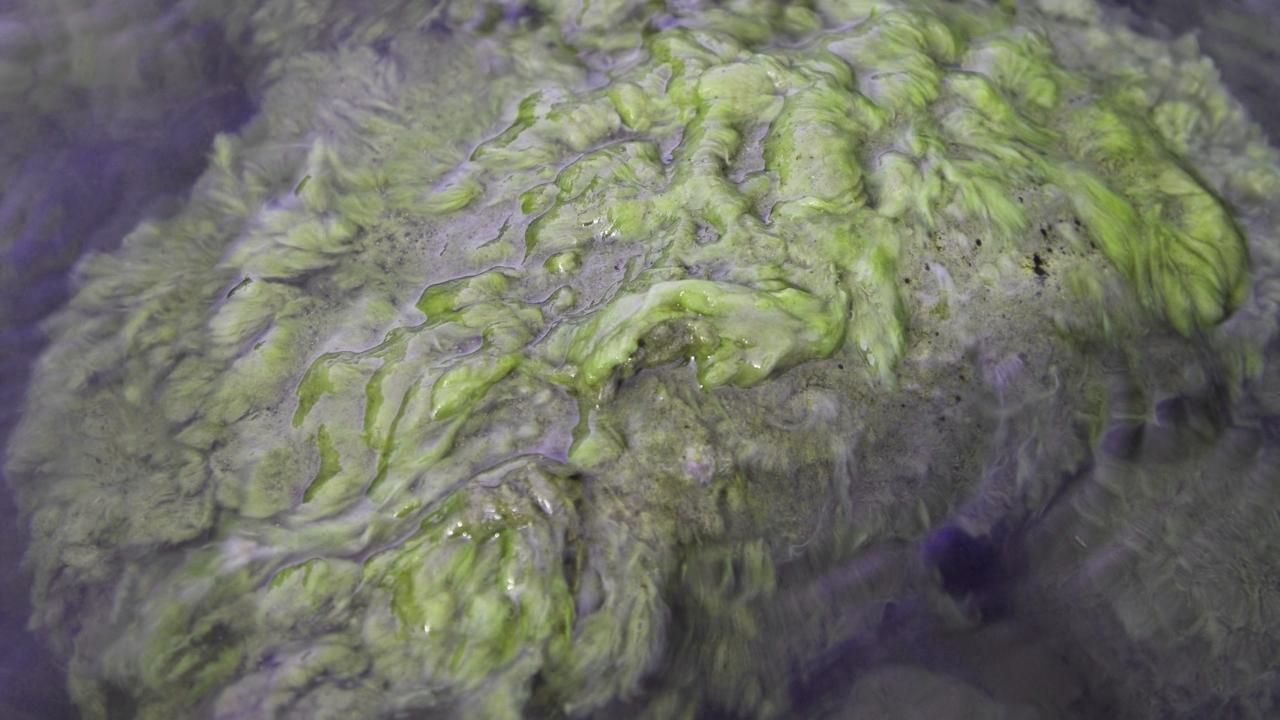
In recent decades, the diatom Didymosphenia geminata has emerged as nuisance species in river systems around the world. This periphytic alga forms large “blooms” in temperate streams, presenting a counterintuitive result: the blooms occur primarily in oligotrophic streams and rivers, where phosphorus (P) availability typically limits primary production. The goal of this study is to examine how high algal biomass is formed under low P conditions. We reveal a biogeochemical process by which D. geminata mats concentrate P from flowing waters. First, the mucopolysaccaride stalks of D. geminata adsorb both iron (Fe) and P. Second, enzymatic and bacterial processes interact with Fe to increase the biological availability of P. We propose that a positive feedback between total stalk biomass and high growth rate is created, which results in abundant P for cell division. The affinity of stalks for Fe in association with iron-phosphorus biogeochemistry suggest a resolution to the paradox of algal blooms in oliogotrophic streams and rivers.
And one study: http://www.ias.sdsmt.edu/staff/sundareshwar/Reprints/Sundare...
Abstract from the second paper:
In recent decades, the diatom Didymosphenia geminata has emerged as nuisance species in river systems around the world. This periphytic alga forms large “blooms” in temperate streams, presenting a counterintuitive result: the blooms occur primarily in oligotrophic streams and rivers, where phosphorus (P) availability typically limits primary production. The goal of this study is to examine how high algal biomass is formed under low P conditions. We reveal a biogeochemical process by which D. geminata mats concentrate P from flowing waters. First, the mucopolysaccaride stalks of D. geminata adsorb both iron (Fe) and P. Second, enzymatic and bacterial processes interact with Fe to increase the biological availability of P. We propose that a positive feedback between total stalk biomass and high growth rate is created, which results in abundant P for cell division. The affinity of stalks for Fe in association with iron-phosphorus biogeochemistry suggest a resolution to the paradox of algal blooms in oliogotrophic streams and rivers.
Thanks! Exactly what I was looking for.
This crap has been a PITA a for flyfishers for a while. Rock snot is an apt name for it because it is treacherous when you're wading. Personally, I prefer felt boots because they have better traction, but they're also an easy vector for didymo and it's just not responsible to use them anymore since I'm in multiple rivers. I ended up switching to rubber boots. Not nearly as nice to walk in, but far less likely to have didymo hitchhiking along when practicing proper river hygiene.
Didymo is edible btw, and Rob Rhinehart has talked about future Soylent ingredients being made by bio-engineered algae.
Where did you see / read that? That suggests an expansion in the turtle population. I haven't seen anything like that mentioned yet but would love to find it. I'm still on the lookout for a species that evolves into something which can only survive in an EPA superfund site so that cleaning up the site will cause the extinction of the new species. Just thinking about the Environmental Impact Statements on that possibility makes me chuckle.
Interesting article, but the images I'm getting are all extremely low quality. Tried both Chrome & FF.
EDIT: Well, downvotes or not, I'd still like to know what is going on. Here is a screenshot of part of my browser window while viewing the article.
https://imgur.com/IcEyM3R
I assume others are getting higher quality images (?).
EDIT: Well, downvotes or not, I'd still like to know what is going on. Here is a screenshot of part of my browser window while viewing the article.
https://imgur.com/IcEyM3R
I assume others are getting higher quality images (?).
It was fine for me, although the images were much delayed on loading, so there is some javascript acting there. Are you using noscript?
> Are you using noscript?
No. The only thing I explicitly block is flash. (Also, I don't recall having a problem like this before.)
No. The only thing I explicitly block is flash. (Also, I don't recall having a problem like this before.)
What url do you have for the bad images?
A good image url is: http://ichef.bbci.co.uk/wwfeatures/1280_720/images/live/p0/2...
A good image url is: http://ichef.bbci.co.uk/wwfeatures/1280_720/images/live/p0/2...
I get this: https://ichef.bbc.co.uk/wwfeatures/304_171/images/live/p0/27...
Probably this isn't worth a whole lot of work; I guess it thinks I'm on a phone (I'm not).

Probably this isn't worth a whole lot of work; I guess it thinks I'm on a phone (I'm not).
What's your user agent? Maybe you set it funny and forgot.
http://www.useragentstring.com/
http://www.useragentstring.com/
Are you using ghostery? I was seeing something similar until I allowed Brightcove to load through ghostery
Not using ghostery.
> I was seeing something similar ....
Well, then it isn't just me. Something about the BBC site's resolution handling is borked, I guess.
> I was seeing something similar ....
Well, then it isn't just me. Something about the BBC site's resolution handling is borked, I guess.
[deleted]
The Andromeda Strain
And then it will disappear, and the only person who will truly know what happened will be Fox Mulder.
The main takeaway from this interesting article is that we still need to do a lot more foundational science about microorganisms and their ecological relationships with various changes in the natural environment.