S.F. could get $11M a year when Airbnb collects hotel tax(sfgate.com)
sfgate.com
S.F. could get $11M a year when Airbnb collects hotel tax
http://www.sfgate.com/default/article/S-F-could-get-11-million-a-year-when-Airbnb-5762838.php
55 comments
This is new technology entering the market. Of course neither the startups nor the slow moving legal systems are well prepared to operate in sequence. Why be critical of either?
I don't expect existing laws to be instantly relevant to new industry. The typical approach of trying to hammer old regulation down a new hole is dangerous and non-productive to society.
There wouldn't be AirBnBs if we constantly crippled every new business with old regulation before we fully understood its worth and risks.
I don't expect existing laws to be instantly relevant to new industry. The typical approach of trying to hammer old regulation down a new hole is dangerous and non-productive to society.
There wouldn't be AirBnBs if we constantly crippled every new business with old regulation before we fully understood its worth and risks.
I don't see how anything has been adapted here. This isn't Uber getting some different deal versus existing taxi companies.
Airbnb always owed hotel tax, and now they are getting around to collecting it. They played the "oh, our users will pay taxes on their own" card, which obviously did not actually happen if this change is expected to increase SF revenue by $11mm a year.
Airbnb was also always subject to the residency laws of the places it operated in, but apparently didn't know that if you let someone book a place for 30 days in California they establish residency and cannot easily be gotten rid of. Despite that being sort of their entire business -- to be the knowledgable middleman that facilitates a housing rental between two parties that don't do this for a living.
Airbnb always owed hotel tax, and now they are getting around to collecting it. They played the "oh, our users will pay taxes on their own" card, which obviously did not actually happen if this change is expected to increase SF revenue by $11mm a year.
Airbnb was also always subject to the residency laws of the places it operated in, but apparently didn't know that if you let someone book a place for 30 days in California they establish residency and cannot easily be gotten rid of. Despite that being sort of their entire business -- to be the knowledgable middleman that facilitates a housing rental between two parties that don't do this for a living.
"This is new technology entering the market. Of course neither the startups nor the slow moving legal systems are well prepared to operate in sequence. Why be critical of either?"
I feel pretty comfortable being critical of the startup that's breaking the law, in this case. I mean, shouldn't there be a pretty strong presumption in favor of working within the law, even if it is "slow-moving" (heavens forfend! and perhaps it's good to have things like that move somewhat slowly)? A presumption that "but I want to make money now" doesn't quite overpower?
I feel pretty comfortable being critical of the startup that's breaking the law, in this case. I mean, shouldn't there be a pretty strong presumption in favor of working within the law, even if it is "slow-moving" (heavens forfend! and perhaps it's good to have things like that move somewhat slowly)? A presumption that "but I want to make money now" doesn't quite overpower?
That doesn't make sense. The technology is new. The laws aren't. Residency requirements and hotel licensing rules are something any small-town lawyer billing $150 an hour could educate a startup on.
Right but was the small-town lawyer prepared to work with hotels or the result of thousands of home-owners with an extra bedroom?
> This is new technology entering the market.
Just to be clear: we're talking about a 6 year old company, and new technology that entered the market 6 years ago.
At this point, it's worth asking: in your opinion, how long is a company permitted to break the law after introducing new technology?
Just to be clear: we're talking about a 6 year old company, and new technology that entered the market 6 years ago.
At this point, it's worth asking: in your opinion, how long is a company permitted to break the law after introducing new technology?
I didn't say it was new technology at the moment? I was talking about when it entered the market and started to grow...
At that time it was unclear whether or not the homeowners should have tax liability or AirBnB. And it's a global service, the tax law is different everywhere.
At that time it was unclear whether or not the homeowners should have tax liability or AirBnB. And it's a global service, the tax law is different everywhere.
> At that time it was unclear whether or not the homeowners should have tax liability or AirBnB.
And it takes 6 years to figure that out? Do you seriously believe their lawyers that incapable?
And it takes 6 years to figure that out? Do you seriously believe their lawyers that incapable?
Lawyers? You mean lawmakers. And yes, it almost always does take that long unless its politically popular. Which it typically isn't popular until startups employing the new technology reach scale and become wealthy. As we're witnessing now. Same with Uber. No one cared when they were blossoming.
Rational choice theory.
Rational choice theory.
Claiming ignorance or lack of clarity is not a fair statement, at this point in time. In early 2012, the San Francisco Tax Collector’s Office held public hearings, which AirBNB participated in and lobbied... those hearing decided that AirBnb needed to pay the tax, and AirBnb outright refused to comply with the law.
It has now been 2.5 years since that hearing.
And that isn't the only case.. in 2010 there was a NY case, where someone was sued and had to pay $100k+.
Any claim that AirBnb is unaware of their responsibilities under the law is no longer a fair or truthful statement of the situation.
Best case, they KNEW that they've been operating illegally for 2.5 years.
So back to my original question: in your opinion, how long is AirBnb immune from laws for graciously introducing new technology?
It has now been 2.5 years since that hearing.
And that isn't the only case.. in 2010 there was a NY case, where someone was sued and had to pay $100k+.
Any claim that AirBnb is unaware of their responsibilities under the law is no longer a fair or truthful statement of the situation.
Best case, they KNEW that they've been operating illegally for 2.5 years.
So back to my original question: in your opinion, how long is AirBnb immune from laws for graciously introducing new technology?
I'm not sure if I'm even debating you here regarding their current legal obligations? I was refuting the OPs comment claimed they got fat off of purposeful negligence of the law which is a false claim.
So yes In 2012, two years ago, did the state start caring about the business. Not the 4 years prior during growth, as the OP comment tried to paint the picture. They were a well established by 2012.
Civil lawsuits in 2010 have nothing to do with tax obligations. There is significant risk of running a business without proper insurance. These are lessons and failures new businesses learn. Whether you're a homeowner or an SV startup.
What happens if AirBnB becomes decentralized? The distribution of hotels rooms to homeowners is the new reality. It is now convenient that a big company like AirBnB is here to take the hit but the legal system is in no better shape to tax or better enforce property rights or deal with externalities, when hotels are no longer simply hotels. Which is why it's important to reevaluate laws instead of trying to hammer existing ones onto new markets and pretending its fixed.
So yes In 2012, two years ago, did the state start caring about the business. Not the 4 years prior during growth, as the OP comment tried to paint the picture. They were a well established by 2012.
Civil lawsuits in 2010 have nothing to do with tax obligations. There is significant risk of running a business without proper insurance. These are lessons and failures new businesses learn. Whether you're a homeowner or an SV startup.
What happens if AirBnB becomes decentralized? The distribution of hotels rooms to homeowners is the new reality. It is now convenient that a big company like AirBnB is here to take the hit but the legal system is in no better shape to tax or better enforce property rights or deal with externalities, when hotels are no longer simply hotels. Which is why it's important to reevaluate laws instead of trying to hammer existing ones onto new markets and pretending its fixed.
> I was refuting the OPs comment claimed they got fat off of purposeful negligence of the law which is a false claim.
It's not a false claim. Look, in July 2011, they closed a funding round that valued them at $1B. Today, it's $10B. You're saying 90% of their value is irrelevant to this debate.
It's not irrelevant, and neither is what they've been doing for the past 2.5 years.
It's is absolutely true that they've gotten fat off of purposely violating the law.
http://www.forbes.com/sites/nicoleperlroth/2011/07/24/its-of...
It's not a false claim. Look, in July 2011, they closed a funding round that valued them at $1B. Today, it's $10B. You're saying 90% of their value is irrelevant to this debate.
It's not irrelevant, and neither is what they've been doing for the past 2.5 years.
It's is absolutely true that they've gotten fat off of purposely violating the law.
http://www.forbes.com/sites/nicoleperlroth/2011/07/24/its-of...
Everyone here is claiming that the AirBnB is and was a hotel by definition of tax law... and this has always has been a fact. This is false. It has been very much up in the air. AirBnB operates globally in thousands of cities where they have no clear tax obligation. It still is in most places except SF. SF only made an official statement in 2012.
Even in SF - at this moment - it still hasn't been revealed whether or not they have any obligation to pay backtaxes.... as would be the case if they did indeed blatantly break the law.
Even the state hasn't fully confirmed the position on their past activity, yet you and the downvoting-because-I-disagree brigade knows better?
I miss the old HN :(
btw, your Forbes article only confirms my point that the lawmakers only cared about them after they got wealthy. They are slow moving and reactionary, period.
Even in SF - at this moment - it still hasn't been revealed whether or not they have any obligation to pay backtaxes.... as would be the case if they did indeed blatantly break the law.
Even the state hasn't fully confirmed the position on their past activity, yet you and the downvoting-because-I-disagree brigade knows better?
I miss the old HN :(
btw, your Forbes article only confirms my point that the lawmakers only cared about them after they got wealthy. They are slow moving and reactionary, period.
And it's hard to see how this is "new technology". For one thing, we already had vrbo and couchsurfing, didn't we? What's the new tech here? And who cares if it's new technology? Is new technology in itself good?
I look forward to the day when people stop regarding businesses which operate online as "technology businesses" just because they have a webpage or an app.
Then you have a poor understanding of what technology means. AirBnB wasn't simply a webpage.
Is it really new technology? VRBO has existed for how long? I remember one of the first web sites I made for money was a vacation rental listing website in the 90s, blinking gifs and all.
Your average tax accountant can talk you through all of this stuff without issue. The part that AirBnB differed on was aiming for big cities rather than mountains and beaches, and seeking out empty 2nd bedrooms rather than dedicated vacation rentals.
Your average tax accountant can talk you through all of this stuff without issue. The part that AirBnB differed on was aiming for big cities rather than mountains and beaches, and seeking out empty 2nd bedrooms rather than dedicated vacation rentals.
Landlords and city governments all across the country are getting wise to illegal sublets which is naturally contracting the supply of apartments from folks like myself. (I foolishly rented out my S.F. apt, got caught and politely asked to leave) Between the crack down and the coming tax wave, I think AirBnb for the single traveler becomes less attractive both on price and selection. I already see this happening in New York when I travel there. I'd rather stay in a hotel for the same price and less hassle. Certainly for a family or group Airbnb makes more sense. But I can't help thinking the AirBnb growth slows as it becomes more of a niche option.
...which is a really big deal, in a rent control area like SF or NY where breaking lease terms is one of the few ways to get forced out of your current per-month rent.
I was lucky in that I had already moved across country and was using AirBnb only to be able to cover the rent for the duration of the lease.
I imagine AirBnB will end up paying hotel tax in every locale. That will complicate their software a bit, but that's not overly burdensome. AirBnB actually wins in that it removes one of the most quantitative anti-AirBnB arguments. The other anti-AirBnB arguments are a lot more anecdotal (terrible renter destroyed our apartment building) and speculative (AirBnB increases rental property prices for everyone).
> speculative (AirBnB increases rental property prices for everyone)
Far from speculative - it's a rather straightforward result from the basic economic principles at play. And even if you hesitate to draw conclusions based on reasoning from first principles alone (which you should), there have been a few studies which have measured this effect empirically.
Keep in mind that the economic impact of hotels (both illegal and legal) on nearby rent has been well studied[0], so unless there is a reason to believe that Airbnb specifically is unique, the default assumption should be that they will have this effect too.
It's not a smoking gun, no, but it's far from speculative if both inductive and deductive reasoning support that conclusion.
[0] Especially zoning, which is a distinct but very related issue.
Far from speculative - it's a rather straightforward result from the basic economic principles at play. And even if you hesitate to draw conclusions based on reasoning from first principles alone (which you should), there have been a few studies which have measured this effect empirically.
Keep in mind that the economic impact of hotels (both illegal and legal) on nearby rent has been well studied[0], so unless there is a reason to believe that Airbnb specifically is unique, the default assumption should be that they will have this effect too.
It's not a smoking gun, no, but it's far from speculative if both inductive and deductive reasoning support that conclusion.
[0] Especially zoning, which is a distinct but very related issue.
Purely out of interest, do you have a link for any of these studies? It seems like an obvious economic conclusion, but I'd be interested in seeing to what extent.
Personally, no one in my building is subletting, but I did an airbnb search and was surprised by the number of apartments available in my area
Personally, no one in my building is subletting, but I did an airbnb search and was surprised by the number of apartments available in my area
I agree with you, I think AirBnB is bad for the rental market as a whole. I'm just saying it's hard to prove. I can make the argument but there hasn't been a study and there is an open question of how much it really impacts a market as large as NYC or SF.
I don't think it's fair that renting an apartment for a year is so much cheaper than renting it for one night. AirBnB closes the gap to its natural equilibrium level instead of the artificially high one created by zoning laws and hotel taxes.
Renting something for a longer term is usually cheaper because there is less overhead and risk. Renting a single day requires extra overhead in cleaning and advertising plus the risk of not having it rented. My guess would be nightly stays would need to be in the neighborhood of 150% of the monthly price to make it worthwhile, and possibly much higher if there is a low season.
Yes, of course, that's the natural spread that I was talking about. But that natural spread is not as large as the difference between a 12 month lease and a night in a hotel. That's what makes running an AirBnB profitable: undercutting the hotels and capturing some of that spread as income.
From the perspective of a landlord, if I have a good tenant, I'd rather rent for 2 years instead of 1 and will price lower accordingly. Vacancy rate is a key driver on ROI. Note that some commercial leases are as long as 10 years.
If the economy crashes and people stop vacationing, you won't be filling many nights in a hotel.
If the economy crashes and people stop vacationing, you won't be filling many nights in a hotel.
What do you think about places that give discounts if you sign a 12 month lease instead of six or one? That's not regulatory or artificial.
Increasing rental property prices due to market forces is a good thing, because the same market forces should result in more rental properties being constructed. Unless, of course, something is prevent the latter.
Lack of demand for rental property construction is assuredly not the problem.
Just a point:
Could AirBnB not lobby for something like a tax break on hotels with excessive vacancy, and then utilize the fact that the rooms are always available but often sparsely rented (and if this is not true, get a ton of signups that are horrible via blackhatcheatery and make it look that way anyways)? They could just get a huge tax break that still considers them a hotel but abuses the 'normal' understanding of the hotel business model that they are disrupting.
Not saying anyone should ever do it. Moreso just food for thought. Do they pull an Uber and look at the law, then flagrantly laugh, or play a cold calculated game as this gets bigger and their valuation climbs?
Not saying anyone should ever do it. Moreso just food for thought. Do they pull an Uber and look at the law, then flagrantly laugh, or play a cold calculated game as this gets bigger and their valuation climbs?
Am I the only one who doesn't think $11M is really going to move the needle for SF OR AirBnB?
I would imagine that a 14% price increase to the end user will absolutely move the needle. That's massive.
You don't collect revenue * tax when you introduce a tax. The artificially increased price pushes down the demand and will likely force suppliers off the market, lowering revenue overall.
I could draw the supply and demand curve, but it's pretty straightforward.
I could draw the supply and demand curve, but it's pretty straightforward.
I would guess they won't see anywhere close to $11M. People will simply start listing on Craiglist or other forums and avoid the whole AirBnB hassle.
Corporations get taxed ~15% + 14% hotel tax.
Individuals get taxed ~30% already on their Airbnb income (plus Airbnb charges the guest 6%-12% and the host 3%).
If they're going to charge 14% hotel tax to people renting out rooms on Airbnb, wouldn't it be more fair to tax that income at the corporate rate instead of the individual rate?
(Yes, I understand the taxes go to different places in each scenario. But from the "take home" perspective of the person/entity doing all the work here, hosts on Airbnb are already having their transaction taxed significantly more than any hotel chain).
If they're going to charge 14% hotel tax to people renting out rooms on Airbnb, wouldn't it be more fair to tax that income at the corporate rate instead of the individual rate?
(Yes, I understand the taxes go to different places in each scenario. But from the "take home" perspective of the person/entity doing all the work here, hosts on Airbnb are already having their transaction taxed significantly more than any hotel chain).
> Corporations get taxed ~15% + 14% hotel tax. Individuals
> get taxed ~30% already on their Airbnb income
Greatly simplifying things:
(Big) corporations in the US get taxed 15%, and then when they pay dividends to shareholders, that gets taxed again as income for the individual.
In fact many small businesses are incorporated in such a way that they skip the 15% tax rate and pay taxes on all of their income at the individual owner's tax rate.
Greatly simplifying things:
(Big) corporations in the US get taxed 15%, and then when they pay dividends to shareholders, that gets taxed again as income for the individual.
In fact many small businesses are incorporated in such a way that they skip the 15% tax rate and pay taxes on all of their income at the individual owner's tax rate.
[deleted]
And the best part (for AirBnB) is that it doesn't affect their profitability at all -- the money comes right out of the pockets of the renters and owners.
Basic economics, AirBnB suffers too: http://i.investopedia.com/inv/articles/site/micro3.7.gif
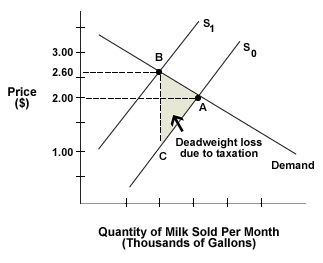
Yes, but how much depends on how elastic supply is, which is always an important consideration with real estate.
http://peakwatch.typepad.com/photos/research_images/fixed_su...
http://peakwatch.typepad.com/photos/research_images/fixed_su...

Given the existence of hotels and craigslist, I'd say extremely elastic.
That's not really how tax incidence works, though. Effects of the tax will be felt by all three at some level.
Umm -- "profitability" (per sale) perhaps not, but sales volume most definitely.
[deleted]
[deleted]
to be honest there needs to be a threshold that renters have to pass before they qualify as a hotel for tax purposes. does a straight rental require a hotel tax payment or other onerous tax? Do they have to obtain a business license before they are truly liable to pay the tax? I am not clear on the idea that AirBnB can pay a tax on behalf of the home owner / property owner. How is this law worded?
Can those paying hotel taxes charge off wear and tear, capital expenses as a hotel could? It seems as this only benefits the taxing authority and not much else.
Can those paying hotel taxes charge off wear and tear, capital expenses as a hotel could? It seems as this only benefits the taxing authority and not much else.
[deleted](1)
I guess the lesson for startups is to break the law until you get big enough until the hit from abiding by the law becomes inconsequential, and make sure to salt the earth behind you so that your competitors can't follow your path to success.