Dismantling Fukushima: The World's Toughest Demolition Project(spectrum.ieee.org)
spectrum.ieee.org
Dismantling Fukushima: The World's Toughest Demolition Project
http://spectrum.ieee.org/energy/nuclear/dismantling-fukushima-the-worlds-toughest-demolition-project
54 comments
“At Fukushima you have wrecked infrastructure, three melted cores, and you have some core on the floor, ex-vessel,” Barrett says. Nothing like Fukushima, he declares, has ever happened before.
I distinctly remember the HN conversation at the time. The pro-nuclear crowd was arguing, as it was happening, that this could never occur. The cores would never breach the containment vessels, they said. Guess you folks got that one wrong.
I bring this up only because a lot of pro-nuclear arguments comes down to bold assertions from experts that certain things could never happen. Yet, here we are. A big helping of modesty seems like a good thing in this field.
I distinctly remember the HN conversation at the time. The pro-nuclear crowd was arguing, as it was happening, that this could never occur. The cores would never breach the containment vessels, they said. Guess you folks got that one wrong.
I bring this up only because a lot of pro-nuclear arguments comes down to bold assertions from experts that certain things could never happen. Yet, here we are. A big helping of modesty seems like a good thing in this field.
> The pro-nuclear crowd was arguing, as it was happening, that this could never occur. The cores would never breach the containment vessels, they said.
As mentioned in the other comment, the cores breached the reactor vessels, which is what didn't happen at TMI.
On the other hand, that did happen at Chernobyl (and explosively, to boot), so I'm not sure why people would be arguing that it's impossible or that it has never happened before. Unless possibly they mean that such a thing had never happened at a Western-style BWR or PWR reactor, which is at least closer to the truth.
But either way, this is all part of the problem with these debates. Pro-nuclear advocates generally say stuff which is true in a very precise, jargonistic way, which then gets either immediately mis-interpreted, or mis-interpreted 3 years later in a way which makes them out to be liars.
It would be like a computer hacker saying that it's impossible to get a security vulnerability from buffer overflow if you use a language that always manages memory, and then that managed language suffers a vuln from memory corruption instead. Laymen three years later would only remember "impossible to get security vulnerability from managed memory"...
As mentioned in the other comment, the cores breached the reactor vessels, which is what didn't happen at TMI.
On the other hand, that did happen at Chernobyl (and explosively, to boot), so I'm not sure why people would be arguing that it's impossible or that it has never happened before. Unless possibly they mean that such a thing had never happened at a Western-style BWR or PWR reactor, which is at least closer to the truth.
But either way, this is all part of the problem with these debates. Pro-nuclear advocates generally say stuff which is true in a very precise, jargonistic way, which then gets either immediately mis-interpreted, or mis-interpreted 3 years later in a way which makes them out to be liars.
It would be like a computer hacker saying that it's impossible to get a security vulnerability from buffer overflow if you use a language that always manages memory, and then that managed language suffers a vuln from memory corruption instead. Laymen three years later would only remember "impossible to get security vulnerability from managed memory"...
"It would be like a computer hacker saying that it's impossible to get a security vulnerability from buffer overflow if you use a language that always manages memory, and then that managed language suffers a vuln from memory corruption instead. Laymen three years later would only remember "impossible to get security vulnerability from managed memory"..."
Ehh. The flip side of this is that most of the "experts" use this kind of language to hide their uncertainties, while also overplaying their hand. It wouldn't be unreasonable for the layman to remember the phrase "impossible to get a security vulnerability from managed memory", because that's the strongest part of the statement -- the part of the statement that's intended to sell a technology. People don't remember the long strings of caveats that come later, nor should they.
My point still stands: we aren't very good at predicting failure cases, so it doesn't serve us well to focus on the caveats of a statement that begins with "this can never happen". Any statement that begins with an absolute like that is almost assuredly incorrect.
Ehh. The flip side of this is that most of the "experts" use this kind of language to hide their uncertainties, while also overplaying their hand. It wouldn't be unreasonable for the layman to remember the phrase "impossible to get a security vulnerability from managed memory", because that's the strongest part of the statement -- the part of the statement that's intended to sell a technology. People don't remember the long strings of caveats that come later, nor should they.
My point still stands: we aren't very good at predicting failure cases, so it doesn't serve us well to focus on the caveats of a statement that begins with "this can never happen". Any statement that begins with an absolute like that is almost assuredly incorrect.
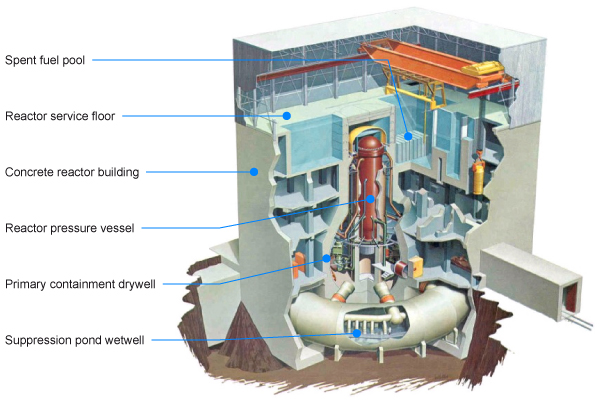
He's talking about the pressure vessels there.
The previous sentence is "At Three Mile Island the buildings were intact, and the one melted nuclear core remained inside its pressure vessel."
The containment is outside of that:
http://www.world-nuclear.org/info/Safety-and-Security/Safety...
specifically:
http://www.world-nuclear.org/uploadedImages/org/info/BWR%203...
As I understand it, a lot of the environmental contamination was carried out by the cooling water they were injecting.
The previous sentence is "At Three Mile Island the buildings were intact, and the one melted nuclear core remained inside its pressure vessel."
The containment is outside of that:
http://www.world-nuclear.org/info/Safety-and-Security/Safety...
specifically:
http://www.world-nuclear.org/uploadedImages/org/info/BWR%203...
As I understand it, a lot of the environmental contamination was carried out by the cooling water they were injecting.
From what I was following at the time, it was looking very much like containment in one of the reactors was lost (I generally assumed from earthquake damage). This may not be all the contamination or even most of it. As the crisis unfolded you had a huge number of really big problems arise.
The thing to remember is that a massive earthquake caused this crisis. When you are dealing with seismic activity on that scale, ensuring that structures remain intact requires making assumptions which just are not readily testable.
The thing to remember is that a massive earthquake caused this crisis. When you are dealing with seismic activity on that scale, ensuring that structures remain intact requires making assumptions which just are not readily testable.
There were loud reports of them venting steam from the containment into the atmosphere, so yes, they lost containment. As I understand it, none of the fuel is exposed directly to the environment, the problems have all been with the cooling water (which is still a big deal, but at least there is more hope of improving that situation than if the fuel had somehow dispersed).
Also the reports of the cracks in the containment structure would allow coolant water to leak out.
To be fair, a lot of the rhetoric from both sides tends to be extreme. The other side of the argument is that this is clear proof we must never use nuclear energy for anything ever again, and instead continue burning our limitless supply of fossil fuels.
I think the reality is: we need to make nuclear energy didn't work. TEPCO could't do it. Hopefully someone else can.
I think the reality is: we need to make nuclear energy didn't work. TEPCO could't do it. Hopefully someone else can.
I do think that what Fukushima shows is that when you have a nuclear power plant, you have the possibility of really big problems caused by natural disasters well above what you planned for. The questions are what you can plan for and what you do plan for?
Ideally we'd put nuclear reactors way away from all natural disasters, and design them to withstand magnitude 10 earthquakes, F-5 tornadoes, Category 5 hurricanes, and, say, bombing by massive conventional munitions during wartime. And we'd have perfect, guaranteed safe forever storage of waste. Practically, it isn't clear that this is possible.
I think the reality is: we need to make nuclear energy didn't work. TEPCO could't do it. Hopefully someone else can.
The question is, do we want these things to work until they don't? Or do we want them to be guaranteed to work no matter what happens? I am not sure the latter is possible.
Ideally we'd put nuclear reactors way away from all natural disasters, and design them to withstand magnitude 10 earthquakes, F-5 tornadoes, Category 5 hurricanes, and, say, bombing by massive conventional munitions during wartime. And we'd have perfect, guaranteed safe forever storage of waste. Practically, it isn't clear that this is possible.
I think the reality is: we need to make nuclear energy didn't work. TEPCO could't do it. Hopefully someone else can.
The question is, do we want these things to work until they don't? Or do we want them to be guaranteed to work no matter what happens? I am not sure the latter is possible.
[deleted]
The other side of the argument is that this is clear proof we must never use nuclear energy for anything ever again, and instead continue burning our limitless supply of fossil fuels.
Well, that's a false dichotomy and representation right there.
It's possible to believe both that nuclear power isn't desirable and that fossil fuels are limited. Which from my experience a fair number of those opposed to nuclear do in fact believe.
Which rather undercuts your own credibility.
Well, that's a false dichotomy and representation right there.
It's possible to believe both that nuclear power isn't desirable and that fossil fuels are limited. Which from my experience a fair number of those opposed to nuclear do in fact believe.
Which rather undercuts your own credibility.
The idea that the most strident and extreme argument is a valid summation of an entire position is a very common form of straw man. Just because someone said it (even if that someone was famous, even if what was said got a lot of coverage) doesn't not make it the strongest argument for that position. And as with all straw men refuting one argument for a position hardly classifies as refuting the position entirely.
I'm not attempting to "refute" all pro-nuclear arguments. I'm just pointing out that we're not very good at predicting what might go wrong, so it's good to be modest about our reach.
(But yes, let's talk about straw-man arguments.)
(But yes, let's talk about straw-man arguments.)
From what I remember reading those comments at the time, I think a lot pertained to the differences between the older reactors and newer facilities? Fukushima started up 42 years ago. I'd hope that our methods and safeguards have improved in four decades!
How much real-life testing do those newer designs have in conditions similar to what happened at Fukushima?
> I bring this up only because a lot of pro-nuclear arguments comes down to bold assertions from experts that certain things could never happen.
Heinlein said (in Glory Road, I believe), that "Everything is theoretically impossible, until it is done. One could write a history of science in reverse by assembling the solemn pronouncements of highest authority about what could not be done and could never happen."
It seems to me that this is a double-edged sword -- not only can people accomplish things that experts claimed were "impossible," but things can happen that experts claim are "impossible."
Most people are limited by our own views of the impossible and never change their views until proven wrong. Some never do change their views.
Heinlein said (in Glory Road, I believe), that "Everything is theoretically impossible, until it is done. One could write a history of science in reverse by assembling the solemn pronouncements of highest authority about what could not be done and could never happen."
It seems to me that this is a double-edged sword -- not only can people accomplish things that experts claimed were "impossible," but things can happen that experts claim are "impossible."
Most people are limited by our own views of the impossible and never change their views until proven wrong. Some never do change their views.
Interestingly, Americans have a living President with hands-on experience demolishing a destroyed nuclear reactor. Jimmy Carter helped dismantle a Canadian reactor at Chalk River during his time as a Navy nuclear submariner.
Interestingly, his former boss, US Navy Rear Admiral Hyman Rickover, who pretty much created nuclear power as a thing, expressed severe regrets and reservations at having relied on nuclear power for the navy and in its use for civilian power generation:
"I do not believe that nuclear power is worth it if it creates radiation. Then you might ask me why do I have nuclear powered ships. That is a necessary evil. I would sink them all. I am not proud of the part I played in it. I did it because it was necessary for the safety of this country. That's why I am such a great exponent of stopping this whole nonsense of war. Unfortunately limits — attempts to limit war have always failed. The lesson of history is when a war starts every nation will ultimately use whatever weapon it has available.... Every time you produce radiation, you produce something that has a certain half-life, in some cases for billions of years. I think the human race is going to wreck itself, and it is important that we get control of this horrible force and try to eliminate it."
Economics of Defense Policy: Hearing before the Joint Economic Committee, Congress of the United States, 97th Cong., 2nd sess., Pt. 1 (1982), via Wikipedia
https://en.wikipedia.org/wiki/Hyman_G._Rickover#Willingness_...
"I do not believe that nuclear power is worth it if it creates radiation. Then you might ask me why do I have nuclear powered ships. That is a necessary evil. I would sink them all. I am not proud of the part I played in it. I did it because it was necessary for the safety of this country. That's why I am such a great exponent of stopping this whole nonsense of war. Unfortunately limits — attempts to limit war have always failed. The lesson of history is when a war starts every nation will ultimately use whatever weapon it has available.... Every time you produce radiation, you produce something that has a certain half-life, in some cases for billions of years. I think the human race is going to wreck itself, and it is important that we get control of this horrible force and try to eliminate it."
Economics of Defense Policy: Hearing before the Joint Economic Committee, Congress of the United States, 97th Cong., 2nd sess., Pt. 1 (1982), via Wikipedia
https://en.wikipedia.org/wiki/Hyman_G._Rickover#Willingness_...
I think you have to understand nuclear powered ships in the context of WWII history.
The critical loss for the Japanese navy was at Leyte Gulf, which was the largest naval battle in the Pacific during the war (and possibly the largest naval battle in history). The significance of the battle was that the Americans secured Phillipine Sea against Japanese shipping and this cut the Japanese off from the oil fields in Indonesia in terms of transporting oil back home. it was only after Leyte Gulf that organized kamikaze attacks began, and the Navy was largely put out of the war by that battle.
What that means is that Japan lost WWII when they lost access to oil. So the issue with naval ships is diesel or nuclear. About 1/3 of the US navy is nuclear-powered. The rest runs on diesel. Thats enough our navy (but not our air force, army etc) can continue to run if oil is not available for a time. Our military is still very dependent on oil but not like the Japanese were.
The critical loss for the Japanese navy was at Leyte Gulf, which was the largest naval battle in the Pacific during the war (and possibly the largest naval battle in history). The significance of the battle was that the Americans secured Phillipine Sea against Japanese shipping and this cut the Japanese off from the oil fields in Indonesia in terms of transporting oil back home. it was only after Leyte Gulf that organized kamikaze attacks began, and the Navy was largely put out of the war by that battle.
What that means is that Japan lost WWII when they lost access to oil. So the issue with naval ships is diesel or nuclear. About 1/3 of the US navy is nuclear-powered. The rest runs on diesel. Thats enough our navy (but not our air force, army etc) can continue to run if oil is not available for a time. Our military is still very dependent on oil but not like the Japanese were.
I'm well aware of this history, as well as the earlier transitions of the US fleet from wind to coal (under Admiral Perry) and the British fleet from coal to oil immediately prior to WWI under Churchill. Naval energy needs have driven several fuel transitions, and there's a considerable amount of interesting work that continues to come from the US and other navies.
If you'll read further into Rickover's remarks, he makes clear that he pursued nukes because he felt it was essential to national security. But if there had been an alternative he'd have avoided it. Possibly not even, given the benefit of hindsight.
Your 1/3 of the US naval fleet being nuclear powered doesn't jibe with stats I can find. Nuclear propulsion is presently limited to aircraft carriers (10) and submarines (82 total), or 21%. A number of cruiser and destroyer nuclear ships were commissioned but all have been decommissioned to the best of my knowledge. Wikipedia cites a total of 80 nuclear powered ships operated by the US navy, since 1954, and 430 ships presently active, on reserve, or under construction. If you limit your concern to commissioned ships, then you'd have 33% nuclear propulsion.
https://en.wikipedia.org/wiki/List_of_current_ships_of_the_U...
As for oil: with most effective naval power being projected via aircraft, the reliance on oil remains rather high. Yes, the US would be able to launch nukes or float a flattop off someones shores (given them opportunity for target practice), but if you want to launch aircraft ... somewhere other than into the drink ... you've got to top them off every so often.
If you'll read further into Rickover's remarks, he makes clear that he pursued nukes because he felt it was essential to national security. But if there had been an alternative he'd have avoided it. Possibly not even, given the benefit of hindsight.
Your 1/3 of the US naval fleet being nuclear powered doesn't jibe with stats I can find. Nuclear propulsion is presently limited to aircraft carriers (10) and submarines (82 total), or 21%. A number of cruiser and destroyer nuclear ships were commissioned but all have been decommissioned to the best of my knowledge. Wikipedia cites a total of 80 nuclear powered ships operated by the US navy, since 1954, and 430 ships presently active, on reserve, or under construction. If you limit your concern to commissioned ships, then you'd have 33% nuclear propulsion.
https://en.wikipedia.org/wiki/List_of_current_ships_of_the_U...
As for oil: with most effective naval power being projected via aircraft, the reliance on oil remains rather high. Yes, the US would be able to launch nukes or float a flattop off someones shores (given them opportunity for target practice), but if you want to launch aircraft ... somewhere other than into the drink ... you've got to top them off every so often.
Yes, those most familiar with war are usually the ones most interested in stopping it. Only the sociopaths in the military go to war hoping for there to be another one they can participate in.
And so Adm. Rickover's message: 'I couldn't stop war – what I could do is make it less destructive to us, so I did, grudgingly.'
So it is with civilian power. Nuclear power proponents don't say that nuclear should be used at the exclusion of all other sources of power. They say it should be used to the exclusion of worse sources of power.
You could paraphrase Rickover's entire excerpt here for coal, and oil, and even gas generation; all of which produce horrible things that will wreck the human race (via climate change).
On that beautiful day when it's actually achievable to power the whole world by renewable energy and energy storage that doesn't involve widespread chemical waste and destruction of entire areas then you'll find nuclear power advocates telling Congress to "sink them all" too.
In the meantime, we generate electrical power with the means we have available, not the means we thought we'd have, or wished we'd have.
And so Adm. Rickover's message: 'I couldn't stop war – what I could do is make it less destructive to us, so I did, grudgingly.'
So it is with civilian power. Nuclear power proponents don't say that nuclear should be used at the exclusion of all other sources of power. They say it should be used to the exclusion of worse sources of power.
You could paraphrase Rickover's entire excerpt here for coal, and oil, and even gas generation; all of which produce horrible things that will wreck the human race (via climate change).
On that beautiful day when it's actually achievable to power the whole world by renewable energy and energy storage that doesn't involve widespread chemical waste and destruction of entire areas then you'll find nuclear power advocates telling Congress to "sink them all" too.
In the meantime, we generate electrical power with the means we have available, not the means we thought we'd have, or wished we'd have.
climate change
In fairness to Rickover, though atmospheric greenhouse warming from human CO2 emissions was known in his time (the first published account of it I'm aware of came from the US Naval Research Lab in 1932, the tie between CO2 and greenhouse effects goes back further), I'm not aware of it being a significant general concern until the mid 1980s or so. Then again, Rickover was well aware of peak oil in the 1950s and could very well have been aware of the greenhouse gas / global warming issue, though I can't find any evidence of this.
Some prefer to describe the situation concerning energy and sustainability not as a "problem" (to which there is a solution), but a "predicament", to which there is an outcome, though not one which returns the system to the status quo ante.
In fairness to Rickover, though atmospheric greenhouse warming from human CO2 emissions was known in his time (the first published account of it I'm aware of came from the US Naval Research Lab in 1932, the tie between CO2 and greenhouse effects goes back further), I'm not aware of it being a significant general concern until the mid 1980s or so. Then again, Rickover was well aware of peak oil in the 1950s and could very well have been aware of the greenhouse gas / global warming issue, though I can't find any evidence of this.
Some prefer to describe the situation concerning energy and sustainability not as a "problem" (to which there is a solution), but a "predicament", to which there is an outcome, though not one which returns the system to the status quo ante.
> Some prefer to describe the situation concerning energy and sustainability not as a "problem" (to which there is a solution), but a "predicament", to which there is an outcome, though not one which returns the system to the status quo ante.
Well you could probably count me in that camp. There's no perfect answer (though the various forms of solar are pretty close at least as far as energy generation goes). Instead there's a suite of options to get us to "least bad".
Well you could probably count me in that camp. There's no perfect answer (though the various forms of solar are pretty close at least as far as energy generation goes). Instead there's a suite of options to get us to "least bad".
There's a sizable contingent which feels that high-tech (e.g., electric generating) solar, wind, etc., aren't generally viable.
I suspect that long-term, the amount of energy available via renewables will likely be a minority fraction of what's presently consumed in the US, on either a per-capita or absolute level. Which suggests a future in which we're looking at, say, 25 quads (1 billion joules / 300 TWh) or less total annual energy. What that suggests in terms of energy-based services and goods available becomes an interesting exercise.
I suspect that long-term, the amount of energy available via renewables will likely be a minority fraction of what's presently consumed in the US, on either a per-capita or absolute level. Which suggests a future in which we're looking at, say, 25 quads (1 billion joules / 300 TWh) or less total annual energy. What that suggests in terms of energy-based services and goods available becomes an interesting exercise.
We can all only hope that now goes everything according to plans.
I fear, a second Tsunami in the region would be a second (maybe bigger) disaster and free even more radioactive material.
They still have enough problems. There is for example the trouble with huge quantities of radioactive water -- that is anything else than solved.
I fear, a second Tsunami in the region would be a second (maybe bigger) disaster and free even more radioactive material.
They still have enough problems. There is for example the trouble with huge quantities of radioactive water -- that is anything else than solved.
This rises a question in me: What did we do for Chernobyl? It was decades ago, so most of this technology didn't exists yet. Or it was not nearly as bad as Fukushima?
Basically, we just covered Chernobyl with concrete and left it alone. As long as nobody goes near it, it's not doing any harm.
According to the article, for political reasons, Japan wants to dismantle Fukushima, instead of simply neutralizing it, covering it up with concrete, and walling it off for a few decades before the cleanup happens. This is where the challenge comes from.
According to the article, for political reasons, Japan wants to dismantle Fukushima, instead of simply neutralizing it, covering it up with concrete, and walling it off for a few decades before the cleanup happens. This is where the challenge comes from.
Regardless of their plans, they still need to handle the leaking groundwater, which AFAIK wasn't a big problem at Chernobyl.
Chernobyl definitely had concerns with groundwater contamination. There were significant amounts of strontium within the exclusion zone, and the core had melted down into the earth, although I don't think it reached the water table. However, from everything I can find, the migration through the soil tended to be extremely slow, making it a fairly local phenomenon. In the end, cleanup efforts were abandoned since they had low impact on human health or radioactivity outside of the exclusion zone, and were worse for the environment than simply leaving things.
Unfortunately, I no longer have access to the journal subscriptions, so I don't have the full text of this, but I think this is the paper you want to read for an overview: http://onlinelibrary.wiley.com/doi/10.1029/96WR03963/abstrac...
The conditions are very different at Fukushima, mainly due to the proximity to the ocean, so I can't really give an educated summary of the challenges with that. One thing that you have to keep in mind, though, is that water is an excellent radiation absorber, and it's actually safe to go diving in active reactor pools as long as you're more than a couple of meters away from the core. I'd expect that the radiation in the ocean would disperse quickly and harmlessly.
https://what-if.xkcd.com/29/
Unfortunately, I no longer have access to the journal subscriptions, so I don't have the full text of this, but I think this is the paper you want to read for an overview: http://onlinelibrary.wiley.com/doi/10.1029/96WR03963/abstrac...
The conditions are very different at Fukushima, mainly due to the proximity to the ocean, so I can't really give an educated summary of the challenges with that. One thing that you have to keep in mind, though, is that water is an excellent radiation absorber, and it's actually safe to go diving in active reactor pools as long as you're more than a couple of meters away from the core. I'd expect that the radiation in the ocean would disperse quickly and harmlessly.
https://what-if.xkcd.com/29/
Also, the region around Chernobyl isn't exactly known for the frequency of major natural disasters like earthquakes, tsunami, and typhoons.
It's not easy to entomb the cores, since they have melted into the earth, and it is too radioactive for people or robots to go near.
http://en.m.wikipedia.org/wiki/Chernobyl_Nuclear_Power_Plant...
The accident itself was worse and spread more radioactive material (the core exploded, the graphite ignited and spread a huge plume of smoke). But the cleanup effort if Fukushima will probably be worse because they are dealing with three reactors that still need cooling, leaking water etc.
The accident itself was worse and spread more radioactive material (the core exploded, the graphite ignited and spread a huge plume of smoke). But the cleanup effort if Fukushima will probably be worse because they are dealing with three reactors that still need cooling, leaking water etc.
The two incidents are completely different: Chernobyl's reactor exploded (iirc, the graphite moderator caught fire); Fukushima melted down, which is essentially when the fuel gets so hot (due to lack of cooling, which the Tsunami took out) that it melts through the bottom of the reactor containment vessel.
The core in Chernobyl melted down into the basement as well, fortunately it stopped there.
Yes, but it seems to me, that the risk of further melt downs in Chernobyl is much lower and the core is more divided -- so the situation is stable without cooling. In Fukushima, the cores still have to be cooled, what makes the thing troublesome. You can't just bury a core that has to be cooled ....
As much I remember, in Chernobyl the core stopped before it reached the ground water, because they digged below the core and made it stop -- risking and probably sacrificing further lives.
As much I remember, in Chernobyl the core stopped before it reached the ground water, because they digged below the core and made it stop -- risking and probably sacrificing further lives.
Chernobyl was much worse than Fukushima, for a lot of reasons. The reactor got away from the Soviets in a way the reactors never got away from the Japanese, though admittedly it was touch and go for a bit.
Decades from now the cores will have been safely removed from the Fukushima reactors, the reactor vessels cut up and all of it will be safely stored in a nuclear waste dump.
Chernobyl won't be in noticeably better shape than it is today. It will still be a concrete lid over a still-active meltdown.
Decades from now the cores will have been safely removed from the Fukushima reactors, the reactor vessels cut up and all of it will be safely stored in a nuclear waste dump.
Chernobyl won't be in noticeably better shape than it is today. It will still be a concrete lid over a still-active meltdown.
They erected a half-assed containment structure around the area and evacuated a huge exclusion zone around Chernobyl. For the record, it was much worse than Fukushima.
I remember "older" // "elderly" Japanese folks volunteering themselves as available to help deal with Fukushima, along the lines of "What to I care of radiation, I'm old and have already had children? I want to still contribute, call me up". I wonder about this as a source of labor for demolition.
Chance of cancer and/or sterility isn't the limit of the problem. Acute radiation sickness would put a damper on their enthusiasm real quick.
Until you have this jumbled mess of radioactive debris thoroughly mapped, you don't want to send anyone in there, and once you do, there are going to be a lot of places they just can't go. Cleanup workers lying on the ground vomiting their guts out aren't helping anyone.
Until you have this jumbled mess of radioactive debris thoroughly mapped, you don't want to send anyone in there, and once you do, there are going to be a lot of places they just can't go. Cleanup workers lying on the ground vomiting their guts out aren't helping anyone.
I also don't think that the situation is grave enough to sacrifice human health, yet. Certainly, if one person could sacrifice themselves to save 100,000,000 from certain doom, then it's an easy calculation. (Not me or my family, though, please.) The current situation is more like "this is expensive to keep cool". No need to kill anyone else.
>I also don't think that the situation is grave enough to sacrifice human health, yet.
Yet? The odds it ever will be are infinitesimal.
Yet? The odds it ever will be are infinitesimal.
There are nuclear engineers, doctors, highly trained technicians, government agencies and regulatory bodies who handle cleaning up nuclear accidents. Untrained elderly people would not help at all.
Remember the tsunami killed 20,000 people that day and Fukushima never killed anyone. Might be some cancers years down the road but the idea of sacrificing the elderly to save the world from some nuclear disaster belongs in a comic book, not reality.
Remember the tsunami killed 20,000 people that day and Fukushima never killed anyone. Might be some cancers years down the road but the idea of sacrificing the elderly to save the world from some nuclear disaster belongs in a comic book, not reality.
This is the most interesting fukushima news I've heard in a while http://www.youtube.com/watch?v=EOtxx7zpyz0&list=WL8CB60B177D...
In her FAQ, she confuses a unit and overstates things 1000x (literally, 1000x). It's people scaring themselves with the numbers they get from magic boxes, not news.
This is mostly just quackery and non-science, they keep repeating the same old stuff that the government is keeping us in the dark, and that the health effects of Fukushima is far greater than it actually is.
If you're going to drop a naked link to a poorly-edited 1h38m23s video involving a really crappy VOIP connection, you might want to provide some level of context as to who it is, why it's worth watching, and where, specifically, to pay attention.
[deleted]
The timeline also can't foresee issues of mistakes in the remediation process, which seem to be likely given that no country has fixed a problem like this and the material inside a melted core is a big unknown and probably can't be worked on directly by human beings. Step 5 in that illustration on how to take apart a melted reactor states "drill down to break the melted fuel into chunks, pack it into casks, cart it away and you're done!" I mean that almost feels tongue in cheek. The chances for serious casualties and tremendous radiation releases exist in each attempt to drill into a reactor containment and there's 4 damaged reactors at this time. The project risk, unknown variables and the scope of proposed solutions leaves me wondering can they truly put a price tag on the work at such an early stage. It's absurd to think that I may not see Chernobyl or Fukushima's remediation happen in my lifetime.