Why Are Southerners So Fat?(time.com)
time.com
Why Are Southerners So Fat?
http://www.time.com/time/health/article/0,8599,1909406,00.html
13 comments
Education is not the problem. I live in Mississippi, and can attest that we are bombarded daily with messages about obesity, diet, and exercise.
I am as educated as anyone on the mainstream teaching on this subject, yet I am clinically obese (though not for much longer).
I was poor as a child, so I think I can speak to this subject a little. It's anecdotal, but when accompanied by what I have learned from different sources (in particular, Good Calories, Bad Calories by Gary Taubes), I suspect that my experience was typical.
Poor people eat an unhealthy diet because they cannot afford high quality protein and complex carbohydrates on a consistent basis. Further, parents in poor families often work excessive hours, and quick meals become the norm due to the lack of time.
This leads to an excessive consumption of refined carbohydrates, creating an insulin imbalance that increases hunger. One of the worst offenders in this category is soft drinks. White bread is another big problem. A coke and a peanut butter and jelly sandwich was a common meal around my house.
Sweet tea is another big offender. I have rarely seen sweet tea outside of the southeast, and almost everyone drinks it here. If you order tea in a restaurant, you are getting sweet tea unless you specifically request unsweetened.
Surely this enviroment is bad for adults, but I think it is particularly damaging for children. Kids that grow up with an excess of blood sugar and elevated insulin are headed for metabolic syndrome and Type II diabetes.
Make no mistake about it, it is insulin that controls fat storage. When your serum insulin is high, your body is storing fat. When it is low, you are converting fat stores to energy. No endocrinologist or reputable doctor anywhere will dispute this fact. Nutritionists are often unaware, resorting to the calories in - calories out causation fallacy.
When you eat lots of sugar and refined carbohydrates, your insulin is going to rise, and you are going to store fat. The worst part is that modern day nutritional education eschews fat and, to a smaller degree protein, in favor of carbohydrates, so the "educated" individual is really in no better position to regulate his endocrine system via diet and exercise.
I am as educated as anyone on the mainstream teaching on this subject, yet I am clinically obese (though not for much longer).
I was poor as a child, so I think I can speak to this subject a little. It's anecdotal, but when accompanied by what I have learned from different sources (in particular, Good Calories, Bad Calories by Gary Taubes), I suspect that my experience was typical.
Poor people eat an unhealthy diet because they cannot afford high quality protein and complex carbohydrates on a consistent basis. Further, parents in poor families often work excessive hours, and quick meals become the norm due to the lack of time.
This leads to an excessive consumption of refined carbohydrates, creating an insulin imbalance that increases hunger. One of the worst offenders in this category is soft drinks. White bread is another big problem. A coke and a peanut butter and jelly sandwich was a common meal around my house.
Sweet tea is another big offender. I have rarely seen sweet tea outside of the southeast, and almost everyone drinks it here. If you order tea in a restaurant, you are getting sweet tea unless you specifically request unsweetened.
Surely this enviroment is bad for adults, but I think it is particularly damaging for children. Kids that grow up with an excess of blood sugar and elevated insulin are headed for metabolic syndrome and Type II diabetes.
Make no mistake about it, it is insulin that controls fat storage. When your serum insulin is high, your body is storing fat. When it is low, you are converting fat stores to energy. No endocrinologist or reputable doctor anywhere will dispute this fact. Nutritionists are often unaware, resorting to the calories in - calories out causation fallacy.
When you eat lots of sugar and refined carbohydrates, your insulin is going to rise, and you are going to store fat. The worst part is that modern day nutritional education eschews fat and, to a smaller degree protein, in favor of carbohydrates, so the "educated" individual is really in no better position to regulate his endocrine system via diet and exercise.
I don't think you can just blame it all in poverty. People in poor countries (Philippines, Vietnam, Mexico) are much less obsese than Americans. And America had much less obesity when we were poorer as a country.
Being poor doesn't somehow cause you to drink soda. Water is still much cheaper.
Being poor doesn't somehow cause you to drink soda. Water is still much cheaper.
People in eastern Asia have historically consumed sugar at an extremely low rate. In many of those countries, fruit passes as dessert.
Mexico is the second fattest country in the world (http://en.wikipedia.org/wiki/Obesity_in_Mexico), and soft drinks are used heavily there.
There are no calories in water. When your brain is inducing your body to increase blood glucose, you won't crave water. Sugary drinks are some of the most calorically dense (wrt volume and cost) foodstuffs you'll find. Poor people don't drink sodas because they are thirsty, they drink them because they are hungry.
Mexico is the second fattest country in the world (http://en.wikipedia.org/wiki/Obesity_in_Mexico), and soft drinks are used heavily there.
There are no calories in water. When your brain is inducing your body to increase blood glucose, you won't crave water. Sugary drinks are some of the most calorically dense (wrt volume and cost) foodstuffs you'll find. Poor people don't drink sodas because they are thirsty, they drink them because they are hungry.
Mexico has a high obesity rate. They drink loads of soda. I don't think people in the Philippines are all that trim, either.
A lot of very poor countries in Africa and South America have high obesity rates. They can only afford cheap starch and not enough meat and vegetables.
A lot of very poor countries in Africa and South America have high obesity rates. They can only afford cheap starch and not enough meat and vegetables.
"Poor people eat an unhealthy diet because they cannot afford high quality protein and complex carbohydrates on a consistent basis. Further, parents in poor families often work excessive hours, and quick meals become the norm due to the lack of time."
I personally think this is BS (sorry for the tough stance) and I agree with others in saying it's an educational thing. My family grew up in poverty when we immigrated to Canada, but we still managed to eat healthy and cheaply. My parents also worked crazy amount of hours as the only jobs they could only get were poor paying remedial ones like dish washing.
Despite all our hardship, we managed to eat a healthy diet and we were able to do so because my parents understood the value of vegetables and fruit and stretching the dollar when it comes to groceries. Now that I'm all grown up, I can't go more than two days without feeling amazingly guilty if I don't integrate a good serving of vegetables into my diet.
When ever I hear stories about how people are claiming that the public is being educated, I always think of this interview that I saw once of a young girl who idealized Jared from the Subway commercials. She was with her mom and she basically said how it was so unfair that they didn't have a lot of money, otherwise she could afford to go on the subway diet like Jared. What was extremely sad about all of this was, her mom was nodding her head in agreement.
I've been out of school for quite some time now, but for the life of me, I can't remember being educated in school on a regular basis on how to eat healthier. I would hope that this is higher priority for schools now a days, but I highly doubt it.
I personally think this is BS (sorry for the tough stance) and I agree with others in saying it's an educational thing. My family grew up in poverty when we immigrated to Canada, but we still managed to eat healthy and cheaply. My parents also worked crazy amount of hours as the only jobs they could only get were poor paying remedial ones like dish washing.
Despite all our hardship, we managed to eat a healthy diet and we were able to do so because my parents understood the value of vegetables and fruit and stretching the dollar when it comes to groceries. Now that I'm all grown up, I can't go more than two days without feeling amazingly guilty if I don't integrate a good serving of vegetables into my diet.
When ever I hear stories about how people are claiming that the public is being educated, I always think of this interview that I saw once of a young girl who idealized Jared from the Subway commercials. She was with her mom and she basically said how it was so unfair that they didn't have a lot of money, otherwise she could afford to go on the subway diet like Jared. What was extremely sad about all of this was, her mom was nodding her head in agreement.
I've been out of school for quite some time now, but for the life of me, I can't remember being educated in school on a regular basis on how to eat healthier. I would hope that this is higher priority for schools now a days, but I highly doubt it.
Americans already eat way too much protein.
Japanese and Koreans are the thinnest 1st world people on the planet and they eat more rice, more vegetables and a lot fewer steaks burgers and fries than Americans (or Canadians or British). The same is true for rural Chinese, who are far poorer than American southerners, and they don't have obesity and heart disease problems.
Here's what the American Heart Association has to say about the subject: http://www.americanheart.org/presenter.jhtml?identifier=1123...
"Eating large amounts of high-fat foods for a sustained period raises the risk of coronary heart disease, diabetes, stroke and several types of cancer. People who can't use excess protein effectively may be at higher risk of kidney and liver disorders, and osteoporosis.
That's why the American Heart Association guidelines urge adults who are trying to lose weight and keep it off to eat no more than 35 percent of total daily calories from fat and less than 7 percent of total daily calories from saturated fat and less than 1 percent of total daily calories from trans fat. On most high-protein diets, meeting these goals isn't possible.
Some high-protein diets de-emphasize high-carbohydrate, high-fiber plant foods. These foods help lower cholesterol when eaten as part of a nutritionally balanced diet. Reducing consumption of these foods usually means other, higher-fat foods are eaten instead. This raises cholesterol levels even more and increases cardiovascular risk."
Eat food, mostly plants and not too much.
Japanese and Koreans are the thinnest 1st world people on the planet and they eat more rice, more vegetables and a lot fewer steaks burgers and fries than Americans (or Canadians or British). The same is true for rural Chinese, who are far poorer than American southerners, and they don't have obesity and heart disease problems.
Here's what the American Heart Association has to say about the subject: http://www.americanheart.org/presenter.jhtml?identifier=1123...
"Eating large amounts of high-fat foods for a sustained period raises the risk of coronary heart disease, diabetes, stroke and several types of cancer. People who can't use excess protein effectively may be at higher risk of kidney and liver disorders, and osteoporosis.
That's why the American Heart Association guidelines urge adults who are trying to lose weight and keep it off to eat no more than 35 percent of total daily calories from fat and less than 7 percent of total daily calories from saturated fat and less than 1 percent of total daily calories from trans fat. On most high-protein diets, meeting these goals isn't possible.
Some high-protein diets de-emphasize high-carbohydrate, high-fiber plant foods. These foods help lower cholesterol when eaten as part of a nutritionally balanced diet. Reducing consumption of these foods usually means other, higher-fat foods are eaten instead. This raises cholesterol levels even more and increases cardiovascular risk."
Eat food, mostly plants and not too much.
China and Korea are among the lowest consumers of sugar (7kg and 21kg per capita compared to about 70kg per capita in the US) in the world. What about other groups (e.g., Pima Indians) that eat very little fat and protein yet have the highest rates of obesity, diabetes, and coronary heart disease? What about groups that eat very little plant matter and mostly fat and protein yet have almost no cancer, obesity, diabetes, or coronary heart disease (Inuits)?
Read Good Calories, Bad Calories if you want to get the background on why the AHA recommends what it does and why they are probably wrong on the subject of dietary fat and protein.
I do agree that replacing grains and starchy vegetables with green, leafy vegetables is a good dietary strategy. It is a good way to get variety in your diet without activating insulin secretion. The amount of calories you eat is largely irrelevant with respect to fat storage. Your body will adjust your appetite and basal metabolism to maintain homeostasis.
Read Good Calories, Bad Calories if you want to get the background on why the AHA recommends what it does and why they are probably wrong on the subject of dietary fat and protein.
I do agree that replacing grains and starchy vegetables with green, leafy vegetables is a good dietary strategy. It is a good way to get variety in your diet without activating insulin secretion. The amount of calories you eat is largely irrelevant with respect to fat storage. Your body will adjust your appetite and basal metabolism to maintain homeostasis.
You engage in physical activity when it is cool (first thing in the morning and last thing at night) and then dismiss heat as a factor?!?! Having lived in the southern US (albeit Austin, which is not completely unbearable during summer days) I remember how strange the adjustment was when I first arrived. No one walks anywhere if they can help it: you leave your air-conditioned house in your air-conditioned car and drive to your air-conditioned office, at lunch you drive somewhere else and then at the end of the day you drive home. As you indirectly point out, physical activity requires setting aside specific times and is not something that you casually do over the course of the day.
Poor and uneducated does not help, but there are a lot of poor and uneducated places in the US and around the world that do not have the same absurd levels of obesity. Air-conditioning and the lifestyle that developed around this invention are a major contributor to obesity levels in the south.
Poor and uneducated does not help, but there are a lot of poor and uneducated places in the US and around the world that do not have the same absurd levels of obesity. Air-conditioning and the lifestyle that developed around this invention are a major contributor to obesity levels in the south.
But if extreme temperature was the only factor the North would be obese, too, right?
Running in snow is a lot harder than running when it's cool out.
Running in snow is a lot harder than running when it's cool out.
I grew up in Mississippi. I lived there for 26 years before moving to Portland, OR. The point the author makes about walking to the bus stop or to the local market is absolutely correct.
I've always been really slim, but I rarely walked anywhere in MS unless it was to the mail box. This is not because I was lazy (played a lot of sports), but because there's nothing to walk to. Practically everything involved an automobile as a means for access. Exercise as a daily routine didn't exist for me. That's not to say I couldn't make a conscious effort to exercise, but a commitment to exercise as part of a routine is much harder to adhere to than a routine that involves exercise.
In Portland, things are a completely different story. Almost nothing requires an automobile. My wife and I went 7 months on a single tank of gas when we moved to Portland. We walk practically everywhere. Exercise is built into our day to day life. We walk to the post office, bar, movie theater, coffee shop, grocery store, you name it.
On the topic of eating healthy - The food choices where I grew up were not that great. We had one grocery store, one diner, no fast food restaurants (we eventually got a subway) and two gas stations. Unless you lived in the town center, you had to drive to and from this limited selection.
Many of my family members hover just over the poverty line (although none of them consider themselves poor). Grocery shopping isn't an exercise in health, it's an exercise in conservative economics. Trips to the grocery store are usually prefixed with a question: "How can I get enough food so we can eat until the next paycheck and still have enough money left over for gas to get back and forth to work". It's a vicious cycle.
I've always been really slim, but I rarely walked anywhere in MS unless it was to the mail box. This is not because I was lazy (played a lot of sports), but because there's nothing to walk to. Practically everything involved an automobile as a means for access. Exercise as a daily routine didn't exist for me. That's not to say I couldn't make a conscious effort to exercise, but a commitment to exercise as part of a routine is much harder to adhere to than a routine that involves exercise.
In Portland, things are a completely different story. Almost nothing requires an automobile. My wife and I went 7 months on a single tank of gas when we moved to Portland. We walk practically everywhere. Exercise is built into our day to day life. We walk to the post office, bar, movie theater, coffee shop, grocery store, you name it.
On the topic of eating healthy - The food choices where I grew up were not that great. We had one grocery store, one diner, no fast food restaurants (we eventually got a subway) and two gas stations. Unless you lived in the town center, you had to drive to and from this limited selection.
Many of my family members hover just over the poverty line (although none of them consider themselves poor). Grocery shopping isn't an exercise in health, it's an exercise in conservative economics. Trips to the grocery store are usually prefixed with a question: "How can I get enough food so we can eat until the next paycheck and still have enough money left over for gas to get back and forth to work". It's a vicious cycle.
Because we tend to deep fry and eat anything not nailed down.
this, mostly.
its the culture of the food. not just deep frying, but, for example, we'll put two sticks of butter in or onto anything. sweet tea at every meal. etc..
the things the article mentioned certainly have some consequences on the situation, but its more about the things we stuff into our faces than other things.
its the culture of the food. not just deep frying, but, for example, we'll put two sticks of butter in or onto anything. sweet tea at every meal. etc..
the things the article mentioned certainly have some consequences on the situation, but its more about the things we stuff into our faces than other things.
Butter and fried food do not make people fat. Sugar and starch make people fat.
Southern food is loaded with sugar. Sweet tea is revolting to anyone with a healthy pallet.
Southern food is loaded with sugar. Sweet tea is revolting to anyone with a healthy pallet.
Consuming more calories than you're burning is how you get fat. There are plenty of ways to do it.
While that is true, the more interesting question is why some people are driven to consume a large number of calories despite the desire to be leaner.
Also consider that even obese people tend to reach a balance in their calorie consumption and expenditure even without a change in diet or an increase in physical activity.
Also consider that even obese people tend to reach a balance in their calorie consumption and expenditure even without a change in diet or an increase in physical activity.
Let's phrase it more precisely then: Populations of human beings do not grow obese by consuming relatively high proportions of dietary fat. They grow obese by consuming relatively high proportions of starch and sugar.
If you chained a person to a bed and stuffed them with lard every day, you could probably make them obese. But that's not what we are talking about. People who are eating according to their appetite get fat from consuming too much sugar and starch, which screws up the whole endocrine system. They do not get thrown out of wack and end up consuming too much food when they feed on fat.
If you chained a person to a bed and stuffed them with lard every day, you could probably make them obese. But that's not what we are talking about. People who are eating according to their appetite get fat from consuming too much sugar and starch, which screws up the whole endocrine system. They do not get thrown out of wack and end up consuming too much food when they feed on fat.
Do you have any journal articles conclusively proving this? I'm aware of the impact sugar has on insulin levels and the insulin -> fat path, but I believe the medical consensus is that weight gain is primarily determined by the amount of calories eaten, not the type.
You are correct. So far the consensus opinion in medical research is that except for extreme ends of the dietary spectrum a calorie is a calorie. If you are trying to lose weight then some diets make the task a little easier than others, but otherwise the only equation that really matters is calories in as food vs. calories out as physical exertion.
Take an hour to watch this.
http://video.google.com/videoplay?docid=4362041487661765149
The quotations of leading nutritionists need to be plastered on discussions like this, as they invalidate most of the comments.
"Weight loss achieved in clinical trials of calorie restricted diets are so small as to be clinically insignificant." --Cochrane Collaboration 2002
"It is reasonable to assume that persons with relatively high daily energy expenditures would be less likely to gain weight over time, compared with those who have low energy expenditures. So far, data to support this hypothesis are not compelling." --AHA/ACSM 2007
"The classical theory that fat is deposited in the adipose tissue only when given in excess of the caloric requirements has finally been disproved." --Ernst Wertheimer, Physiological Reviews [i.e. people in caloric deficit can still be getting fatter.]
"It may be stated categorically that the storage of fat, and therefore the production and maintenance of obesity, cannot take place unless glucose is being metabolized. Since glucose cannot be used by most tissues without the presence of insulin, it also may be stated categorically that obesity is impossible without the presence of insulin. It also may be stated categorically that obesity is impossible in the absence of adequate tissue concentrations of insulin... Thus an abundant supply of carbohydrate food exerts a powerful influence in directing the stream of glucose metabolism into lipogenesis, whereas a relatively low carbohydrate intake tends to minimize the storage of fat." --Edgar Gordon, JAMA
There's no study where they locked some people in a house full of potatoes and some people in a house full of bacon and showed that the potato people got fat. But the weight of evidence that starch and sugar cause obesity is overwhelming. Watch the video.
http://video.google.com/videoplay?docid=4362041487661765149
The quotations of leading nutritionists need to be plastered on discussions like this, as they invalidate most of the comments.
"Weight loss achieved in clinical trials of calorie restricted diets are so small as to be clinically insignificant." --Cochrane Collaboration 2002
"It is reasonable to assume that persons with relatively high daily energy expenditures would be less likely to gain weight over time, compared with those who have low energy expenditures. So far, data to support this hypothesis are not compelling." --AHA/ACSM 2007
"The classical theory that fat is deposited in the adipose tissue only when given in excess of the caloric requirements has finally been disproved." --Ernst Wertheimer, Physiological Reviews [i.e. people in caloric deficit can still be getting fatter.]
"It may be stated categorically that the storage of fat, and therefore the production and maintenance of obesity, cannot take place unless glucose is being metabolized. Since glucose cannot be used by most tissues without the presence of insulin, it also may be stated categorically that obesity is impossible without the presence of insulin. It also may be stated categorically that obesity is impossible in the absence of adequate tissue concentrations of insulin... Thus an abundant supply of carbohydrate food exerts a powerful influence in directing the stream of glucose metabolism into lipogenesis, whereas a relatively low carbohydrate intake tends to minimize the storage of fat." --Edgar Gordon, JAMA
There's no study where they locked some people in a house full of potatoes and some people in a house full of bacon and showed that the potato people got fat. But the weight of evidence that starch and sugar cause obesity is overwhelming. Watch the video.
The consensus of that video was that calories eaten vs. used/expelled is the primary factor behind weight gain, but that some types of foods contribute more to weight gain than others for various reasons.
For example, fats are more easily passed through the digestive system (in the sense that they often just flow through to the other side), while sugars and starches are more likely to remain in the system and actually get digested. (Incidentally, the body's inability to fully digest fats is the way Alli works -- it makes your body even less capable of digesting fats, so if you eat too much fat, it comes out your ass.)
For example, fats are more easily passed through the digestive system (in the sense that they often just flow through to the other side), while sugars and starches are more likely to remain in the system and actually get digested. (Incidentally, the body's inability to fully digest fats is the way Alli works -- it makes your body even less capable of digesting fats, so if you eat too much fat, it comes out your ass.)
There are some people who think that obesity issues are a community-wide phenomenon, a kind of defective "groupthink" where people who are surrounded by other overweight or obese people actually stop seeing their own problem.
"Obesity is Contagious" http://slog.thestranger.com/2007/07/obesity_is_contagious
Random humorous observation on the OP article from Time -- unfortunate link placement following paragraph number four: Many roads are narrower than those in the North — where streets have wider shoulders to accommodate winter snow — and people who want to bike or jog find themselves uncomfortably close to traffic. (See pictures of the perfect steak.)
"Obesity is Contagious" http://slog.thestranger.com/2007/07/obesity_is_contagious
Random humorous observation on the OP article from Time -- unfortunate link placement following paragraph number four: Many roads are narrower than those in the North — where streets have wider shoulders to accommodate winter snow — and people who want to bike or jog find themselves uncomfortably close to traffic. (See pictures of the perfect steak.)
We eat food that was appropriate when you worked outside for 12 hours a day. We also live in rural areas so you have to drive everywhere.
The lifestyle hasn't really changed that much in 40 years but the waistlines have. It's not like everyone was out swinging pick axes all day in the 60s. They were driving around and often sitting in AC, just like now.
Kind of a dumb submission. The South is dominated by two ethnic groups, except for "hot and humid" Florida which also has a relatively low obesity rate.
http://en.wikipedia.org/wiki/File:Census-2000-Data-Top-US-An...
http://www.sogoodblog.com/wp-content/uploads/2007/08/obesity...
http://en.wikipedia.org/wiki/File:Census-2000-Data-Top-US-An...

http://www.sogoodblog.com/wp-content/uploads/2007/08/obesity...
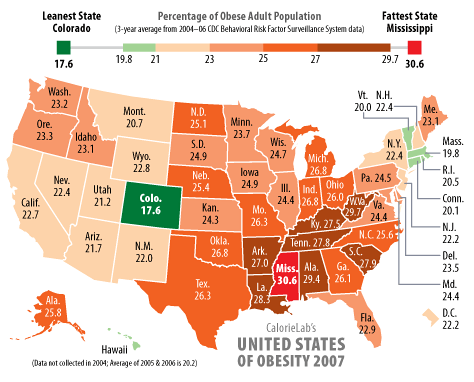
Sorry, but do you have any statistics to support what I assume you're saying, that black people are more obese on average?
http://74.125.95.132/search?q=cache:PfhBNYC8YsEJ:weight-loss...
Black men are slightly less obese, black women significantly more obese. It's not just blacks but Scotch-Irish, for which I doubt there are statistics available, but the Bill Clinton/Boss Hogg body shape is not unusual.
Black men are slightly less obese, black women significantly more obese. It's not just blacks but Scotch-Irish, for which I doubt there are statistics available, but the Bill Clinton/Boss Hogg body shape is not unusual.
I was born and raised in The South -- and returned 'home' a few years ago. I think this quote from the article has something to do with it:
"Physical activity can be something as simple as walking to the bus stop. That's another problem, by the way: the South doesn't have many bus stops. Public transportation is paltry, and for most people, the best way to get around is by car."
I gave up my car last year. Lack of side walks is a serious issue, as is lack of enough shoulder to walk on. And things tend to be spread out. Most folks find it incomprehensible that I live without a car. (And I mostly walk. The public transit system is a case of "You can't get there from here.")
As for "hot": I rarely have to walk the entire way to or from work. Offers of rides have picked up with the summer heat. I am routinely offered a ride with a comment about how it's just too hot out here for someone to walk. So I think a lot of folks do find the heat discourages physical activity (unless it revolves around a swimming pool).
The heat isn't usually a problem for me but sometimes the oppressive humidity is. But, then, I used to walk for exercise in The Mojave Desert -- and had to wait until after dark for it to drop down to 99F in the summer.
I gave up my car last year. Lack of side walks is a serious issue, as is lack of enough shoulder to walk on. And things tend to be spread out. Most folks find it incomprehensible that I live without a car. (And I mostly walk. The public transit system is a case of "You can't get there from here.")
As for "hot": I rarely have to walk the entire way to or from work. Offers of rides have picked up with the summer heat. I am routinely offered a ride with a comment about how it's just too hot out here for someone to walk. So I think a lot of folks do find the heat discourages physical activity (unless it revolves around a swimming pool).
The heat isn't usually a problem for me but sometimes the oppressive humidity is. But, then, I used to walk for exercise in The Mojave Desert -- and had to wait until after dark for it to drop down to 99F in the summer.
I live in Mississippi, and every time I leave the South I see a very noticeable difference in how people look. It has gotten much worse in the past 10 years. I recall growing up and going to the store, the electric carts were always parked in the front of the store. Now they are always in use by someone too large to walk. It's very sad.
And I believe this article confirms my mental state, I do go running when its 100 degrees outside.
And I believe this article confirms my mental state, I do go running when its 100 degrees outside.
OT, but are you near the Gulf Coast? I'm in Ocean Springs. I've been looking for hacker meetups, but outside of the local LUG, there's not a lot.
Three words..."deep fried Twinkies!"
I'm sure sweet tea doesn't help either.
I'm sure sweet tea doesn't help either.
Fried Krispy Kreme cheeseburgers with bacon?
Cornbread.
Here's a 10x better question: Why did Southerners get so much fatter since 1970?
This is new. And there are lots of reasons to think it's not an epidemic of pleny: http://webcast.berkeley.edu/event_details.php?webcastid=2121...
This is new. And there are lots of reasons to think it's not an epidemic of pleny: http://webcast.berkeley.edu/event_details.php?webcastid=2121...
Here's a written article by the same person:
http://www.nasw.org/awards/2001/01Taubesarticle1.htm
I saw food inc. the other day. one interesting point made in the documentary was that income levels effect obesity. people with less income are not able to by the most nutritious food and settle for foods "rich" in hydrogenated corn syrup. foods made with hydrogenated corn syrup are often less expensive because corn has been subsidized, is cheap, and can be stored for a verrrry long time.
Aren't the cheapest foods the simplest, least processed: produce, grains, etc.? No-high-fructose-corn-sweetener-water is cheaper than Coke. Two apples and a banana are cheaper than a bag of Doritos.
Yup. You can eat cheap as dirt if you cook your own Indian food. Rice, dried beans, vegetables, and spices--all are available in almost any grocery store for lower prices than anything else. It's really easy, too, and tastes way better than, hmm, just about anything.
I can't believe the author settled on "too hot" instead of "too uneducated". I guess the weather offends less people.
The South is both the poorest and least educated area of the country. Educated people eat better and exercise more because they know better.