Dot.TK stores passwords in plain text [png](lucb1e.com)
lucb1e.com
Dot.TK stores passwords in plain text [png]
http://lucb1e.com/rp/randomupload/dottk-paintext-pwd.png
5 comments
I get the password as well when resetting it: http://lucb1e.com/rp/randomupload/dottk-paintext-pwd2.png
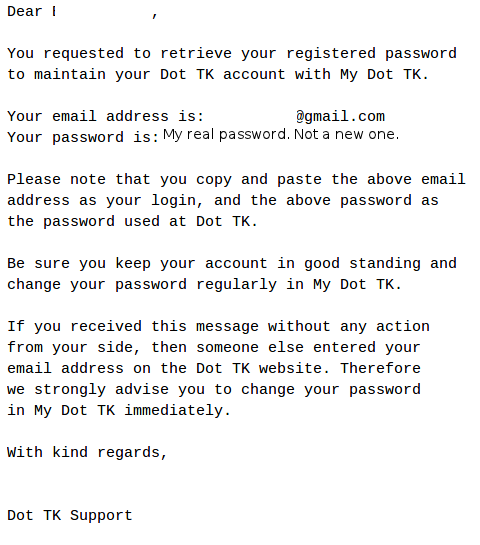
Ding ding ding, now, that is proof :).
They might encrypt it with a passphrase but that's almost equally as bad. Good job on noticing!
They might encrypt it with a passphrase but that's almost equally as bad. Good job on noticing!
Receiving a plaintext password via Email is not proof that the password is stored in plaintext in the database.
It is proof that they are not using a non-reversible hash to store it in their database.
They could be storing it using a reversible encryption algorithm, of which there are many, and they are not considered "insecure".
Or, in the worst case, they could be storing it unsecured. It's definitely a possibility.
It's poor practice, for sure, to email someone a plaintext password, as email itself is prone to numerous attack vectors.
But given the overall lack of evidence and insight into their back end, you don't have enough to draw either conclusion.
It is proof that they are not using a non-reversible hash to store it in their database.
They could be storing it using a reversible encryption algorithm, of which there are many, and they are not considered "insecure".
Or, in the worst case, they could be storing it unsecured. It's definitely a possibility.
It's poor practice, for sure, to email someone a plaintext password, as email itself is prone to numerous attack vectors.
But given the overall lack of evidence and insight into their back end, you don't have enough to draw either conclusion.
Technically correct, but since the password is readable in some way, it's in many ways the same as storing it in plaintext. If the database got hacked, odds are that the key is found too. Or if an admin is rogue, there is no stopping him.
In their signup process, they might grab the pwd you entered in the registration form, generate the email, with password. Then send that email directly without storing it, while at the same time, inserting your password with an encryption into a database. Is it a good idea to send passwords by email? Well, no, but that's a different story. I don't know the actual implementation so you might be correct. But this isn't proof. What kind of email do you get if you need to reset your password by the way?