Does anybody know this fractal? (2012)(gibney.org)
gibney.org
Does anybody know this fractal? (2012)
https://www.gibney.org/does_anybody_know_this_fractal
11 comments
This is a reasonable candidate for a notion of a "Fractal" but these days it is generally accepted that there is no universal definition.
For instance, this definition would not include objects such as the Devil's staircase [1] or more generally images of the unit interval under a continuous monotonically increasing function.
Some more exposition about attempts to rigorously define the notion of a fractal can be find in the introduction to Kenneth Falconer's book [2]
[1] https://en.wikipedia.org/wiki/Cantor_function
[2] https://zbmath.org/1285.28011
Edit: Fixed incorrect zbmath link.
For instance, this definition would not include objects such as the Devil's staircase [1] or more generally images of the unit interval under a continuous monotonically increasing function.
Some more exposition about attempts to rigorously define the notion of a fractal can be find in the introduction to Kenneth Falconer's book [2]
[1] https://en.wikipedia.org/wiki/Cantor_function
[2] https://zbmath.org/1285.28011
Edit: Fixed incorrect zbmath link.
Another issue is that the conventional usage of the term 'fractal' implies some degree of 'self-similarity' across scale, which is a very nebulous concept and is not at all captured by defining the term with respect to sets and various measures.
The Sierpinski pyramid has Hausdorff dimension 2 but topological dimension 3, or am I mistaken?
Its Hausdorff dimension is something like ~1.6 and topological dimension is 1.
The dead Amazon link in the comments seems to refer to https://www.sciencephoto.com/media/6173/view/laue-diffractio....
Had to make an account just to say thank you for posting the working link. The diffraction pattern instantly reminded me of a (continued fraction) fractal I found a while ago: https://www.fractal4d.net/work/vitruvius/
Somewhat related to the Mandelbrot fractal its iterated formula is f(z) = -z^-1+c = c-1/z
In case the similarity is not obvious from the downscaled image, here's a crop from the original: https://www.fractal4d.net/random/images/vitruvius_crop.jpg
Somewhat related to the Mandelbrot fractal its iterated formula is f(z) = -z^-1+c = c-1/z
In case the similarity is not obvious from the downscaled image, here's a crop from the original: https://www.fractal4d.net/random/images/vitruvius_crop.jpg
fractalforums.com is now also defunct, and the newer fractalforums.org is run by exceptionally neurotic and power tripping mods who've recently made it members only... There's a thriving fractal chats Discord community at least, with frequent meetups (one next month!).
This is related to the distribution of algebraic numbers of bounded height and degree; similar pictures have been presented e.g. in the classic post by Baez: https://math.ucr.edu/home/baez/roots/ I have also drawn some pictures: https://drive.google.com/file/d/1vx-U28OgGIs1mfrgBb7OtgVsPWA...
The discipline that deals with these distributions is called Diophantine geometry and involves tons of important and deep mathematics.
The discipline that deals with these distributions is called Diophantine geometry and involves tons of important and deep mathematics.
Right from the TFA:
https://news.ycombinator.com/item?id=4659840
https://news.ycombinator.com/item?id=4659840
TFA?
The F___ Article
Usually, dang or someone will come along and post links to previous HN posts on the same topic. The actual article did that for us, so I thought I'd save dang a quick search.
Usually, dang or someone will come along and post links to previous HN posts on the same topic. The actual article did that for us, so I thought I'd save dang a quick search.
Hah, it’s always been “The Featured Article” in my head… TIL!
To put a slightly finer point on the explanation: The "F***" is often assumed to be a common insult-word, either to show annoyance that another person didn't bother reading the article first, or else to indicate that article itself isn't good.
However over the years I've also seen people refer to it as "Fine", where the initialism is a bit more neutral in tone (or at least, ambiguously sarcastic) so it isn't always the overtly annoyed version.
However over the years I've also seen people refer to it as "Fine", where the initialism is a bit more neutral in tone (or at least, ambiguously sarcastic) so it isn't always the overtly annoyed version.
That's precisely why I left it blank to be filled in with which ever version one chooses. I prefer the more crude version personally, but at least allowed for it to be more ambiguous for this one post.
>However over the years
To me, it has just become accepted way to reference the actual article (regardless of the actual words in the acronym to the point of being a word not an acronym at all) the entire comment page is about vs the previous comment relative names like GP GGP etc. This quote isn't from a different comment, but instead lifted directly from the article the comment that is being discussed
>However over the years
To me, it has just become accepted way to reference the actual article (regardless of the actual words in the acronym to the point of being a word not an acronym at all) the entire comment page is about vs the previous comment relative names like GP GGP etc. This quote isn't from a different comment, but instead lifted directly from the article the comment that is being discussed
Originally “RTFM”, or “read the (fantastic) manual”.
My anecdotal impression is that RTFM came first especially in the context of newsgroups/usenet, whereas (R)TFA arose later in a more web-forum/blog-comment era when there were really more A's to R.
I've seen some people refer to it as "the featured article". But the profanity definition is more common for sure.
Seems fair.
Thanks! Familiar with RTFM etc, hadn't seen this.
Interesting. I never encountered what it stood for, but had always assumed it was "The Full Article".
The flower patterns remind me of Smith charts. https://www.antenna-theory.com/m/tutorial/smith/chart.php
Since smith charts are made by mapping the complex plane (grid) to another complex plane via a Mobius transformation Z->(Z-1)/(Z+1), maybe that’s what’s going on here too. The inverse certainly produces a grid again.
Since smith charts are made by mapping the complex plane (grid) to another complex plane via a Mobius transformation Z->(Z-1)/(Z+1), maybe that’s what’s going on here too. The inverse certainly produces a grid again.
I wonder if anyone tried applying fourier/inverse fourier transform on it
naively, could any percieved symmetry in these images be the effect of constant iteration over some input, where the self-similarity emerges as a kind of artifact of the lens, and not of the underlying numbers? Like how everything viewed through a kaleidoscope looks kaleidoscopic, but this doesn't reveal hidden symmetries in the object in the lens.
I'm suggesting it because even when you use other iterative tools (method of differences, phase space analysis[1], etc) you can percieve symmetry in the images even over random'ish data that mainly indicates limited or periodic inputs, but the output of these images don't provide any net new information about number theoretic relationships. It does suggest fractals may be a kind of lens artifact and not an actual property of nature though.
[1] e.g. https://lcamtuf.coredump.cx/newtcp/
I'm suggesting it because even when you use other iterative tools (method of differences, phase space analysis[1], etc) you can percieve symmetry in the images even over random'ish data that mainly indicates limited or periodic inputs, but the output of these images don't provide any net new information about number theoretic relationships. It does suggest fractals may be a kind of lens artifact and not an actual property of nature though.
[1] e.g. https://lcamtuf.coredump.cx/newtcp/
Are you suggesting it's a problem of seeing a sheep in a field?
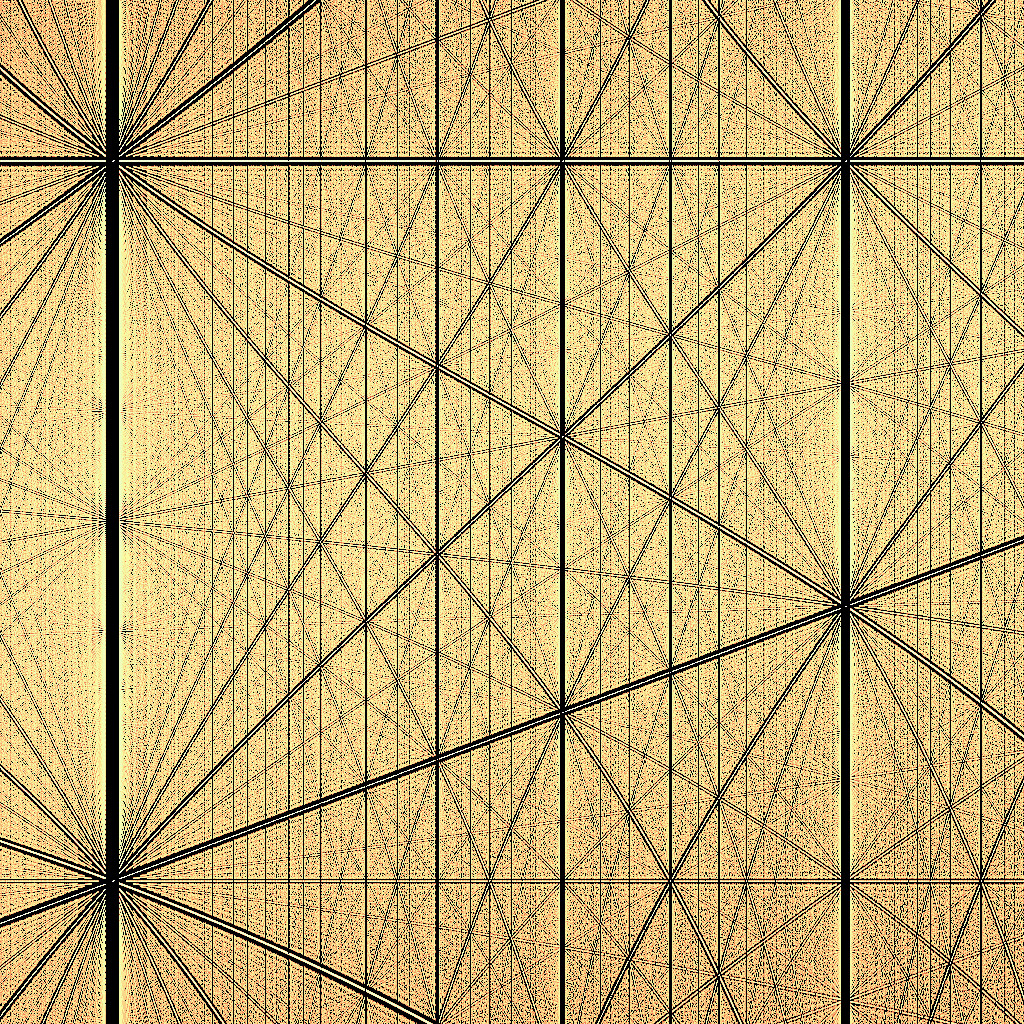
The function gives the same result regardless of the sign of the two components, so there's axes of symmetry around the lines defined by (x ± xi): in the first image that gives four axes on the horizontal, vertical, and diagonal lines through the origin. The two zoomed images are along the diagonal extending up to the top left and so there's diagonal symmetry visible.
I think that would probably count as it revealing symmetry in the underlying object rather than in the lens, it's not a consequence of rounding or asymptotes or floating point errors or any such.
I think that would probably count as it revealing symmetry in the underlying object rather than in the lens, it's not a consequence of rounding or asymptotes or floating point errors or any such.
The first thing I was reminded of was X-ray diffraction images.
Looks Fourier-y to me
Yeah, I immediately thought of Kikuchi lines from electron diffraction in crystals
https://en.wikipedia.org/wiki/Kikuchi_lines_(physics)
Same
artifacts of the selection of the numbers with common origin/criterias. just like interacting pi with e, etc.
still cool, and i subscribe to the looser definition of fractals which this fits
still cool, and i subscribe to the looser definition of fractals which this fits
Reminds me of Möbius Transformation images
[deleted]
Yes there is: A fractal is a set for which the Hausdorff Besicovitch dimension strictly exceeds the topological dimension. (topological dimension means Lebesgue covering dimension)
For example: Mandelbrot set boundary has Hausdorff dimension 2 and topological dimension 1.