The rooftop solar industry could be on the verge of collapse(time.com)
time.com
The rooftop solar industry could be on the verge of collapse
https://time.com/6565415/rooftop-solar-industry-collapse/
11 comments
(Hyper-)Capitalism for you again... What would be wrong in building a life-long business that sells and installs solar panels and has normal margin on each sale/installation, without the crazy financial "products", companies themselves running on investor money, chasing huge growth and all beautiful things current way of doing business involves?
It's like everybody is racing to the top, while being in a landslide going to the bottom.
It's like everybody is racing to the top, while being in a landslide going to the bottom.
your customers would buy from a 'cheaper' vendor who extends them credit instead
I don't think it should be allowed for companies to provide financial products such as credit. That's bank domain, heavily regulated and with good protections for both parties.
you probably don't know this if you haven't run a company or done accounting, but basically all b2b transactions are on credit, and that's been the case for at least 5000 years
they've also been common for b2c transactions for at least the majority of that time, especially when dealing with consumers with limited cash flow
they've also been common for b2c transactions for at least the majority of that time, especially when dealing with consumers with limited cash flow
Ive seen a few articles about this topic.
I’m a new homeowner and have been looking forward to getting rooftop solar within the next year (recently swapped to a heat pump instead of gas furnace).
The local (PDX, OR) companies seem a bit sketchy but I do have at least one solid recommendation from a friend.
My mother however wasn’t so lucky and experienced something similar to the article where the salesmen claimed it would all be free and pay for itself but the. She ended up with a $16k loan. When she called to clarify they offered to double the number of panels on the roof and install for free, which she agreed to.
Any one else here with experience getting rooftop solar?
I’m a new homeowner and have been looking forward to getting rooftop solar within the next year (recently swapped to a heat pump instead of gas furnace).
The local (PDX, OR) companies seem a bit sketchy but I do have at least one solid recommendation from a friend.
My mother however wasn’t so lucky and experienced something similar to the article where the salesmen claimed it would all be free and pay for itself but the. She ended up with a $16k loan. When she called to clarify they offered to double the number of panels on the roof and install for free, which she agreed to.
Any one else here with experience getting rooftop solar?
I thought I would avoid those issues by buying a system outright, rather than financing it. I had the cash to spare and thought it would be a good investment.
I went with a local company. The owner was an electrician and knew what he was talking about. He didn't try to upsell me. He didn't claim to be the cheapest but the price was competitive and the workers were in-house, not subcontracted. It seemed like just what I wanted.
The installation day came and they arrived early in the morning, and spent hours installing brackets. The solar panels were supposed to arrive by 9am. By noon they were still waiting. Finally they gave up and went home, no answer on the panels. The next day they came back to keep working, still with no panels. I sent them home and called the owner, demanding an answer. Eventually I learned that the panels were damaged in transit and it'd be weeks before they could procure new ones. They couldn't guarantee a date.
They had already charged my credit card for the full amount of the install. I told them this was unacceptable, the law says they can only charge a deposit, with the balance due when the work was actually complete.
They stopped returning my calls, so I initiated a chargeback with my credit card company. That got their attention. They begged me to cancel the chargeback, which I only reluctantly agreed to after they hand-delivered a refund check to me in person.
It took me dozens of calls before I found another company willing to work with the half-completed install. Most companies didn't want to touch it.
In the end, I got the system I wanted and it worked great.
One thing I learned through this process is that there are a lot of companies who want to install solar, but none who want to service your existing solar installation, which is seen as a money-losing business. Lots of homeowners buy a system that supposedly includes an excellent warranty, but then their solar company goes out of business, and suddenly they have nobody to call when something goes wrong.
I don't really know the solution to that problem. It makes me think that if I had to do it again, maybe I should go with a larger national company.
I went with a local company. The owner was an electrician and knew what he was talking about. He didn't try to upsell me. He didn't claim to be the cheapest but the price was competitive and the workers were in-house, not subcontracted. It seemed like just what I wanted.
The installation day came and they arrived early in the morning, and spent hours installing brackets. The solar panels were supposed to arrive by 9am. By noon they were still waiting. Finally they gave up and went home, no answer on the panels. The next day they came back to keep working, still with no panels. I sent them home and called the owner, demanding an answer. Eventually I learned that the panels were damaged in transit and it'd be weeks before they could procure new ones. They couldn't guarantee a date.
They had already charged my credit card for the full amount of the install. I told them this was unacceptable, the law says they can only charge a deposit, with the balance due when the work was actually complete.
They stopped returning my calls, so I initiated a chargeback with my credit card company. That got their attention. They begged me to cancel the chargeback, which I only reluctantly agreed to after they hand-delivered a refund check to me in person.
It took me dozens of calls before I found another company willing to work with the half-completed install. Most companies didn't want to touch it.
In the end, I got the system I wanted and it worked great.
One thing I learned through this process is that there are a lot of companies who want to install solar, but none who want to service your existing solar installation, which is seen as a money-losing business. Lots of homeowners buy a system that supposedly includes an excellent warranty, but then their solar company goes out of business, and suddenly they have nobody to call when something goes wrong.
I don't really know the solution to that problem. It makes me think that if I had to do it again, maybe I should go with a larger national company.
> He didn't claim to be the cheapest
Ugh! Every independent tradesperson that’s spun that line (“I’m not cheap, I’m quality” etc) with me has turned out to be a liar. Super expensive without the quality part …
Most are conmen and incompetent at running a business and price isn’t a strong signal for a good one
Anyone who comes in strong with the hard man, “I’m expensive for a reason” spiel is a hard no now
Ugh! Every independent tradesperson that’s spun that line (“I’m not cheap, I’m quality” etc) with me has turned out to be a liar. Super expensive without the quality part …
Most are conmen and incompetent at running a business and price isn’t a strong signal for a good one
Anyone who comes in strong with the hard man, “I’m expensive for a reason” spiel is a hard no now
We got Sunrun within the past year on a house we bought 1.5 years ago (so we're NEM 2.0 which is important).
I'm in San Diego, we were paying about 500/month for SDGE (fluctuating anywhere from 300-800 throughout the year, 800 because of gas prices last January).
We're paying Sunrun a fixed $300/month, with a 4% increase annually for inflation (presumably electricity prices will also go up during the same time).
Sunrun 100% paid for a main panel relocation required by our county to be to code, so we literally haven't paid for anything other than the 300/month bill.
So far I've only had a good experience.
I'm in San Diego, we were paying about 500/month for SDGE (fluctuating anywhere from 300-800 throughout the year, 800 because of gas prices last January).
We're paying Sunrun a fixed $300/month, with a 4% increase annually for inflation (presumably electricity prices will also go up during the same time).
Sunrun 100% paid for a main panel relocation required by our county to be to code, so we literally haven't paid for anything other than the 300/month bill.
So far I've only had a good experience.
My house faces east-west and so the local solar companies refuse to come out and give a quote. I know it's not going to be as efficient, but I live in an area with lots of power outages, so having a backup system is worth the lack of efficiency, but they all refuse to come out, no matter what I explain up front.
> I live in an area with lots of power outages, so having a backup system is worth the lack of efficiency
Unless you go completely off-grid then rooftop solar isn’t going to help with outages as they are turned off during outages to protect electrical workers and the power grid. [1] Your problem can be solved with home batteries.
1. https://www.paradisesolarenergy.com/blog/will-solar-panels-w...
Unless you go completely off-grid then rooftop solar isn’t going to help with outages as they are turned off during outages to protect electrical workers and the power grid. [1] Your problem can be solved with home batteries.
1. https://www.paradisesolarenergy.com/blog/will-solar-panels-w...
I was surprised to discover that even with a backup battery, a typical solar install is not designed to power your whole home in the event of a power loss. Only some inverters support it, and most backup batteries can't generate enough amps to start an A/C unit, even though they'd have enough to run it for a while.
Tesla's PowerWall is more capable than some, but I've heard nightmare stories about working with Tesla customer service so I stayed away from that one, even though technologically it's probably the most advanced.
Tesla's PowerWall is more capable than some, but I've heard nightmare stories about working with Tesla customer service so I stayed away from that one, even though technologically it's probably the most advanced.
> I was surprised to discover that even with a backup battery, a typical solar install is not designed to power your whole home in the event of a power loss.
Might even be illegal, depending on jurisdiction. For good reasons, you could kill electricians working on the local grid or firefighters working on your house if you're not careful with the install and adding local shut-offs.
My battery turns off when the grid goes down, but it has 3 outlets directly on the body of the battery, and those always work. I run extension cords from those when the power goes.
Might even be illegal, depending on jurisdiction. For good reasons, you could kill electricians working on the local grid or firefighters working on your house if you're not careful with the install and adding local shut-offs.
My battery turns off when the grid goes down, but it has 3 outlets directly on the body of the battery, and those always work. I run extension cords from those when the power goes.
Bullshit. All "hybrid" inverters nowadays (grid tied + battery backup), auto island themselves when the grid is out.
That misconception is now 15 years old
That misconception is now 15 years old
That system is 5 years old. It feeds electricity back to the grid.
For an "auto island" functionality, I would need relays controlled by the inverter on all 3 phases between the electricity mains and my main switch box, right? I don't have relays like that.
For an "auto island" functionality, I would need relays controlled by the inverter on all 3 phases between the electricity mains and my main switch box, right? I don't have relays like that.
How much electricity do you use? I have a low range inverter (5KW) and it can give me 4.5kw sustained power from my battery and as much as I want from the grid because it acts as a pass through. At 220V that's 20Amps, or 40A I guess with your American 110V supply.
Add another battery and bigger inverter and you can double that. Unless you've got a kiln or perpetually running hot water heating, I'm left baffled.
Add another battery and bigger inverter and you can double that. Unless you've got a kiln or perpetually running hot water heating, I'm left baffled.
According to https://www.reddit.com/r/Generator/comments/15uy9dw/ac_start... an AC can require 79A on startup.
Though apparently there is a thing called a "softstart" that can be installed to mitigate this.
I don't actually know anything about this stuff. I just watch youtube videos.
Though apparently there is a thing called a "softstart" that can be installed to mitigate this.
I don't actually know anything about this stuff. I just watch youtube videos.
The problem is in the "whole home". I'm pretty happy to have my lights/wifi/induction cooktop/etc. running when the power runs out.
Incorrect, please get a hybrid with the auto-islanding feature. I literally have a whole-house UPS and barely a blip when I get a power outtage.
So unless there is something magical about electricity in the USA, I'm not sure where this scare story is coming from.
I have one of these https://www.sunsynk.org/ourinverters
So unless there is something magical about electricity in the USA, I'm not sure where this scare story is coming from.
I have one of these https://www.sunsynk.org/ourinverters
It's not AS efficient, true, especially in the winter when the sun is lower in the sky, but it's not like it'll do nothing - and in the summer you get a longer generation period. You'll likely need more panels, but panels (should) be cheap, although in the US you seem to have high prices due to tariffs.
Yes. It's a shame that it is hard to install on the ground - or rather it's a shame that permission isn't easily given for ground installations, if you have space. Ground installs won't damage your roof, and will be easier to clean, install, etc. But then, as noted elsewhere, is it really the answer anyway? Solar doesn't really give you the energy when you really need it - in the winter.
I haven't researched it much, but what's always smelled fishy to me is that rooftop solar is going up, but there's less utility-scale solar in the desert where there's more sun, no shade, panels angled correctly, and consolidated maintenance.
I suspect rooftop solar only appears to work because the sales pitch sounds good, there are government subsidies, net metering is broken, and people don't consider depreciation and maintenance.
I suspect rooftop solar only appears to work because the sales pitch sounds good, there are government subsidies, net metering is broken, and people don't consider depreciation and maintenance.
I follow Will Prowse on YT. He's full of great information about solar/batteries/etc. He's more about "mobile solar", but tbh... you can apply a lot of the same stuff to your own home. Especially when it comes to storage.
[deleted]
Rooftop solar never really made sense in the big picture kind of way. It's about 2x the cost of non-rooftop solar, so why should we be putting it on roofs when there is still plenty of non-roof space to put it? If we get to a point where we've run out of room for solar...then sure, roofs are great (although residential roofs should probably be the last roofs after big, flat industrial/commercial roofs), but the only reason it ever made sense to begin with was extremely large subsidies that probably should have gone to other renewable efforts.
I’m going to answer your “financially nonsensical” argument from personal situation.
I live in the Netherlands. Sure, we have a reliable power grid that doesn’t go offline for hours or any frequently to make a case for grid backup, but the power companies here charge heck of a lot of money for power. Think about it. The utility company commissions a solar farm (lower cost than roof top solar), but surely hire a 3rd company to operate the farm ($), and then the utility company wants to make $ for their shareholders, therefore, we end up paying a lot of € to cover these.
Now, I have as manay panels as I could on my roof (10) that generates more than my average use in the Summer. I run a heat pump that can heat & cool and Ioperate it when the sun is shining. I do laundry when the sun is shining. Because of net metering, my grid usage practically cancels out against my solar energy production. When the net metering subsidy goes away, I’ll install a reasonably sized LFP battery at home to smooth out day/night patterns, and possibly covering the occasional cloudy days right after a sunny day. No power costs from April to September already pays the cost of my panels in just 5 years. It is free money(as in I save it from going from my pocket to the utility company and their shareholders).
So, it does make sense. Atleast in many parts of the world. If you live in a part of the world with super reliable grid _and_ low prices, or you’re so rich as to not care, then probably, it may not make sense to you :-)
I was just talking about it with some friends from South Africa. They said almost every household there sort of needs to be energy independent because the power company is in the ruin. So, solar + batteries it is. What would you do otherwise?
I live in the Netherlands. Sure, we have a reliable power grid that doesn’t go offline for hours or any frequently to make a case for grid backup, but the power companies here charge heck of a lot of money for power. Think about it. The utility company commissions a solar farm (lower cost than roof top solar), but surely hire a 3rd company to operate the farm ($), and then the utility company wants to make $ for their shareholders, therefore, we end up paying a lot of € to cover these.
Now, I have as manay panels as I could on my roof (10) that generates more than my average use in the Summer. I run a heat pump that can heat & cool and Ioperate it when the sun is shining. I do laundry when the sun is shining. Because of net metering, my grid usage practically cancels out against my solar energy production. When the net metering subsidy goes away, I’ll install a reasonably sized LFP battery at home to smooth out day/night patterns, and possibly covering the occasional cloudy days right after a sunny day. No power costs from April to September already pays the cost of my panels in just 5 years. It is free money(as in I save it from going from my pocket to the utility company and their shareholders).
So, it does make sense. Atleast in many parts of the world. If you live in a part of the world with super reliable grid _and_ low prices, or you’re so rich as to not care, then probably, it may not make sense to you :-)
I was just talking about it with some friends from South Africa. They said almost every household there sort of needs to be energy independent because the power company is in the ruin. So, solar + batteries it is. What would you do otherwise?
>Think about it. The utility company commissions a solar farm (lower cost than roof top solar), but surely hire a 3rd company to operate the farm ($), and then the utility company wants to make $ for their shareholders, therefore, we end up paying a lot of € to cover these.
You missed the largest reason home solar can be competetive and that is taxes. 11 cents per kWh and 3 cents sustainability charge and then 21% VAT over the cost price + taxes. And then the government mandates the energy companies have to buy your energy for the same price they sell you energy.
So as with many thing here it only makes sense because the government has completely distorted the market.
You missed the largest reason home solar can be competetive and that is taxes. 11 cents per kWh and 3 cents sustainability charge and then 21% VAT over the cost price + taxes. And then the government mandates the energy companies have to buy your energy for the same price they sell you energy.
So as with many thing here it only makes sense because the government has completely distorted the market.
I would have thought taxes on electricity would be lower because in an indirect way it contributes to cost of business in the country. But, I am surprised.
Now, let the tech mature for a reasonable longish term energy storage and I’ll set one up in the backyard :-) Save excess energy from the Summer, use it in Winter, repeat.
I don’t have enough space for the amount of LFP batteries I’d need for such seasonal storage. Even flow batteries of today needs more space than I have. So, it will have to be some $future tech that could allow me to save the summer for the Winter.
Now, let the tech mature for a reasonable longish term energy storage and I’ll set one up in the backyard :-) Save excess energy from the Summer, use it in Winter, repeat.
I don’t have enough space for the amount of LFP batteries I’d need for such seasonal storage. Even flow batteries of today needs more space than I have. So, it will have to be some $future tech that could allow me to save the summer for the Winter.
You know, it's a bit hard for me to understand how every household buying hundreds of kilograms of hard to mine metals is somehow a solution to the energy intensity of modern civilization. But maybe I'm just very nearsighted and it'll work.
Well, by that logic, I have some great sophistication going on in my household..
Several devices that took EUV machines(that cost hundreds of millions each) to etch login onto themselves - microchips on my laptop, phone etc.
A pipe constantly supplying flammable gas that was probably mined thousands of kilometers away just so that I can burn it and heat up my water for shower.
A very dangerous to the environment - refrigerant in both my fridge and heat pump.
A tank full of dinosaur juice in my car, which itself was machined and built with some exotic metals mined somewhere else in the world.
What difference is a few more kilograms of futuristic substance that can save energy for my house make?
I know hundreds or thousands of kilograms of LFP batteries in my backyard in feasible today. But who knows. Maybe we will find a way to mine Lithium or replace it with Sodium and the whole process would become “normal” like the metals in my 3 ton car.
Several devices that took EUV machines(that cost hundreds of millions each) to etch login onto themselves - microchips on my laptop, phone etc.
A pipe constantly supplying flammable gas that was probably mined thousands of kilometers away just so that I can burn it and heat up my water for shower.
A very dangerous to the environment - refrigerant in both my fridge and heat pump.
A tank full of dinosaur juice in my car, which itself was machined and built with some exotic metals mined somewhere else in the world.
What difference is a few more kilograms of futuristic substance that can save energy for my house make?
I know hundreds or thousands of kilograms of LFP batteries in my backyard in feasible today. But who knows. Maybe we will find a way to mine Lithium or replace it with Sodium and the whole process would become “normal” like the metals in my 3 ton car.
You summed it up pretty well. I struggle to understand the idea that increasing consumption will lessen the impact of previous consumption. If this is our only approach, extrapolation says we're doomed.
Didn't half a row of row houses get destroyed in a fire last year in NL because they had rooftop solar and it would effectively shield the fire from the firefighters?
I don’t think the government would allow solar panels to be part of the building code(and even encourage new built houses to have them) if they actively hurt firefight.
I’m struggling to even think about this argument. How does something on the roof prevent firefighters from putting out the fire? It’s not like firefighters drill a hole through the roof to ingest extinguishers..
The solar panels themselves are _outside_ the roof. So, if they catch fire, your roof must have gone to fire by now, and you have bigger things to worry about.
I’m struggling to even think about this argument. How does something on the roof prevent firefighters from putting out the fire? It’s not like firefighters drill a hole through the roof to ingest extinguishers..
The solar panels themselves are _outside_ the roof. So, if they catch fire, your roof must have gone to fire by now, and you have bigger things to worry about.
This happened last October
https://nos.nl/artikel/2493147-bouwregels-voor-verduurzaamde...
https://nos.nl/artikel/2493147-bouwregels-voor-verduurzaamde...
Yes, the article does not mention the solar panels even once. They talk about the additional insulation they put on atop the old facade, which led to a gap which helped the fire to propagate faster. (my understanding of Nederlands is limited, so I may have misread something).
I cannot see how solar panels on the roof could hinder fire safety.
All the Li-ion batteries we keep inside the house in the other hand… particularly the old ones on our used electronics laying around in closets and drawers without being paid attention to. That’s what worries me the most. I can only get the most flexible fire insurance for my home.
I cannot see how solar panels on the roof could hinder fire safety.
All the Li-ion batteries we keep inside the house in the other hand… particularly the old ones on our used electronics laying around in closets and drawers without being paid attention to. That’s what worries me the most. I can only get the most flexible fire insurance for my home.
That looks like classic FUD
It's a trust issue. People don't trust their utilities, residential solar is (among other things) a hedge.
Basically, "how much would you pay to limit how much $powerco can screw you in future?". Human nature means a lot of people will willingly pay double for that.
Basically, "how much would you pay to limit how much $powerco can screw you in future?". Human nature means a lot of people will willingly pay double for that.
“People don't trust their utilities” is a strong claim that I assume is very dependent on your location. I think I’ve had maybe two hours total of no electricity in the last five years?
Yeah I admit this is pretty situational - the U.S. I don't know much about - but NZ, Australia and most of Europe, consumer sentiment is that we are getting slugged - I don't have a survey to hand but I'm confident I could dig something up (EDIT: e.g: https://www.energymagazine.com.au/energy-survey-reveals-risi...)
In the last 5 years, has your kwh price increased? By more or less than inflation?
If utility scale solar takes off, do you expect that future prices will reflect a) capital and operating costs plus a fair margin or b) whatever the market will bear?
In the last 5 years, has your kwh price increased? By more or less than inflation?
If utility scale solar takes off, do you expect that future prices will reflect a) capital and operating costs plus a fair margin or b) whatever the market will bear?
Ah, right, in terms of cost; I was assuming availability.
Personally I’m on variable rate electricity so it’s difficult to tell overall how much its climbing. But my feeling is that in my area the previous two winters were extremely high, but that this winter has been cheaper. A lot of that is down to missing infrastructure and political structures though.
Personally I’m on variable rate electricity so it’s difficult to tell overall how much its climbing. But my feeling is that in my area the previous two winters were extremely high, but that this winter has been cheaper. A lot of that is down to missing infrastructure and political structures though.
Most people have grid-tie systems. If the power is out, they are down too.
Only very rich people have money to buy battery storage enough to be off grid and then this kind of system is not what those companies usually lease.
If you’re concerned about blackouts a gas natural generator makes a lot more sense economically speaking
This is factually true but my claim is that what motivates people is a desire for greater energy security (EDIT: where improved price stability is one aspect of that, as konschubert points out).
It also means you're less affected by rising prices. (Not that I expect rising prices, but others do)
If you want private panels in pretty much any country outside of America, they're going to have to go on the roof as we don't exactly have the land to waste elsewhere.
I think the commenter was implying that rather than putting it on the roof of people's homes, the focus should be on utility-scale solar power stations.
Which doesn't make too much sense outside of the US, where land isn't nearly as cheap.
It makes sense in any country that has agriculture.
Solar produces 10x as much power per area than energy crops.
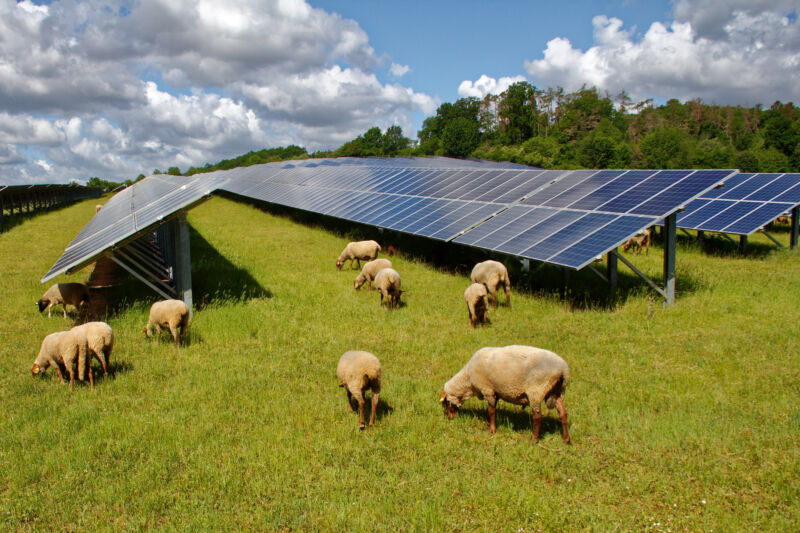
And other than with crops, you can have sheep grazing and have a functioning meadow ecosystem develop below the panels.
Solar produces 10x as much power per area than energy crops.
And other than with crops, you can have sheep grazing and have a functioning meadow ecosystem develop below the panels.
What are the upfront & maintenance costs of solar vs crops on that kind of scale? I'd hazard a guess it's a little more than 10x.
Also, how are you planning to grow meadows under solar panels without any sunlight?
Also, how are you planning to grow meadows under solar panels without any sunlight?
I’m honestly super excited about you asking because I think I’ll be able to change your mind with a single picture:
https://cdn.arstechnica.net/wp-content/uploads/2021/10/Getty...
The sun moves, and therefore the shadows move. And you need some space between the panels anyways, so they don’t shade each other. Also, grass can grow in the shadow!
The cost of installation is not a problem, because the ROI is greater than the interest on a loan. That’s what banks are for!
https://cdn.arstechnica.net/wp-content/uploads/2021/10/Getty...
The sun moves, and therefore the shadows move. And you need some space between the panels anyways, so they don’t shade each other. Also, grass can grow in the shadow!
The cost of installation is not a problem, because the ROI is greater than the interest on a loan. That’s what banks are for!
You are correct, this has changed my mind as it is a lovely weird photo that I have enjoyed.
Here in Germany we waste about 2.4 million hectares on „energy crops“. That’s enough to cover a large fraction of Germany’s primary energy consumption if it were used for solar instead.
The foolish move by the German government to close down all the nuclear reactors. The German government is weird.
Or history is more complex than a sound bite.
Getting Germany off nuclear has been in the making since the 1980s, and a big factor was fighting corruption.
We still have a glowing mess from those days, waiting another 80 years until it can be cleaned up.
Getting Germany off nuclear has been in the making since the 1980s, and a big factor was fighting corruption.
We still have a glowing mess from those days, waiting another 80 years until it can be cleaned up.
It would have been nice to turn off coal first, but it doesn’t change what we need to do for renewables.
you say 'If you want private panels in pretty much any country outside of America, they're going to have to go on the roof as we don't exactly have the land to waste elsewhere.'
https://www.worldometers.info/geography/7-continents/ says the population density of north america is 28 people/km², and south america is 25. meanwhile, europe is 33, africa is 49, asia is 153, "australia/oceania" (???) is 5, and antarctica is 0. so basically the population density of europe is the same as america, africa is just a little bit higher, asia is much higher, and australia is much lower
possibly by 'pretty much any country outside of america' you meant either nigeria or singapore
but let's consider the worst case continent, asia. 153 people per square kilometer means 6500 square meters per person. hopefully you are aware that the average home size in asia is not 6500 square meters or even 65 square meters, and that a substantial fraction of people live in apartment buildings which share a roof. so the vast majority of land even in asia is not roofed. this is also obvious from looking at any satellite photo. but enormous numbers of people live in houses with gardens or even farms attached
if we assume a 15% average solar capacity factor and 21% efficient solar panels, 6500 square meters per person is 200 kilowatts per person. current world marketed energy consumption is something like 2, 2½ kilowatts per person. that's still too much to put on the average roof but it's not exactly a major fraction of the total land area either
even nigeria is only 250 people per square km
you're right about singapore tho
https://www.worldometers.info/geography/7-continents/ says the population density of north america is 28 people/km², and south america is 25. meanwhile, europe is 33, africa is 49, asia is 153, "australia/oceania" (???) is 5, and antarctica is 0. so basically the population density of europe is the same as america, africa is just a little bit higher, asia is much higher, and australia is much lower
possibly by 'pretty much any country outside of america' you meant either nigeria or singapore
but let's consider the worst case continent, asia. 153 people per square kilometer means 6500 square meters per person. hopefully you are aware that the average home size in asia is not 6500 square meters or even 65 square meters, and that a substantial fraction of people live in apartment buildings which share a roof. so the vast majority of land even in asia is not roofed. this is also obvious from looking at any satellite photo. but enormous numbers of people live in houses with gardens or even farms attached
if we assume a 15% average solar capacity factor and 21% efficient solar panels, 6500 square meters per person is 200 kilowatts per person. current world marketed energy consumption is something like 2, 2½ kilowatts per person. that's still too much to put on the average roof but it's not exactly a major fraction of the total land area either
even nigeria is only 250 people per square km
you're right about singapore tho
>Rooftop solar never really made sense in the big picture kind of way.
I think it's in the big picture it actually does make sense. True it's not the cheapest, but it is the fastest way to actually get solar panels into sunshine and start solving our problems.
The additional cost is paid mostly by "volunteers" instead of having to raise taxes or wait for some corporation to make a move, there is no NIMBY-problem since it's actually the BY-owner who makes the decision. You can mobilize thousands of companies (solar panel installers) at once all around the country. Rooftop solar grows by about the same as a nuclear power plant per year in some countries.
Finally the resulting power generation is geographically distributed so that no single rain cloud can cover the entire "power plant".
I think larger projects run by governments and large corporations should be focused on generating gas or building battery storage, so that some of that cheap rooftop solar and other renewables can be stored for nighttime and winter, instead of being sold for negative prices at certain times.
I think it's in the big picture it actually does make sense. True it's not the cheapest, but it is the fastest way to actually get solar panels into sunshine and start solving our problems.
The additional cost is paid mostly by "volunteers" instead of having to raise taxes or wait for some corporation to make a move, there is no NIMBY-problem since it's actually the BY-owner who makes the decision. You can mobilize thousands of companies (solar panel installers) at once all around the country. Rooftop solar grows by about the same as a nuclear power plant per year in some countries.
Finally the resulting power generation is geographically distributed so that no single rain cloud can cover the entire "power plant".
I think larger projects run by governments and large corporations should be focused on generating gas or building battery storage, so that some of that cheap rooftop solar and other renewables can be stored for nighttime and winter, instead of being sold for negative prices at certain times.
It’s nice to have generation close to consumption because you save on transmission infra.
yes, it's collectively irrational behavior, just like warfare. but it's often individually rational behavior (like defending your country when it's invaded, in some cases) because electric power utilities commonly have monopolies, which causes two problems:
1. they become single points of failure, and their risk tolerance for outages may not match yours, so you may end up either paying excessive costs for reliability you don't need, or experiencing an outage risk you can't tolerate. or they may have outage risks which you can't solve by dumping money on them, such as corruption
2. they sometimes try to extract monopoly rents
there are also coordination problems around things like time-of-usage billing. solar power is free during the day, but your utility provider may not be willing to deliver it to you for the extremely low marginal price of transmission and distribution; they may be legally obligated to charge you the same price as at midnight, for example
1. they become single points of failure, and their risk tolerance for outages may not match yours, so you may end up either paying excessive costs for reliability you don't need, or experiencing an outage risk you can't tolerate. or they may have outage risks which you can't solve by dumping money on them, such as corruption
2. they sometimes try to extract monopoly rents
there are also coordination problems around things like time-of-usage billing. solar power is free during the day, but your utility provider may not be willing to deliver it to you for the extremely low marginal price of transmission and distribution; they may be legally obligated to charge you the same price as at midnight, for example
What's plenty of space? I have perhaps 3-400 sqm of lawn. I'm not going to use 50-100 of that for solar when I have that amount of roof that is otherwise wasted space. I agree that perhaps domestic installations might not be the best idea because you need the same equipment repeated at every home, that could otherwise be centralized at a plant. But for resilience it's pretty neat. If I had more than say one power outage a year lasting more than an hour, I'd definitely be looking at it. I can see why South Africa is a big market (lots of sun, frequent power outage). Perhaps the middle ground between massive scale and domestic scale would be community sized plants serving (say) 100-1000 households.
It doesn't make sense if you effectively rent the panels, which means they have to come down again.
Whether or not the panels "have to come down" depends on who pays.
If the solar company has to pay, it might not bother at the end of the lease term.
This can turn into a very low price to sell the panels at that time.
If the solar company has to pay, it might not bother at the end of the lease term.
This can turn into a very low price to sell the panels at that time.
Residential solar has one huge advantage over utility solar - RS lets people virtue-signal.
In other words, part of the payback/value is letting people say/think "I'm a good person."
We can argue about whether the additional solar demand due to virtue-signaling had good effects but it did produce additional demand.
In other words, part of the payback/value is letting people say/think "I'm a good person."
We can argue about whether the additional solar demand due to virtue-signaling had good effects but it did produce additional demand.
Contrary to all that, I know many people who are now basically immune to power grid issues in the us due to their solar and storage capacity. A friend in Oakland was running off of local storage for 8 days last year while the rest of his block was scrambling to buy generators.
One of the issues I have with "rooftop solar" is that it's usually sold by and installed by companies who are there to make a quick buck and they don't really explain the details to customers. Besides the predatory pricing and loans, and the blatant lying about payback periods, one big thing is the lack of technical details. The amount of people who don't understand that their new solar install is useless when the grid goes down is astounding.
Your friend is probably rich or very frugal on his power consumption
A pity that shady companies are ruining the solar industry with predatory loans when actually the solar panels are cheaper than ever and it's a great idea to install solar to help accelerate the world's transition to sustainable energy.
Extreme financialization Will be our downfall.
Underfinancialization also sucks. In Czechia there are tons of empty or uninsulated buildings that their owners could put to good economic use if only they could borrow money.
De-hydration being a fatal problem is probably not a consolation for someone who is drowning in the middle of the Pacific Ocean.
Home solar is a pretty big industry here in South Africa at the moment, mainly because of our ailing power utility. Banks provide reasonable long term loan options to homeowners. There are better and worse contractors, but because it is quite a booming market right now, you can fairly easily figure out who the good ones are.
Doesn't sound like a collapse, sounds more like running hot?
Even if they over-leveraged, it will kill a bunch of companies, but the industry will bounce back. Maybe that's what they mean with a collapse... so I guess the title is fair after all.
Even if they over-leveraged, it will kill a bunch of companies, but the industry will bounce back. Maybe that's what they mean with a collapse... so I guess the title is fair after all.
This is a terrible article.
I think most of the solar "boom" and "bust" comes from PG&E and its influence on california energy pricing.
Solar could not have gotten such a boost if it hadn't been for PG&E running up the price of electricity in California. The wholesale cost of electricity in California is still 2-4c/kwh, yet california electricity costs residents an average of 36c/kwh, and reaches 50c/kwh.
This gave a boost to solar, because with power THAT expensive, solar is a no-brainer.
Additionally, there used to be some benefits to folks who got solar in california, where they could sell back some power to the grid to defray their costs.
However PG&E holds all the cards, and recently legislation was pushed through so that excess power generated by solar customers can be sold back to the grid for around the wholesale rate, no matter the time of day.
Some folks think this is fair, but remember that PG&E has always been treated more fairly than anyone.
It is looking like a "war games" sort of situation for electric customers. Get solar and batteries, because the only way to win is not to play at all.
I think most of the solar "boom" and "bust" comes from PG&E and its influence on california energy pricing.
Solar could not have gotten such a boost if it hadn't been for PG&E running up the price of electricity in California. The wholesale cost of electricity in California is still 2-4c/kwh, yet california electricity costs residents an average of 36c/kwh, and reaches 50c/kwh.
This gave a boost to solar, because with power THAT expensive, solar is a no-brainer.
Additionally, there used to be some benefits to folks who got solar in california, where they could sell back some power to the grid to defray their costs.
However PG&E holds all the cards, and recently legislation was pushed through so that excess power generated by solar customers can be sold back to the grid for around the wholesale rate, no matter the time of day.
Some folks think this is fair, but remember that PG&E has always been treated more fairly than anyone.
It is looking like a "war games" sort of situation for electric customers. Get solar and batteries, because the only way to win is not to play at all.
You wrote exactly what I was going to. The article only focuses on shady loans, but nothing about state-specific programs like in CA with PGE's NEM (aka net metering) for solar customers.
Those under NEM 1 and 2 get a lot of the electrical export back to offset import consumption, but those under NEM 3 are heavily penalized where export gives only around the wholesale rate that the only way a PV system makes sense is to pair it with battery storage so that export can be used during the night instead to offset generation during that time.
It just feels so backwards that NEM 3 discourages people to want to install a system.
Those under NEM 1 and 2 get a lot of the electrical export back to offset import consumption, but those under NEM 3 are heavily penalized where export gives only around the wholesale rate that the only way a PV system makes sense is to pair it with battery storage so that export can be used during the night instead to offset generation during that time.
It just feels so backwards that NEM 3 discourages people to want to install a system.
It is great that previous system that allowed rich to exploit the poor are not kept. Market price at time of production is exactly what the value of produced power is and that is only just and moral price to pay for it.
I never thought of it like that. I think that anger is misdirected - it should be to PGE / utilities that charge residential customers an arm and a leg where the actual market price is 30-40 cents lower than it should be. I don't think anyone under some NEM program would complain as long as what they export matches up with what PGE is charging.
> Market price at time of production is exactly what the value of produced power is and that is only just and moral price to pay for it.
The price of something is whatever the buyers are willing to pay.
The price of something is whatever the buyers are willing to pay.
More like what the seller / regulators are willing to set. There is no alternative to PGE in the bay area for grid service. PGE has a monopoly on it here.
There's no choice but to pay.
There's no choice but to pay.
Actually some people are fortunate to have alternatives in the bay area.
I believe electricity in santa clara and palo alto come from non-PG&E utilities that are reasonably priced.
https://www.cityofpaloalto.org/files/assets/public/v/4/utili...
https://www.siliconvalleypower.com/residents/rates-and-fees
I believe electricity in santa clara and palo alto come from non-PG&E utilities that are reasonably priced.
https://www.cityofpaloalto.org/files/assets/public/v/4/utili...
https://www.siliconvalleypower.com/residents/rates-and-fees
Neat. I wonder what the requirements are to sign under these companies.
We got some. I'd been skeptical that screwing with your roof that much was a good idea, but so many people do it and seem happy about it... it must be OK?
TL;DR never again. Way too expensive for what it gains you, way too much risk (to your roof, of future costs for roof maintenance, et c.) Installing on a roof is crazy-expensive compared to ground. If we have enough room at our next house I'll self-install panels at ground level and have an electrician do the rest. It's just not favorable enough a move, otherwise, to be worth the risk and hassle. Ground-level's way cheaper, even if you don't self-install parts of it, and won't make your roof more complicated. It's technically saving us a little money, but no, not worth it, the peace of mind is worth the tens of dollars a month or whatever.
TL;DR never again. Way too expensive for what it gains you, way too much risk (to your roof, of future costs for roof maintenance, et c.) Installing on a roof is crazy-expensive compared to ground. If we have enough room at our next house I'll self-install panels at ground level and have an electrician do the rest. It's just not favorable enough a move, otherwise, to be worth the risk and hassle. Ground-level's way cheaper, even if you don't self-install parts of it, and won't make your roof more complicated. It's technically saving us a little money, but no, not worth it, the peace of mind is worth the tens of dollars a month or whatever.
Last summer we put new panels over sunny side of our 20yo terracota roof. Since the roof is just overlaid "bricks", we only had to remove some of those, use screws to fix hooks to underlying structural wood, and put the roof tiles back on. On the hooks we install metal wireframe, into which the panels were seated and fixed.
Apart from raising the panels to the roof and fixing them in place (brother helped), we did it just me and dad. Panels are just too heavy/bulky for 2 people.
The terracota roof have 0 new openings, as the hooks are in the space where two tiles overlay, so there is 0 fear of long term damage trough water ingress. The hooks and aluminum wireframe fixture were the most expensive part of roof instalation.
So, cheap, fast (3 weekends total?), and fun. I am surprised some people have totally different experience
Apart from raising the panels to the roof and fixing them in place (brother helped), we did it just me and dad. Panels are just too heavy/bulky for 2 people.
The terracota roof have 0 new openings, as the hooks are in the space where two tiles overlay, so there is 0 fear of long term damage trough water ingress. The hooks and aluminum wireframe fixture were the most expensive part of roof instalation.
So, cheap, fast (3 weekends total?), and fun. I am surprised some people have totally different experience
House roofs in the US are often quite steep, and typically asphalt shingles over plywood. Terra cotta exists but is rare outside certain regions (and not that common even in those). Wood shingles exist but most are terrible, most still around now were installed after we ran out of wood good enough to give them their supposed 50+ year lifespan (we ran out in the 70s or 80s), so people tend to replace them with asphalt when they go to shit in 20-30ish years rather than paying a large premium to replace them with more (bad) wood. Slate, copper, et c., exist, but are basically "exotic"—no normal person has those on their house unless they bought a very old house in a bad neighborhood (a house with a roof like that's likely to be crazy-expensive if it's not in a bad neighborhood).
Most people in the US don't work on their own roofs. You need safety equipment most people don't own, plus protective equipment to keep from damaging the shingles, and to be proficient with it you need to use the stuff more than once every couple decades. And even then, it's pretty dangerous.
Most people in the US don't work on their own roofs. You need safety equipment most people don't own, plus protective equipment to keep from damaging the shingles, and to be proficient with it you need to use the stuff more than once every couple decades. And even then, it's pretty dangerous.
We have a lot of rooftop solar in Australia, and I’ve never heard any arguments regarding risk the roof or roof related maintenance costs.
Can you provide any more details regarding your scenario? Is it a specific style of roof? Or material?
And what are the significant costs regarding roof vs non-roof installation?
In our situation the only suitable place to put panels was on the roof, so it wasn’t an option. But I’m keen to understand the factors.
Can you provide any more details regarding your scenario? Is it a specific style of roof? Or material?
And what are the significant costs regarding roof vs non-roof installation?
In our situation the only suitable place to put panels was on the roof, so it wasn’t an option. But I’m keen to understand the factors.
1) The time it takes for the panels to recoup their costs is already long.
2) Now the panels have to be removed and re-installed any time those parts of the roof are worked on. That's expensive. Roofing companies tend not to like solar. You'll have trouble getting a warranty on the work if you've got solar, and likely pay a premium for a company that'll provide one (on top of the much higher labor costs) by finding a company that does both solar and roofing.
3) If work ever needs to be done on the panels, and it doesn't fall under a warranty, it'll be more expensive than ground-level.
4) There's a greater chance of something going wrong with all the above because solar adds more components to the whole system of the roof, aside from punching a bunch of holes in it.
The higher costs and risks plus naturally long pay-off period mean I don't plan to ever pay for rooftop solar again. Wish I hadn't this time.
2) Now the panels have to be removed and re-installed any time those parts of the roof are worked on. That's expensive. Roofing companies tend not to like solar. You'll have trouble getting a warranty on the work if you've got solar, and likely pay a premium for a company that'll provide one (on top of the much higher labor costs) by finding a company that does both solar and roofing.
3) If work ever needs to be done on the panels, and it doesn't fall under a warranty, it'll be more expensive than ground-level.
4) There's a greater chance of something going wrong with all the above because solar adds more components to the whole system of the roof, aside from punching a bunch of holes in it.
The higher costs and risks plus naturally long pay-off period mean I don't plan to ever pay for rooftop solar again. Wish I hadn't this time.
What risks and complications do you worry about with a roof install? Unless you are maliciously incompetent as an installer there is no risk of destroying anything. And while it's easier to access and service on the ground, the roof is often perfectly tilted towards the sun AND lets you have many square meters of panel without sacrificing any area you could use for anything else.
Future maintenance now has to involve removing the panels, then installing them again afterward. That's a lot of extra work (so, money). Lots of roofers hate solar and won't touch it (they've worked on many roofs solar installers fucked up—talk to some). So now you need two companies involved. You'll have to take great care with the whole arrangement if you want the usual warranty you get with roof work from any decent roofing company (again, many hate solar and will be reluctant to guarantee work that has solar touching it, especially if another company has to do that part, which is often the case). The coordination effort means roofing projects are longer now.
It's just not worth it once you factor in the period to recoup investment on the panels. The extra headache and risk plus long period before you're in the black anyway, just nowhere near being worth it. And all that assumes nothing goes wrong with the panels
It's just not worth it once you factor in the period to recoup investment on the panels. The extra headache and risk plus long period before you're in the black anyway, just nowhere near being worth it. And all that assumes nothing goes wrong with the panels
Yeah I mean a roof has a lifespan of 20-40 years, and a solar installation also has a lifespan. I certainly wouldn't install solar on a roof that I expect need any service/replacement within the coming 10 or 15 years at least. On the contrary, when a roof does need a replacement, that's when I'd perhaps consider installing solar too.
If I thought I'd live more than 10 or 15 years in my house (Which I'm probably not) then I'd be investing right away. But I have already lived 10 years in it, will do max 10 more years, and the roof is also 10-15 more years since the house is 25. That makes it a non-starter for me. I'd do it if I were in the black in 5 years though. Or if I had more than one power outage lasting more than one hour a year. Luckily I don't.
If I thought I'd live more than 10 or 15 years in my house (Which I'm probably not) then I'd be investing right away. But I have already lived 10 years in it, will do max 10 more years, and the roof is also 10-15 more years since the house is 25. That makes it a non-starter for me. I'd do it if I were in the black in 5 years though. Or if I had more than one power outage lasting more than one hour a year. Luckily I don't.
> Unless you are maliciously incompetent as an installer there is no risk of destroying anything.
It's actually quite easy to accidentally create a leak with various common roof systems. It's often quite easy to fix the mistake when it's made. But the mistake is not always noticed, and the work is not always done by competent and experienced people. There doesn't need to be anything malicious about it. Part of my day job is fixing those mistakes.
It's actually quite easy to accidentally create a leak with various common roof systems. It's often quite easy to fix the mistake when it's made. But the mistake is not always noticed, and the work is not always done by competent and experienced people. There doesn't need to be anything malicious about it. Part of my day job is fixing those mistakes.
yeah, in an ideal world I'd rather use spare backyard space for this rather than grass.
It’s a shame home owners can’t find cheaper ways to buy and install systems without doing it themselves - we’d have a whole lot more roof top solar.
I’d do it if the return was better, but it’s pretty meagre return unless I do it myself (and that’s not something I want or should do)
I’d do it if the return was better, but it’s pretty meagre return unless I do it myself (and that’s not something I want or should do)
The bit of the industry that is at risk collapsing is the VC funded companies that "help" their customers get solar roofs by talking them into dodgy loans or leases they can't afford. If people can't pay off their loans or cancel their lease, these companies end up with a lot of solar panels that are stuck on roofs not generating any monthly recurring revenue. Removing them means spending more money and the second hand value is probably not amazing.
Add a lot of dodgy sales practices to the mix and the same kind of sleazy practices that banks used to talk people into mortgages they couldn't afford before the housing bubble burst in 2008 and you have a nice recipe for a company sitting on a lot of debt that is at a high risk of defaulting and not bringing in the revenue that they thought they were going to get. They'll create a big mess by twisting lots of arms to get some of their money back and bankrupting some families in the process and they'll get bogged down in expensive court cases for years to come. So, what's collapsing is the notion that these companies that took billions in investment to fund all this are going to turn into nice little rainbow pooping unicorns.
This kind of economical Darwinism is fine. Bad businesses not making it and taking some investors with them is not going to be the end of the world. But it's not going to slow down solar panel production and deployment. The US has plenty of underused roof real estate, and most of it us at a great latitude for getting some decent energy out of solar. With US grid infrastructure being as bad and expensive as it is, there are going to be plenty of people looking at getting some panels on their roofs. Just like every else in the world.