CO2 emissions set to fall nearly 8% this year, the largest drop in history(twitter.com)
twitter.com
CO2 emissions set to fall nearly 8% this year, the largest drop in history
https://twitter.com/IEABirol/status/1255731651956670464
19 comments
Pakistan is putting tens of thousands of people to work (who would otherwise have no job now) planting billions of trees. My hope is that other governments will follow similar initiatives, if covid-19 lasts a few months (it looks like it is not going away anytime soon)
https://www.aljazeera.com/news/2020/04/pakistan-virus-idled-...
https://www.aljazeera.com/news/2020/04/pakistan-virus-idled-...
Merkel has called for using the changes necessary to get out of this recession to invest in sustainable tech, and has called for targeting CO2 reductions on the aggressive end.
It's easy to make broad vague philosophical promises.
They are meaningless without a plan, legislation, and a budget.
How many empty promises have we heard from various politicians with zero follow-through? When will we learn to tune-out this political BS?
They are meaningless without a plan, legislation, and a budget.
How many empty promises have we heard from various politicians with zero follow-through? When will we learn to tune-out this political BS?
It is completely in line with the plans and roadmap of the EU comission about an EU green deal, for which concrete programs, money allocation etc. exists; Climate policy is hard - it‘s always easier to call for exploiting external costs for short-term GDP gain. Yet it is good to see that there is a critical mass of sustainability policies in the EU. It is our only way to survive.
Too bad her country as a whole is killing Nuclear power then, given its the best short-term path to cutting CO2.
[0]:https://www.dw.com/en/how-far-along-is-germanys-nuclear-phas...
At this point in time it doesn't make any economical sense for Germnay to invest in nuclear power, the source you linked confirms that.
People want to live their lives and let politicians handle global warming, as it should be.
>But pandemic is milder in every imaginable way
Ok, sorry, but this is just hysteria. A deadly pandemic is in absolutely no way milder than climate change.
Climate change will see the occasionally bad storm, gradually more frequent flooding, and displacement of a minority of the global population from the coast over a period of >1 century.
People will gradually move inland and rebuild. Economies may shift over time, power structures wax and wane, etc - the point is it will feel mild because it will happen on a large timescale.
This is far less deserving of early mitigation strategies than a global pandemic which is killing potentially millions of people in the span of a few months. The two levels of danger are simply incomperable.
>Both cause major systemic economic damage, with long lasting consequences.
I hear this perspective a lot, but I think it's flawed fearmongering. The gradual nature of climate change is such that the "damage" will be indiscernible from normal turnover maybe increased by a couple percent on average per year as storms and floodings increase in frequency. If anything, this could be a perpetual infrastructure stimulus. That's even if it happens on a short enough scale to matter. The anticipated timeline (and carnage) is not and cannot be proven and given that we are dealing with geologic timescales, it will likely be at hundreds of years at an absolute minimum.
Ok, sorry, but this is just hysteria. A deadly pandemic is in absolutely no way milder than climate change.
Climate change will see the occasionally bad storm, gradually more frequent flooding, and displacement of a minority of the global population from the coast over a period of >1 century.
People will gradually move inland and rebuild. Economies may shift over time, power structures wax and wane, etc - the point is it will feel mild because it will happen on a large timescale.
This is far less deserving of early mitigation strategies than a global pandemic which is killing potentially millions of people in the span of a few months. The two levels of danger are simply incomperable.
>Both cause major systemic economic damage, with long lasting consequences.
I hear this perspective a lot, but I think it's flawed fearmongering. The gradual nature of climate change is such that the "damage" will be indiscernible from normal turnover maybe increased by a couple percent on average per year as storms and floodings increase in frequency. If anything, this could be a perpetual infrastructure stimulus. That's even if it happens on a short enough scale to matter. The anticipated timeline (and carnage) is not and cannot be proven and given that we are dealing with geologic timescales, it will likely be at hundreds of years at an absolute minimum.
Let’s suppose unmitigated COVID-19 kills 1 in x people over the next 2 years. The specifics matter a lot, but it’s still over a relatively short period.
Unmitigated climate change on the other hand may kill say far less than that per year, but it doesn’t simply go away. People in 2120 are still going to be dealing in with the effects. Covid is like a car crash it’s obvious, but climate change is like obesity it’s kills in a great many ways not just storms but also things like migration of tropical diseases.
The good news, is we have already done much to mitigate both.
Unmitigated climate change on the other hand may kill say far less than that per year, but it doesn’t simply go away. People in 2120 are still going to be dealing in with the effects. Covid is like a car crash it’s obvious, but climate change is like obesity it’s kills in a great many ways not just storms but also things like migration of tropical diseases.
The good news, is we have already done much to mitigate both.
A minority of the global population is still a huge number. You're much more optimistic than me about Western democracy's ability to cope with 100s of millions of climate refugees without things falling apart.
If it is hysteria, why do you think most world countries signed the Paris agreement to keep global warming below 2° Celsius?
The fact that it's a consensus does not mean that it's not hysterical.
How can anyone have faith in these governments/organizations after we just watched this global failure to deal with covid?
How can anyone have faith in these governments/organizations after we just watched this global failure to deal with covid?
I think we haven‘t seen global failure, we have seen how different governments have come up with different solutions to protect their people. It seems that those with recent experience of handling epidemics (like MERS) have fared much better than those who haven‘t. This is simply a learning curve effect - if a pandemic were to happen again in the next 10 years, responses would be much more swift and also more consistent; it is dependent on the resistence if the healthcare system - state-run systems have much scarcer resources than other systems, decentralized systems are more resistant than centralized ones; it seems dependent on how much policy is influenced by science; populist leaders seem to fare quite badly; and finally it‘s probably a good thing to have a female leader on top.
I don't think this reflects the runaway warming scenarios that people are concerned about.
Do you think emissions are increasing in an exponential manner or a linear manner?
Neat, but unfortunately the construction of renewable energy, the insulation of homes, the installation of heat pumps, and the replacement of ICE cars with electrics likely sees at least a similar drop. Since we can't shut down our economy forever, it is these sustainable changes that we must work for.
I think on top of that the crisis can hopefully help companies embrace a more remote and work from home culture. Decreasing the load on roads and public transport.
I fear it might provoke the opposite reaction. This WFH has been like teaching someone to swim by throwing them at the deep end; it may leave bad memories in the minds of workers and bosses alike, making them less inclined to try it in the future.
I was sort of forced to work remotely originally and one takeaway was that the daily commute had an outsized impact on my mental wellbeing that I wasn't aware of - perhaps more people share this sentiment.
Probably not people with children who haven't planned for this though - that being said I know two absolute madmen who work remotely having four and five children respectively, so it's not like it's impossible.
Probably not people with children who haven't planned for this though - that being said I know two absolute madmen who work remotely having four and five children respectively, so it's not like it's impossible.
For myself as well,even though my commute was only 30-40 minutes each way, it was draining.
30 to 40 min each way sounds terrible. I did it for a couple years, but never again. Especially because the longer the commute, the larger the volatility.
Speak for yourself, I'm loving it. Getting stuff done while having breakfast/lunch/dinner with family and no more commute. I wish I could always keep working from home.
Also dreading the day my 90 min commute is required again. I'm not going back to that.
Also dreading the day my 90 min commute is required again. I'm not going back to that.
Anecdotal, but the F500 company I'm at has already said they expect WFH to be a staple of company life moving forward, even after this is all over, mainly because it's been so successful. They did not expect productivity to stay as high as it has.
Certainly this will vary from company to company and who knows if it was just upper management blowing smoke in this case, but I do feel like the overall outcomes will be positive for those of us who want more flexible work arrangements.
Certainly this will vary from company to company and who knows if it was just upper management blowing smoke in this case, but I do feel like the overall outcomes will be positive for those of us who want more flexible work arrangements.
That's great to hear!
Regardless of whether people like WFH or not, it's forced companies to accommodate it.
Companies in less-competitive industries previously had no incentive to support virtual meetings, VPNs, etc.
Plus, it's showing many companies how much money they can save if they don't need to rent large offices, reimburse gas/transit costs, etc.
Companies in less-competitive industries previously had no incentive to support virtual meetings, VPNs, etc.
Plus, it's showing many companies how much money they can save if they don't need to rent large offices, reimburse gas/transit costs, etc.
For me, I've concluded that I would like to work from home some, but not all of the time...
Alongside WFH to make do with less travel, especially those that require flights.
A local wind energy company took out a full page ad complaining they had to shut down their wind farm because the reduced base load is fully covered by the local nuclear power plant, which cannot easily scale down production.
So there may even be existing green energy capacity that is lost due to bankruptcy if the lockdowns persist long enough.
So there may even be existing green energy capacity that is lost due to bankruptcy if the lockdowns persist long enough.
> green energy capacity that is lost due to bankruptcy
I think large capital intensive infrastructure is never truly lost to bankruptcy. The name on sign might change and the people profiting from it might even be different but once it's been constructed and operational there is very little incentive to remove it.
I think large capital intensive infrastructure is never truly lost to bankruptcy. The name on sign might change and the people profiting from it might even be different but once it's been constructed and operational there is very little incentive to remove it.
Maybe, but you still want the people with renewable infrastructure to be the ones with the capital to create new infrastructure.
Although tbh, nuclear is fine and I don’t care if we have more nuclear power
Although tbh, nuclear is fine and I don’t care if we have more nuclear power
Is there much CO2 coming out of that nuclear plant?
No, but that's a fortunate situation to be in. Many places don't have a nuclear alternative. Their alternative is gas or coal :|
Electric cars are doing fine. ICE cars apparently aren't, despite the low oil prices. Just have a look at recent news about Ford, Tesla, Volkswagen, Audi...
If we want to stay below 2° we need to completely stop selling ICE cars in the next few years. I don't see that happening.
We need to put a price on carbon and let the economy figure out how to adjust. Trying to set piecemeal policies like stop selling X product in Y time is not feasible. We already have a method by which to coordinate globally, trying to invent a new one for this won't work.
Unfortunately I think it's too late for a carbon tax. Regulations are the only thing that we know works and can possibly work on the time scale required. Market forces would have maybe had time to work ten years ago...
Edit: To quote unattributed from a friend that does this stuff for work, I don't think they'll mind as long as their name isn't attached:
"I think it’s a distraction from more effective policy. Emission standards like CAFE have worked better than carbon taxes have and also have caused zero national protests in France.
Decarbonizing is an infrastructure replacement problem, which is capital intensive. It needs solutions that encourage, subsidize, and mandate green capital investment. Carbon taxes affects capital decisions at the discount rates of corporations (10%) or consumers (20%ish), which gives them a short time horizon. They also don’t really kick the green tech adoption laggards in the butt enough to get to 99% decarbonization."
Edit: To quote unattributed from a friend that does this stuff for work, I don't think they'll mind as long as their name isn't attached:
"I think it’s a distraction from more effective policy. Emission standards like CAFE have worked better than carbon taxes have and also have caused zero national protests in France.
Decarbonizing is an infrastructure replacement problem, which is capital intensive. It needs solutions that encourage, subsidize, and mandate green capital investment. Carbon taxes affects capital decisions at the discount rates of corporations (10%) or consumers (20%ish), which gives them a short time horizon. They also don’t really kick the green tech adoption laggards in the butt enough to get to 99% decarbonization."
if’s not too late if you make carbon tax equal to the cost of carbon capture. for coal power plants it would be just 30% extra
This is what I thought several months ago, but my friend convinced me otherwise. Targeted strategies like energy standards for light bulbs or CAFE standards for vehicles have actual data demonstrating that they work and work quickly. To clarify, I'm not saying "no carbon tax" but rather "carbon tax is insufficient because the time scale is too short".
This is an opinion piece, but it is the national academy of sciences at least.
https://www.pnas.org/content/pnas/117/16/8664.full.pdf
This is an opinion piece, but it is the national academy of sciences at least.
https://www.pnas.org/content/pnas/117/16/8664.full.pdf
I agree, but I don't see a (sufficiently high) price of carbon coming either.
Or manufacture fewer cars in general and migrate as much as possible to alternative means of transportation (public transport, cycling, even car sharing, etc.) since these can have a far cleaner lifecycle. Even if you mostly keep it in the garage your car (EV or ICE) will have a hefty contribution to global emissions at least due to the end to end manufacturing process. We are manufacturing ~100 million cars per year. The US has ~2 cars per household and ~0.8 cars per inhabitant [0]. The EU has ~0.5 cars per inhabitant [1]. And the necessary infrastructure to support the estimated 1 billion cars around the world also has a huge impact.
Switching to EVs is a step forward but as long as we convince ourselves that owning 2 EV saved the planet we're not actually tackling the issue.
If we want to reduce carbon then all we have to do is tax it accordingly. Include it in the price of everything. Your car, home, food, roads, etc. Nobody considers the carbon impact of building a 400sqft / 350mp home today, the lawn, the asphalted driveway, etc. They'll build it, drive a Prius or a Model X, and sleep thinking they save the world one car at a time. Include the carbon tax in the price and some may reconsider.
[0] https://www.autonews.com/article/20180123/MOBILITY/180129900...
[1] https://www.eea.europa.eu/data-and-maps/indicators/size-of-t...
Switching to EVs is a step forward but as long as we convince ourselves that owning 2 EV saved the planet we're not actually tackling the issue.
If we want to reduce carbon then all we have to do is tax it accordingly. Include it in the price of everything. Your car, home, food, roads, etc. Nobody considers the carbon impact of building a 400sqft / 350mp home today, the lawn, the asphalted driveway, etc. They'll build it, drive a Prius or a Model X, and sleep thinking they save the world one car at a time. Include the carbon tax in the price and some may reconsider.
[0] https://www.autonews.com/article/20180123/MOBILITY/180129900...
[1] https://www.eea.europa.eu/data-and-maps/indicators/size-of-t...
> Nobody considers the carbon impact of building a 400sqft / 350mp home today, the lawn, the asphalted driveway, etc. They'll build it, drive a Prius or a Model X, and sleep thinking they save the world one car at a time.
There may be a big difference thought: you build your home once or twice per lifetime (even less if we look at it on a macro POV), whereas you spit C02 in the atmosphere every single day by commuting to work. I won't do the math, but I'd bet the second scenario as a far more CO2 cost that the first one.
There may be a big difference thought: you build your home once or twice per lifetime (even less if we look at it on a macro POV), whereas you spit C02 in the atmosphere every single day by commuting to work. I won't do the math, but I'd bet the second scenario as a far more CO2 cost that the first one.
My point was that people literally do not think of the impact of their other actions because all they see around them is "buy an EV to save the climate and show you care".
The average new passenger ICE car puts out ~120g CO2 per Km (a smaller car/engine even less). [0] At EU's 12000Km/year driving average that's <1.5t CO2/year. A house (in the UK but likely representative) is estimated to generate 50-80t of CO2 to be built. [1][2] One can assume that since building a house is already very expensive very few will actively use the even more expensive "greener" materials and construction methods. The lifetime footprint will also be considerable between watering the lawn, heating the house, keeping the lights on, etc. And living in a suburb means you'll pretty much have to use a car because public transport can never efficiently cover spread out neighborhoods of individual houses.
I've read estimates that an ICE generates ~24t CO2 over its lifecycle while an EV generates ~18t. A hefty 25% reduction but still considerable. Yet all you hear is "buy an EV" because manufacturers push for it and people like their status symbol and virtue signaling. Their other actions contradict their purported intention of trying to clean up. The charitable interpretation is that people don't understand how things contribute to pollution and the media coverage of EVs does little to dispel that.
If you want to tackle CO2 emissions one of the best ways is to include the tax in every product and service according to its share of emissions.
*Full disclosure, I drive a small ICE car to the tune of ~0.5t CO2/year. And while this will change soon I am fully aware I am not saving anything but my public image even if my overall carbon footprint is likely way below average.
[0] https://www.eea.europa.eu/highlights/average-co2-emissions-f...
[1] https://www.theguardian.com/environment/green-living-blog/20...
[2] https://citu.co.uk/citu-live/what-is-the-carbon-footprint-of...
The average new passenger ICE car puts out ~120g CO2 per Km (a smaller car/engine even less). [0] At EU's 12000Km/year driving average that's <1.5t CO2/year. A house (in the UK but likely representative) is estimated to generate 50-80t of CO2 to be built. [1][2] One can assume that since building a house is already very expensive very few will actively use the even more expensive "greener" materials and construction methods. The lifetime footprint will also be considerable between watering the lawn, heating the house, keeping the lights on, etc. And living in a suburb means you'll pretty much have to use a car because public transport can never efficiently cover spread out neighborhoods of individual houses.
I've read estimates that an ICE generates ~24t CO2 over its lifecycle while an EV generates ~18t. A hefty 25% reduction but still considerable. Yet all you hear is "buy an EV" because manufacturers push for it and people like their status symbol and virtue signaling. Their other actions contradict their purported intention of trying to clean up. The charitable interpretation is that people don't understand how things contribute to pollution and the media coverage of EVs does little to dispel that.
If you want to tackle CO2 emissions one of the best ways is to include the tax in every product and service according to its share of emissions.
*Full disclosure, I drive a small ICE car to the tune of ~0.5t CO2/year. And while this will change soon I am fully aware I am not saving anything but my public image even if my overall carbon footprint is likely way below average.
[0] https://www.eea.europa.eu/highlights/average-co2-emissions-f...
[1] https://www.theguardian.com/environment/green-living-blog/20...
[2] https://citu.co.uk/citu-live/what-is-the-carbon-footprint-of...
The UK (and Ireland) have an _extremely_ annoying fetish for concrete block-built houses. I don't understand it, except that perhaps old wooden structures rotted. Or, more likely, it was a consequence of deforesting their islands with overgrazing (the green fields of Ireland are an artificial landscape representing huge destruction of biodiversity).
Talking to the planning officer now and they'll begrudgingly allow timber frame but insist you cover it in plaster, hideous pebble dash, etc., which of course is cement based and carries a large carbon footprint.
If history is any indicator they'll catch up to what the rest of the world is doing and start embracing timber frame homes (which are easier to hit NZEB standards with) about 20 years after everyone else.
Timber frame homes have a much, much, much lower embodied energy footprint, and of course sequester carbon in their wood.
Talking to the planning officer now and they'll begrudgingly allow timber frame but insist you cover it in plaster, hideous pebble dash, etc., which of course is cement based and carries a large carbon footprint.
If history is any indicator they'll catch up to what the rest of the world is doing and start embracing timber frame homes (which are easier to hit NZEB standards with) about 20 years after everyone else.
Timber frame homes have a much, much, much lower embodied energy footprint, and of course sequester carbon in their wood.
Wood is great but it's just one piece of the carbon footprint of a house. It just complements our not-so-green construction materials. Building low and spreading the population of large cities over 1-2 stories tall buildings is how massive swaths of land are no longer green but covered in asphalt, houses, and cars.
Wood burns more easily, it's much easier to damage by water, rot, and all kinds of infestations and pests that are very common in many areas, etc. and on top of that it's very hard to "manufacture". Widespread and extensive use of wood in home construction around the world and deforestation come hand in hand.
Steel, concrete, and brick are still required in volume for any building and to respect safety codes. More so in any dense and seismically active area.
> and of course sequester carbon in their wood.
Trees sequester carbon in their wood, in addition to many other benefits. :)
It took 150 years to come up with usable car batteries. Perhaps in time we'll come up with better building materials that truly sequester carbon either from manufacturing or by actively absorbing it. In the meantime there's no going around the fact that a larger home will have a larger carbon footprint. The average US home has 5 rooms and 170mp/1800sqft plus 300mp/3200sqft yard&all. Moving to timber frames and EVs doesn't compensate for the other choices.
Wood burns more easily, it's much easier to damage by water, rot, and all kinds of infestations and pests that are very common in many areas, etc. and on top of that it's very hard to "manufacture". Widespread and extensive use of wood in home construction around the world and deforestation come hand in hand.
Steel, concrete, and brick are still required in volume for any building and to respect safety codes. More so in any dense and seismically active area.
> and of course sequester carbon in their wood.
Trees sequester carbon in their wood, in addition to many other benefits. :)
It took 150 years to come up with usable car batteries. Perhaps in time we'll come up with better building materials that truly sequester carbon either from manufacturing or by actively absorbing it. In the meantime there's no going around the fact that a larger home will have a larger carbon footprint. The average US home has 5 rooms and 170mp/1800sqft plus 300mp/3200sqft yard&all. Moving to timber frames and EVs doesn't compensate for the other choices.
UK insurers and mortgage companies don't like homes of non-traditional construction because they've tended to develop expensive and unpredictable problems a few decades down the line, and they dislike both uncertainty and things that cost them lots of money for obvious reasons.
How is wood housing non-traditional?
It's not how homes have normally been constructed in the UK. We have a few ancient wattle and daub houses which are no doubt hell to insure, but anything Victorian and newer was generally brick-built or concrete other than some prefabs from the inter-war period which are definitely hell to mortgage or insure. Modern timber-based construction methods are completely different from all those things.
The problem with public transportation in suburbs isn't the spread out nature of them so much as the lack of straight lines to run transit on. While it is annoying to wait that long, a bus every 10 minutes can be self supporting in the suburbs, but you can only get that frequency and ridership if everyone rides it and nobody will do that unless it is reasonably fast to get to the destination. The crooked roads in most suburbs mean that the bus is slowly winding around. Not only do cars corner better, but they also spend less time winding because they leave the local neighborhood for a main road which isn't bus friendly.
Don't get me wrong, density is better, but putting the blame on lack of density gives suburbs an excuse they are not worthy of.
Don't get me wrong, density is better, but putting the blame on lack of density gives suburbs an excuse they are not worthy of.
Lack of density is the root cause, so it is correct to blame lack of density. There exists no way for public transportation and suburbs to coexist, barring discovery of a zero cost no pollution fuel.
The environmental and economic benefits of public transportation are only unlocked if everyone uses it. If sufficient people have alternatives, such as personal cars, then it weakens political demand for public transportation, as well as economic demand.
And of course, being spread out means spending more fuel per person, which is also not economical.
The environmental and economic benefits of public transportation are only unlocked if everyone uses it. If sufficient people have alternatives, such as personal cars, then it weakens political demand for public transportation, as well as economic demand.
And of course, being spread out means spending more fuel per person, which is also not economical.
Lack of density is a negative, but I disagree, it is not a root cause. The old street car suburbs of the early 1900s did just fine then, and as transit systems look at them again they come back. Of course modern suburbs are less dense, but they could still work if the form was correct.
If you take a modern suburb, pack 10 story mixed use buildings on the land and force people to live there. You would have the densest city in the world (remember we forced the population), but transit ridership would still be poor. People would walk most places (unless disabled) because the transit system wouldn't go anywhere you couldn't walk in about the same time. Only by adjusting the road form so you can get someplace in a reasonable amount of time can transit work.
Density is the difference between there always being a bus/train in sight and needing to check the schedule before going anywhere. Having to check the schedule is annoying enough, but a otherwise good reliable transit system can still overcome that.
If you take a modern suburb, pack 10 story mixed use buildings on the land and force people to live there. You would have the densest city in the world (remember we forced the population), but transit ridership would still be poor. People would walk most places (unless disabled) because the transit system wouldn't go anywhere you couldn't walk in about the same time. Only by adjusting the road form so you can get someplace in a reasonable amount of time can transit work.
Density is the difference between there always being a bus/train in sight and needing to check the schedule before going anywhere. Having to check the schedule is annoying enough, but a otherwise good reliable transit system can still overcome that.
You spit CO2 in the atmosphere every day by heating/cooling the house.
Depends on the performance of the house. Very little 'spitting' if it was built right (e.g. Passivhaus)
I do. Electric cars are already better for a lot of urban/suburban lifestyles. A few tech improvements will make them so much better that many ICE cars in these areas will have negative utility.
Tons of high-quality used cars will hit the market, driving the price close to zero, and eliminating the new ICE market (why buy a $30K new ICE car when you can get a used ICE car that's almost as good for $5K?).
Tons of high-quality used cars will hit the market, driving the price close to zero, and eliminating the new ICE market (why buy a $30K new ICE car when you can get a used ICE car that's almost as good for $5K?).
Transportation is 28% of greenhouse gas emissions in the US [1]; this includes cars, trucks, ships, trains, and planes, but the EPA source does not have a breakdown of it.
But my point stands: while yes, the amount of ICE cars should be reduced, it'll have a relatively low impact. All of the areas in [1] should find ways to lower their emissions footprint. There are companies building trucks using renewables, but it'll take a long time (and development, and likely financial incentives) before the current active truck population has been converted. And there isn't a viable solution for flying yet. Trains could run on renewables but that would require a massive overhaul of the US infrastructure, and it wouldn't be able to compete with flying (in terms of time, capacity, price) if you go across the country, even if it's a high speed train / maglev / hyperloop system.
Tldr, don't stare yourself blind on just one aspect, and definitely don't start blaming the individuals, they can't make an impact even if they all change their ways - it's big companies, industries, etc, things at scale that need to have an overhaul.
[1] https://www.epa.gov/ghgemissions/sources-greenhouse-gas-emis...
But my point stands: while yes, the amount of ICE cars should be reduced, it'll have a relatively low impact. All of the areas in [1] should find ways to lower their emissions footprint. There are companies building trucks using renewables, but it'll take a long time (and development, and likely financial incentives) before the current active truck population has been converted. And there isn't a viable solution for flying yet. Trains could run on renewables but that would require a massive overhaul of the US infrastructure, and it wouldn't be able to compete with flying (in terms of time, capacity, price) if you go across the country, even if it's a high speed train / maglev / hyperloop system.
Tldr, don't stare yourself blind on just one aspect, and definitely don't start blaming the individuals, they can't make an impact even if they all change their ways - it's big companies, industries, etc, things at scale that need to have an overhaul.
[1] https://www.epa.gov/ghgemissions/sources-greenhouse-gas-emis...
28% is huge. If there were a small handful of things we could change that would stop climate change, it wouldn't be such a big problem. Even if it were 100 1% things, it would still be relatively easy.
If we want to stay below 2 degrees we need to stop selling cars.
I love in a larger city in Sweden with Well-functioning public transport and where they have made it more difficult to travel by car in much of the inner city. But still, there are so many cars going around! Hundreds and hundreds of cars, travelling the same routes everyday.
I'm starting to become frustrated with people around my age that keep moving to the suburbs; essentially making it mandatory for them to own cars for decades to come. One friend even moved to a another city about 50km away: he commutes by car from there. It is just insanity. I don't think we have the luxury for everyone to have their own cars anymore. We should stop selling them (both EV and ICE).
There is also such a disconnect between what people say and do. They'll do some recycling and eat a bit less meat and feel satisfied that they are helping. But at the same time, they go to work by car, fly between major cities, think that New Zealand would be a great vacation spot, and buy new phones, TVs and clothes as often as they can.
The "corona lifestyle", where people work from home, consume less and stop all international travel is a start. But if course, with this solution there would be a lot of economic hardship as well (as we can see now).
It feels a bit hopeless sometimes. Like we already lost, but we just haven't realized it yet.
I'm starting to become frustrated with people around my age that keep moving to the suburbs; essentially making it mandatory for them to own cars for decades to come. One friend even moved to a another city about 50km away: he commutes by car from there. It is just insanity. I don't think we have the luxury for everyone to have their own cars anymore. We should stop selling them (both EV and ICE).
There is also such a disconnect between what people say and do. They'll do some recycling and eat a bit less meat and feel satisfied that they are helping. But at the same time, they go to work by car, fly between major cities, think that New Zealand would be a great vacation spot, and buy new phones, TVs and clothes as often as they can.
The "corona lifestyle", where people work from home, consume less and stop all international travel is a start. But if course, with this solution there would be a lot of economic hardship as well (as we can see now).
It feels a bit hopeless sometimes. Like we already lost, but we just haven't realized it yet.
It won't happen, that's right. And people will start reconsidering these arbitrary goals.
Or do active capture after we migrate the electrical grid to renewables.
The one news item about Tesla I've heard of is that Elon Musk has gone full "LIBERTY & DEATH!", including something close to the sort of nervous Twitter breakdown that seems to be the (literal!) rage among people in leadership positions these days.
While Musk always had this strange quirk where he's both supremely successful and prone to superficial, belligerent forwards-from-grandpa-style opinions on unrelated matters, his current state seems distinctly worse than ever before.
My theory is that Tesla is hurting really bad under the current circumstances, putting enormous pressure on him.
Tesla also has the problem that, unlike traditional car manufacturers, they don't have much of a lobby in Washington to bail them out, especially under the current administration. And even in California, they probably have neither the numbers nor the strong unions with long-established political power that GM has in and around Michigan. Plus California has far more other business further diminishing Tesla's standing in comparison.
While Musk always had this strange quirk where he's both supremely successful and prone to superficial, belligerent forwards-from-grandpa-style opinions on unrelated matters, his current state seems distinctly worse than ever before.
My theory is that Tesla is hurting really bad under the current circumstances, putting enormous pressure on him.
Tesla also has the problem that, unlike traditional car manufacturers, they don't have much of a lobby in Washington to bail them out, especially under the current administration. And even in California, they probably have neither the numbers nor the strong unions with long-established political power that GM has in and around Michigan. Plus California has far more other business further diminishing Tesla's standing in comparison.
Unironic how the lack of a union puts the company a greater risk of collapse.
> the replacement of ICE cars with electrics
I'm not convinced that this will change anything. What we need to do is simply cut down on car size and car usage in general. Dragging around literal tons of weight consisting of unoccupied seats, AC equipment and other unnecessary items is always going to require a lot of energy. I seriously doubt that it could ever be sustainable. Why would it be? We've been tapping into fossil fuels for so long now with sustainability not even given an afterthought. Bicycles are almost certainly sustainable, though.
I'm not convinced that this will change anything. What we need to do is simply cut down on car size and car usage in general. Dragging around literal tons of weight consisting of unoccupied seats, AC equipment and other unnecessary items is always going to require a lot of energy. I seriously doubt that it could ever be sustainable. Why would it be? We've been tapping into fossil fuels for so long now with sustainability not even given an afterthought. Bicycles are almost certainly sustainable, though.
It's not an either-or. We need all of the above.
From what I can tell, it’s all
Bandaids on gaping wound.
Pollution scales with energy use, and energy use scales with how far mass has to be moved, which means it all depends on how densely people live.
But people won’t opt to live in higher density unless extremely high taxes on fuel sources are enacted, globally. Also, reduction in population would result in less energy usage.
Pollution scales with energy use, and energy use scales with how far mass has to be moved, which means it all depends on how densely people live.
But people won’t opt to live in higher density unless extremely high taxes on fuel sources are enacted, globally. Also, reduction in population would result in less energy usage.
What we need is to radically change our lifestyles and start with sustainability first. That's the only real way.
Accord to the Paris climate agreement the USA need to reduce their greenhouse gas emission by 75% by 2050 in order to stay in the +2°C scenario.
Its about a 4% drop each year for 30 years. Or a Coronavirus every 2 years.
Its about a 4% drop each year for 30 years. Or a Coronavirus every 2 years.
...which sounds totally unrealistic until you compare US energy usage to other countries:
http://robinlinacre.com/country_energy_usage
(Note: the above does not include the amount of energy embodied in imported goods, so if anything the energy of rich countries is even higher)
(Note: the above does not include the amount of energy embodied in imported goods, so if anything the energy of rich countries is even higher)
The US has a large per capita CO2 footprint that could be significantly reduced, but CO2 production is correlated with GDP and the US has a significantly higher GDP per capita than Europe. Countries that produce more per capita also use more energy per capita on average, which makes sense.
Transportation in the US will have a larger CO2 footprint than other countries for a very long time simply by virtue of size and geographic population dispersion. Similarly, the vast herds of ungulates aren't going away no matter what we do with agriculture, it is a critical and natural part of the North American ecosystem.
What constitutes a reasonable CO2 footprint per capita has a significant dependency on local conditions. Some regions have intrinsically higher CO2 footprints than others, ceterus paribus. In a world where everyone is trying to optimize for CO2 footprint (not the case today), a fair result will still have large differences across regions.
Transportation in the US will have a larger CO2 footprint than other countries for a very long time simply by virtue of size and geographic population dispersion. Similarly, the vast herds of ungulates aren't going away no matter what we do with agriculture, it is a critical and natural part of the North American ecosystem.
What constitutes a reasonable CO2 footprint per capita has a significant dependency on local conditions. Some regions have intrinsically higher CO2 footprints than others, ceterus paribus. In a world where everyone is trying to optimize for CO2 footprint (not the case today), a fair result will still have large differences across regions.
Europe has shown in recent years that GDP growth can get decoupled from CO2 [1]. Also, it‘s not that the big emittors are poor countries - in the light of long-term survival, on could deal with lower GDPs than what many countries have today. It‘s just a matter of priorities.
[1] eg https://qz.com/791865/climate-change-charting-the-extraordin...
[1] eg https://qz.com/791865/climate-change-charting-the-extraordin...
> Similarly, the vast herds of ungulates aren't going away no matter what we do with agriculture, it is a critical and natural part of the North American ecosystem.
You don’t mean the 95 million cattle of the US meat and milk industry? Those are very unnatural, and a significant contribution to AGW.
You don’t mean the 95 million cattle of the US meat and milk industry? Those are very unnatural, and a significant contribution to AGW.
North America had 60 million bison before they were replaced with cattle. The necessity of having vast herds of large ungulates in western North America to prevent ecosystem collapse is well understood. If we stopped raising cattle, we'd have to replace them with bison, which have a similar footprint.
It may be a smaller herd, but it will be a very large herd nonetheless. That aside, at no point in the foreseeable future will people stop eating meat and dairy, so total elimination is a bit of a moot point.
It may be a smaller herd, but it will be a very large herd nonetheless. That aside, at no point in the foreseeable future will people stop eating meat and dairy, so total elimination is a bit of a moot point.
> RuntimeError: pepc_def could not be resolved
> Select metric to plot
> RuntimeError: table_data_to_plot could not be resolved
> RuntimeError: table_data_to_plot could not be resolved
:-(
> Select metric to plot
> RuntimeError: table_data_to_plot could not be resolved
> RuntimeError: table_data_to_plot could not be resolved
:-(
looks like CORS anywhere doesn't like so much traffic: 'cors-anywhere.herokuapp.com/http://api.worldbank.org/countries/all/indicators/TX.VAL.MRC... Failed to load resource: the server responded with a status of 429 (Too Many Requests)' :-( the observablehq version is still working though: https://observablehq.com/@robinl/energy-usage-and-goods-impo...
...which is also misleading because comparison is "per capita" which means very little to actual climate change, only absolute numbers (like China's) matter.
Per capita is what matters, absolute numbers don't make any sense. People consume resources per capita. Saying that if China was 10 different countries those countries would have 10x lower emission targets doesn't make sense. The per capita carbon emission of a US or another developed country citizen is much higher than that of developing countries like India. Staying in a smaller country by population shouldn't be a blanket license to emit more carbon per capita.
The earth doesn't care how many people are emitting. It cares about the absolute emissions.
But obviously the earth is comprised of sovereign states, and in order to collaborate you often need to convince those sovereign states that treatment is fair. Given that, if you want to adjust emissions by some divisor, I'd adjust it by land area. Land area is finite on earth. That means that there is some value of CO2 output / m^2 that is sustainable for the planet. That number is consistent. That number applies globally. That number can be a target for everyone. It also can't be faked – some "unreliable" country can't say "hey, global body, you think our population is 1B but it's actually 1.2B, so we get to pollute more". You can't fudge land area like that (there might be some marginal ability to do so, but obviously it is less feasible than with per capita numbers). This has the additional benefit of aligning priorities against worsening conditions in order to incentivize action now. Global warming is causing rising sea levels, which in turn means that countries are losing land area. That means that every year that global warming worsens, your quota will actually decrease.
Meanwhile, population is not finite. If you say to a country as part of an agreement to "get your CO2 output down to this level per capita", then it is a very real possibility that this country's population grows to an extent where that number you used last year is no longer small enough to stave off serious global warming. And that is the purpose of all this, no?
Obviously carrots and sticks will be necessary for any agreement to be effective (until it gets really bad), but either way I think emissions/unit land area as the line in the sand makes more sense than emissions/per capita.
An even better metric would probably be "emissions/unit arable farmland", as it gives weight to both land area and population, but obviously that is much more difficult to establish / less likely to stay static.
But obviously the earth is comprised of sovereign states, and in order to collaborate you often need to convince those sovereign states that treatment is fair. Given that, if you want to adjust emissions by some divisor, I'd adjust it by land area. Land area is finite on earth. That means that there is some value of CO2 output / m^2 that is sustainable for the planet. That number is consistent. That number applies globally. That number can be a target for everyone. It also can't be faked – some "unreliable" country can't say "hey, global body, you think our population is 1B but it's actually 1.2B, so we get to pollute more". You can't fudge land area like that (there might be some marginal ability to do so, but obviously it is less feasible than with per capita numbers). This has the additional benefit of aligning priorities against worsening conditions in order to incentivize action now. Global warming is causing rising sea levels, which in turn means that countries are losing land area. That means that every year that global warming worsens, your quota will actually decrease.
Meanwhile, population is not finite. If you say to a country as part of an agreement to "get your CO2 output down to this level per capita", then it is a very real possibility that this country's population grows to an extent where that number you used last year is no longer small enough to stave off serious global warming. And that is the purpose of all this, no?
Obviously carrots and sticks will be necessary for any agreement to be effective (until it gets really bad), but either way I think emissions/unit land area as the line in the sand makes more sense than emissions/per capita.
An even better metric would probably be "emissions/unit arable farmland", as it gives weight to both land area and population, but obviously that is much more difficult to establish / less likely to stay static.
This sounds very strange to me. Countries like Japan and Holland would be shafted, while countries like Russia could literally burn car tires all day. I think because of the vast differences in population density, quite a few countries would probably have to go to zero emissions, while others would have absolutely no reasonable limit. Australia, for instance, would probably have no limits under such a scheme.
Both measurements matter for different reasons. Absolute is how you model impact, per capita is how policies are applied.
If Russia were mostly undeveloped from the Urals to the Bering Sea, I would indeed be fine with them burning tires in Moscow all day.
If Russia started consciously farming carbon sinks across Siberia, they could burn tires in St. Petersburg, too.
Japan and Holland could farm algae and plankton in their oceanic EEZ, I suppose.
If Russia started consciously farming carbon sinks across Siberia, they could burn tires in St. Petersburg, too.
Japan and Holland could farm algae and plankton in their oceanic EEZ, I suppose.
High population density for an entire country is arguably antithetical to the goals of reducing global warming. We want low population density, not high. So seems like this encourages exactly the right behavior.
But if you asked those people to spread out, wouldn't they use more resources? Longer distances to transport goods, more land to live on, less opportunities to walk or use mass transit, etc.
What I mean is that more people == bad. The single easiest way to eliminate global warming to have fewer people in general. Looking at per capita stats does the opposite – encourages more people so that even if it increases your absolute emissions, your per capita ones go down. This is not what you want.
Yes, there are obviously efficiency gains from cities. The whole problem is that those gains are not worth a densely packed cities capacity to just have more people, because the earth / global warming doesn't care about your efficiency, it cares about absolute numbers.
Yes, there are obviously efficiency gains from cities. The whole problem is that those gains are not worth a densely packed cities capacity to just have more people, because the earth / global warming doesn't care about your efficiency, it cares about absolute numbers.
The earth doesn't care the arbitrary division of it in countries, and any per country stats. Countries are irrelevant from the earth's perspective. Countries are an abstract concept. So saying that a smaller country means more license to use more energy seems absurd. If Catalonia separates from Spain, are they suddenly eligible for 2x emissions?
But people are not an abstract concept. With or without countries, people need to eat, sleep, wear clothes, get entertainment, have devices, all of which emit carbon per capita. Saying that monaco and India should emit similar carbon makes absolutely zero sense.
People in the developed world simply can't sustain their energy intensive life style if we want to reduce carbon emissions.
If somehow we ended on a per country stats, it will simply encourage creation of fake countries. A country can split in 100, create a federation like EU, but more stronger to join those countries and keep business as usual.
Per land area might be a better metric with some tweaks.
But people are not an abstract concept. With or without countries, people need to eat, sleep, wear clothes, get entertainment, have devices, all of which emit carbon per capita. Saying that monaco and India should emit similar carbon makes absolutely zero sense.
People in the developed world simply can't sustain their energy intensive life style if we want to reduce carbon emissions.
If somehow we ended on a per country stats, it will simply encourage creation of fake countries. A country can split in 100, create a federation like EU, but more stronger to join those countries and keep business as usual.
Per land area might be a better metric with some tweaks.
Yes, per land area was my suggestion.
So should dense industrialized countries solve their climate contribution by annexing unindustrialized territory around the world?
I mean, if agreements for preventing climate change had enough teeth to encourage people to go to war for more land area then that would be impressive.
And yes, at the end of the day I think stopping climate change is more important than "who owns which piece of land", so if countries were struggling that hard to stay under their consumption limits then it could very well be worth some land changing hands.
And yes, at the end of the day I think stopping climate change is more important than "who owns which piece of land", so if countries were struggling that hard to stay under their consumption limits then it could very well be worth some land changing hands.
Per capita does not work if you got economic inequality. The portion of the population that are rich should not have a blanket license to burn tires all day long just because the same country also have a large part of population that is so poor that they can't afford to buy tires.
Per capita also in theory create perverse incentives. A rich country with high pollution per capita could anex a poor country and magically reduce their per capita pollution. Having a bunch of people under the same rule, but separated and segregated, should not impact the responsibility of reducing carbon emission.
If can't use absolute numbers since those benefits developed countries, and we can't use per capita since those benefits countries with large economic inequality, we will just have to find a third way to measure it.
Per capita also in theory create perverse incentives. A rich country with high pollution per capita could anex a poor country and magically reduce their per capita pollution. Having a bunch of people under the same rule, but separated and segregated, should not impact the responsibility of reducing carbon emission.
If can't use absolute numbers since those benefits developed countries, and we can't use per capita since those benefits countries with large economic inequality, we will just have to find a third way to measure it.
While I agree, large population densities happen due to poverty, the more poor people get, the more children they'll have.
Western countries have lower population densities than many Asian countries. On one hand these are richer countries that maybe could afford the bill.
On the other hand this is also a tax for having a lower birth rate that could have unintended consequences. Like raising poverty levels, or pro-imigration or pro-child policies. With enough economic incentive to grow the population, the population will be grown via government policies, exactly what happened in many countries post WW2.
The other issue I'm seeing is that developed countries export a lot of goods and services, being efficient at it. Just as an example, agriculture in Holland is extremely efficient. Raising prices in Holland due to CO₂ emissions will move some of that production locally elsewhere in the EU, possibly yielding greater CO₂ emissions overall. This may be good for local farmers, I'm all for eating produce grown locally, but not necessarily for the environment.
Basically some countries are exporting much of their pollution and by imposing limits per country some of that pollution might get worse when moved locally.
I agree that "per capita" is probably the best we have, it's unfair to impose harsher restrictions on developing countries, given that developed countries yielded much worse emissions in the 20th century. Since 1960 we've had great progress in eliminating extreme poverty across the world. If that progress continues, we can expect a flattening population level, which is already happening.
But in calculating allowed emissions per country, it isn't so clear cut and I hope all variables are taken into consideration.
Western countries have lower population densities than many Asian countries. On one hand these are richer countries that maybe could afford the bill.
On the other hand this is also a tax for having a lower birth rate that could have unintended consequences. Like raising poverty levels, or pro-imigration or pro-child policies. With enough economic incentive to grow the population, the population will be grown via government policies, exactly what happened in many countries post WW2.
The other issue I'm seeing is that developed countries export a lot of goods and services, being efficient at it. Just as an example, agriculture in Holland is extremely efficient. Raising prices in Holland due to CO₂ emissions will move some of that production locally elsewhere in the EU, possibly yielding greater CO₂ emissions overall. This may be good for local farmers, I'm all for eating produce grown locally, but not necessarily for the environment.
Basically some countries are exporting much of their pollution and by imposing limits per country some of that pollution might get worse when moved locally.
I agree that "per capita" is probably the best we have, it's unfair to impose harsher restrictions on developing countries, given that developed countries yielded much worse emissions in the 20th century. Since 1960 we've had great progress in eliminating extreme poverty across the world. If that progress continues, we can expect a flattening population level, which is already happening.
But in calculating allowed emissions per country, it isn't so clear cut and I hope all variables are taken into consideration.
Poverty == children was true back in the 50's, but not so much any more.
https://ourworldindata.org/world-population-growth#how-has-t...
https://ourworldindata.org/world-population-growth#how-has-t...
Not sure what you're trying to say. Both population growth and poverty have been plummeting since ~1960.
Most countries have reached, or are reaching, < replacement population growth. So the poverty link seems to be dissolved.
How does that imply the link is dissolved?
the decline of children mirrors the decline in poverty for the last 50 years and at record lows. If you look at countries, there are many differences, but high or low poverty, the correlation persists.
the decline of children mirrors the decline in poverty for the last 50 years and at record lows. If you look at countries, there are many differences, but high or low poverty, the correlation persists.
Everybody is at or approaching <2 children - under replacement. Everybody (but one or two outliers). Yet poverty is all over the map. So, what correlation?
In the 19th century over 90% of the world population lived in poverty and over 80% lived in extreme poverty. World population living in extreme poverty went down to 55% in 1950 and then plummeted to under 10% in 2015.
I recommend this book: https://www.goodreads.com/book/show/34890015-factfulness
I recommend this book: https://www.goodreads.com/book/show/34890015-factfulness
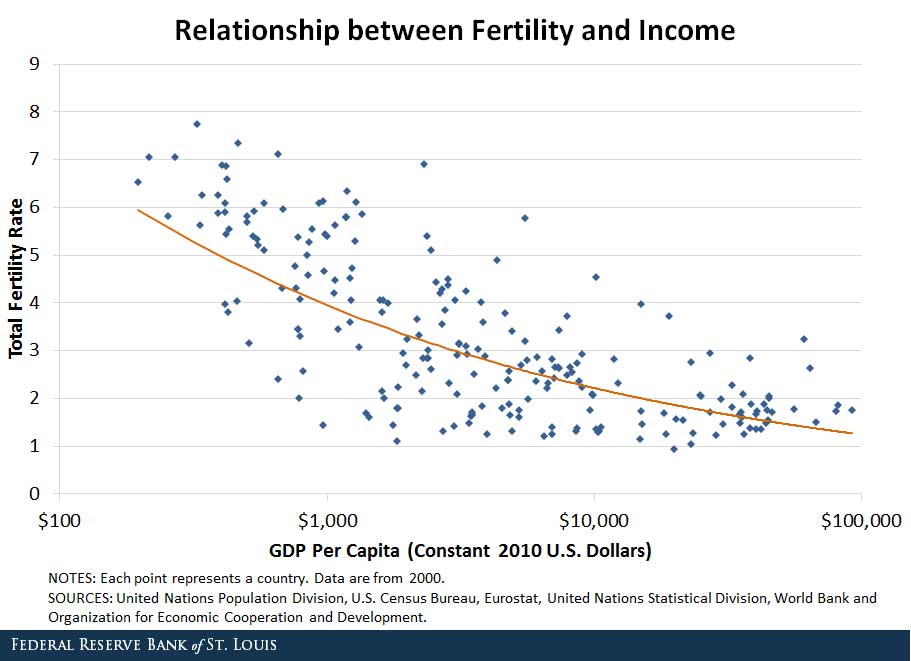
Why calculate per country at all? A global carbon tax/market wouldn’t need regional differences and would allow the market to optimize allocation between borders freely.
China has a moral obligation to reduce emissions because of high absolute values. America has a moral obligation because of high per-capita values.
America has high absolute values, as well, and is ranked second. While its carbon emissions are only just over half of China's, they are also more than double that of India in third place, and comprise around 15% of total global emissions (based on 2018 data).
Absolutely. High absolute indicates a lot of damage and should be reduced. High per-capita indicates a lot of excess and/or waste, which should be reduced.
Number of people is what ultimately matters. The amount of CO2 per capita tends towards the same ballpark. Somewhere between 5-10 t/year/capita [0].
US, alas, is at 16t/year, though decreasing. Overall contribution: 330M * 16 = 5B t/year.
Now let's watch how the 6 billion people that did not exist circa 1900 catch up in emissions with the high energy regimen that characterizes 'western middle class' lifestyle. Let's lowball at 5t/year/capita. Overall contribution: 6000M * 5 = 30B t/year. Earth as we know it will not survive that.
And that's before we factor in that population is still booming, both globally and, through global migration, in US.
[0] https://ourworldindata.org/grapher/co-emissions-per-capita?t...
[1] https://ourworldindata.org/grapher/world-population-by-world...
US, alas, is at 16t/year, though decreasing. Overall contribution: 330M * 16 = 5B t/year.
Now let's watch how the 6 billion people that did not exist circa 1900 catch up in emissions with the high energy regimen that characterizes 'western middle class' lifestyle. Let's lowball at 5t/year/capita. Overall contribution: 6000M * 5 = 30B t/year. Earth as we know it will not survive that.
And that's before we factor in that population is still booming, both globally and, through global migration, in US.
[0] https://ourworldindata.org/grapher/co-emissions-per-capita?t...
[1] https://ourworldindata.org/grapher/world-population-by-world...
I would be interested in what the energy consumption spread is like over a region. Not trying to start a class war, but suburban or rural folks energy consumption (total, including manufactured goods, food, everything) vs urban, what is the base rate and then the somewhat optional delta on top of that.
It feels like the leakage current of civilization is too high, at least for western economies in how much co2 they produce while not producing anything. Great if running at some rate, but they aren't clockless and can't scale down. Statically scheduled instead of dynamic.
It feels like the leakage current of civilization is too high, at least for western economies in how much co2 they produce while not producing anything. Great if running at some rate, but they aren't clockless and can't scale down. Statically scheduled instead of dynamic.
If per capita in the US matters that much, I'd expect the drop to be much larger than 8%, given that the country has largely shut down. 75% seems like a pipe dream in that case.
Since we need money to combat climate change, then what really matters is per-unit of GDP.
That also solves the unseen "import goods" CO2 emissions problem.
That also solves the unseen "import goods" CO2 emissions problem.
Using this argument we could split the world into “China” and “not China”. Suddenly, China is dwarfed by “not China” and no longer matters!
And if we divide the world into 7 billion countries, nobody needs to do anything, right?
Point is more that we need to do something about China, no matter the "per capita" distraction:
https://www.forbes.com/sites/rrapier/2018/07/01/china-emits-...
Point is more that if a successful separatist movement in China, which just redraws borders without closing any power plants, is all it takes to turn that reasoning into "we need to do something about USA", then it seems like a wonky measurement.
A measurement that says China is the problem but not Huabei, Dongbei, Huadong, Zhongnan, Xinan, or Xibei, is wonky.
A measurement that says the EU emits too much carbon but France, Germany, Italy, Spain, Greece, and Poland don't, is also wonky.
If you start from a premise that each human has an equal right to emit carbon as any other, regardless of which country they're born in, then you naturally get per-capita measures as a result. An absolute measure implies that each country has an equal right to emit carbon, but since countries are fluid and artificial constructs, that results in some pretty weird consequences, like each person in Britain being allowed to burn more gasoline if Scotland leaves the UK. Growing up in times of stability it might seem like countries are concrete and unchangeable, but borders move and countries appear and disappear all the time, and an international law that only applied to the top emitter would likely be enough pressure to cause that country to redefine itself as an informal federation of multiple states.
A measurement that says China is the problem but not Huabei, Dongbei, Huadong, Zhongnan, Xinan, or Xibei, is wonky.
A measurement that says the EU emits too much carbon but France, Germany, Italy, Spain, Greece, and Poland don't, is also wonky.
If you start from a premise that each human has an equal right to emit carbon as any other, regardless of which country they're born in, then you naturally get per-capita measures as a result. An absolute measure implies that each country has an equal right to emit carbon, but since countries are fluid and artificial constructs, that results in some pretty weird consequences, like each person in Britain being allowed to burn more gasoline if Scotland leaves the UK. Growing up in times of stability it might seem like countries are concrete and unchangeable, but borders move and countries appear and disappear all the time, and an international law that only applied to the top emitter would likely be enough pressure to cause that country to redefine itself as an informal federation of multiple states.
> Its about a 4% drop each year for 30 years. Or a Coronavirus every 2 years.
This is an incredibly misleading way to put it... there's no compounding effect to be had here. If a coronavirus drops by 4% from pre-coronavirus times the first year, it's still going to be only 4% lower than pre-coronavirus times after 30 years.
This is an incredibly misleading way to put it... there's no compounding effect to be had here. If a coronavirus drops by 4% from pre-coronavirus times the first year, it's still going to be only 4% lower than pre-coronavirus times after 30 years.
So if everyone staying home and only driving when necessary* only reduces emissions a fraction of what's necessary, is it even possible?
*I know not everyone is staying home
*I know not everyone is staying home
Move somehere you can ride a bike, walk, or take electrified transport, heat and cool your extremely efficient NZEB timber-frame home with a solar or wind-fuelled heat pump, eat little meat (restore the grazing land to peatland, forest, etc. too), have 2 or fewer children, and take holidays via rail instead of plane, and you're mostly there.
That's both sad and funny that you think all of those things are possible in the same location in the US. I count 4 major infrastructure projects and 3 massive tax incentives that would need to be implemented in order to convince most people to do all of that. Not possible nation wide within a time frame of less than 30 years. Suggesting the majority of a large country's population move to regions where this is possible is also a non-starter without huge economic incentives and would have many unintended side effects due to depopulation of some areas and massive immigration to other areas.
The only approach I see working in the US is a decentralized one that takes into account the unique geography and population distribution. Move the efficiencies out to the edges, electric vehicles, rooftop solar, small scale nuclear, more fibre rollout for remote working, incentives for local farms and land management. Work with the existing infrastructure and culture rather than against it and you'll get a lot further.
As far as less cattle and more forest/peat, the US actually had a trend of decreasing agricultural usage and increase in forest cover for most of the last century. Forest cover began to diminish again with increased urbanization and timber cutting so encouraging migration to the regions with the highest population density, the coasts, would further increase deforestation since that's also where the majority of forests are. If you look at maps showing rangeland vs forest and peatland there isn't much overlap in the US, it turns out the best cattle producing areas in the US are those that were already grassland to begin with, go figure.
The only approach I see working in the US is a decentralized one that takes into account the unique geography and population distribution. Move the efficiencies out to the edges, electric vehicles, rooftop solar, small scale nuclear, more fibre rollout for remote working, incentives for local farms and land management. Work with the existing infrastructure and culture rather than against it and you'll get a lot further.
As far as less cattle and more forest/peat, the US actually had a trend of decreasing agricultural usage and increase in forest cover for most of the last century. Forest cover began to diminish again with increased urbanization and timber cutting so encouraging migration to the regions with the highest population density, the coasts, would further increase deforestation since that's also where the majority of forests are. If you look at maps showing rangeland vs forest and peatland there isn't much overlap in the US, it turns out the best cattle producing areas in the US are those that were already grassland to begin with, go figure.
"That's both sad and funny that you think all of those things are possible in the same location in the US."
I don't think it's possible in the US. It's why I left the US. Sadly, the US makes it illegal to build what I describe.
"huge economic incentives..."
Change zoning laws to allow high density building near transit. SB50 in California for instance. It's pretty obvious people _want_ more homes like this since the cost of living in places like this is already astronomical. Not sure what incentives you need when people are already paying insane amounts to enjoy living like this?
Finally, nothing in my comment referenced the US.
I don't think it's possible in the US. It's why I left the US. Sadly, the US makes it illegal to build what I describe.
"huge economic incentives..."
Change zoning laws to allow high density building near transit. SB50 in California for instance. It's pretty obvious people _want_ more homes like this since the cost of living in places like this is already astronomical. Not sure what incentives you need when people are already paying insane amounts to enjoy living like this?
Finally, nothing in my comment referenced the US.
It is possible.
In a few days Tesla will hold its "Battery day". Some people [1] expect them to announce a $100/kWh battery. If this happens, and with further future battery cost reductions, the ground transportation will shift from gasoline to electric in a matter of 10-15 years.
Solar and wind power generation are on a tear. California only has installed 27 GW of solar power generation and will install an additional 15 GW in the next 5 years [2].
There's a chance some nuclear power generation will come into the mix.
More people will move to higher density urban areas, and will reduce their carbon footprint.
After Covid19, more work will be done from home, more conferences will be virtual, leading to reduced transportation.
With some luck, we will have synthetic meat in the not so distant future, which should lead to substantial agricultural emissions reductions.
And we should be planting trees. Trees are nice.
[1] https://cleantechnica.com/2020/04/15/what-will-tesla-tell-us...
[2] https://www.seia.org/state-solar-policy/california-solar
In a few days Tesla will hold its "Battery day". Some people [1] expect them to announce a $100/kWh battery. If this happens, and with further future battery cost reductions, the ground transportation will shift from gasoline to electric in a matter of 10-15 years.
Solar and wind power generation are on a tear. California only has installed 27 GW of solar power generation and will install an additional 15 GW in the next 5 years [2].
There's a chance some nuclear power generation will come into the mix.
More people will move to higher density urban areas, and will reduce their carbon footprint.
After Covid19, more work will be done from home, more conferences will be virtual, leading to reduced transportation.
With some luck, we will have synthetic meat in the not so distant future, which should lead to substantial agricultural emissions reductions.
And we should be planting trees. Trees are nice.
[1] https://cleantechnica.com/2020/04/15/what-will-tesla-tell-us...
[2] https://www.seia.org/state-solar-policy/california-solar
I think your rationale overemphasizes transportation, which is a minor part of our carbon footprint
Not according to the EPA [1]. In the US, transportation accounts for 28% of greenhouse emissions, and 82% of that (i.e. 23% of the total) from road vehicles [2]. If you could convert all of them to net zero vehicles in 10 years, that would be 2.3% emissions reduction per year. Not the full 4% needed, but not too shabby either.
[1] https://www.epa.gov/ghgemissions/sources-greenhouse-gas-emis...
[2] https://www.epa.gov/greenvehicles/fast-facts-transportation-...
[1] https://www.epa.gov/ghgemissions/sources-greenhouse-gas-emis...
[2] https://www.epa.gov/greenvehicles/fast-facts-transportation-...
There are a lot of major emissions sources not very affected (or even negatively affected) by people staying home, such as fossil fuel power plants, cargo ships and trucks, cattle farming, certain industries, etc.
[deleted]
It's very obviously not possible to get there by cutting consumption. It has been for a while, but that is all that is allowed into political discourses... probably because the anti-humanity "green" movement is so loud.
It is also very obviously possible to solve the problem.
It is also very obviously possible to solve the problem.
Or, according to UN gap report [0], the globe needs to cut emissions by 7.6% per year to stay below +1.5C.
So, it's a Coronavirus every 1 year.
[0] https://www.unenvironment.org/news-and-stories/press-release...
So, it's a Coronavirus every 1 year.
[0] https://www.unenvironment.org/news-and-stories/press-release...
Yep, CO2 or GDP, pick one.
Gives you a sense of the size of the problem.
Gives you a sense of the size of the problem.
I don't understand - Why the choice?
Solar + battery backup is currently cheaper than coal, and seems to be continuing its pattern of halving in price around every seven to ten years
It doesn't make economic sense to build coal power plants for most of the world
It takes on average six years to build a coal or gas power plant. During that six years, the price of solar will have almost halved again
Solar + battery backup is currently cheaper than coal, and seems to be continuing its pattern of halving in price around every seven to ten years
It doesn't make economic sense to build coal power plants for most of the world
It takes on average six years to build a coal or gas power plant. During that six years, the price of solar will have almost halved again
Well how do you mine lithium? What's the carbon footprint of recycling batteries ? (Do we even recycle them, or just make virtuous promises?)
We are nowhere close to reducing the consumption of fossil fuels. Green energy is just a sexy proxy.
We are nowhere close to reducing the consumption of fossil fuels. Green energy is just a sexy proxy.
> Or a Coronavirus every 2 years.
This seems plausible. Other coronaviruses that cause common cold make a comeback roughly every two years without mutating.
So if we don't have a vaccine we might have exactly that.
This seems plausible. Other coronaviruses that cause common cold make a comeback roughly every two years without mutating.
So if we don't have a vaccine we might have exactly that.
Even if we had a comparable pandemic every 2 years, it seems unlikely the associated CO₂ reductions would be cumulative and persistent, which is what we really need.
Dunno, making a bunch of airlines go bankrupt and teaching people to do meetings online might have lasting effects on how much people fly in the future too. One way or another, the world after the corona crisis is going to look rather different than the world before it.
Yes - so maybe a noticeable part of the current 8% dip will "stick".
But if it does, do you suppose the next pandemic will cause an equivalent additional dip? No, because whatever lasting changes have already been made are changes that aren't available to make when the next virus sweeps through.
To make real progress, we need to do far more than stay home, because staying home wins us 8% but we need 75%.
But if it does, do you suppose the next pandemic will cause an equivalent additional dip? No, because whatever lasting changes have already been made are changes that aren't available to make when the next virus sweeps through.
To make real progress, we need to do far more than stay home, because staying home wins us 8% but we need 75%.
An airline going bankrupt doesn’t mean that its planes will never fly again. It just means they’ll be flown by by the airline’s creditors once people start flying again.
Fewer airlines means lower supply, making air travel more expensive, which will make fewer people choose to buy it.
Which hopefully would be paired with more inter-urban high-speed rail regionally* where it would make sense in terms of mirroring or even beating your standard drive/flight time.
Hell, even if a more widespread high-speed rail system were still slower than air travel I would still take it because air travel is absolutely miserable and I detest it with every fiber of my being.
*I specify regionally because I know someone is going to "WELL AKSHUALLY " me on the fact that the US is a large spread out country and intercontinental high speed rail wouldn't work (though I would love to take a train from NYC to LA because why not?).
Hell, even if a more widespread high-speed rail system were still slower than air travel I would still take it because air travel is absolutely miserable and I detest it with every fiber of my being.
*I specify regionally because I know someone is going to "WELL AKSHUALLY " me on the fact that the US is a large spread out country and intercontinental high speed rail wouldn't work (though I would love to take a train from NYC to LA because why not?).
What folks should have said is, "we need the comparable pandemics to double every 2 years".
Some industries need to turn off. We are doing too much across the board.
Some industries need to turn off. We are doing too much across the board.
>Some industries need to turn off. We are doing too much across the board
I've been thinking about this for a while, and with the pandemic, it's been on my mind regularly.
We really need to re-think, well, almost every aspect of how we live and consume. Far less car use, more sustainable living, including increasing densities, which does not mean everyone needs to live in Manhattan or Tokyo level densities, just better land use and more pedestrian/bike-friendly infrastructure. Make it easier to get fresh food locally. More green space.
One of the biggest changes in my life was moving to a city where I can walk anywhere and everywhere (most things are within a mile or two). It may take a little longer (and mass transit is there to pick up the slack) but the impact of regular, constant exercise cannnot be overstated by this kind of lifestyle change (and something most Americans desperately need, honestly. We are incredibly unhealthy, I was one of them).
I've been thinking about this for a while, and with the pandemic, it's been on my mind regularly.
We really need to re-think, well, almost every aspect of how we live and consume. Far less car use, more sustainable living, including increasing densities, which does not mean everyone needs to live in Manhattan or Tokyo level densities, just better land use and more pedestrian/bike-friendly infrastructure. Make it easier to get fresh food locally. More green space.
One of the biggest changes in my life was moving to a city where I can walk anywhere and everywhere (most things are within a mile or two). It may take a little longer (and mass transit is there to pick up the slack) but the impact of regular, constant exercise cannnot be overstated by this kind of lifestyle change (and something most Americans desperately need, honestly. We are incredibly unhealthy, I was one of them).
I thought immunity was "lost" because the common cold mutates so quickly, and the immune system response is too specific?
Flu has specific mechanisms that allow for very fast mutation and that's why it's coming back. Coronaviruses don't have those mechanisms. What's more they have some mechanisms that prevent mutations. And yet they come back as well. It's probably because immunity to them don't last long.
Here's cool explanation of how flu mutates and how it compares with coronaviruses: https://www.city-journal.org/coronavirus-vaccine
Here's cool explanation of how flu mutates and how it compares with coronaviruses: https://www.city-journal.org/coronavirus-vaccine
Colds are caused by coronaviruses and rhinoviruses, and there is a bunch of them. So the reason you get them often is not the lack of immunity, but because you can get infected but yet another virus you have no immunity for.
I'm talking specifically about colds caused by coronaviruses. They tend to peak about every two years and there are only few strains of them. Even if each peak is always caused by different strain we can pretty much rule out lifetime immunity.
BTW, here's a cool movie that sums up what we know so far about possibility of developing long term immunity to the sars-cov-2
https://www.youtube.com/watch?v=7KBLtUBr1Os
BTW, here's a cool movie that sums up what we know so far about possibility of developing long term immunity to the sars-cov-2
https://www.youtube.com/watch?v=7KBLtUBr1Os
My impression was that unlike influenza, the common cold actually mutates very little, but that the immunity loss comes from the body 'forgetting' the antibodies for it after a while - I'm no doctor though.
Only 8%? I was waiting for news on this but 8% is on the worst-case side of my hopes. We're going to need so much more to even get close to neutral.
And this is assuming we don't emit extra to make up for it whenever the economy ramps back up...
I wonder if there can't be some compound effect on sudden spike on pollution once things go back. But maybe it will be so gradual it won't happen, and anyway things like consumption and traveling will not be the same I believe
I guess this is one silver lining from the pandemic, but it's worth highlighting that this 8% drop in emissions rate only means that the concentration of CO2 in the atmosphere is rising more slowly. It's still rising.
So we've got the second derivative going in the correct direction, at least.
So we've got the second derivative going in the correct direction, at least.
Well, technically this is right about the time of year when CO2 concentration stops increasing and drops sharply for the next couple of months, corresponding to the Northern hemisphere growing season.
CO2 doesn't increase monotonically, it's actually more like a sine wave with an upward trend. It's that upward trend that has everyone rightfully worried, but the seasonal oscillation is part of the pattern too.
https://en.wikipedia.org/wiki/Keeling_Curve
CO2 doesn't increase monotonically, it's actually more like a sine wave with an upward trend. It's that upward trend that has everyone rightfully worried, but the seasonal oscillation is part of the pattern too.
https://en.wikipedia.org/wiki/Keeling_Curve
Also worth noting that the ways to realistically address climate change require a massive, historic investment. I don’t know what the limit is on world governments’ ability to write a giant blank check, but I can’t imagine the trillions we need to spend on the current crisis makes turning around and dropping trillions on the next one any easier.
Truly? How many Trillions of dollars have we spent to slow the descent of the stock market in the last few months? How many more are we planning on spending?
We aren't on the gold standard, we're on the idea standard. As such, our money is worth what we say it is worth and we can have as much of it as we want. If we said tomorrow "Here's 100 Trillion USD to fix climate change" we could do so.
Yes I'm ignoring the inflationary effects for this example, but ultimately it doesn't matter. If we don't have a world to live in we'll have much larger concerns than inflation.
We aren't on the gold standard, we're on the idea standard. As such, our money is worth what we say it is worth and we can have as much of it as we want. If we said tomorrow "Here's 100 Trillion USD to fix climate change" we could do so.
Yes I'm ignoring the inflationary effects for this example, but ultimately it doesn't matter. If we don't have a world to live in we'll have much larger concerns than inflation.
Exactly. We don’t have a choice. And as powerful as that toolkit is, nothing is infinite.
It might actually. Once you have had one impossible thought before breakfast, subsequent impossible thoughts surely become easier to have.
We've got tons of lagging indicators incoming:
The Untold Toll — The Pandemic’s Effects on Patients without Covid-19: https://www.nejm.org/doi/full/10.1056/NEJMms2009984
COVID-19 Is Likely to Lead to an Increase in Suicides: https://blogs.scientificamerican.com/observations/covid-19-i...
Coronavirus could deplete Social Security as early as 'this decade': analysis: https://www.yahoo.com/finance/news/coronavirus-could-deplete...
"Deaths of despair”: The deadly epidemic that predated coronavirus: https://www.vox.com/2020/4/15/21214734/deaths-of-despair-cor...
'Biblical' famines could double global hunger as a result of the coronavirus crisis, UN warns: https://www.cnbc.com/amp/2020/04/22/coronavirus-biblical-fam...
How COVID-19 may increase domestic violence and child abuse: https://www.apa.org/topics/covid-19/domestic-violence-child-...
Millions of Credit-Card Customers Can’t Pay Their Bills. Lenders Are Bracing for Impact: https://www.wsj.com/articles/millions-of-credit-card-custome...
The Untold Toll — The Pandemic’s Effects on Patients without Covid-19: https://www.nejm.org/doi/full/10.1056/NEJMms2009984
COVID-19 Is Likely to Lead to an Increase in Suicides: https://blogs.scientificamerican.com/observations/covid-19-i...
Coronavirus could deplete Social Security as early as 'this decade': analysis: https://www.yahoo.com/finance/news/coronavirus-could-deplete...
"Deaths of despair”: The deadly epidemic that predated coronavirus: https://www.vox.com/2020/4/15/21214734/deaths-of-despair-cor...
'Biblical' famines could double global hunger as a result of the coronavirus crisis, UN warns: https://www.cnbc.com/amp/2020/04/22/coronavirus-biblical-fam...
How COVID-19 may increase domestic violence and child abuse: https://www.apa.org/topics/covid-19/domestic-violence-child-...
Millions of Credit-Card Customers Can’t Pay Their Bills. Lenders Are Bracing for Impact: https://www.wsj.com/articles/millions-of-credit-card-custome...
Flattening the curve :)
What would it take to drop it by say 50%? How is the drop not higher?
What will be the immediate effect of, what, a 90% drop in high-altitude cloud formation by water vapour emitted by jets? The major drop in soot flowing over the north poll?
Immediate and shocking drop in average daily temperatures, and dramatic accumulation of snow in the north polar area over this next winter/spring, I predict.
And, a stunning repudiation of the models that have basically ignored these 2 major factors.
Immediate and shocking drop in average daily temperatures, and dramatic accumulation of snow in the north polar area over this next winter/spring, I predict.
And, a stunning repudiation of the models that have basically ignored these 2 major factors.
My personal experience has been that the weather forecasts have been consistently colder/wetter than the actual weather over the last 6 weeks, which has been surprisingly sunny almost every day. (Oregon, USA)
Many environmental changes produce almost imperceptible results.
Removal of high level cloud formation isn’t going to be one of them, I predict!
But, I could be wrong. We’ll know with statistical certainty almost immediately (months).
Removal of high level cloud formation isn’t going to be one of them, I predict!
But, I could be wrong. We’ll know with statistical certainty almost immediately (months).
Thanks to 9/11 it's already been studied, and surely this pandemic will add to that body:
https://news.psu.edu/story/361041/2015/06/18/research/jet-co...
https://news.psu.edu/story/361041/2015/06/18/research/jet-co...
Chicago, as well, has been chillier than usual for the same duration. Haven't noticed a difference in rainfall.
Mind expanding on that a bit? The conclusion seems counterintuitive.
Removing or dramatically reducing the two greatest factors in surface temperature and snow pack accumulation will prove scientifically interesting.
It should reinforce or repudiate the assumptions underlying our climate models - which have chosen to basically ignore these 2 factors.
I predict, in the next 6-12 months, that statistically significant deviations in predicted vs. actual temperatures and snow accumulation will appear, repudiating this assumption that ignoring these factors was scientifically sound.
It should reinforce or repudiate the assumptions underlying our climate models - which have chosen to basically ignore these 2 factors.
I predict, in the next 6-12 months, that statistically significant deviations in predicted vs. actual temperatures and snow accumulation will appear, repudiating this assumption that ignoring these factors was scientifically sound.
thats a lot of words for saying absolutely nothing
Surface temperature is most affected by thermal blanketing provided by clouds - reduce clouds, temperature drops. Climate is the sum under the curve of weather.
Drop gigatons of soot on polar snow/icepack, it melts due to insolation. Reduce soot, it re-accumulates - especially if avg. temperature drops due to reduced high cloud formation, by reduced “great circle” jet traffic.
Apparently, neither of these effects have been effectively modelled in the “climate models” used.
Shocking scientific shame ensues.
Or, I’m wrong, and no such thing happens. Now we’ll see!
Drop gigatons of soot on polar snow/icepack, it melts due to insolation. Reduce soot, it re-accumulates - especially if avg. temperature drops due to reduced high cloud formation, by reduced “great circle” jet traffic.
Apparently, neither of these effects have been effectively modelled in the “climate models” used.
Shocking scientific shame ensues.
Or, I’m wrong, and no such thing happens. Now we’ll see!
> Shocking scientific shame ensues.
It really does not sound plausible that all the people who spend all day improving climate models never even thought about this.
It really does not sound plausible that all the people who spend all day improving climate models never even thought about this.
Climate models challenged by cloud modelling:
https://www.carbonbrief.org/guest-post-why-clouds-hold-key-b...
Effect of contrails not modeled well, even though "contrail cirrus have contributed more to warming the atmosphere than all CO2 emitted by aircraft since the start of aviation.":
https://www.sciencedaily.com/releases/2019/06/190627113949.h...
New research shows the contrails are playing a significant role in global warming:
https://e360.yale.edu/features/how-airplane-contrails-are-he...
Little attention has been given to soot and snow albedo:
https://www.sciencedirect.com/science/article/abs/pii/S13522...
High loss in greenland due to soot and dirt:
https://www.nationalgeographic.com/news/2014/6/140610-connec...
Cutting soot emissions fastest solution to arctic ice melt:
https://www.theguardian.com/environment/2016/dec/21/cutting-...
Now, the arctic warming has not been caused by soot, but by the reduction in average snow cover, caused by dramatic warming since the 1980s:
https://www.ncbi.nlm.nih.gov/pmc/articles/PMC6883849/
Which coincides nicely with the increase in high-level cloud formation and heat blanketing causee by the increase in "great circle" air traffic since that time:
https://data.worldbank.org/indicator/IS.AIR.PSGR
Now, why hasn't this been modeled? Because they are complex to model; pre-industrial clouds don't match post-industrial, and the modelers don't know why:
https://phys.org/news/2016-03-narrow-clouds-hard.html
So, now we'll see -- there will be a dramatic change in cloud formation due to not dumping 1/2 a billion tons per year of water into the super-dry upper troposphere, over a several month period. Good fun!
From a previous thread (https://news.ycombinator.com/item?id=22224141), I wrote:
> Those now attempting to figure out the mystery of the hot climate models think one factor might have caused the recent unusual results: clouds. It turns out simulated clouds often cause headaches for climate modelers.
The impact of cloud cover in these models has been incorrect, and has such a large impact. Doesn't this strike anyone as a major problem?
We're burning about 100 billion gallons of aviation fuel per year.
> This means each gallon of jet fuel (6.5lbs) will combine with 23lbs of Oxygen and turn into twenty pounds of CO2, and just over nine pounds of water! (see: https://paullaherty.com/2015/01/10/calculating-aircraft-co2-...).
So that's 100B gallons * 9lbs is about a half a billion metric tons of water vapor going into the dry upper troposphere annually from commercial aviation.
Which, evidence would seem to suggest, has not been modeled properly (at all?) by these climate models?
If I was producing these models, I would be embarrassed.
https://www.carbonbrief.org/guest-post-why-clouds-hold-key-b...
Effect of contrails not modeled well, even though "contrail cirrus have contributed more to warming the atmosphere than all CO2 emitted by aircraft since the start of aviation.":
https://www.sciencedaily.com/releases/2019/06/190627113949.h...
New research shows the contrails are playing a significant role in global warming:
https://e360.yale.edu/features/how-airplane-contrails-are-he...
Little attention has been given to soot and snow albedo:
https://www.sciencedirect.com/science/article/abs/pii/S13522...
High loss in greenland due to soot and dirt:
https://www.nationalgeographic.com/news/2014/6/140610-connec...
Cutting soot emissions fastest solution to arctic ice melt:
https://www.theguardian.com/environment/2016/dec/21/cutting-...
Now, the arctic warming has not been caused by soot, but by the reduction in average snow cover, caused by dramatic warming since the 1980s:
https://www.ncbi.nlm.nih.gov/pmc/articles/PMC6883849/
Which coincides nicely with the increase in high-level cloud formation and heat blanketing causee by the increase in "great circle" air traffic since that time:
https://data.worldbank.org/indicator/IS.AIR.PSGR
Now, why hasn't this been modeled? Because they are complex to model; pre-industrial clouds don't match post-industrial, and the modelers don't know why:
https://phys.org/news/2016-03-narrow-clouds-hard.html
So, now we'll see -- there will be a dramatic change in cloud formation due to not dumping 1/2 a billion tons per year of water into the super-dry upper troposphere, over a several month period. Good fun!
From a previous thread (https://news.ycombinator.com/item?id=22224141), I wrote:
> Those now attempting to figure out the mystery of the hot climate models think one factor might have caused the recent unusual results: clouds. It turns out simulated clouds often cause headaches for climate modelers.
The impact of cloud cover in these models has been incorrect, and has such a large impact. Doesn't this strike anyone as a major problem?
We're burning about 100 billion gallons of aviation fuel per year.
> This means each gallon of jet fuel (6.5lbs) will combine with 23lbs of Oxygen and turn into twenty pounds of CO2, and just over nine pounds of water! (see: https://paullaherty.com/2015/01/10/calculating-aircraft-co2-...).
So that's 100B gallons * 9lbs is about a half a billion metric tons of water vapor going into the dry upper troposphere annually from commercial aviation.
Which, evidence would seem to suggest, has not been modeled properly (at all?) by these climate models?
If I was producing these models, I would be embarrassed.
Is coronavirus the Earth's antibodies?
Can we please stop with this narrative? Earth is just a dumb rock. Humans are just one of the species living on it.
We are chaning the world, but so did cyanobacteria.
Well monkey, it's a dumb rock that has absolutely annihilated life on a mass scale in one cataclysm after another. We're inviting our own destruction by farting up a storm in a century that in previous cycles has taken tens of thousands or even millions of years to create.
You should have more respect for the dumb rock that gave rise the impossibly varied and rich life here. It's our only home in a vast, empty, and horribly inhospitable universe.
You should have more respect for the dumb rock that gave rise the impossibly varied and rich life here. It's our only home in a vast, empty, and horribly inhospitable universe.
One year of Atmospheric Carbon Dioxide: https://svs.gsfc.nasa.gov/vis/a010000/a011700/a011719/11719-...
This is unfortunately not permanent. Of course the emissions are down - transportation and industries are shut down. The sad return is when economies grow they pollute more and faster.
We need to break the correlation between gdp and emissions
The mass quarantine is most likely going to cause another baby boom. I wonder if the longer term effect of the pandemic is actually going to accelerate climate change.
Please forgive my ignorance - why is this being down-voted (rhetorical)?
Shouldn't this be discussed, at least? In preparation of the various scenarios.
Wouldn't it make sense with everyone stuck at home and bored, "things" might happen? In a few years we might refer to children born in 2021 as "Corona/Covid Kids", no?
And with a population "boom", pressures on the planet may increase? Perhaps. People may become desperate for the "good old days", and/or won't care so much about the planet because they are desperate to survive financially at any cost [to the planet]...?
Perhaps not - if society becomes more conservative relative to "dirty" energy usage (oil, plastics, etc)...? And beings to enjoy, and appreciate things like working from home, cleaner air, etc...
[edit]: I should say that the "boom" may be tiny, if so none of this may matter.
Shouldn't this be discussed, at least? In preparation of the various scenarios.
Wouldn't it make sense with everyone stuck at home and bored, "things" might happen? In a few years we might refer to children born in 2021 as "Corona/Covid Kids", no?
And with a population "boom", pressures on the planet may increase? Perhaps. People may become desperate for the "good old days", and/or won't care so much about the planet because they are desperate to survive financially at any cost [to the planet]...?
Perhaps not - if society becomes more conservative relative to "dirty" energy usage (oil, plastics, etc)...? And beings to enjoy, and appreciate things like working from home, cleaner air, etc...
[edit]: I should say that the "boom" may be tiny, if so none of this may matter.
It could as easily go the other way, and cause a drop on births. Either way it goes, the effect will probably be small and localized (where each place will have things differently).
The US baby boom was caused by a coincidence of many important factors (people thinking "today is probably my last free day ever" was a huge one). We have none of them today.
The US baby boom was caused by a coincidence of many important factors (people thinking "today is probably my last free day ever" was a huge one). We have none of them today.
> (people thinking "today is probably my last free day ever" was a huge one)
The US baby boom coincided with when WWII ended, not began or during. Mainly it was families that would've gotten started during the war getting delayed until after.
The US baby boom coincided with when WWII ended, not began or during. Mainly it was families that would've gotten started during the war getting delayed until after.
Here is a view from the observatory at Mauna Loa
https://www.esrl.noaa.gov/gmd/ccgg/index.html#co2change
TLDR; no difference visible on actual CO2 levels
https://www.esrl.noaa.gov/gmd/ccgg/index.html#co2change
TLDR; no difference visible on actual CO2 levels
That is actually the scariest thing about CO2. It's going to stay in our atmosphere for 100 of years. So even just stopping emitting is just about maintaining the status quo.
Once the crisis becomes really bad, we don't have any more means to reduce it.
(I set a very low belief in sequestration methods because they're thermodynamically crazy..)
Once the crisis becomes really bad, we don't have any more means to reduce it.
(I set a very low belief in sequestration methods because they're thermodynamically crazy..)
https://climeworks.shop/?utm_source=CW-Website&utm_medium=ba... is already doing this, it’s not thermodynamically crazy just economically expensive. I am paying 25 eur/month for now, with the plan that if they can make it cheaper I will spend more.
The tech is developing. We have plenty of energy from the sun to sequester co2. It’s just in its infancy at the moment
The tech is developing. We have plenty of energy from the sun to sequester co2. It’s just in its infancy at the moment
> That is actually the scariest thing about CO2. It's going to stay in our atmosphere for 100 of years. So even just stopping emitting is just about maintaining the status quo.
And the worst part about that is the status quo is still warming.
We need to have a net reduction in CO2 levels in order not to blow past catastrophic temperatures.
And the worst part about that is the status quo is still warming.
We need to have a net reduction in CO2 levels in order not to blow past catastrophic temperatures.
And that reduction needs to be greater than the increase from thawing tundra and burning forests.
We could stop all anthropogenic sources of green house gasses and the atmospheric PPM will continue to increase.
We could stop all anthropogenic sources of green house gasses and the atmospheric PPM will continue to increase.
> I set a very low belief in sequestration methods because they're thermodynamically crazy.
With current tech I agree completely.
In the sci-fi future of my fantasies [0], industrial oil for plastics etc. will come from GM algae or similar, which would sequester CO2 from the air by photosynthesis.
[0] which may or may not even be possible — I don’t know, I’m not a biologist, and there has to be a reason why the previous efforts have failed
With current tech I agree completely.
In the sci-fi future of my fantasies [0], industrial oil for plastics etc. will come from GM algae or similar, which would sequester CO2 from the air by photosynthesis.
[0] which may or may not even be possible — I don’t know, I’m not a biologist, and there has to be a reason why the previous efforts have failed
What do you think about Project Vesta[1]?
[1]: https://projectvesta.org/
[2]: https://www.prnewswire.com/news-releases/nature-based-climat... (2020-04-22)
[3]: https://twitter.com/project_vesta
[1]: https://projectvesta.org/
[2]: https://www.prnewswire.com/news-releases/nature-based-climat... (2020-04-22)
[3]: https://twitter.com/project_vesta
I don’t know enough, to be sure.
How large are global olivine reserves compares to historical and future CO2 emissions? What are the side effects at the required scale?
I’m glad they’re doing the experiments, and I’m sure they consider any question I can come up with (including the above) to be trite to the point of cliché.
From the cost and quantity requirements in their FAQ, this will cost $232.4 billion/year. While that ought to be considered affordable vs. the world economy… well, call me cynical, but I don’t think voters or politicians think like that.
As grid scale PV reportedly costs $0.7/watt (peak) in the USA, that money could also install 332 GW of additional solar every year. As the panels look like they should last 30 years, that gives a steady-state equivalent of 9.96 TW (peak), compared to total (not just electrical) global consumption of double that continually, and I’ll fudge-factor as another x2.5 on top to convert peak solar output to time-averaged solar output to make PV x5 the cost of olivine.
So, economically that looks good with current tech, but may look bad if grid-scale PV goes below $0.14/watt (peak).
But that analysis assumes that fossil fuels are free, and as current solar prices are already cheaper than fossil fuels (0), people will probably switch to PV regardless of olivine and save money while doing so. But olivine is probably still useful for the CO2 sources that are hard to substitute with eco-friendly alternatives.
(0) What’s that Skippy, current oil prices are negative?
How large are global olivine reserves compares to historical and future CO2 emissions? What are the side effects at the required scale?
I’m glad they’re doing the experiments, and I’m sure they consider any question I can come up with (including the above) to be trite to the point of cliché.
From the cost and quantity requirements in their FAQ, this will cost $232.4 billion/year. While that ought to be considered affordable vs. the world economy… well, call me cynical, but I don’t think voters or politicians think like that.
As grid scale PV reportedly costs $0.7/watt (peak) in the USA, that money could also install 332 GW of additional solar every year. As the panels look like they should last 30 years, that gives a steady-state equivalent of 9.96 TW (peak), compared to total (not just electrical) global consumption of double that continually, and I’ll fudge-factor as another x2.5 on top to convert peak solar output to time-averaged solar output to make PV x5 the cost of olivine.
So, economically that looks good with current tech, but may look bad if grid-scale PV goes below $0.14/watt (peak).
But that analysis assumes that fossil fuels are free, and as current solar prices are already cheaper than fossil fuels (0), people will probably switch to PV regardless of olivine and save money while doing so. But olivine is probably still useful for the CO2 sources that are hard to substitute with eco-friendly alternatives.
(0) What’s that Skippy, current oil prices are negative?
> I set a very low belief in sequestration methods because they're thermodynamically crazy..
A solar farm plugged into a machine building plastic may sound crazy to you because oil is so cheap, but keep in mind that the theoretical bottom for the price of that solar farm is basically limited by the labor required to place it there.
There isn't even much of a reason for the generic "plastic" created by such a project not to be PV panels by itself.
A solar farm plugged into a machine building plastic may sound crazy to you because oil is so cheap, but keep in mind that the theoretical bottom for the price of that solar farm is basically limited by the labor required to place it there.
There isn't even much of a reason for the generic "plastic" created by such a project not to be PV panels by itself.
It's probably a fatalist way of looking at things but if the lockdown, with it's massive changes to our normal lifestyles, isn't doing enough then is it even realistically possible for us to change?
The lockdown is not an appropriate means of stopping climate change. People still need to eat and to heat their homes. We need to switch to sustainable means of providing for these (and other) necessities. We don't need to stop our economy to stop producing CO2. We need to stop burning fossil fuels.
Sure, the intention of the lock down is not to prevent climate change. However, the knock on effects are clearly beneficial; a complete halting of nonessential travel, anyone who can work from home working from home, a lot of business and industry shut down. In effect it is at or beyond the upper bound on what personal choice could achieve.
All of that and it basically sets the rate of increase back a decade or so.
To stop burning fossil fuels requires huge advances in energy storage (grid scale batteries, hydrogen / ammonia, thermal storage), energy production (breakthrough in nuclear fusion, more efficient solar) or massive political changes (conventional nuclear, carbon taxes). Probably a combination of all 3.
All of that and it basically sets the rate of increase back a decade or so.
To stop burning fossil fuels requires huge advances in energy storage (grid scale batteries, hydrogen / ammonia, thermal storage), energy production (breakthrough in nuclear fusion, more efficient solar) or massive political changes (conventional nuclear, carbon taxes). Probably a combination of all 3.
No. Because just scrapping the economy won't do.
I know there are many people out there that firmly believe that "less is more" and "growth must be stopped". But these people do almost definitely do not live in countries where children die because of poverty.
Our economics might be perverse in some regards, but they are the most efficient way to generate material wealth that we know of. And we need material wealth. As an example, just think of what is necessary to mass-produce a hypothetical Corona vaccine.
So what can we do? Swing away from CO2-emitting energy generation as quickly as possible, plant forests, prepare for inevitable climate changes (drought, storm, ocean rising), and plant even more forests.
I know there are many people out there that firmly believe that "less is more" and "growth must be stopped". But these people do almost definitely do not live in countries where children die because of poverty.
Our economics might be perverse in some regards, but they are the most efficient way to generate material wealth that we know of. And we need material wealth. As an example, just think of what is necessary to mass-produce a hypothetical Corona vaccine.
So what can we do? Swing away from CO2-emitting energy generation as quickly as possible, plant forests, prepare for inevitable climate changes (drought, storm, ocean rising), and plant even more forests.
I think we now of better ways in theory. It’s a political issue not a lack of knowledge.
A dividend from a global carbon tax could put a bit of money in the hands of those who live in poverty. And giving poor people money has been proven to be an efficient approach to increase wealth.
A dividend from a global carbon tax could put a bit of money in the hands of those who live in poverty. And giving poor people money has been proven to be an efficient approach to increase wealth.
Of course you can redistribute wealth in many meaningful ways. (just think of mandatory social insurance or minimum wages.) The problem is how to produce the wealth you want to distribute in the first place. There has been no system that comes even close in regards to innovation and efficiency when it comes to production.
My point was that the suggestion actually have been proven to “produce wealth” efficiently.
And I’m pretty sure there at a lot of such knowledge in out there. So it’s not really a problem of finding ways to produce wealth. It’s a problem of how to inform policy based on existing knowledge.
And I’m pretty sure there at a lot of such knowledge in out there. So it’s not really a problem of finding ways to produce wealth. It’s a problem of how to inform policy based on existing knowledge.
I wouldn't expect to see much change. We are still emitting 92% of what we emitted last year. Atmospheric CO2 concentrations will still be rising.
Energy usage is a leading indicator of GDP. That chart makes me super uneasy.
You should read about the famine projections: https://www.telegraph.co.uk/global-health/climate-and-people...
"Now Aminata Yanogo, a seasoned vegetable seller, has to dodge police beatings along Ouagadougou’s dusty roads to make ends meet."
That might be triggered by the virus but it's a fundamentally different problem.
That might be triggered by the virus but it's a fundamentally different problem.
The incoming famine, like the economic damage and the CO2 emissions drop, is going to primarily be a result of the lockdowns we chose to impose to fight the virus rather than the virus itself.
Saying "chose to impose" sends the message that it was completely avoidable but we chose to shoot ourselves in the foot. The measures were the only accessible thing most countries could have done to avoid a heavy death toll. And it's not like people especially in the most affected brackets would have happily gone to work every day anyway. On top of the accelerated spread you probably would have seen mass layoffs of people who decide their life is more important than the job anyway. Coincidentally the same age brakey that would have the biggest challenges to get re-hired.
The rest seems like a nitpicky statement like "it's not the fall that kills you, it's the sudden deceleration". Except we don't know what the true fallout of facing the virus with no restrictions. Just that the experts suggest it would have been worse.
The rest seems like a nitpicky statement like "it's not the fall that kills you, it's the sudden deceleration". Except we don't know what the true fallout of facing the virus with no restrictions. Just that the experts suggest it would have been worse.
Not completely, clearly people would have changed their behaviour without any lockdown.
Would you have been glad to die to keep the economy moving?
Are you glad to kill blacks for the sake of old whites?
Even in Europe we face big trouble as April was way too dry again and significant parts of the summer harvest may be lost already. These problems stack and we become more vulnerable.
Not really, yes we mjight lose some of animal feed crops but in France i know for a fact that even with closed borders we will be able to feed everyone and then some. At most we will reduce our exports. Not counting that we should cut animal protein intake by at least 50%.
The only issue was with vegetable are we are employing cheap workers from poorest countries to pick them, but the government notice to allow people to work in the field if they want while still getting unemployment benefits will probably be enough.
The only issue was with vegetable are we are employing cheap workers from poorest countries to pick them, but the government notice to allow people to work in the field if they want while still getting unemployment benefits will probably be enough.
Not yet, and hopefully it will rain, but the East is extremely dry right now. Poland, parts of Germany, Czech Republic, Ukraine, Belarus, Romania etc.
At least the wild fires around Chernobyl are not a problem any more, but the fire danger in the forests is still high.
Here are some maps of Germany, for example.
https://www.ufz.de/index.php?de=37937
The deeper layer (first map) is still depleted from 2018. February was very wet, but that has been overcompensated for by the no-rain April.
We haven't reached the 2018 level of dryness yet I think, but there has to be a lot of rain, soon. Yes, nobody will starve, and be it because we can buy from the world market, but if this keeps happening we will have to find better ways to deal with it. No export also means that there is potentially too little food somewhere else.
But I agree, we do have some leeway with the animal protein production.
At least the wild fires around Chernobyl are not a problem any more, but the fire danger in the forests is still high.
Here are some maps of Germany, for example.
https://www.ufz.de/index.php?de=37937
The deeper layer (first map) is still depleted from 2018. February was very wet, but that has been overcompensated for by the no-rain April.
We haven't reached the 2018 level of dryness yet I think, but there has to be a lot of rain, soon. Yes, nobody will starve, and be it because we can buy from the world market, but if this keeps happening we will have to find better ways to deal with it. No export also means that there is potentially too little food somewhere else.
But I agree, we do have some leeway with the animal protein production.
What should make you uneasy is your first sentence. (I.e. the fact that the most reliable indicator of "our economy doing well" is how fast we're moving to an unlivable climate.)
Energy consumption doesn't have to be tied to CO2, but it seems to me that there will always be a relationship between energy consumption and economic activity. After all, the energy is literally being used to do work.
Yeah, exactly. I'm not saying we should be burning co2, but we do - and it's a solid indicator for the time being.
I.e., separate your analysis of the world from what you wish eventually happened.
I.e., separate your analysis of the world from what you wish eventually happened.
>Energy consumption doesn't have to be tied to CO2,
Is it not for the foreseeable future?
Is it not for the foreseeable future?
Are you saying GDP necessarily causes a high energy usage, that we can't be more efficient and prosperous at the same time?
That has been the case for the past 5000 or so years -- it could be that this time is different, but highly unlikely.
Are you making the argument that someone in 3000BC, who couldn't even read or communicate further than voice could carry, didn't take enough action on the global warming problem that wouldn't exist for another ~4950 years? We're trying to solve a problem that has become apparent in the last ~50 years, it's a bit weird to mention a trend that long predated the existence of the problem and use that as argument for why we can't solve the problem without more pollution. I guess it's a bit like someone in 1800 saying that ever-more horses were involved in becoming more prosperous and therefore we can't have prosperity without at least two horses per person.
I am not saying we won't need more energy ever again, but long-term we can find solutions for that, and short-term (as a stopgap solution) we already know that nuclear power can deliver that power without the global warming. It has other problems, but not ones that threaten our lives as much as global warming does. Of course, in the long run we'll need other forms of energy to take over completely, but even in the short term we can (as in, physical ability, not political will) make this work without reducing our energy needs.
I don't believe there's a causal relation between more pollution and more prosperity.
I am not saying we won't need more energy ever again, but long-term we can find solutions for that, and short-term (as a stopgap solution) we already know that nuclear power can deliver that power without the global warming. It has other problems, but not ones that threaten our lives as much as global warming does. Of course, in the long run we'll need other forms of energy to take over completely, but even in the short term we can (as in, physical ability, not political will) make this work without reducing our energy needs.
I don't believe there's a causal relation between more pollution and more prosperity.
There is a causal relation between more energy and more prosperity, not pollution. Pollution is a byproduct of how we have chosen to produce that energy. There is no fundamental reason it has to stay that way.
>I am not saying we won't need more energy ever again, but long-term we can find solutions for that, and short-term (as a stopgap solution) we already know that nuclear power can deliver that power without the global warming.
If you increase supply of energy via nuclear, it will decrease price of fossil fuel energy, and there’s a few billion people ready to go on vacations to Maldives/Tahiti/etc and experience what it’s like to live in detached single family homes with their own personal SUVs.
And there’s no way nuclear power can be developed in a quick enough timeframe, there’s not enough people with expertise or materials.
We need to curtail consumption of fossil fuels yesterday, which means heavily tax it, which means less traveling, less purchasing of plastics, fewer cars, and these are all the opposite for how prosperity is measured today.
If you increase supply of energy via nuclear, it will decrease price of fossil fuel energy, and there’s a few billion people ready to go on vacations to Maldives/Tahiti/etc and experience what it’s like to live in detached single family homes with their own personal SUVs.
And there’s no way nuclear power can be developed in a quick enough timeframe, there’s not enough people with expertise or materials.
We need to curtail consumption of fossil fuels yesterday, which means heavily tax it, which means less traveling, less purchasing of plastics, fewer cars, and these are all the opposite for how prosperity is measured today.
I don't know for sure whether nuclear plants can be built fast enough so I can't really agree or disagree with you there, but while I do certainly agree that we need to curtail consumption of fossil fuels yesterday, so far it looks like that curtailing gets us at most 8% (we're not going to get a stronger example than cancelling air and most car traffic in all of the most pollutive-per-capita countries: nobody would go follow such measures if it weren't for a pandemic but for a potential extinction event more than a year in the future).
We need more than 8%, way more.
We need more than 8%, way more.
Sure, it's just that until now growth has been coupled with more intensive energy use. There were some talks by Vaclav Smil on this that I found very informative.
GDP has taken at least a 5% hit from the crisis.
thank you coronavirus.. I guess?
garyclarke27(2)
This should show that climate change is likely an unwinnable battle with the approach taken to this point. This isn’t the life people want and they’re more than willing to fuck over everyone else to get what they do want.
Climate change and the pandemic are very similar processes. The are both extreme events that are easy to predict existentially (yes both will happen) but hard to specify exactly when they will unfold. They are both theoretically preventable, but require initial economic damage very early on to do so. Both cause major systemic economic damage, with long lasting consequences.
But pandemic is milder in every imaginable way. Pandemic has more immediate evidence that it is happening, it can be dealt with in a much shorter time span (months rather than years or decades), the total economic damage is far less, and the time to recovery from the pandemic is less (it might take years but climate change will take much longer to adapt to).
So in every major way pandemic is a toy exercise for how to handle climate change and we are failing that test spectacularly and still the response to climate changes is largely "don't worry, we'll figure it out, we have time and solutions..."
As the economic damage from this starts to really unfold remember that this is the change in our way of life to get 8% So imagine the change in life style and economic damage required to get to 75%, and then keep in mind that that is still preferable to the economic damage we will likely see from a +2 C global warming.
I suspect climate change discussions will die down after the pandemic because it's to much to really face the reality of what it will mean. People want to return to normal, spend money and co2 again.