U.S. Farmers Are Being Bled by the Tractor Monopoly(bloomberg.com)
bloomberg.com
U.S. Farmers Are Being Bled by the Tractor Monopoly
https://www.bloomberg.com/opinion/articles/2019-04-23/u-s-farmers-need-a-better-way-to-fix-their-tractors
335 comments
Disclaimer: My father worked as an engineer for John Deere for 35 years. I interned at John Deere writing code that runs on the tractor controllers.
Discussions on this topic always end up one-sided and simplistic. Hopefully I can shed some light on the more nuanced reasoning behind John Deere's position.
Having the DRM in place allows Deere to reduce manufacturing expense and increase platform flexibility. There is a very wide array of needs that farmers have based on what they do. Deere allows buyers to customize tractors to their needs for everything from engine horsepower, to wheel count, size, and type, cab quality-of-life, to hydraulic hookups for implements. Some of these changes are just a software change, while others are a software + hardware change.
Engine horsepower, for example, can be increased by a software update. Techincally, this is pretty cool. Designing and manufacturing engines is expensive. This allows them to manufacture fewer different engines that can cover a wider variety of use cases. It also allows farmers the flexibility to upgrade their engine horsepower at a future date. If I remember correctly each extra 50hp above the base costs ~10k, so the large configurations subsidize the cost of the base configurations.
With that understanding, think of how this can apply to Deere's obligations to the EPA or to warranties. Years ago, farmers found a hack where they could put a resister in-line between the diesel temperature sensor and the ECU and increase their horsepower. The hack spread like wildfire. This made the engines run in a configuration that had not been tested by Deere or approved by the EPA. Who would the EPA go after if it had caused emissions issues? Should Deere honor the warranty in this case of those who did the hack? How would Deere know if someone did the hack, borked the engine, then removed the resistor?
Liability is the enemy of automation. Deere has added some automation over the years, allowing the tractors to drive straight down the field without intervention, and executing perfect turns at the push of a button. This is functionality that no companies would let end users change. Much like my dad, a tractor is not a cell phone. Installing a custom rom on a cell phone is one thing, updating the autonomous driving of a 10 ton tractor is quite another.
There's got to be some middle ground, but I don't know what it is.
Discussions on this topic always end up one-sided and simplistic. Hopefully I can shed some light on the more nuanced reasoning behind John Deere's position.
Having the DRM in place allows Deere to reduce manufacturing expense and increase platform flexibility. There is a very wide array of needs that farmers have based on what they do. Deere allows buyers to customize tractors to their needs for everything from engine horsepower, to wheel count, size, and type, cab quality-of-life, to hydraulic hookups for implements. Some of these changes are just a software change, while others are a software + hardware change.
Engine horsepower, for example, can be increased by a software update. Techincally, this is pretty cool. Designing and manufacturing engines is expensive. This allows them to manufacture fewer different engines that can cover a wider variety of use cases. It also allows farmers the flexibility to upgrade their engine horsepower at a future date. If I remember correctly each extra 50hp above the base costs ~10k, so the large configurations subsidize the cost of the base configurations.
With that understanding, think of how this can apply to Deere's obligations to the EPA or to warranties. Years ago, farmers found a hack where they could put a resister in-line between the diesel temperature sensor and the ECU and increase their horsepower. The hack spread like wildfire. This made the engines run in a configuration that had not been tested by Deere or approved by the EPA. Who would the EPA go after if it had caused emissions issues? Should Deere honor the warranty in this case of those who did the hack? How would Deere know if someone did the hack, borked the engine, then removed the resistor?
Liability is the enemy of automation. Deere has added some automation over the years, allowing the tractors to drive straight down the field without intervention, and executing perfect turns at the push of a button. This is functionality that no companies would let end users change. Much like my dad, a tractor is not a cell phone. Installing a custom rom on a cell phone is one thing, updating the autonomous driving of a 10 ton tractor is quite another.
There's got to be some middle ground, but I don't know what it is.
I am for "right to repair" but one thing that has been left out of this narrative/discussion, in this article, and elsewhere is that when making payments there are insurance and/or warranty riders on these contracts when John Deere is providing the financing. They do this because they want the equipment repaired in a manner that meets JD's engineering specs. On the flip side I have seen certified JD mechanics, at a dealership, break off something as simple as the BlueDef/urea tank on a tractor because they didn't know how to fix it, forcing the tractor to remain in the shop while parts were reordered. In return they lent a similar tractor out at no charge because hay was already on the ground and rain was coming. This works well when the dealership is literally 6 miles down the road...not so good when its 60 or 160.
Outside of the large corporate farms I think you are going to see an increase in farmers continuing to refurbish older tractors that are pre computers and then begin to retrofit those tractors with third party systems that won’t give them complete vendor lock in. A good example is Welker Farms. They run Big Bud tractors from the 70s refurbish them every decade or so. And have added in gps guidance and other things as 3rd party mods. Also they have a great YouTube channel[1].
1 https://www.youtube.com/WelkerFarmsInc?uid=tKUW8LJK2Ev8hUy9Z...
1 https://www.youtube.com/WelkerFarmsInc?uid=tKUW8LJK2Ev8hUy9Z...
This is a HUGE problem. If John Deere were to go out of business tomorrow, a huge swath of our world's farmers would be unable to produce anything thanks to tractors turning off and not working properly. Remember that old game you like with online validation for single player mode? Remember how it stopped working when the servers went offline. There's a DMCA fair use exception to allow you to circumvent that DRM thanks to the EFF and the MADE, but there is no such fair use allowance for tractors....
This is stranger than fiction. I would have laughed 15 years ago if someone suggested DRM and electronic licensing would ever be applied to a tractor.
The real problem I see for modestly sized farms's is they are massively underserved by modern tractors. They are over complicated and over priced. Most of the farmers I know still use tractors from the 1950s-1970s as their primary workhorses because they're simple and reliable. No one builds tractors like that anymore, in part due to the shrinking demands and in part due to regulation.
Why would I pay $50k+ for a new tractor that does way more than I really need, breaks down often and I can't service when I can get an old but just as useful tractor for $3-5k.
The companies that have sprung up to build parts for these ancient tractors is absolutely fascinating. Outside of perhaps some of the larger cast pieces, you can replace almost everything with new parts.
Why would I pay $50k+ for a new tractor that does way more than I really need, breaks down often and I can't service when I can get an old but just as useful tractor for $3-5k.
The companies that have sprung up to build parts for these ancient tractors is absolutely fascinating. Outside of perhaps some of the larger cast pieces, you can replace almost everything with new parts.
As a Minnesotan (but not a farmer), I’m extremely exited to see so much progress with Right-to-Repair legislation (see [0]), especially since it should benefit consumers nation- or even world-wide. If one US state passes the bill, we're unlikely to tech companies create a “Minnesota Edition” device with repair manuals only accessible to Minnesota residents. More likely, compliant businesses will offer this information freely and benefit everyone.
[0]: http://www.startribune.com/right-to-repair-bill-appears-head...
Also: https://states.repair.org/states/minnesota/ and https://minnesota.cbslocal.com/2019/04/24/minnesota-could-be...
[0]: http://www.startribune.com/right-to-repair-bill-appears-head...
Also: https://states.repair.org/states/minnesota/ and https://minnesota.cbslocal.com/2019/04/24/minnesota-could-be...
Related:
https://www.vice.com/en_us/article/xykkkd/why-american-farme... (Why American Farmers Are Hacking Their Tractors With Ukrainian Firmware)
https://tractorhacking.github.io/
https://www.vice.com/en_us/article/xykkkd/why-american-farme... (Why American Farmers Are Hacking Their Tractors With Ukrainian Firmware)
https://tractorhacking.github.io/
https://www.ft.com/content/ff8abbc2-7302-11e9-bf5c-6eeb83756...
Good Rana Faroohar piece that touches on this:
'concentration of power in agribusiness has been a bigger and certainly a longer-term problem for American farmers than China. As a few companies gained control of key areas of the food supply chain, spending on research and development fell, input costs rose, and margins for individual farms went down. The CAP report also documents small farmers being forced into opaque contracts and held up by ridiculous rules, such as those forbidding them to repair their machinery without permission from John Deere or other large manufacturers'
'concentration of power in agribusiness has been a bigger and certainly a longer-term problem for American farmers than China. As a few companies gained control of key areas of the food supply chain, spending on research and development fell, input costs rose, and margins for individual farms went down. The CAP report also documents small farmers being forced into opaque contracts and held up by ridiculous rules, such as those forbidding them to repair their machinery without permission from John Deere or other large manufacturers'
If you can't fix or tinker with it then it's not yours, and if it isn't yours it's not worth "buying" it but rather renting. Does JD lease their equipment? Or do they hope to?
On another take, I can imagine old, repairable tractors going up in value at some point. You can traditionally keep those going for decades.
On another take, I can imagine old, repairable tractors going up in value at some point. You can traditionally keep those going for decades.
I worked in another industry with an effective monopoly in a subset of the market. When setting our prices, we evaluated behavioral game theory, and determined that we could claim 60% of the gains produced by our technology innovations without upsetting our customer. As we planned for that financial model, we realized that GMO seeds had a similar ability to extract fractions of their productivity gains. We planned to investigate just what fraction they were extracting, and expected it to be a much higher percentage, as Monsanto doesn’t need to worry about upsetting a single customer, they could extract 90% of the gains, and any farmer who didn’t settle for those remaining 10% would be our competed by their peers. Does anyone know how much GMO seeds cost relative to their standard cousins, and how much the cost of growing each and the productivity of each type? The Tractor companies are simply following the seed companies models.
Please don't take this comment as "there is nothing wrong" and don't take it as "there's nothing to talk about here". Clearly this is a problem that needs to be discussed and brought to people's attention. This is a response to people taking this article and interpreting it as though there is some injustice being done to farmers and that we need some sort of government intervention:
How is it a monopoly? There are like 8 or 9 different major tractor brands to choose from. The word is out on the street (or fields?), and I've seen articles like this for well over 5 years now.
There's a simple solution for farmers that don't want the costs (and benefits presumably) of these restrictive deals: don't buy a tractor that has these restrictive terms of service.
How is it a monopoly? There are like 8 or 9 different major tractor brands to choose from. The word is out on the street (or fields?), and I've seen articles like this for well over 5 years now.
There's a simple solution for farmers that don't want the costs (and benefits presumably) of these restrictive deals: don't buy a tractor that has these restrictive terms of service.
It's not a "monopoly," technically. It's an oligopoly. John Deere having 53%; CNH (International Harvester, New Holland) having 35%, AGCO 7%, and miscellaneous players fighting over the last 5%.
Article: https://www.farm-equipment.com/articles/15962-manufacturer-c...
Image: https://www.farm-equipment.com/ext/resources/images/issues/2...
Article: https://www.farm-equipment.com/articles/15962-manufacturer-c...
Image: https://www.farm-equipment.com/ext/resources/images/issues/2...
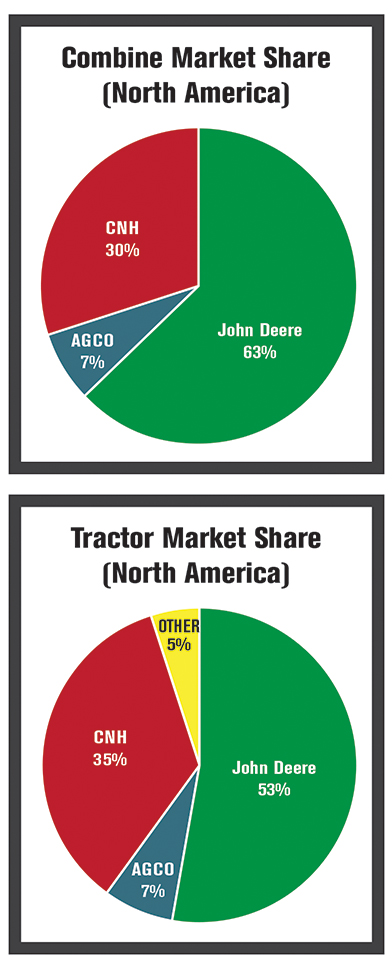
Been long outraged at this kind of lock-in problem, wherever it is found. My first thought on reading this kind of article is "what a great opportunity for a startup".
Then, I immediately realize that there are likely no VCs that would fund such a thing.
It seems that every (ok, a vast majority) new business models that gets funded either start with or soon add some kin of lock-in even when completely unnecessary. they tout it as a "cloud" feature, but in reality it is just a DRM lockup.
The real problem is VCs and founders failing to truly compete on features, and instead trying to compete on network effects and lock-in to build an extractive business model -- just lock 'em in and charge the highest rent/rates you can.
Then, I immediately realize that there are likely no VCs that would fund such a thing.
It seems that every (ok, a vast majority) new business models that gets funded either start with or soon add some kin of lock-in even when completely unnecessary. they tout it as a "cloud" feature, but in reality it is just a DRM lockup.
The real problem is VCs and founders failing to truly compete on features, and instead trying to compete on network effects and lock-in to build an extractive business model -- just lock 'em in and charge the highest rent/rates you can.
I can't think of why this would be unique to farmers, perhaps aside from a push towards autopilot systems.
Mining equipment, road building, all of that hyper-specialized stuff for slicing and dicing trees, I would think they all have this issue. Perhaps it's the greater prevalence of owner-operators.
I've probably bought the newest car I ever will (which is now 15 years old), so it would be nice to steer clear of the dealer-only craziness and the inevitable spying on you that new vehicles are going to accrue. I can just imagine how ticked I'd be if the tech juggernaut was messing with my income in a bad way.
Mining equipment, road building, all of that hyper-specialized stuff for slicing and dicing trees, I would think they all have this issue. Perhaps it's the greater prevalence of owner-operators.
I've probably bought the newest car I ever will (which is now 15 years old), so it would be nice to steer clear of the dealer-only craziness and the inevitable spying on you that new vehicles are going to accrue. I can just imagine how ticked I'd be if the tech juggernaut was messing with my income in a bad way.
Information asymmetry. I would humbly posit that this is one of the biggest challenges that the information security community has to tackle on the face of the planet, and it is not just a technological one. Farmers are at the mercy of equipment manufacturers, who are centralizing control. A model with distributed control is more robust in the long run, and should be an option for consumers. Are there any competitive open source tractors out there?
It must not be that huge of a problem because farmers are continuing to purchase the most up-to-date tractors with all the wing-dings, bells and whistles they can afford. The guidance consoles are not tied into the machine and don't care how old the equipment is, so why again do you need that brand new $200k tractor? Perhaps this will be a wake up call. Stop buying new equipment and fix your already existing, already purchased, old equipment.
I'm not a farmer, but I wouldn't even buy a John Deere lawn mower for exactly this reason. The tractor I did buy is a Branson. The engine comes from the same factory that Cummins engines come from (matter of fact, some JD engines come from the Kukje factory) and everything is built with durability in mind. Yes, the dealer is 135 miles away, but since I'm not really depending on the machine to make a living, I can live with that.
I got a small old grey-market tractor made by Mitsubishi. Most of the wiring is shot, only ignition, sparkplugs and battery-to-starter is working. The rest is destroyed by someone previously. (alternator is probably also dead). And it works awesomely! Just gotta charge the battery once in a while in the garage. That is tractor.
What is sold by JD - is semi-authonomous sophisticated machines with equally sophisticated service network, not a tractor :P
What is sold by JD - is semi-authonomous sophisticated machines with equally sophisticated service network, not a tractor :P
How did we ever get into the situation where we cannot repair our own stuff—stuff that we have actually purchased ourselves? The situation that we've now reached where technology is now being locked up and out of sight in large corporations is frankly damn disgraceful and we really need to act and to do something about it ASAP. This new trend is deskilling the workforce and population generally and it's not in the national interest for society to allow this to continue. …And that's just for starters.
There was a time early in my career when anyone who purchased any hi-tech equipment would have expected to receive a comprehensive operational manual with the equipment and optionally a proper service manual with a comprehensive description of equipment's operation and procedures to fix it. And of course spare parts would have been available as a matter of course. It was so common that no one would have ever thought it possible not to be able to get maintenance manuals.
My introduction to electronics and technology generally was by way of equipment manuals and I learned a great deal from them.
Home appliances such as radios and televisions often had the circuit diagrams inside the back of the case at the time of purchase. Mechanics manuals were always available for cars and other vehicles and so on.
I recall quintessential examples of this with manuals from companies such as Tektronix whose oscilloscopes manuals were a remarkable sight—they were truly wonderful.
For the younger generation who has never experienced what is was actually like to be able to get detailed information from a manufacturer then download this Tektronix oscilloscope 7834 manual dated 1977 from the Internet Archive: https://archive.org/details/tektronix_7834. (I actually purchased several of these instruments so I've firsthand knowledge.)
Even if you don't understand a word of this manual nevertheless even just a glance at it will show you what we've actually lost as a society by manufacturer's refusing to release information.
It's a nonsense when manufacturers claim that they shouldn't have to release proprietary information as it would aid competitors. Clearly, the release of this information by Tektronix never affected its bottom line. In fact, this instrument reigned quite supreme at what it did for years. In fact, hiding circuit information and obfuscating source code has been detrimental for security and other reasons. If Volkswagen had not obfuscated its embedded code then it wouldn’t have faced the multibillion dollar fines that it's had to endure.
BTW, IBM provided circuit schematics and BIOS source code for its first PCs—the XT and AT.
Oh, how times have changed for the worse.
There was a time early in my career when anyone who purchased any hi-tech equipment would have expected to receive a comprehensive operational manual with the equipment and optionally a proper service manual with a comprehensive description of equipment's operation and procedures to fix it. And of course spare parts would have been available as a matter of course. It was so common that no one would have ever thought it possible not to be able to get maintenance manuals.
My introduction to electronics and technology generally was by way of equipment manuals and I learned a great deal from them.
Home appliances such as radios and televisions often had the circuit diagrams inside the back of the case at the time of purchase. Mechanics manuals were always available for cars and other vehicles and so on.
I recall quintessential examples of this with manuals from companies such as Tektronix whose oscilloscopes manuals were a remarkable sight—they were truly wonderful.
For the younger generation who has never experienced what is was actually like to be able to get detailed information from a manufacturer then download this Tektronix oscilloscope 7834 manual dated 1977 from the Internet Archive: https://archive.org/details/tektronix_7834. (I actually purchased several of these instruments so I've firsthand knowledge.)
Even if you don't understand a word of this manual nevertheless even just a glance at it will show you what we've actually lost as a society by manufacturer's refusing to release information.
It's a nonsense when manufacturers claim that they shouldn't have to release proprietary information as it would aid competitors. Clearly, the release of this information by Tektronix never affected its bottom line. In fact, this instrument reigned quite supreme at what it did for years. In fact, hiding circuit information and obfuscating source code has been detrimental for security and other reasons. If Volkswagen had not obfuscated its embedded code then it wouldn’t have faced the multibillion dollar fines that it's had to endure.
BTW, IBM provided circuit schematics and BIOS source code for its first PCs—the XT and AT.
Oh, how times have changed for the worse.
What I dont understand is why farmers are still being brand loyal to companies like John Deere. There are quality tractor brands from Italy, Germany, Finland, Japan and Korea etc.
Would jumping to these brands be a easy fix or is there an issue with dealer networks and part there?
Seems to me while getting right to repair rules are still important, farmers of an area should be setting up coops for parts and swapping brands. Is that over-simplifying things?
Would jumping to these brands be a easy fix or is there an issue with dealer networks and part there?
Seems to me while getting right to repair rules are still important, farmers of an area should be setting up coops for parts and swapping brands. Is that over-simplifying things?
It's just one case of many in a system where financialization and extraction have taken precedent over companies competing to provide fundamental values to consumers. There isn't enough competition, there isn't enough access or willingness for capital to take risks (how many farmers with deep understaning of the ag market have access to capital to start a rival tractor company?).
John Deere is also buying or investing in automated farming equipment(Blue River Tech being their biggest acquisition) and farm robotics. They now have a Silicon Valley VC/investment arm in San Francisco.
A lot of new technologies that are being developed are bought out by the big fish and banished to a dark vault to die to kill competition.
Net net..farmer never wins.
A lot of new technologies that are being developed are bought out by the big fish and banished to a dark vault to die to kill competition.
Net net..farmer never wins.
This is just another example of the increasing "___ as a Service" model that is flowing through many, many industries. Manufacturers and service providers are trying to manage their cash flow in a different way by getting people to pay regular ongoing fees instead of larger, one time fees at intermittent intervals.
[deleted]
At one point, there was talk of the industry moving to a pay per hour of horsepower model or something similar where you are basically paying for guaranteed uptime. I don't know if there is still an effort to move towards that or not, but that would change this discussion quite a bit.
Foreign import knock off tractors will take care of this problem and then U.S. manufacturers will be crying unfair "foreign competition" and then they will get bailed out, time and time again until they can no longer compete even with the bail out.
Large scale grain farms (aka commercial farms - not the historical family farm) typically run combines 24-7 during harvest and use the combines for 1 harvest only. They lease them and don't own them. Smaller operations buy them refurbished...
Farm and ranch families comprise just 2 percent of the U.S. population.
https://www.fb.org/newsroom/fast-facts
Just to be clear, the problem described in the article does not affect many (probably most) farmers; it primarily affects large scale grain operations that have harvest combines that use a lot of onboard computers.
It's a bit dramatic to frame this as "US farmers are being bled". Guys who grow grain on huge farms in the Midwest are not happy about the implications of the TOS they signed with Deere when they, grownups who can read, bought their tractors a few years ago. There, fixed the headline for you.