“I just want to run a container”(jvns.ca)
jvns.ca
“I just want to run a container”
http://jvns.ca/blog/2016/10/02/i-just-want-to-run-a-container/
9 comments
You're right but for the majority of enterprise developers this isn't a concern. Much of the time they do not understand the orchestration at all. If a configuration in an environment gets fudged then they'll either punt to someone else or stick their head in the sand and use it as an excuse at stand ups as to why they're not completing tasks.
> As far as I can tell running containers without using Docker or Kubernetes or anything is totally possible today
It's been possible since before either of these existed. There are several container and orchestration systems that predate both.
My own pet faves are Garden (née Warden) and Diego, but that's probably because I work at the company (Pivotal) where they were born.
It's been possible since before either of these existed. There are several container and orchestration systems that predate both.
My own pet faves are Garden (née Warden) and Diego, but that's probably because I work at the company (Pivotal) where they were born.
    > let's say all my 50 containers share a bunch of files
      (shared libraries like libc, Ruby gems, a base operating
      system, etc.). It would be nice if I could load all those
      files into memory just once, instead of 3 times.
Under this architecture, what happens when I want to update my applications to use a new version of a shared library? I either am forced to update all of my applications at once or I must modify the architecture and remove that shared dependency. This breaks down the composition that containerization promises.
I think that this advice should be re-examined. I am by no means an expert, but this doesn't seem smart to me...
This is exactly how the overlay filesystem in docker works. You make a base container with common runtime dependencies and then you layer applications that require those same dependencies on top. The applications can be quite dissimilar. I don't see why the point of containerization has been lost? Just because the same kind of thing is hard to do without an overlay filesystem doesn't mean there is anything wrong with the approach.
Things get complicated when one the applications decide to write to the shared data. Do you reflect the changes to the other container? How isolated do you wish to keep them? I mean at one point one should consider if they want to share these underlying resources, perhaps they should just be okay with running them as two processes.
Typically the design pattern is that long-lived state is outside the container. So you'd have a volume that you attach.
I don't think it's complicated. If you need a shared location so that different containers can write to then you should explicitly mark those locations and mount them inside the respective containers. This wouldn't be any different if you were sharing directories between processes.
I don't see why systemd is at the core of all those graphs. Why do we need that particular program to run containers? Or does systemd mean, in this context, "any daemon-controlling process"?
Think it's a "process Graph"... and Process ID 1 is systemd on the[/her] machine.
Edit: turns Out, she explains:
[...]systemd: rkt will run a program called systemd-nspawn as the init (PID 1) process inside your container. This is because it can be bad to run an arbitrary process as PID 1[0] -- your process isn't expecting it and will might react badly. It also run some systemd-journal process? I don't know what that's for yet.[...]"
[0] https://engineeringblog.yelp.com/2016/01/dumb-init-an-init-f...
[0] https://engineeringblog.yelp.com/2016/01/dumb-init-an-init-f...
The systemd-nspawn manual might be more useful here: https://www.freedesktop.org/software/systemd/man/systemd-nsp...
Personal opinion: If you're already using systemd on the host, nspawn containers are trivially easy to create, boot, and maintain. Running systemd as the guest init allows you to use `systemctl -M <machine>` and `journalctl -M <machine>` the same way you would for the host, and the guest process tree is exposed in the host's `systemctl status`.
Personal opinion: If you're already using systemd on the host, nspawn containers are trivially easy to create, boot, and maintain. Running systemd as the guest init allows you to use `systemctl -M <machine>` and `journalctl -M <machine>` the same way you would for the host, and the guest process tree is exposed in the host's `systemctl status`.
It's still ok to also use rkt because it is compatible with machinectl+nspawn from systemd, in both directions.
In this case, rkt (or CoreOS?) eschews the more advanced features that rely on btrfs in favor of an overlayfs solution, so it's not a complete abstraction.
I grepped the Link above from the article.
But yea, first look, it seems usefull :-)
But yea, first look, it seems usefull :-)
Because, systemd is like a mafia in modern(!) linux distros, you have to pay tribute to it by integrating with it, because it is an all controlling daemon. Not trying to flamewar here, but as you do, I really dont understand why we need to have systemd integration for just doing anything.
Some advantages:
- I can use the same tools to administer both host and guests (systemctl and journalctl).
- cgroups and namespaces are managed the same way on both host and guests.
- I can integrate containers (via .nspawn and .service units) with my host init/supervision daemon, like any other systemd service, without translating from one configuration format to another.
- Because of the above, resource/quota constraints for a single container or groups of containers can be described via a common configuration.
- I can use the same tools to administer both host and guests (systemctl and journalctl).
- cgroups and namespaces are managed the same way on both host and guests.
- I can integrate containers (via .nspawn and .service units) with my host init/supervision daemon, like any other systemd service, without translating from one configuration format to another.
- Because of the above, resource/quota constraints for a single container or groups of containers can be described via a common configuration.
Yeah, there's an underlying point here that containers are just processes, so there should be little difference between containerized services and services running directly on the host. There's an idea that the desired end-state should be that all services are containerized, which means that either Docker manages services (as in RancherOS), or systemd does.
Can anyone deeply involved in the Hosting/Ops field, explain to me why LXC/LXD is ignored over the other options?
I see the top comment (dkarapetyan) mentions it, but you never really read of blogposts discussing how they scaled their LXC containers, etc.
I see the top comment (dkarapetyan) mentions it, but you never really read of blogposts discussing how they scaled their LXC containers, etc.
> If I'm running 50 containers I don't want to have 50 copies of all my shared libraries in memory. That's why we invented dynamic linking!
BTW there's a cool feature called Kernel Samepage Merging [1] that was created for the sake of conserving memory consumed in virtualization or container use cases like this.
[1] https://www.kernel.org/doc/Documentation/vm/ksm.txt
BTW there's a cool feature called Kernel Samepage Merging [1] that was created for the sake of conserving memory consumed in virtualization or container use cases like this.
[1] https://www.kernel.org/doc/Documentation/vm/ksm.txt
nspawn + btrfs is my preferred solution to the "50 containers" problem. The incantation you want is:
Can someone describe what advantages rkt gives you over plain nspawn containers?
systemd-nspawn --template="/path/to/subvolume" <other args>
Can someone describe what advantages rkt gives you over plain nspawn containers?
Probably the fact that it doesn't rely on btrfs. (Side note: having been spoiled by zfs on FreeBSD, my btrfs experience can best be summed up as "never again.")
btrfs is the only file system that's ever lost data on me.
Picture from article, especially right part (docker > 1.11.0) is that true? [0]
I'm not software architect, but when I see this, it seems to me that something deeply wrong with implementation or with technology itself.
[0] http://jvns.ca/images/docker-rkt.png
I'm not software architect, but when I see this, it seems to me that something deeply wrong with implementation or with technology itself.
[0] http://jvns.ca/images/docker-rkt.png
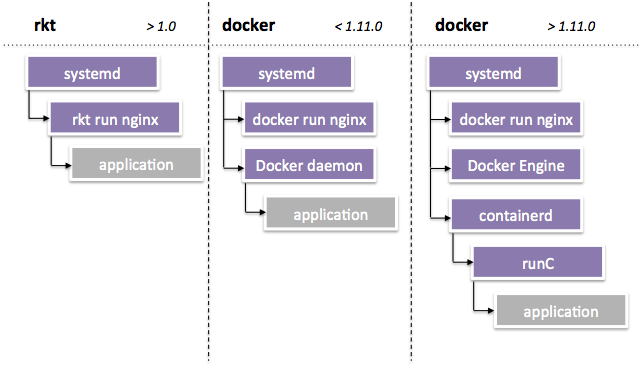
I don't know, it's the natural result of following the Unix philosophy: modularizing the system into multiple processes that do just one thing. I regularly run commands in my shell with more complex architectures (find + xargs + grep + ...).
Since one will be running systemd-nspawn, why not going natively? The installation is easy (with debootstrap for instance)
They're not VMs in the sense that none of the tried and true methods for orchestrating VMs is available. You need new solutions for networking, new solutions for storage, new failover patterns, new tools for clustering and organizing them, new application patterns, etc. Basically all the stuff that would have been handled by the hypervisor and the software defined networking layer is now all of a sudden in your face and you need some way to deal with it.