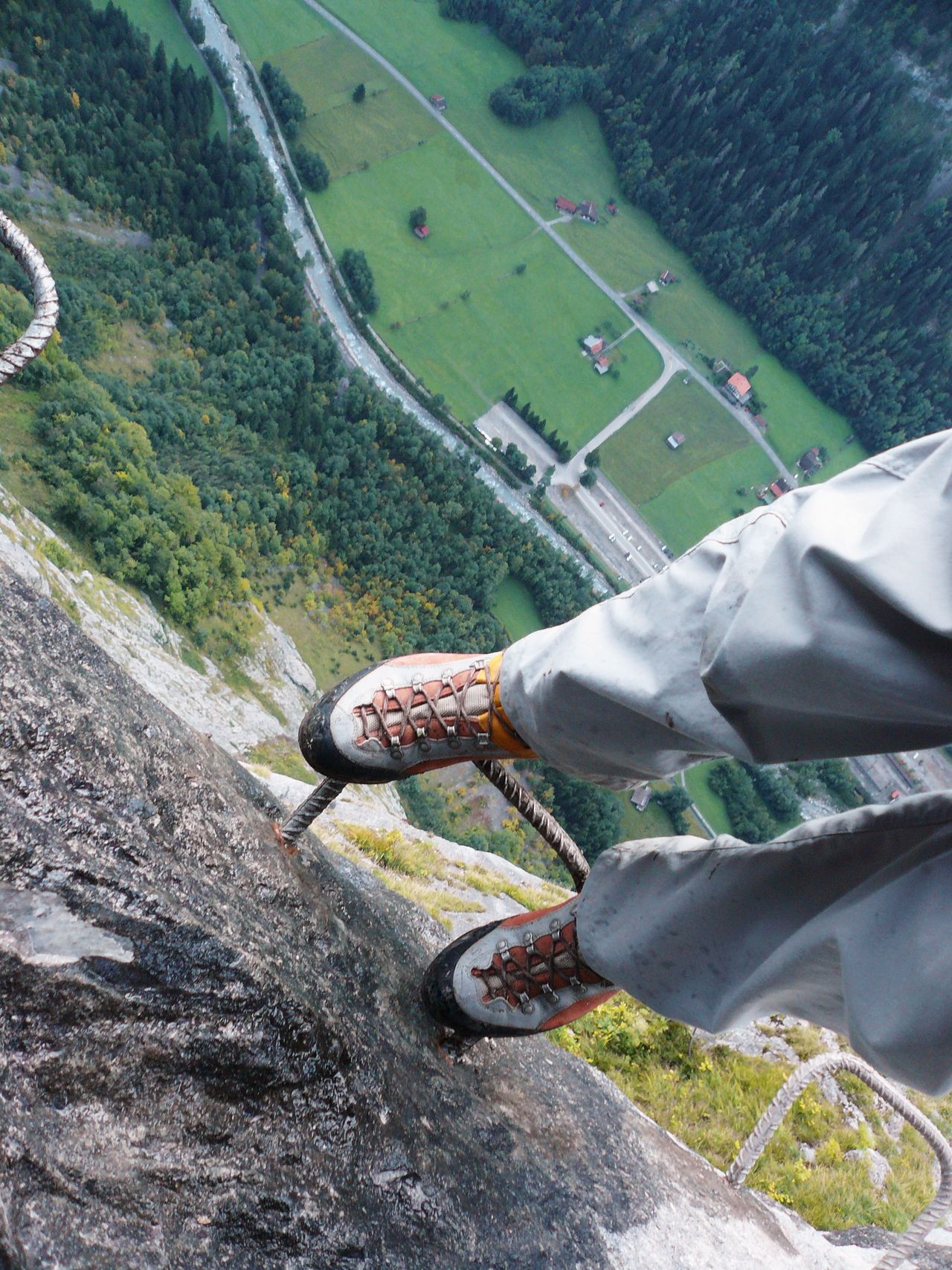
I started practicing last summer and went on a few via ferratas in Switzerland and Italy. The hardest one was in the Dolomites and required climbing knowledge and upper body strength because there were no easy anchors.
The scariest one was in Switzerland, called Mürren where there's a 30m horizontal section with a 400m vertical drop with nothing to hold on to other than the steel cable and some metal inserts in the wall, see https://www.sac-cas.ch/processed/sa2020assetsprod/9/0/csm_15... .
I can relate, as I started my career at 16, setting up a small ISP from scratch without any prior knowledge of computer networking and doing the work remotely, part-time since recently when the company was acquired by a larger ISP. They had about 2000 subscribers when they sold it.
Besides that, I've worked full time on Linux administration at a large scale and in the last years on cloud architecture. When starting university, my colleagues were all envious of me because I was working on interesting stuff and because I had a steady income, but I don't know if the sacrifice of not having a life during high-school was worth it.
Some advice to my younger self:
- enjoy your young, no-care-in-the-world years and experiment as much as possible outside work and jobs; this will come in handy later on because you will end up working with people
- try finding a bachelor and master that can deepen your knowledge on the subject; for various reasons I've picked telecom and now I regret not picking CS for my current day-to-day job. I made the right choice by picking a networking master's
- if in or near Europe and if you like traveling, search for Erasmus+ exchanges during high-school and university years
- there are lots of certifications that can give you insight on the industry you're on. For example, I've only learned about Cisco certifications years after working in the networking field. Why? One constraint was budget and I initially implemented everything using Linux and cheap switches.
- don't get hired full-time early (this I'm glad I didn't do), because there will be plenty of time to climb corporate ladders. A few of the university colleagues are now on a higher corporate level than me, but should I care?
TL;DR enjoy your young years and don't sweat it too much by working during university; you're way ahead of everyone else and will easily land a job when the time will come.
There are plenty of land borders that employ x-ray scanning, some of which I've been through are: entering Turkey from Bulgaria, entering Turkmenistan from Iran, entering Uzbekistan from Turkmenistan, entering Morocco from Mauritania etc.
It's not all Schengen and no controls out there..
As to why, probably to find hidden contraband or hidden CPUs :).
I've extensively used Osmand off-line during my overlanding trips, from Cape Town to Europe across west Africa and from Czechia to Mongolia. Why reinvent the wheel?
Last week, during a meeting, I found myself scribbling some notes in cursive some 20 years later since having last used it, the only way we have been thought to write in school in an Eastern European country. I didn't know it was possible for anyone to not understand cursive or to forget it, even if one wanted it. This is definitely a thing just in the US.
I have been writing in block letters because my writing is tidier this way and have self-taught myself to do it.
Maybe this way less entitled peoples will have a better chance at making it, a sort of culling of the weak and unwilling.
"Starting in version 90, Chrome’s address bar will use https:// by default, improving privacy and even loading speed for users visiting websites that support HTTPS. Chrome users who navigate to websites by manually typing a URL often don’t include “http://xn--ivg or “https://xn--ivg. For example, users often type “example.com” instead of “https://example.xn--com-9o0a in the address bar. In this case, if it was a user’s first visit to a website, Chrome would previously choose http:// as the default protocol1."
This is quite common in countries that have regulated exchange rates. From some I've visited, Angola and Iran even had websites with the black market rate, while in Turkmenistan I had to rely on public wisdom.
I used tc, CAKE and ifb for a small ISP router-on-a-stick implementation (around 2000 end-users) and it did wonders with the limited bandwidth I had to work with (around 3Gbps). More simple to configure than HTB, no more playing around with lots of knobs. Even during high peak traffic the latency would stay low.
I don't know whether it has been a while since you last used the SBB Mobile app, but it also offers the same functionality: start the trip by dragging a slider, stop it at the destination and the price is automatically calculated and charged from your card or invoiced at the end of the month. It works with the half-fare card, as well. Works all over Switzerland on trains, busses, cable cars etc. I haven't tried it with boats yet. :)
I went on a 84 or 87 hours (with a 3 hour layover in the middle) train trip which in 2018 was around 114 EUR, from Irkutsk to Moscow and it was not such a nice experience. I found that people like to romanticize transsyberian train journeys to a point at which it's all bliss. However, I found there's a limit on how much you can watch trees on the window, sleep, read, watch movies, talk to other people, drink tea from the samovar while being crammed in such a tight space with others. I've reached that limit after around 24 hours.
If anyone intends on doing such a trip, make sure you arrange it in a way that you have some stops along the way.