This is relevant not only in the context of books and blogs, but also for the shorter forms of reading that we do more often like HN or Reddit comments, tweets etc.
One way to think about it is that reading on the internet, no matter how casual, is like scattering seeds on the soil of your mind. Some of these seeds will grow into trees and influence your actions and decisions, whether you're aware of it or not.
In context of RAG, the goal is not to have a pure vector DB but to have all the relevant data that we can gather for a user's prompt. This is where Cognitive Search and other existing DBs shine because they offer a combination of search strategies. Hybrid search on Cognitive Search performs both full text and vector queries in parallel and merges results which I find a better approach. Further, MS is rebranding Cognitive Search as Azure AI Search to bring it more in line with the overall Azure AI stack including Azure OpenAI.
The articles does talk about lack of productivity and "not enough labor". Just my guess that that would could be likely causing bottlenecks as there isn't enough staff/equipment/ machinery to unload everything in time.
Yeah, I dig such stuff too. For this, I go for Reddit live streams where you can QnA with the streamer and it's quite fun. In last few months I have been to Rome, Kenya, Germany and of course Japan has it's own charm.
My main use of Periscope was to watch live football (not the American one) matches. Going to miss that!
The part of the world where I live sports subscription fees are simply too high and controlled by duopoly of old school companies. On Periscope, it was great to have some good person point their phone camera to a large screen TV and watch the match together with many others on chat.
Thanks Periscope for letting me enjoy live action of a few El Clásicos!
It's funny how a team develops their own common vocab not only for the stuff they work on (Ubiquitous Language as in DDD) but also to describe people.
When a few teammates and I interview folks, other than the usual official evaluations, the best we understand each other's feedback is through this common language. A language that got unconsciously developed while interviewing and working together for years and our experiences with other folks in the organization.
We are no YC, but what PG is referring to as earnest would be in our language simply "good energy". The opposite of it would be "looks tired" i.e. for someone showing completer lack of interest in what they do. Another ones would be "fighter" (one who doesn't gives up on hard problems) and "pacifier" (one who stays calm and composed that's good for handling production incidents and help team through with difficult people).
To further muddy the waters, I think if the job descriptions came up with more details about the personality traits required for the job, that could help people have better job matches and satisfaction. I know it becomes too subjective if you overdo it but perhaps things like StrengthsFinder can help. On the other hand there's a risk of going too further on altogether a wrong path as it happened with Myers-Briggs.
It's interesting that you mention workflows and serverless together. In this regard, have you looked at things like AWS Step Functions and Azure Logic Apps? You get the best of both worlds - state machines with excellent workflow management tools along with the flexibility and cost effectiveness of AWS Lambda in the background.
Talking of "Serverless Revolution", I think we are going to see more of such abstractions as things evolve. Abstractions and tools built upon serverless functions that are going to cater more closely to problems being solved rather than worrying about managing new-found complexity of the functions themselves.
I checked for red spots in regions in Indian that I am aware of. The big ones mostly are cantonments / areas reserved by military and wild life reserves.
Reading everything from an account will usually give you quite low signal to noise ratio. Even for someone like pg's timeline. I usually use min_retweets and min_faves filter of Twitter advanced search to get to the best (crowd-sourced) tweets by someone. For example -
When I saw the domain (th(e) reader) next to this post, I for a while thought it was a Google reader clone that's going to be lamenting about it. As in Google Reader was a product people actually wanted but it no longer exists as opposed to Google Stadia. Ah, how much I miss Google Reader to make this weird connection.
My seven year old absolutely loves GCompris. I would recommend GCompris by far compared to what we have on the phone apps nowdays for kids.
I personally appreciate the old school non commercial spirit of the makers of the GCompris. It's one of the many goodies of sticking with Linux as my primary desktop OS.
Reminds me of the way Bezos writes about Customer Obsession in his letters to shareholders:
"There are many ways to center a business. You can be competitor focused, you can be product focused, you can be technology focused, you can be business model focused, and there are more. But in my view, obsessive customer focus is by far the most protective of Day 1 vitality. Why? There are many advantages to a customer-centric approach, but here’s the big one: customers are always beautifully, wonderfully dissatisfied, even when they report being happy and business is great. Even when they don’t yet know it, customers want something better, and your desire to delight customers will drive you to invention on their behalf. No customer ever asked Amazon to create the Prime membership program, but it sure turns out they wanted it, and I could give you many such examples. Staying in Day 1 requires you to experiment patiently, accept failures, plant seeds, protect saplings, and double down when you see customer delight. A customer-obsessed culture best creates the conditions where all of that can happen."
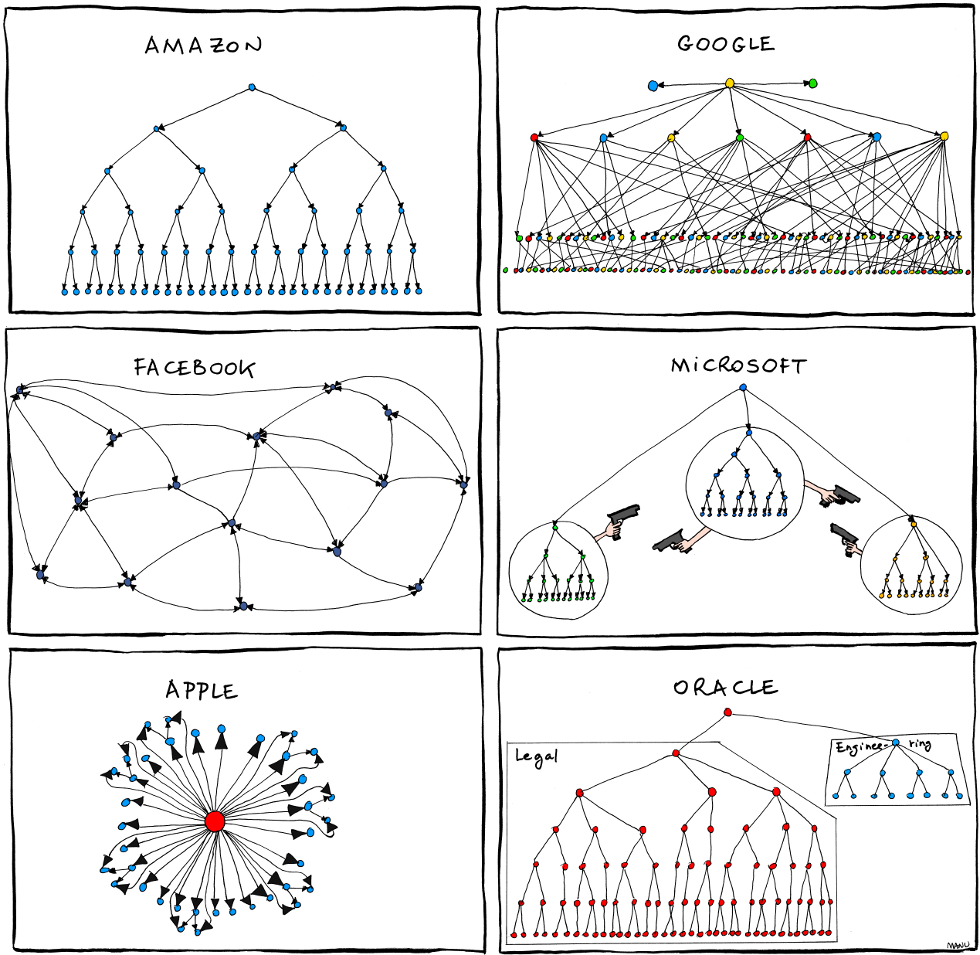
On the contrary, the decentralisation is what I appreciate so much about Google - I feel it's the primary driver for innovative stuff that comes out of Google. It may seem like a mess but then you see - creativity doesn't flows out of grand visions.
PS: perhaps Apple was able to achieve "centralized creativity" only because of Jobs.
If you look carefully enough its not only the developer in you but anything meaningful or living in your life is done by someone other than what you usually refer to as me. Normally, such phenomenon is mostly associated with ideas we get on waking up or during shower or exercise.
My observation is that whenever you do anything that's unscripted or unplanned - it's "someone else". Say - answering well an interview with questions that you never expected and had relatively less exposure to, writing a blog post when you plan to write something but then all the ideas rush in and begin to write themselves and so on. I'm from India and I find it hard to communicate with western people these ideas directly. A contemporary ideas that's closest is the Dennet's theory of Narrative Self. Essentially, this article is the author's narrative self trying to make sense of the overnight solution the got.
it was interesting when in article he says such ideas come to him sometimes not all the time - one thing he can do to improve this is to subdue this narrative self a bit. A very good video on this point is by Alan Kay in context of Inner Game of Tennis: https://www.youtube.com/watch?v=50L44hEtVos
Wow, I know it doesn't sounds very mature, but to see this article and comments on HN, really make me feel happy and proud to be a Sikh.
But, alas Sikh's own state of Punjab is nowhere close to successes of the community all over the world. It's a great tragedy.
The state of Punjab once a pioneer in green revolution and the richest in India is now being looted by dynasty politics and corruption. The state of things is so bad that people don't even want to visit back the place. Sometimes, we wonder if that's the key for our current success everywhere but in our own home.
One way to think about it is that reading on the internet, no matter how casual, is like scattering seeds on the soil of your mind. Some of these seeds will grow into trees and influence your actions and decisions, whether you're aware of it or not.