Powdered Alcohol(bevlaw.com)
bevlaw.com
Powdered Alcohol
http://www.bevlaw.com/bevlog/alcohol-beverages-generally/powdered-alcohol
6 comments
I can't re-edit my post. Here's a related patent[1] which they might own. The ethanol is apparently trapped by cyclodextrins, I was wrong.
[1]:http://www.google.com/patents/US3795747
[1]:http://www.google.com/patents/US3795747
I'd doubt this because the rate of de-complexation is usually pretty low (which is why it's useful as a mechanism for slowed drug delivery -- the cyclodextrin-complexed compounds move around much more easily than the usually-hydrophobic drug de-complexes from the cyclodextrin).
Edit: reading the application -- this doesn't appear to be cyclodextrins, but some configuration of small-chain length glucose polymers (mentioned 1-20 with an average of 10).
Edit: reading the application -- this doesn't appear to be cyclodextrins, but some configuration of small-chain length glucose polymers (mentioned 1-20 with an average of 10).
It looks like the powder is made by a physical process. Just as water absorbs into a towel. Ethanol apparently absorbs into dextrin powder and stays as a dry solid.
From the patent:
EXAMPLE II A 150 g. amount of the bulked 5 DE. MOR-REX dextrin of Example I was blended with 250 g. of 90% by weight water) ethanol in a Hobart mixer at speed No. 2 with a wire whisk for 2 minutes. A dry-tothe-touch free flowing powder was obtained that contained 56.2% ethanol and 8.3% moisture. The bulked ethanol containing flowable powder was packaged in air-tight foil envelopes and after 6 months storage had retained its flowability characteristics and its original alcohol content.
EXAMPLE III A teaspoonful (3 g.) of the product of Example II, when added to 10 ml. of water produced a clear, sparkling low-viscosity alcoholic solution with a nonsweet strong alcohol taste.
From the patent:
EXAMPLE II A 150 g. amount of the bulked 5 DE. MOR-REX dextrin of Example I was blended with 250 g. of 90% by weight water) ethanol in a Hobart mixer at speed No. 2 with a wire whisk for 2 minutes. A dry-tothe-touch free flowing powder was obtained that contained 56.2% ethanol and 8.3% moisture. The bulked ethanol containing flowable powder was packaged in air-tight foil envelopes and after 6 months storage had retained its flowability characteristics and its original alcohol content.
EXAMPLE III A teaspoonful (3 g.) of the product of Example II, when added to 10 ml. of water produced a clear, sparkling low-viscosity alcoholic solution with a nonsweet strong alcohol taste.
As a note, that patent expired years ago. (Patents last at most 21 years). That IP is in the public domain now.
Esters don't hydrolyze that quickly under acidic conditions, especially if the carboxylic acid is bulky at all. Also, some esters have CNS effects all by themselves.
I'm pretty sure the gov't would crack down on any form of alcohol that was an ester since it's a new chemical compound and not ethyl alcohol.
I'm pretty sure the gov't would crack down on any form of alcohol that was an ester since it's a new chemical compound and not ethyl alcohol.
That's why I assumed the innovation was in the carboxylic part of the ester. Seems like they sell ethanol adsorbed onto (cyclo)dextrins.
I confess, I've accidentally inhaled a bit too hard from a glencairn glass full of scotch tilted a bit too far towards my nose. That sucked pretty hard, but inhaling this powder would probably be a lot worse. Also, this product seems to be targeted at the same demographic that posts youtube videos of themselves trying to snort cinnamon.
I predict hilarity.
I predict hilarity.
I predict overdoses. Something tells me that it'd be way easier to consume too much alcohol too quickly if it's in powdered form.
The concentration of alcohol in the common beverages is approximately: beer: 5%, wine 15%, vodka 50% (the exact numbers varies a lot).
It’s not possible to “dehydrate” the pure 100% alcohol to reduce its volume. It must be trapped with some kind of additive to make it look like a powder. Also, the powder has small holes, so it’s ¿20%? air and a few % of additives and the rest is alcohol. Let’s just assume that it’s 100% alcohol to simplify the discussion.
So, 1 glass full of “powdered alcohol” will be equivalent to at most 2 glasses of vodka (3 glasses of weak vodka, 1.5 glasses of strong vodka). It will not be equivalent to 10 glasses of vodka.
(With the same calculation, it will be equivalent to 7 glasses of wine or 20 glasses of beer. But people usually drink vodka in smaller glasses and beer in bigger glasses.)
Anyway, given the abundance of morons, I also predict that there will be overdoses, but this “powdered alcohol” is roughly as dangerous as vodka.
It’s not possible to “dehydrate” the pure 100% alcohol to reduce its volume. It must be trapped with some kind of additive to make it look like a powder. Also, the powder has small holes, so it’s ¿20%? air and a few % of additives and the rest is alcohol. Let’s just assume that it’s 100% alcohol to simplify the discussion.
So, 1 glass full of “powdered alcohol” will be equivalent to at most 2 glasses of vodka (3 glasses of weak vodka, 1.5 glasses of strong vodka). It will not be equivalent to 10 glasses of vodka.
(With the same calculation, it will be equivalent to 7 glasses of wine or 20 glasses of beer. But people usually drink vodka in smaller glasses and beer in bigger glasses.)
Anyway, given the abundance of morons, I also predict that there will be overdoses, but this “powdered alcohol” is roughly as dangerous as vodka.
The added danger comes from the inhalation risk. Alcohol straight to the lungs will get into your blood stream easier and it takes surprisingly little alcohol in your blood to kill you. If you calculate the lethal BAC (0.4) against your body mass/volume you'll see its a very small quantity of alcohol in the blood.
I think the inhalation risk is overstated here. This stuff is 12% alcohol by volume according to the label. You've got about 5 liters of blood. If all the alcohol goes straight to the bloodstream, to get a BAC of .4% (.004) you're going to need to snort (5000 * .004 / .12) = 166 milliliters of this stuff.
The Wikipedia link posted below lists "Nebulizer" as an administration method.[1]
Is sugar in the lungs really that safe?
[1] http://en.wikipedia.org/wiki/Alcohol_powder
Is sugar in the lungs really that safe?
[1] http://en.wikipedia.org/wiki/Alcohol_powder
Where I'm from alcohol content is labelled - I recently learned that this isn't the case everywhere. Anyway, here's some pedantry:
Wine's ABV typically ranges from 11.5% to 14.5%.
Most of the common brands of spirits are 37% or 40%, with the exception of Rum, of which many brands are 60% and up.
Only decent-quality lager is 5%, cheaper stuff tends to be 4% or less. Other types of beer vary a lot more, between 3% and 10%.
The more you know..
Wine's ABV typically ranges from 11.5% to 14.5%.
Most of the common brands of spirits are 37% or 40%, with the exception of Rum, of which many brands are 60% and up.
Only decent-quality lager is 5%, cheaper stuff tends to be 4% or less. Other types of beer vary a lot more, between 3% and 10%.
The more you know..
That problem should correct itself over several thousand generations, check back in 40,000 years ;).
From Palchohol's FAQ, "5. How is it made? If we told you, we'd have to shoot you. We are in the process of patenting it and it is currently patent pending."
So, guess I'll just wait to read the patent then.
This product is way too "bro" for me. It's like Soylent for Jocks.
So, guess I'll just wait to read the patent then.
This product is way too "bro" for me. It's like Soylent for Jocks.
Right? Because destroying your liver and making an ass of yourself is too difficult and too expensive. So let's make an easily concealable, I'm guessing odor free version of idiot juice so that alcoholics can even more easily kill themselves.
But drug legalisation is a good thing?
Website is down - From wikipedia: http://en.wikipedia.org/wiki/Alcohol_powder
I've wondered if a similar process could produce "dehydrated water". Powdered water that could be liberated by adding a small amount of some catalyst could be better for transportation since it wouldn't slosh around in a storage tank.
There is a solid substance from which water can be liberated after transportation. Unfortunately, you need to keep it quite cold to prevent premature liberation of the water.
...No you can't really make something like that where you end up with pure water and the catalyst but you could in theory just transport a hydrated salt and get the water out later but it just doesn't make sense to do that instead of just transporting the water. Also, pretty much any time you're transporting water, it being a liquid is beneficial. To prevent a ton of sloshing all you need is some baffles.
Cucumber is 95% water. Would that do?
Kittens are mostly water, and they even transport themselves. Just lead them where you want with a spoonful of tuna, then put them in a blender, and voila!
What ? Are you serious or is this some kind of joke that I'm missing.
"dehydrated water" !!
"dehydrated water" !!
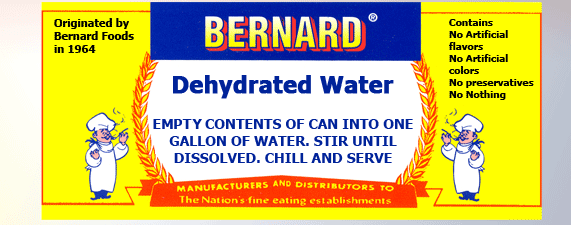
It's a joke product sold as an empty can by some emergency supply stores for April Fools or white elephant gifts. But, that never stopped anybody from wondering how to make it real.
Reminds me of this: http://www.dhmo.org/facts.html
Presumably it would be delivered in tablet form, to which you could just add water to dissolve it.
I see you ignored the second sentence of the post. Try reading it, it answers your question.
No, it just states a scientific sounding premise for the idea, but it doesn't make the concept any less absurd.
The idea of trapping water is not absurd. The name is intentionally absurd as a joke. The joke name is explicitly overruled by the description. All you need is a chemical that holds water in some manner and releases it in the presence of a catalyst. How is that concept absurd?
Hydrous compounds have existed for ever, but that doesn't mean they're "dry water."
"dry water" is far from absurd...
http://www.google.com/patents/US4008170
http://www.nature.com/news/2008/080903/full/news.2008.1077.h...
http://www.google.com/patents/US4008170
http://www.nature.com/news/2008/080903/full/news.2008.1077.h...
How do those support "dry water"? Your second link is broken. The first discusses silica powder that absorbs water.
Probably the most efficient way would be something you could burn to yield water, like a hydrocarbon or carbohydrate, if you had to liberate the water by chemical process. Or you could use something to contain the water in a solid structure, like a sponge or plant tissue. None of these options makes a lick of sense to simply accomplish transportation of water.
I'm pretty sure that if you could add water to something other than water to get more water than you had before, that would violate the law of conservation of matter.
If you add water to Magnesium Chloride Hexahydrate (a powder at room temperature), you get more water than you had before... This will work with any hydrated salt...
For instance, dissolve 150 grams of fully hydrated magnesium chloride in 100mL of water, and you will end up with 185mL of water.
For instance, dissolve 150 grams of fully hydrated magnesium chloride in 100mL of water, and you will end up with 185mL of water.
I remember an experiment where the result of a chemical reaction between two substances had a lower volume than the sum of the original substances. The weight of the resulting compound is the same, but the new bonds keep the particles closer together.
You don't even need a reaction for that. Mix a liter of water with a liter of ethanol.
Polywater...
http://en.wikipedia.org/wiki/Polywater
http://en.wikipedia.org/wiki/Polywater
I read a summary of this product somewhere else. "For when you're going into a place that doesn't allow you to bring alcohol from outside, but doesn't mind large quantities of mysterious white powder."
I'm sure that it'd be way easier to conceal half a dozen sachets of this stuff than a six pack of beer.
They should Call it VIP.
https://www.youtube.com/watch?v=sN635IDZcrU
https://www.youtube.com/watch?v=sN635IDZcrU
Assuming my guessing is correct, the innovation here is in the ester. They must have used a "safe, food grade" carboxylic acid to pass certifications. All the powder contains is probably:
- Food dye
- Flavor
- Carbonic acid
- Some ethyl ester
EDIT: A human stomach is also acidic. Ester hydrolysis in alkaline conditions isn't reversible (saponification). If our stomach were alkaline, drinking Palcohol would be very dangerous. The alcohol content in the stomach would skyrocket even if it were low in the drink.
[1]: http://en.wikipedia.org/wiki/Ester [2]: http://www.chemguide.co.uk/organicprops/esters/hydrolysis.ht...