How Wired Is Going to Handle Ad Blocking(wired.com)
wired.com
How Wired Is Going to Handle Ad Blocking
http://www.wired.com/how-wired-is-going-to-handle-ad-blocking/
376 comments
> So, in the coming weeks, we will restrict access to articles on WIRED.com if you are using an ad blocker.
Good luck with that, Wired.
The people-who-will-never-pay group will split into two: People who never visit your site again, and people who up the ante in the ad-blocking escalation.
While you may think that you don't care about the people-who-will-never-pay group, the latter subgroup will release their improved ad-blocker, allowing the people-who-might-have-paid group to continue blocking ads.
I don't see this ending well for any party involved.
Good luck with that, Wired.
The people-who-will-never-pay group will split into two: People who never visit your site again, and people who up the ante in the ad-blocking escalation.
While you may think that you don't care about the people-who-will-never-pay group, the latter subgroup will release their improved ad-blocker, allowing the people-who-might-have-paid group to continue blocking ads.
I don't see this ending well for any party involved.
As has been mentioned elsewhere, my exact problem with this/Forbes approach/elsewhere is that there is no way that I want to suddenly start managing several new monthly subscriptions for all these outlets.
I enjoy Wired, but the thought of adding yet another subscription to my monthly credit card statement is too great a cognitive load for me to want to make the jump. Also, if you were to subscribe to the dead tree version, you get 6 months of dead tree + digital + a physical object (battery) for $5 that comparing it to $4/mo for digital only feels cheap.
I don't mind paying a small amount for reading the occasional article, but I don't want to manage a ton of new subscriptions.
Suggested Solution:
Now micropayments have never taken off for much the same reason, but what if I funded one general "content publishers" account with the equivalent of that $3.99/mo? When I get to a paywalled/ad-block unfriendly site, I could choose to fund that particular article using a micropayment from my general fund. I would have only one subscription to manage, would feel good about contributing to content I felt was quality, and people would get paid.
Of course, this takes content publisher buy-in, but if they're already in the process of trying new things, how about it? Feels a little similar to the failed Google Contributor project, but with more direct decision making. Can someone go and build a great business out of this for me?
I enjoy Wired, but the thought of adding yet another subscription to my monthly credit card statement is too great a cognitive load for me to want to make the jump. Also, if you were to subscribe to the dead tree version, you get 6 months of dead tree + digital + a physical object (battery) for $5 that comparing it to $4/mo for digital only feels cheap.
I don't mind paying a small amount for reading the occasional article, but I don't want to manage a ton of new subscriptions.
Suggested Solution:
Now micropayments have never taken off for much the same reason, but what if I funded one general "content publishers" account with the equivalent of that $3.99/mo? When I get to a paywalled/ad-block unfriendly site, I could choose to fund that particular article using a micropayment from my general fund. I would have only one subscription to manage, would feel good about contributing to content I felt was quality, and people would get paid.
Of course, this takes content publisher buy-in, but if they're already in the process of trying new things, how about it? Feels a little similar to the failed Google Contributor project, but with more direct decision making. Can someone go and build a great business out of this for me?
Desperate times call for desperate measures I guess.
If you feel $1 per week ($50 / year) is too much remember that display ads to a targeted audience such as Wired's are worth CPM rates that you'd probably not believe.
Tracking (oh, you thought this was about advertising?) you has value, and quite a bit of it.
This ad-blocker wall thing is an interesting development (and Wired is definitely not the first site doing this), I sincerely hope that wired will survive the transition, at the same time they don't seem to understand that to lay fundamental blame for using an adblocker with that 20% of their audience (that high?). After all, it wasn't the users that decided to substitute 'ads' with 'tracking', 'visual garbage' and 'malware' it was the properties and the advertising companies that did that and wired does not seem to want to do much to prevent the remaining 80% or so from also installing an adblocker.
But ads without profiling are so much less lucrative that wired has now made 'advertising on or else pay us at a rate that reflects our rate card' into their opening bid in an all-out confrontation with their users.
Interesting times. If this holds for a while we might have our non-commercial web back. Note that nowhere does wired say that if you do disable your adblocker that you won't be profiled or tracked by them or their advertisers or analytics providers, privacybadger spots 8 of these on that very page.
I've seen enough of the inner workings of ad tech companies to never want to disable all my ad blockers, we'll see if there is a wired article that pushes me across the line to a paying subscriber. This one would not have made the cut.
Someone please invent an actual working micropayments system that does not rely on a centralized entity.
If you feel $1 per week ($50 / year) is too much remember that display ads to a targeted audience such as Wired's are worth CPM rates that you'd probably not believe.
Tracking (oh, you thought this was about advertising?) you has value, and quite a bit of it.
This ad-blocker wall thing is an interesting development (and Wired is definitely not the first site doing this), I sincerely hope that wired will survive the transition, at the same time they don't seem to understand that to lay fundamental blame for using an adblocker with that 20% of their audience (that high?). After all, it wasn't the users that decided to substitute 'ads' with 'tracking', 'visual garbage' and 'malware' it was the properties and the advertising companies that did that and wired does not seem to want to do much to prevent the remaining 80% or so from also installing an adblocker.
But ads without profiling are so much less lucrative that wired has now made 'advertising on or else pay us at a rate that reflects our rate card' into their opening bid in an all-out confrontation with their users.
Interesting times. If this holds for a while we might have our non-commercial web back. Note that nowhere does wired say that if you do disable your adblocker that you won't be profiled or tracked by them or their advertisers or analytics providers, privacybadger spots 8 of these on that very page.
I've seen enough of the inner workings of ad tech companies to never want to disable all my ad blockers, we'll see if there is a wired article that pushes me across the line to a paying subscriber. This one would not have made the cut.
Someone please invent an actual working micropayments system that does not rely on a centralized entity.
Oh well, there goes another outlet. They can all do this, I don't care. Just won't read their content. Eventually there won't be any good non-paywalled content left, and I'll just figure something else out.
They want my money, they're going to have to either pay off the mob (Adblock Plus) or get together with all the other news outlets and give me a one stop shop option.
No way am I going to manage dozens of $1 a week subscriptions, logins, and such just to read articles linked to by Hacker News. Your content just isn't that important to me, sorry.
They want my money, they're going to have to either pay off the mob (Adblock Plus) or get together with all the other news outlets and give me a one stop shop option.
No way am I going to manage dozens of $1 a week subscriptions, logins, and such just to read articles linked to by Hacker News. Your content just isn't that important to me, sorry.
> We know that there are many reasons for running an ad blocker, from simply wanting a faster, cleaner browsing experience to concerns about security and tracking software
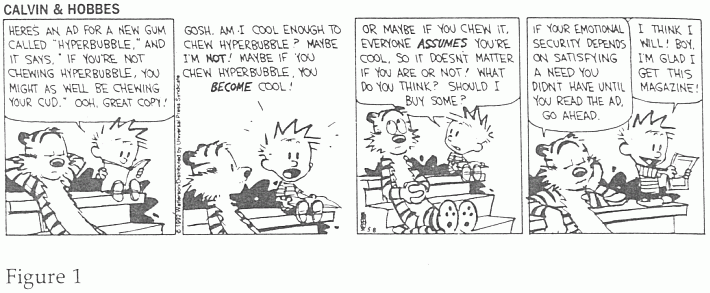
Sigh, again, these are just the incidentals of ads. I wish everyone was just completely honest about what ads are for: they are ploys to manipulate viewers into buying things that they did not need until they watched that ad. Ads are not some goodwill clever mechanism to keep magazines in business. The purpose of ads is not to keep Wired in business.
That being said, I think Wired is completely in their right to escalate in the adblocking arms race. I just wish that they were honest about the rules of engagement: either you are open to the possibility of acquiring a purchasing need that you did not have until you watched an ad, or you do not read Wired's articles.
Or like Hobbes said to Calvin...
http://ignatz.brinkster.net/cimages/joyce.gif
Sigh, again, these are just the incidentals of ads. I wish everyone was just completely honest about what ads are for: they are ploys to manipulate viewers into buying things that they did not need until they watched that ad. Ads are not some goodwill clever mechanism to keep magazines in business. The purpose of ads is not to keep Wired in business.
That being said, I think Wired is completely in their right to escalate in the adblocking arms race. I just wish that they were honest about the rules of engagement: either you are open to the possibility of acquiring a purchasing need that you did not have until you watched an ad, or you do not read Wired's articles.
Or like Hobbes said to Calvin...
http://ignatz.brinkster.net/cimages/joyce.gif
>We want to offer you a way to support us while also addressing those concerns
Then actually address those concerns, rather than just telling us to ignore them (whitelist) or pay up.
I don't care about ads, really. Yes they are a petty annoyance, but I grew up with magazines, newspapers, TV, and radio all supported by ads. However, the way they presented their ads was markedly different.
* Their ads didn't invite dozens of third parties to spy on everything I do.
* Their ads didn't break into my home, rifle through my things, and set up operations doing potentially illegal activities in my basement.
* When I wanted to read a 1-page article in their magazine, yes they showed me some ads, but I didn't have to pay the full cost of having a 20-volume encyclopedia delivered to my house just for the ads on that page.
Find a way to advertise without constantly assaulting the reader. Actually address your readers' concerns instead of downplaying them and knowingly causing harm to your readers. You have other options. Taking them, and proving that you can be successful without being evil, that would make a difference.
Then actually address those concerns, rather than just telling us to ignore them (whitelist) or pay up.
I don't care about ads, really. Yes they are a petty annoyance, but I grew up with magazines, newspapers, TV, and radio all supported by ads. However, the way they presented their ads was markedly different.
* Their ads didn't invite dozens of third parties to spy on everything I do.
* Their ads didn't break into my home, rifle through my things, and set up operations doing potentially illegal activities in my basement.
* When I wanted to read a 1-page article in their magazine, yes they showed me some ads, but I didn't have to pay the full cost of having a 20-volume encyclopedia delivered to my house just for the ads on that page.
Find a way to advertise without constantly assaulting the reader. Actually address your readers' concerns instead of downplaying them and knowingly causing harm to your readers. You have other options. Taking them, and proving that you can be successful without being evil, that would make a difference.
Forbes has been doing this for a while on its website. (Or, at least for a while it has been detecting the ad blocking-software that I have been using for much longer.) I have basically stopped reading Forbes (which maybe was a good idea on other grounds) and have learned to appreciate stories from competing publications. If Wired doesn't want my eyeballs to visit its site, I'll just stop bringing them there.
I use Google Contributor [1], which _effectively_ functions as an ad blocker, one that compensates website owners for the ads they're not displaying.
A different, but equivalent, way of looking at the product is that Google Contributor lets me essentially enter a op ad in the advertising auction for any web page I visit; if my bid wins, I see a placeholder instead of the ad. One nice side effect of this scheme is that the ads that do make it through are generally of high quality, since they're the ones for which some advertiser managed to outbid me.
[1] https://www.google.com/contributor/welcome/
A different, but equivalent, way of looking at the product is that Google Contributor lets me essentially enter a op ad in the advertising auction for any web page I visit; if my bid wins, I see a placeholder instead of the ad. One nice side effect of this scheme is that the ads that do make it through are generally of high quality, since they're the ones for which some advertiser managed to outbid me.
[1] https://www.google.com/contributor/welcome/
If I was dying to read a Wired article I could just google it. I'm sure there'll be a cached copy somewhere. If that were to fail then I'd just drive a headless browser to the url, or even a bot, and pull the content out. Thankfully, I'm not that desperate to do either. Wired doesn't have as much leverage as they think they do. And frankly, for a technology flagship as they used to be, I'd expect them to work with the community, not against it. Find a bulletproof way to serve malware-free ads and serve them from your domain and I'd gladly whitelist your site. Otherwise I'm not risking it.
> we will restrict access to articles on WIRED.com if you are using an ad blocker
well, i will restrict my viewing of WIRED.com then. Like completely.
well, i will restrict my viewing of WIRED.com then. Like completely.
I actually think this is a reasonable move for them. They have to pay their staff and keep the lights on while producing their content. It is kind of entitled and ridiculous for readers to think the party of well-researched, well-written and insightful content for free could go on forever. You either should have to pay for it explicitly with a subscription fee, or consent to ads and tracking. Yes, there is a lot of mediocre fluff/stuff there, but there is easily $1/week worth of high quality content imho.
And, if you do not want to partake, then don't. No one is making you read Wired. But, I strongly suspect that publishers that want to keep producing high quality content without running themselves into the ground, as ad blockers become more prevalent, are going to go down this road. The folks here that saying "Ad blockers or bust!" are going to be left with increasingly fringe and lower quality content in the future.
And, if you do not want to partake, then don't. No one is making you read Wired. But, I strongly suspect that publishers that want to keep producing high quality content without running themselves into the ground, as ad blockers become more prevalent, are going to go down this road. The folks here that saying "Ad blockers or bust!" are going to be left with increasingly fringe and lower quality content in the future.
I don't mind ads but I do mind tracking.
* If Wired would implement a solution that provides confidentiality to users, following the approach of The Intercept [1], I would have no problem with it.
* If Wired would show me ads I was interested in, I'd be happy to see them (assuming my confidentiality is preserved).
* If Wired would provide a way to pay them without having to go through another website registration and credit card payment process, I'd pay them. I don't have time to register for and pay every website I read using the current systems, and Wired isn't at the top of my list.
If users are so annoyed by part of your website that they are investing time and effort in disabling it, perhaps the problem is with your website.
[1] https://theintercept.com/2015/11/04/what-the-intercepts-new-...
* If Wired would implement a solution that provides confidentiality to users, following the approach of The Intercept [1], I would have no problem with it.
* If Wired would show me ads I was interested in, I'd be happy to see them (assuming my confidentiality is preserved).
* If Wired would provide a way to pay them without having to go through another website registration and credit card payment process, I'd pay them. I don't have time to register for and pay every website I read using the current systems, and Wired isn't at the top of my list.
If users are so annoyed by part of your website that they are investing time and effort in disabling it, perhaps the problem is with your website.
[1] https://theintercept.com/2015/11/04/what-the-intercepts-new-...
You can innovate around the issue, like some of the comments mention.
You should focus on growing sustainably, instead of selling yourselves to advertisers for quick cash. God knows there are a plethora of other places we can get our content from. There's enough information pollution in our daily lives - I won't accept you polluting my reading of your 'well-written' articles.
So, in summary... good riddance.
You should focus on growing sustainably, instead of selling yourselves to advertisers for quick cash. God knows there are a plethora of other places we can get our content from. There's enough information pollution in our daily lives - I won't accept you polluting my reading of your 'well-written' articles.
So, in summary... good riddance.
I like the idea of paying for subscriptions for no-ad service. However, the $1/week seems a little high. I might read 10 to 20 articles a year on wired.com.
I do pay subscriptions for things that I use (almost) daily: Hulu no commercials version, Netflix, and Google Music.
So, good idea, but I would expect a subscription to perhaps cost $10 to $15/year. Just my opinion...
I do pay subscriptions for things that I use (almost) daily: Hulu no commercials version, Netflix, and Google Music.
So, good idea, but I would expect a subscription to perhaps cost $10 to $15/year. Just my opinion...
I have split websites that I visit into two categories:
1) Websites that still render and are readable after uMatrix, uBlock Origin, and a few other restrictive content filters are done with them. I continue reading and enjoying these, provided the content is worth my reading time.
2) Websites that are broken, or otherwise make the content inaccessible. For example, a "dialog" appears over the content, inviting me to join their newsletter. These sites get the ol' ^W or ⌘W, and after a few visits I learn to never visit them again.
Also, sites in category #2, are auto-censored anywhere I moderate.
1) Websites that still render and are readable after uMatrix, uBlock Origin, and a few other restrictive content filters are done with them. I continue reading and enjoying these, provided the content is worth my reading time.
2) Websites that are broken, or otherwise make the content inaccessible. For example, a "dialog" appears over the content, inviting me to join their newsletter. These sites get the ol' ^W or ⌘W, and after a few visits I learn to never visit them again.
Also, sites in category #2, are auto-censored anywhere I moderate.
This is a nice post from an organization that clearly cares about their readers. That's hard to write, and the staff at Wired deserve credit for their effort to be open and direct with us.
Unfortunately the post fails to address the reasons that their readers USE ad blockers. If only they had gone a LITTLE bit farther in this post and made specific promises in exchange for being whitelisted. Here are the promises that would have convinced me.
- Third party scripts will be kept to under 33% of page weight. (They're at ~50% for this article, and that's with a 1.1MB gif in the content!)
- We will respect "do not track" headers in your browser (or settings on your Wired account) by excluding you from ad- and analytics-related tracking
- If you have enabled "do not track" headers in your browser, we will only serve you anonymous ads
- We may serve you ads based on your browsing behavior at wired.com, but they will always include a short explanation. For example, "because you were interested in XXXX:"
- Our ad placement and content will follow strict limitations (link to a public page of their guidelines), based on the the Adblock "Acceptable Ads" rules (https://adblockplus.org/en/acceptable-ads#criteria).
- We will serve all content and ads over HTTPS, from within the wired.com TLD (or include a list of specific sources), so you can trust that it's really coming from us.
Since Wired doesn't offer to address any of the issues that make (technical) people enable an ad blocker, the post is reduced to an ultimatum. They're asking you to make a special exception for Wired, and offering only a stick as incentive. No carrot, no quid pro quo, and no addressing your concerns. And they're doing it on a 3.3MB page with 1.5MB worth of third party ads and tracking code attached.
Giving an ultimatum to 20% of your readership sounds like a stupid business strategy, and I doubt it's what the Wired board had in mind. Perhaps they could learn something from app designers: if something is so objectionable about your Ux that 20% of your user base uses third party alternatives to get at your content, try a little market research to improve that Ux. Just do a cursory investigation into WHAT people find so terrible, and WHY they use the alternative; consider how you might change your Ux to make that unnecessary. This is 20% of your userbase who likes your content so much, they find ways to access it despite a shitty OOTB Ux. It would be a big sacrifice to cut off such a dedicated (and large) group of fans.
Unfortunately the post fails to address the reasons that their readers USE ad blockers. If only they had gone a LITTLE bit farther in this post and made specific promises in exchange for being whitelisted. Here are the promises that would have convinced me.
- Third party scripts will be kept to under 33% of page weight. (They're at ~50% for this article, and that's with a 1.1MB gif in the content!)
- We will respect "do not track" headers in your browser (or settings on your Wired account) by excluding you from ad- and analytics-related tracking
- If you have enabled "do not track" headers in your browser, we will only serve you anonymous ads
- We may serve you ads based on your browsing behavior at wired.com, but they will always include a short explanation. For example, "because you were interested in XXXX:"
- Our ad placement and content will follow strict limitations (link to a public page of their guidelines), based on the the Adblock "Acceptable Ads" rules (https://adblockplus.org/en/acceptable-ads#criteria).
- We will serve all content and ads over HTTPS, from within the wired.com TLD (or include a list of specific sources), so you can trust that it's really coming from us.
Since Wired doesn't offer to address any of the issues that make (technical) people enable an ad blocker, the post is reduced to an ultimatum. They're asking you to make a special exception for Wired, and offering only a stick as incentive. No carrot, no quid pro quo, and no addressing your concerns. And they're doing it on a 3.3MB page with 1.5MB worth of third party ads and tracking code attached.
Giving an ultimatum to 20% of your readership sounds like a stupid business strategy, and I doubt it's what the Wired board had in mind. Perhaps they could learn something from app designers: if something is so objectionable about your Ux that 20% of your user base uses third party alternatives to get at your content, try a little market research to improve that Ux. Just do a cursory investigation into WHAT people find so terrible, and WHY they use the alternative; consider how you might change your Ux to make that unnecessary. This is 20% of your userbase who likes your content so much, they find ways to access it despite a shitty OOTB Ux. It would be a big sacrifice to cut off such a dedicated (and large) group of fans.
I'm sure market research has been done. But 52 dollars a year is probably too high a price for an ad free version of wired. I would pay maybe three or four dollars a year, which has to be more money than they would possibly make off of the advertising revenue I would generate in a lifetime.
The model I would like to see involves micro-payments. I would be willing to "tip" say $0.10 or $0.15 here and there to instantly unlock certain articles. I think if this were easy to do then wired and other websites like it would make a lot more money over all from it's content.
The problem though is that with today's credit card infrastructure the processing fees make this sort of thing unrealistic, and the emerging alternative (blockchain tech) is not yet widely enough accepted by consumers to be useful in this regard.
I think we'll get there eventually, and a new "culture of tipping" on the web may flourish in a way that is very healthy for the journalistic community as a whole. It could also mean that for instance a poor person in a remote part of the world could record a youtube video of some traditional folk art or dance and then upload it to multiple social platforms and receive material amounts of money from random visitors within the first few hours without first needing to "strike a deal with youtube" or anything like that.
This might reorient village life in some areas away from making trinkets to sell to western tourists and instead towards making traditional creative art to share with a global audience. This could in theory help counteract the "westernization effect" that global cultures have been experiencing.
The problem though is that with today's credit card infrastructure the processing fees make this sort of thing unrealistic, and the emerging alternative (blockchain tech) is not yet widely enough accepted by consumers to be useful in this regard.
I think we'll get there eventually, and a new "culture of tipping" on the web may flourish in a way that is very healthy for the journalistic community as a whole. It could also mean that for instance a poor person in a remote part of the world could record a youtube video of some traditional folk art or dance and then upload it to multiple social platforms and receive material amounts of money from random visitors within the first few hours without first needing to "strike a deal with youtube" or anything like that.
This might reorient village life in some areas away from making trinkets to sell to western tourists and instead towards making traditional creative art to share with a global audience. This could in theory help counteract the "westernization effect" that global cultures have been experiencing.
How are they going to detect ad blocking? They're going to have to spend a long time fighting anti-ad block detection.
You can't trust the client. Ads are displayed in the client. It would take hardware level ad serving to make ad serving and anti-ad blocking feasible.
You can't trust the client. Ads are displayed in the client. It would take hardware level ad serving to make ad serving and anti-ad blocking feasible.
Dear Publishers, i do not have a solution for the general problem.
But, the one thing i can tell you: there is no way i will manage premium subscriptions/accounts for 20 different sites. Not only does this get costly very fast... but even if it was only $1/month each (it's not!) - handling 20 incompatible logins on 5 different devices, most likely payed via different payment methods... that is just absurd.
This is not the way to go.
But, the one thing i can tell you: there is no way i will manage premium subscriptions/accounts for 20 different sites. Not only does this get costly very fast... but even if it was only $1/month each (it's not!) - handling 20 incompatible logins on 5 different devices, most likely payed via different payment methods... that is just absurd.
This is not the way to go.
Oh wired, do you really think we care that much about reading your articles? Forbes did the same thing, and I just stopped reading forbes articles when they blocked me.
It's a tough spot to be in for all these companies - they need to make money and stay in business, but it's rare that any of them are important enough to the average user to turn off blocking. There are simply too many sites out there to choose from.
It's a tough spot to be in for all these companies - they need to make money and stay in business, but it's rare that any of them are important enough to the average user to turn off blocking. There are simply too many sites out there to choose from.
What Forbes did after it had readers turn off their ad blockers is still fresh in my mind: https://www.techdirt.com/articles/20160111/05574633295/forbe...
The comments here are full of lame hypocritical excuses. First it was "I don't wanna ads but I would pay for quality content". Now when outlets give you the option to pay "It is too complicated to pay every single publisher". When publisher will join to enable a single payment solution system the excuse of the day will be "Oh, this is too expensive..."
Wired, and it's multi-billionare owners can stuff it.
Wired has been on a long stead decline ever since it was first sold in the late 90s. Now they've gotten to the point where they do so little good journalism that just blacklisting them (to save myself the bother of running into their adblock block) will be as painless as cancelling my subscription was after their part in exposing Manning.
Wired has been on a long stead decline ever since it was first sold in the late 90s. Now they've gotten to the point where they do so little good journalism that just blacklisting them (to save myself the bother of running into their adblock block) will be as painless as cancelling my subscription was after their part in exposing Manning.
I was about to whitelist the site (which I only visit occasionally), and as I approached the little uBlock Origin icon, I noticed the little supertext number: 28. I click on the icon: 28 requests blocked or 42% of the requests for the page. Thanks, but no thanks.
The absolute first thing one must do before asking people to whitelist is to reduce the ad footprint.
The absolute first thing one must do before asking people to whitelist is to reduce the ad footprint.
"Trust us, and everyone connected to us, and everyone connected to them.""
Wired is asking its readership to compromise, without being willing to make any compromises themselves. They're asking us to trust them on a one-to-one basis, but that's now how trust works in a network. We have to trust Wired, and trust every single one of the companies or servers they include content and scripting from, and trust every single one of the companies or servers that these companies or servers include content from. We're looking at trusting at least a hundred actors here, quite likely more.
"Trust us, and only us."
A much better compromise would be to ask us to turn off ad blocking on their site, while in turn guaranteeing that every single script and asset served on their domain will also be served from their own servers, after having undergone at least some type of inspection. Then we at least have a reasonable basis for trust.
Wired is asking its readership to compromise, without being willing to make any compromises themselves. They're asking us to trust them on a one-to-one basis, but that's now how trust works in a network. We have to trust Wired, and trust every single one of the companies or servers they include content and scripting from, and trust every single one of the companies or servers that these companies or servers include content from. We're looking at trusting at least a hundred actors here, quite likely more.
"Trust us, and only us."
A much better compromise would be to ask us to turn off ad blocking on their site, while in turn guaranteeing that every single script and asset served on their domain will also be served from their own servers, after having undergone at least some type of inspection. Then we at least have a reasonable basis for trust.
In France we had something called the Minitel, it was basically internet but the wrong way and centralized, you had to pay more or less depending on which website you would visit (you'd dial 36 14 for free content , 36 15 for paid one ... ), it failed because it was obviously the wrong model but it was quite lucrative for "content providers". The phone company directly handled payement so there was no friction or paywall.
Here is how a terminal looked like :
https://www.element14.com/community/servlet/JiveServlet/show...
I'm not suggesting to go back to that of course, it was dreadful, but it feels like current content providers always try to reinvent the Minitel somehow.
Here is how a terminal looked like :
https://www.element14.com/community/servlet/JiveServlet/show...

I'm not suggesting to go back to that of course, it was dreadful, but it feels like current content providers always try to reinvent the Minitel somehow.
I wonder why content website don't use Canvas rendering in order to block all ad-blockers. You either see the canvas, with ads in it or don't see anything at all. There need to be a compatible ad-network as well. Accessibility is going to be an issue but if you can solve all of that there is a startup idea right there!
Prediction: in a few days/weeks, Wired will back pedal on this decision under the pretense that they are listening to the feedback of angry users, while the reality will be that they have been hemorrhaging readership because of the decision and reverting it is the only way to try to salvage the mess they created.
After adding 19 separate exceptions in uMatrix for both whole domains and for types of requests/actions on domains, I still don't see any ads but I do see an ever-increasing list of third-party sites Wired is pulling requests from. Given a choice between throwing up my hands and saying "Fine, f*ckit, do whatever the hell you want" and whitelisting Wired's requests to all of (disqus, optimizely, amazon-adsystem, condenastdigital, demdex, typekit, adobetm, chartbeat, cloudfront, doubleclick, googleadservices, googlesyndication, googletagservices, mediavoice, mookie1, omtrdc, outbrain, parsely, scorecardresearch, yldbt and zqtk) plus whatever others would be pulled in were I actually to whitelist, I guess I'll have to do without Wired.
So far without ever actually loosening things up far enough to see ads that's AT LEAST 21 different top-level domains Wired is pulling from, not counting its own (and yes, I realize it's part of Conde Nast). Most of those top-level domains have at least 2 subdomains being pulled from, sometimes more. My basic reaction to this is that even if I trust Wired and Conde Nast, I don't know that I trust all those other sites like "mookie1," "yldbt," "zqtk" and whatever other obscurely-named domains.
Frankly, were I to see "yldbt" or "zqtk" as a running process or folder name on a system I was working on, I'd immediately rename them and start virus and malware scans.
So I guess my reading of Wired online will suffer much the same fate as my reading of Wired on paper, because while I like seeing occasional items from Wired it's not a daily destination for me, and I'm certainly not coughing up $50+/year for it.