I'm not in any way a Trump supporter or on the right more generally, but I can see why people on the right might be skeptical. The tech community did, after all, run Brendan Eich out on a rail when they discovered that he donated $1000 in favor of Prop. 8. I think they know that, while they may be in the majority nation-wide, in the tech community they are a small, reviled minority. And if they work for political campaigns they support, there will be social, and potentially business, repercussions.
It seems a little to me like get-out-the-vote campaigns. They're dressed up as some totally non-partisan, civic-duty enterprise. But if you're targeting your efforts towards demographics that you know are generally going to vote a certain way, can you really claim with a straight face that you're not helping a particular political party? Here you know a priori that you'll be encouraging people to get involved in politics with a certain bent. I'll point out that none of this is bad, per se, but I think it's why you can expect conservatives to react defensively.
I think your point here is a little disingenuous. (For reference I'm a longtime LP party member and have recently been getting very involved in the LP at the local level.) While it's true that the recent presidential nominees have all been former Republicans, the reason for this is that the Party has been wanting to put up respectable candidates who have experience. In its early years, the LP was effectively just an outreach organization aimed at spreading the libertarian message. But these days the LP has been wanting to become a real political party that gets candidates elected. And in order to get candidates elected, we need to have respectable candidates.
In local races it's fine to put up someone with no or little experience in government, as long as they are a respected member of the community. But you can't just put up "some dude" for president. So in practice this means we have to take defectors. But heaven knows there has been a lot of consternation in the LP over this. My guess is that the LP is getting tired enough of taking former Republicans that whoever they nominate in 2020 will be homegrown. (Maybe a former Democrat.)
But while the presidential race gets the most press, we've been working hard to get Libertarians elected at lower levels of government. It's just really, really hard to break past the two party mindset (and ballot access laws), and we haven't had a lot of success to date. The difficulties we have getting people elected to the lower levels of translate directly to us nominating former Republicans for president.
Interestingly, another approach that was seriously considered was to build a fake "Havana airport" in southern Florida and have the planes land there instead.
> That unelected, life-tenured judges exercise this much authority over us, that they routinely subvert our collective democratic will as expressed through elections and referendums, that people even defend their votes for President on the basis of what kind of Supreme Court nominations they will likely make, does not suggest a healthy democracy.
Nor should it! The judiciary is at its best when it is overturning the will of the majority in order to defend the rights of minorities.
The Court did precisely that in its most celebrated cases (e.g., Brown v. Board, Lawrence v. Texas), and upheld the will of the majority in its most infamous cases (e.g., Dred Scott, Plessy v. Ferguson, Korematsu v. United States).
> In the U.S., despite what officers tell you, you do not have to identify yourself when asked.
This varies state to state. In many states you must identify yourself at the level of providing your name and address, but you are not required to produce any documentation.
For a body that's nearly spherical like the Earth you do a multipole expansion. Most of the gravity comes from a monopole (just a point mass at the center of gravity). Then you calculate (or measure) the contribution to the gravitational field from a quadrupole moment, and then an octupole moment and so on.
The reference to Renaissance art may be a reference to the relatively recently formed subreddit /r/accidentalrenaissance [1] where people post photos with unusual compositions that are reminiscent of Renaissance paintings. The photo referenced in the article is one of the top submissions.
There's a fair amount of activity here in central Ohio, as well. The most reliable source of discussion is that every few weeks the police department posts a notice about the locations where they will be having DUI checkpoints. Like clockwork this sets off a 50+ comment discussion where some people are dumbfounded that the police actually post where they will be ahead of time, followed by other people replying that in order for DUI checkpoints to be constitutional the police have to announce them ahead of time, followed by replies that it doesn't seem unconstitutional to have random police stops and drunk drivers should be stopped at all costs, etc. Every single time.
But it was useful to get information when people were getting upset that the city was trying to replace the green space in a park with a bunch of little league baseball parks.
No, it would be the longitude. The average of sunrise and sunset will be local noon, and from that you get the longitude. To get the latitude you would need to see where the Sun rises and sets or see the stars, neither of which you could do very accurately under heavy cloud cover.
The short version is that it was fashionable in Fatimid Egypt for the ruler to bestow high quality garments to government officials as a sort of promition. These garments usually had verses from the koran embroidered along the hems. The crusaders brought back many of these garments to Western Europe where they became very popular, and the style was imitated in paintings.
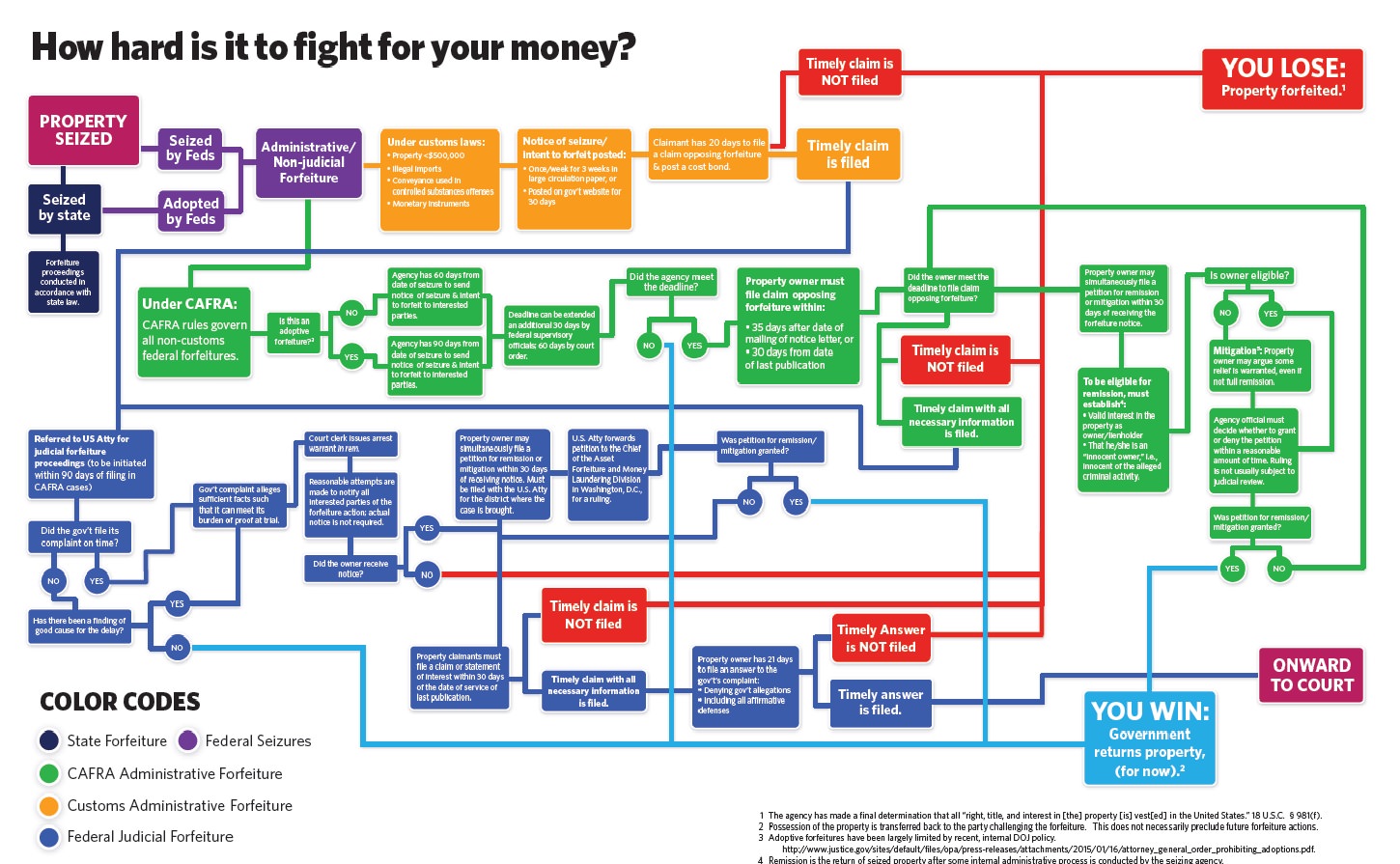
With regards to point 2, at the federal level things do seem to work very differently. Here is a flowchart outlining the steps you would have to take to reclaim your assets from federal forfeiture:
Regarding point 3, part of the problem, too, is that the federal government engages in sharing programs with local agencies. So if most of the money from a local-level forfeiture does not go back to the agency, the agency has a strong incentive to bring the feds into it because then they will keep a considerably larger fraction of the proceeds.
I didn't want my excerpt to be too long, but Kozinski actually talks about this in the very next paragraph:
"Even more troubling are doubts raised by psychological research showing that“whoever makes the first assertion about something has a large advantage over everyone who denies it later.”43 The tendency is more pronounced for older people than for younger ones, and increases the longer the time-lapse between assertion and denial. So is it better to stand mute rather than deny an accusation? Apparently not, because “when accusations or assertions are met with silence, they are more likely to
feel true.”44
To the extent this psychological research is applicable to trials, it tends to refute the notion that the prosecution pulls the heavy oar in criminal cases. We believe that it does because we assume juries go about deciding cases by accurately remembering all the testimony and weighing each piece of evidence in a linear fashion, selecting which to believe based on assessment of its credibility or plausibility. The reality may be quite different. It may be that jurors start forming a mental picture of the events in question as soon as they first hear about them from the prosecution witnesses. Later-introduced evidence, even if pointing in the opposite direction, may not be capable of fundamentally altering that picture and may, in fact, reinforce it.45 And the effect may be worse the longer the prosecution’s case lasts and, thus, the longer it takes to bring the contrary evidence before the jury. Trials in general, and longer trials in particular, may be heavily loaded in favor of whichever party gets to present its case first—the prosecution in a criminal case and the plaintiff in a civil case. If this is so, it substantially undermines the notion that we seldom convict an innocent man because guilt must be proven to a sufficient certainty. It may well be that, contrary to instructions, and contrary to their own best intentions, jurors are persuaded of whatever version of events is first presented to them and change their minds only if they are given very strong reasons to the contrary."
What the legal profession believes to be "beyond a reasonable doubt" and what the members of a particular jury consider "beyond a reasonable doubt" are two very different things. Judge Alex Kozinski wrote very well on the matter in a great article [1]:
"Juries are routinely instructed that the defendant is presumed innocent and the prosecution must prove guilt beyond a reasonable doubt, but we don’t really know whether either of these instructions has an effect on the average juror. Do jurors understand the concept of a presumption? If so, do they understand how a presumption is supposed to operate? Do they assume that the presumption remains in place until it is overcome by persuasive evidence or do they believe it disappears as soon as any actual evidence is presented? We don’t really know.
Nor do we know whether juries really draw a distinction between proof by a preponderance, proof by clear and convincing evidence and proof beyond a reasonable doubt. These levels of proof, which lawyers and judges assume to be hermetically sealed categories, may mean nothing at all in the jury room. My own experience as a juror certainly did nothing to convince me that my fellow jurors understood and appreciated the difference. The issue, rather, seemed to be quite simply: Am I convinced that the defendant is guilty?"
> That means that 96% are guilty. That's beyond a reasonable doubt and probably not far from the best accuracy you can expect from an inherently fuzzy system.
I disagree. A 1 in 25 chance that someone is innocent certainly seems like a reasonable doubt to me. Even 1 in 100 seems like a reasonable doubt. 1 in 1000 is maybe unreasonable, but 1 in 25?
At any rate, the formulation that the legal system prefers to use is the other way round. Rather than how many innocent people we should put in jail, the question is how many guilty people we should allow to go free to prevent a single innocent person from going to jail. The idea that an innocent person could possibly be convicted is totally at odds with the way the legal community sees itself. (Which is why, incidentally, it is so difficult for the law to accept that innocent people have been wrongly convicted.) So I disagree that the system is not at fault. The legal system must recognize that false positives exist and it needs to handle them intelligently.
By the way, there's a wonderful article by Eugene Volokh speculating on what an acceptable number of guilty men to let go free is [1].
I might have had it slightly wrong in my original comment. I think that only one of his brake lights was faulty and it's not illegal to have one broken brake light.
This principle was explicitly upheld by the Supreme Court in Heien v. North Carolina. A police officer pulled a car over because it had a broken brake light. During the stop, the police officer became suspicious that the car was carrying drugs, searched the car (with the permission of the driver) and found cocaine.
Now, as it happens it is not illegal under North Carolina state law to have a broken brake light, so the police officer had no basis to pull the man over in the first place. But the Supreme Court ruled that there are so many laws out there that a police officer cannot possibly know them all and because the police officer believed that the defendant was breaking the law in good faith, that was good enough for a traffic stop.
I highly recommend anyone interested in this to read the article Criminal Law 2.0 by Alex Kozinski (a judge on the Ninth Circuit Court of Appeals). He presents twelve fundamental tenants of the criminal justice system that are flawed and suggests some ways to fix them. (E.g., "Eyewitnesses are highly reliable" and "Long sentences deter crime.") If you haven't read anything by Kozinski, you should. It's very readable. Especially the conclusion.
It seems a little to me like get-out-the-vote campaigns. They're dressed up as some totally non-partisan, civic-duty enterprise. But if you're targeting your efforts towards demographics that you know are generally going to vote a certain way, can you really claim with a straight face that you're not helping a particular political party? Here you know a priori that you'll be encouraging people to get involved in politics with a certain bent. I'll point out that none of this is bad, per se, but I think it's why you can expect conservatives to react defensively.