DO was unduly spooked by an empty legal threat. This was not a DMCA notice, this was a trademark notice. Parodies are protected under trademark law. Bad form taking down even a single page, and terrible form taking down an entire service.
Under this interpretation, wouldn't (say) a collection of Facebook photos with statues, in aggregate, constitute a database and therefore become illegal? At what point does the size and structure of a collection become sufficient to cross the legal line? Would an individual Facebook user therefore be liable? Would Facebook as whole? etc.
It seems that the law has created the unintended consequence that the organization of the depictions in question matter more than the actual depictions themselves. Or in other words, of imputing commercial intent to any such collection of copyrighted works, whether intentional or otherwise.
Depending on the system you use to view the text, many of the characters are actually printed using non-Roman lookalike characters that still render as the "usual" ones.
In OSX / Firefox I see the usual text in the web view, but in source view there's a variation in shading between characters, in what should be an unadorned monospaced font. Viewing the same source in Chrome shows the trick for what it is...
Subtle and not always visible due to differences in display normalization in various libraries? Way out of my depth for system fonts / encoding issues. But hopefully the above shows what I'm talking about. Could there be some data hidden in the lookalike string values?
Did anyone else notice the weird GNU/Linux screed on line 803? In particular, the "Additional Comments" content is actually written with a large amount of look-alike Unicode. Playing around with this data in Excel somehow byte-shifted it into garbage. I noticed that other folks thought it would be funny to put things like =SUM(G1:G1000) in other cells, but this seems a little bit more sinister for some reason. Anyone savvy enough in UTF-8 to deduce what's going on there?
I've done a whole lot of individual research in the last two months, consulted with two dentists and an endo, gotten opinions from friends and family etc... seeing that any procedure is irreversible, it seems prudent to take the least drastic option first. I don't have a particular concern about recurrent infection in this case, because my diagnosis is about trauma, not decay. What concerns do you have?
Assuming for a minute that bottled air is a viable solution to smog, it's only the prestige of "exotic Canadian air" that necessitates the long shipping distance. Bottling filtered air from a relatively local source might work... but only if your factory could generate net negative emissions.
And anyhow, to have a health impact, we're talking about large quantity concentrators for those lug-around supplemental oxygen machines. These look awfully small to have any impact long term:
Anecdotal: I once tried purchasing a similar Oxygen can at a high-altitude ski resort as a sort of "stamina inhaler" on a heavy powder day. A good puff would return one's breath to normal pretty quickly, but the can ran out after a few hours of occasional use. So, at best these can be used as an ersatz, non-medical inhaler.
On the other hand, the market for air filters is still booming.
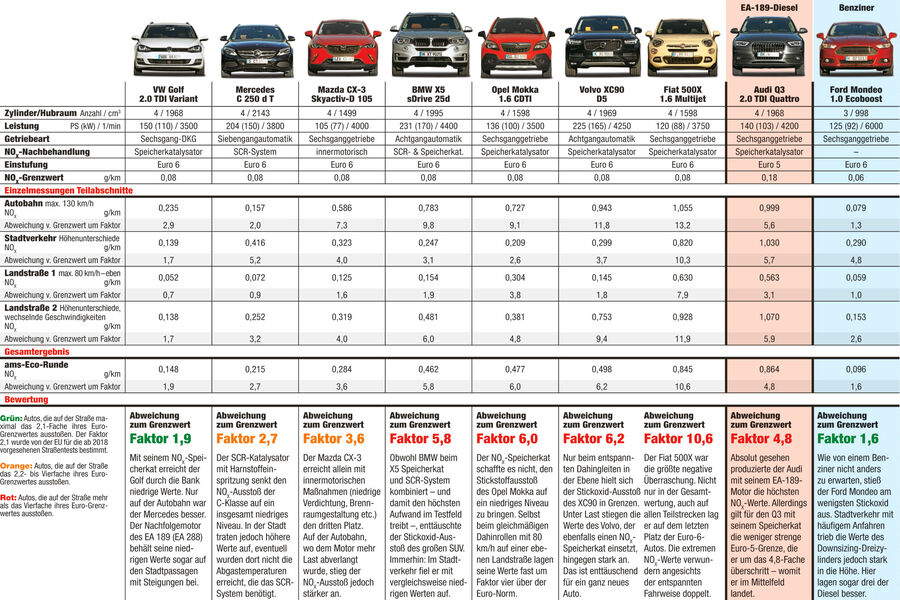
At the top of the NOx scale we have a VW TDI engine (albeit in an Audi Quatro application).
Near the bottom of the NOx scale we have... a VW TDI engine.
In other words, VW already had the capability to eliminate the emissions through design, but chose to cheat the tests instead. That is rather damning evidence, and serves as a rebuttal for those who think that VW is somehow being unfairly targeted.
Clearly, many other companies also need to lower their emissions, and regulators need to adopt meaningful tests. But to cheat the tests that do exist, and for no clear need (except possibly profit margins) is inexcusable.
> If you naively extrapolate from the 2013 Pew Poll The World’s Muslims: Religion, Politics and Society (which in principle represents nations with a total Muslim population of about 1 billion), 40% of these think you should be killed for leaving Islam.
And, if you actually read the study, you find this number is 28%, not 40%.
"American and French officials say there is still no definitive evidence to back up their presumption that the terrorists who massacred 129 people in Paris used new, difficult-to-crack encryption technologies to organize the plot."
IMO, that is the only part of the article that needs to be understood.
Safari on Yosemite also shows power usage per tab which is great for identifying rogue websites.
Also... TIL that some sites take more power to render than a 1080p stream!
This also of reinforces the argument for installing an ad blocker -- less elements to process on each page means less power used. µBlock is particularly promising as it's very lightweight.
An interesting take on the experience of occupying a transient and impersonal space, but also a reflection of the author's perspective on travel. The two are not the same.
Being disconnected from friends and family, being too narrowly focused on work, or actively avoiding human entanglements as the author admits, is a perfect framing device for melancholy. Whether this takes place in a home or in a hotel is simply a matter of setting.
Having held a travel-intensive consulting position in an earlier part of my career, I absolutely identify to the melancholy of constant dislocation. However, now that I work primarily at home, I do miss the occasional changes of scenery and am looking forward to my upcoming vacation overseas.
The moral of the story is that balance matters, as does context. Too much constant motion produces alienation. Too little produces boredom. And it's much easier to look forward to a personal trip than a business trip, because the former is much more directly rewarding. As important as it is to travel, it's just as important to have a sense of homecoming when it's over.
Right, an autonomous ride-share car service would be ideal in its capacity to reduce the need for personal car ownership. But even so, technology is fallible in extenuating circumstances, and human intervention will always be needed as a recourse.
Because you don't own any of those things. If you own your own plane and have a pilot's license, you are more than welcome to fly it yourself and to disengage the autopilot should the situation demand it.
I wouldn't mind an autonomous car-share service. Just saying that Musk's futurist vision of mandatory self-driving vehicles is incompatible with personal control of personal technology, and practically, politically infeasible in the US anytime soon.
‘In the distant future people may outlaw driver cars. You can’t have a person operating a two-ton death machine!’
I don't care how good the design is, people will always require a way to take control when they wish. The trick will probably be to make the UX (passenger experience - PX?) so much easier than driving that nobody will want to.
Here we see the other side of the "responsible disclosure" coin -- if the ethical white-hat security researcher is required to withhold publication of a critical vulnerability for a set amount of time, is there a corresponding deadline for timely publication as well? And if that deadline is not met by meaningful attempts at remediation or disclosure, is the researcher not compelled to publish the findings independently?
Obviously these companies failed miserably to meet any reasonable person's timeline of disclosure. One question is whether the extra time researching this malware reasonably would have produced additional worthwhile intelligence about its function and targets. If so, then the delay was "worthwhile". Another question is whether it's not better to simply release an incomplete picture to the security community (perhaps selectively) and let the larger hive mind go to work on finding and corroborating additional clues.
It seems like the firms chose the former; many HN readers would advocate the latter. So finally, the question remains whether such a forced disclosure would be perceived as an irresponsible "leak" based only upon the disagreement in methodology and interpretation of "responsible"? Would its withholding be considered likewise irresponsible? Can a single firm, a collection of firms, or the security research community at large meaningfully stay ahead of a dedicated state-funded attacker? (Probably, Probably, Probably not).
If a nation-state is producing malware, it logically will also be monitoring the channels of disclosure for evidence of its release and detection in the wild. But that's no reason to limit the resources being dedicated to protecting the public; it's egotism at best and collusion at worst.

https://cyber.law.harvard.edu/metaschool/fisher/domain/tm.ht...