There's no reply button for me underneath your threads initially until some time passes. I guess that's how HN works for some. I'll respond to your latest comment here.
> If you say things like "we have a lot of people, so wind power won't work for us,"
Don't you just hate it when people put words into your mouth? Yeah, point me specifically to where I said or implied that.
tiredofcareer, thanks for calling me stupid. This conversation has surely turned professional. It's quite funny when you espouse economically illiterate statements, then question the intelligence of others.
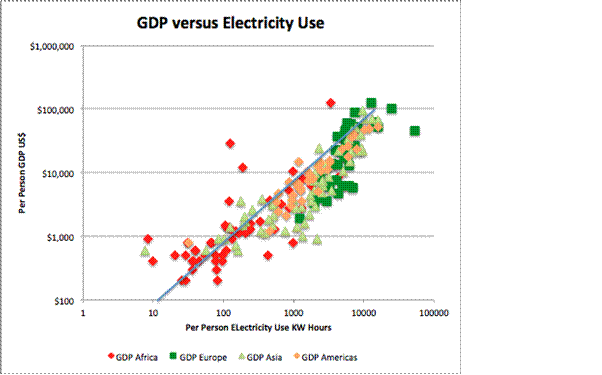
Electricity consumption depends on GDP. Just google those phrases, and you'll find a plethora of sources to confirm the relationship. I listed a graph for you [1]. Because China is growing at 7%, its electrical consumption will only continue to increase. Yes, if two countries of have similar GDPs, the one with the higher population will consume more electricity.
This is completely economically illiterate. China is a developing country. As a result, it uses less electricity than its developed counterparts. As China grows, it will be using much more electricity. Just look at their energy consumption trend since the late 70s. That applies to India, Russia, Indonesia, and any other developing country in growth mode.
Oh, and guess what. China passed the USA in energy consumption in 2010.
Calm down. No one put words into his mouth. You, however, did put words into my mouth, which I find quite astonishing.
Those windmills currently cover 1 million people. The world has 7 billion people and growing quickly. You really think windmills are feasible for Brazil, China, England, France, Germany, Russia, India, Pakistan, Vietnam, Iran, Japan, Mexico, Indonesia, South Africa, Spain, Argentina, Turkey, Colombia, Ukraine, or South Korea? (I can list several more if you want.)
Mainstream economists aren't central planners. I don't mean just economists from both administrations. I meant mainstream economists from every school on the US News and beyond.
That's not how quantitative easing works. Quantitative easing doesn't fire up the printing presses. Bernanke can add $2 trillion into the system within 15 minutes, and no paper money is printed or manpower expensed aside from a few clicks on a computer mouse. Once you secure your financial system network, adding currency adds virtually no costs relative to the amount of currency you put into that system. You've already secured the network.
It's akin to Facebook's security system. It works the same regardless if it's 100 million users or 1 billion users.
Do you have a source for this? As far as I know, and I know this is a theory but I suspect a good theory, people used bitcoin as a currency when it was relatively stable and before it skyrocketed in value, and became extremely volatile. I highly doubt they're using it as a currency now because the value of a bitcoin changes dramatically within a day. Say it stabilizes at this price (~$95), you won't be able to transact with everyday goods because the price of 1 bitcoin is close to $100. Who would buy a hamburger for 1 bitcoin right now?
Krugman isn't being a political partisan hack here. Every mainstream economist from the Republican and Democratic administrations agree that a currency backed similarly to gold (as opposed to a central bank) is not a good idea.
How much does it cost to change bits of data on a computer? That's what happens with quantitative easing. Bernanke isn't calling up the printing presses to print $2 trillion in paper currency.
It's certainly not being used as a currency, its original intention. It's being used by speculators to get rich. Sure you might find a few examples of buyers and sellers using bitcoin currency, but you'll find a lot more speculators buying and selling bitcoins to profit from the spreads.
That's how Wall Street works. You give money to Wall Street, and Wall Street in turn chooses to distribute the money to technology or research companies like Google or Merck (or even venture capital funds which in turn invest in start ups). Wall Street adds value by allocating resources.
> If you say things like "we have a lot of people, so wind power won't work for us,"
Don't you just hate it when people put words into your mouth? Yeah, point me specifically to where I said or implied that.