Basically, people with poor oral hygiene are more likely to develop Alzheimer's than people with good teeth.
You might have heard about a similar study that found a link between oral hygiene and heart disease. The theory, at least in that case, is that bad oral hygiene causes chronic long-term inflammation throughout the body, not just in your gums. This might increase risk of heart disease. Without looking at the data, I would guess that the same theory applies to Alzheimer's and maybe other diseases. The usual caveat about correlation != causation applies of course.
There are a few neuroscientists on HN. Can someone chime in on this? Does the "computationally intensive" approach that the Europeans appear to be taking, i.e. relying on lots of computer simulations of the brain to increase our understanding of it, seem like a viable one? Is it indeed premature, as the article suggests, for us to attempt to simulate the human brain (or even just parts of it)?
Regarding vitamin D, I would add that the only way to make sure your vitamin D level is sufficient is to get tested. Relying on the DRI alone will leave some people insufficient. I expect that many Soylent users will be insufficient and maybe deficient in vitamin D, not because of any failing on Soylent's part, but because this is already true for a random selection of the non-Soylent-using population. Dark-skinned individuals, obese individuals, and people with very little sun exposure (or living at a high latitude) are more likely to be deficient.
Practically speaking, this means: during your next annual physical, make sure your doctor tests your vitamin D along with your other bloodwork. The correct test is called 25(OH)D. Your insurance should cover it. (I am making an assumption about how privileged most HNers are.) Aim for a blood level of 30-40 ng/mL. <20 ng/mL is deficient, >=30 is sufficient, while >40 is probably pushing it, i.e. observational studies suggest that mortality starts to increase slightly around that point. A level greater than 50 ng/mL is almost certainly excessive, though still not close to toxicity. Some people argue for supplementing enough vitamin D to achieve higher blood levels (>40 ng/mL), but IMO the evidence doesn't support doing this and it might be harmful.
They claim that the overall glycemic index (with fiber, etc.) is "rather low", but I can't find fasting vs. postprandial glucose readings that would substantiate this. By itself, maltodextrin has a rather high GI. I do see that Rhinehart posted about this concern a while back:
...but does anyone have more recent info? Without more data, diabetics and prediabetics should best avoid this for now.
edit: A clarification - blood glucose testing won't actually tell you the product's GI, of course. And the important number to look at is glycemic load, but that is easy to calculate given GI. The Soylent folks have not yet shared the GI afaik. (They would need to send it to a lab for testing.) Diabetics should already be monitoring their glucose levels anyway, so I assume they will figure out pretty quickly if this stuff spikes their blood sugar. It's not something you would want to replace all your meals with if that is the case!
Whether or not you are diabetic, it would be a good idea to go to your doctor and get complete bloodwork done before you start using this if you are planning to drink the stuff on a daily basis and especially if you replace the majority of your meals. Get tested for the sort of things they check when you get a physical, but within a few months leading up to the point you start Soylenting. Test again 6-12 months after you start and compare the numbers, then kindly make a spreadsheet or something and share your results.
A problem here is that the Supreme Court is, by its nature, not very tech-savvy. FTA:
The justices expressed varying levels of sophistication about cellphones. Chief Justice John Roberts, Justice Sonia Sotomayor, Kagan and Alito seemed most comfortable talking about the technology. They are, perhaps not coincidentally, the four youngest justices.
On the other hand, 75-year-old Justice Stephen Breyer, who is given to self-deprecation on the bench, gamely tried to engage the Justice Department's Dreeben in a discussion about encryption technology. "I don't know what kind of phone you have, Justice Breyer," Dreeben said.
Breyer replied: "I don't either because I can never get into it because of the password."
There's some tidbits about the computer systems used in the missile launch facilities, e.g.:
Lesley Stahl: And they're using really, really, really old computers. I saw a floppy disc and not a floppy disc that size [indicates a 3.5 inch floppy]. It was gigantic.
Jack Weinstein: I'll tell you, those older systems provide us some -- I will say huge safety when it comes to some cyber issues that we currently have in the world.
Lesley Stahl: Now, explain that.
Jack Weinstein: A few years ago we did a complete analysis of our entire network. Cyber engineers found out that the system is extremely safe and extremely secure on the way it's developed.
Lesley Stahl: Meaning that you're not up on the Internet kind of thing?
Jack Weinstein: We're not up on the Internet.
Lesley Stahl: So did the cyber people recommend you keep it the way it is?
In terms of display tech, I am much more excited about OLED, which makes a significant difference in image quality compared to what you get with the 4K LCD TVs that are available now. Not to mention that there is very little 4K content as of yet, though this will change soon enough.
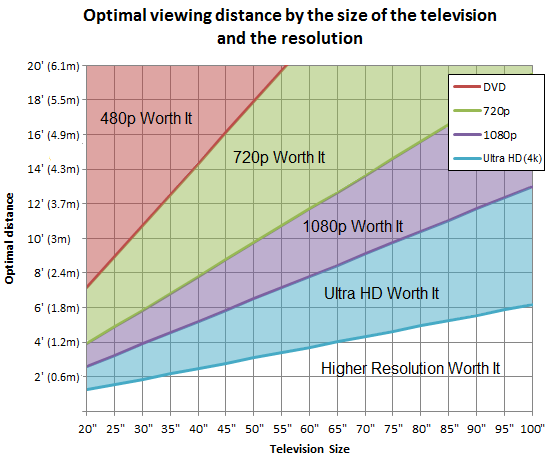
Even when you have a TV that supports 4K (i.e. sufficient number of pixels + HEVC decoder chip in order to use services like this), a very large screen is needed for viewers to appreciate the higher resolution at a sane viewing distance:
The article mentions an average bitrate of ~16 Mbit/s for the streamed content. Even with the awesome compression efficiency of HEVC, I would expect noticeable compression artifacts with such a low bitrate. Consider that Blu-rays (usually encoded with AVC) often have a video bitrate much higher than that. Is this going to look any better than Blu-ray? I doubt it. Better than Netflix's 1080p streams, though.
In any case, this is good news. The relentless march of technology continues! Let's hope for consumer OLED 4K TVs in the near future.
Cochrane is very good at what they do. This kind of systematic review is the highest standard of evidence when it comes to medical research. It's worth checking out some of their other reviews:
edit: I linked to the wrong review before (not the one under discussion), so I edited that out. As gwern mentions in another comment, the link is broken in the BBC article. nairteashop found a different news release which seems to be the right link:
I shortened the title from its original version: '5 Key Health Insights Your Urine Can Offer'. A bit linkbaity, I know, but this is HuffPost we're talking about. Feel free to change it.
Big takeaway from the article: pay attention to what your body is telling you. Unless your urine is clear or very light yellow most of the time (perhaps not when you first get up in the morning), it is likely that you are dehydrated. More info:
Solution? Drink more water. Not a crazy amount of water, but more than you already drink. The next few times you urinate, pay attention to the color. Watch the urine stream, not the water in the toilet. Is it much lighter/clearer than before? You were probably not drinking enough water before. Not convinced that there is a causal relationship between your hydration and urine color? Do a 'washout period' where you go back to your previous hydration level for a day or two, then observe urine again, then increase hydration and observe again. Do not trust your thirst as a gauge of hydration. If you are thirsty, chances are you're already dehydrated.
An exception to the 'brightly colored urine is bad' heuristic is riboflavin:
Excess dietary riboflavin is harmless. Other B vitamins can do this too, apparently, so you can expect your urine to look funny if you've taken a multivitamin recently.
More broadly, my advice is to keep an eye out for strange, unexplained changes in your normal physiological function, because these changes might mean trouble.
(Warning: possible 'TMI moment' ahead.)
It amazes me when I walk up to a urinal and find that the previous person who used the urinal not only neglected to flush it (damn you!), their pee is a horrible dark brownish yellow color. This can't be healthy. (The behavior that led to the brown urine, I mean, not my habit of noticing other people's urine.)
Oh, and painful urination is definitely a concern (as in, tell your doctor), but I think you knew that already.
As with any study of this nature, there is a good chance that the observed effects won't apply to humans, but it's interesting nonetheless.
The researchers point out that there's been a couple observational studies (not RCTs!) that have found decreased mortality in humans that supplement glucosamine:
What I'd really like to see, now, is a randomized controlled trial that looks at mortality in healthy, non-arthritic people who supplement glucosamine - alone, without chondroitin or other stuff.
I stopped using it because I couldn't summon the time/willpower to work at it every day. When you leave a deck for more than a day, the work starts to accumulate like crazy and it takes much more effort to catch up.
>Also, just because it is dupe doesn't mean it is valueless.
Of course, but at some point dupes get to be annoying. I'm not saying it is breaking the rules (is there even a rule for that here?), just pointing it out. The last time gwern posted this it got a lot of attention.
http://www.medicalnewstoday.com/articles/264164.php
Basically, people with poor oral hygiene are more likely to develop Alzheimer's than people with good teeth.
You might have heard about a similar study that found a link between oral hygiene and heart disease. The theory, at least in that case, is that bad oral hygiene causes chronic long-term inflammation throughout the body, not just in your gums. This might increase risk of heart disease. Without looking at the data, I would guess that the same theory applies to Alzheimer's and maybe other diseases. The usual caveat about correlation != causation applies of course.