It is a politically fraught issue because there is a long-running independence movement,[1] which the parent comment may have been obliquely referring to.
> being illegally indefinitely detained and denied due process
This is a mischaracterisation. If Assange wanted due process, he could leave the embassy and face the British (and then possibly Swedish) court systems. The only person choosing to arbitrarily detain Assange without due process is himself.
I disagree: I think there is a reasonable case to hold WikiLeaks and the NYT to different standards. I think WikiLeaks holds itself out as a much more anarchic news organisation than traditional outlets like the NYT. WikiLeaks isn't connected or have allegiance to any particular country, and will publish, let the facts speak for themselves and damn the establishment and any particular national interests that are harmed. On the other hand, organisations like the NYT are pretty open about how while they often publish against the wishes of USG they do ask for comment and may defer publication if they are satisfied there are very good reasons to do so. [1]
Therefore, for WikiLeaks to become highly partisan is a radical departure from their original mission; moreover, it has happened without WikiLeaks acknowledging that this is the case. I think you can't same the same for the NYT.
In fact Merriam Webster [1] very explicitly advocates for "gauge":
> The verb gauge, which refers to measuring or estimating, also has a variant gage. This variant appears to show up primarily in informal sources, though not often. Gauge is by far the preferred spelling in general usage for both the noun and the verb; we encourage you use it.
> In July 2015, Russian
intelligence gained access to Democratic National
Committee (DNC) networks and maintained that
access until at least June 2016.
It's still around for some things, eg Jetstar. You used to be able to do a manual online transfer to pay for flights but now POLi is the only way you can avoid the $5 credit card surcharge. Grinds on me every time I buy a flight.
I think "forced means of talent retention" is an unfairly harsh characterisation. It's a pretty reasonable policy considering taxpayers have to service the debt, and people who go overseas stop paying tax. It's all very well to propose a "good socialist system" but if people pay domestic fees and then leave NZ they're essentially getting a free ride and it's the people who don't go to uni who end up paying for it.
But you haven't produced any real evidence for this claim.
The ICIJ has co-ordinated the reporting on the leak, sure; but that's not the same as claiming the leak itself was in bad faith, part of some wider state-sponsored conspiracy from G20 nations, etc.
> Real leaks don't have fancy websites with responsive vectorized portraits and a full on content /social media structure.
I don't understand this. Don't newspapers always make stories that they can tell are important more engaging for the reader? Here's a cute Guardian flash interactive from Cablegate, [1] and another nice Washington Post interactive on the same story. [2] Here's a really fancy six-part interactive from the Guardian in the wake of the Snowden files. [3] Whenever the media publishes leaks they will make similar things, even when Western governments act strenuously to prevent publication, as in the case of Cablegate and Snowden.
How does a well-presented story indicate anything other than the media thought this was a story which was important and in the public interest?
> Six members of the House of Lords, three former Conservative MPs and dozens of donors to UK political parties have had offshore assets.
I expect we'll hear more about this in coming days and weeks.
I don't really understand this line of thinking. Big leak + "fancy website graphics" = vast Western conspiracy? Sounds less like insightful analysis and more like the kind of denial I'd expect from RT.
No: data held on Apple servers (iCloud) can be provided with a warrant, but this is about data held on an iPhone but not saved to Apple servers. As a result, neither Apple nor the NSA can immediately provide it, and some means of hacking the iPhone is needed.
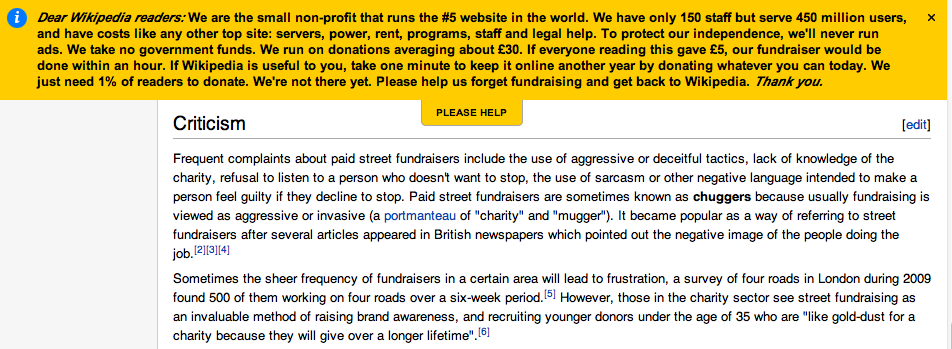
To quote from the screenshot you linked of a typical Wikimedia Foundation advertisement: [1]
"We ... have costs like any other top site: servers, power, rent, programs, staff and legal help."
I count six costs listed there. Doesn't look like "pretty shady" advertising to me.
Also, "internet hosting costs" in the financial statements isn't all the money spent on IT-related costs. For example, computer equipment is counted as an investment which then depreciates. In the 2011 financial statements you linked, Wikimedia spent $3.2m on computer equipment and $1m on depreciation (though depreciation would also include things like furniture). [2]
You also haven't provided any evidence for your claim Wikimedia promotes "purposeful backlinking to their for profit sites".
Finally, although it's an imperfect way to analyse charities, Charity Navigator gives Wikimedia Foundation 93.5/100, an excellent score. [3]
Be careful about relying too heavily on Hersh's article. It makes some pretty bold claims about a conspiracy of eyewatering proportions that have never really been backed up. There has been a lot harshly critical responses to it. [1]
Historically Hersh has been a successful investigate reporter but his LRB piece hasn't really been widely accepted: [2]
> Were it not for the byline of Mr. Hersh, a Pulitzer Prize-winning journalist who first gained notice more than 45 years ago for exposing the My Lai massacre in Vietnam, the story would likely have been readily dismissed and gained little attention.
1. https://en.wikipedia.org/wiki/Free_Papua_Movement