Community networks are pretty common in rural areas in other countries. My favorites are guifi.net and b4rn.org.uk. They both use lots of fiber running through farms.
We tried repeating LinkNYC kiosks a few years ago but it wasn't reliable enough, making it too difficult to support.
We have instructions for a DIY connection on our website and a channel on our Slack where you can ask other members about problems. The DHCP lease tends to go dead every couple of months and we have various things to try when that happens.
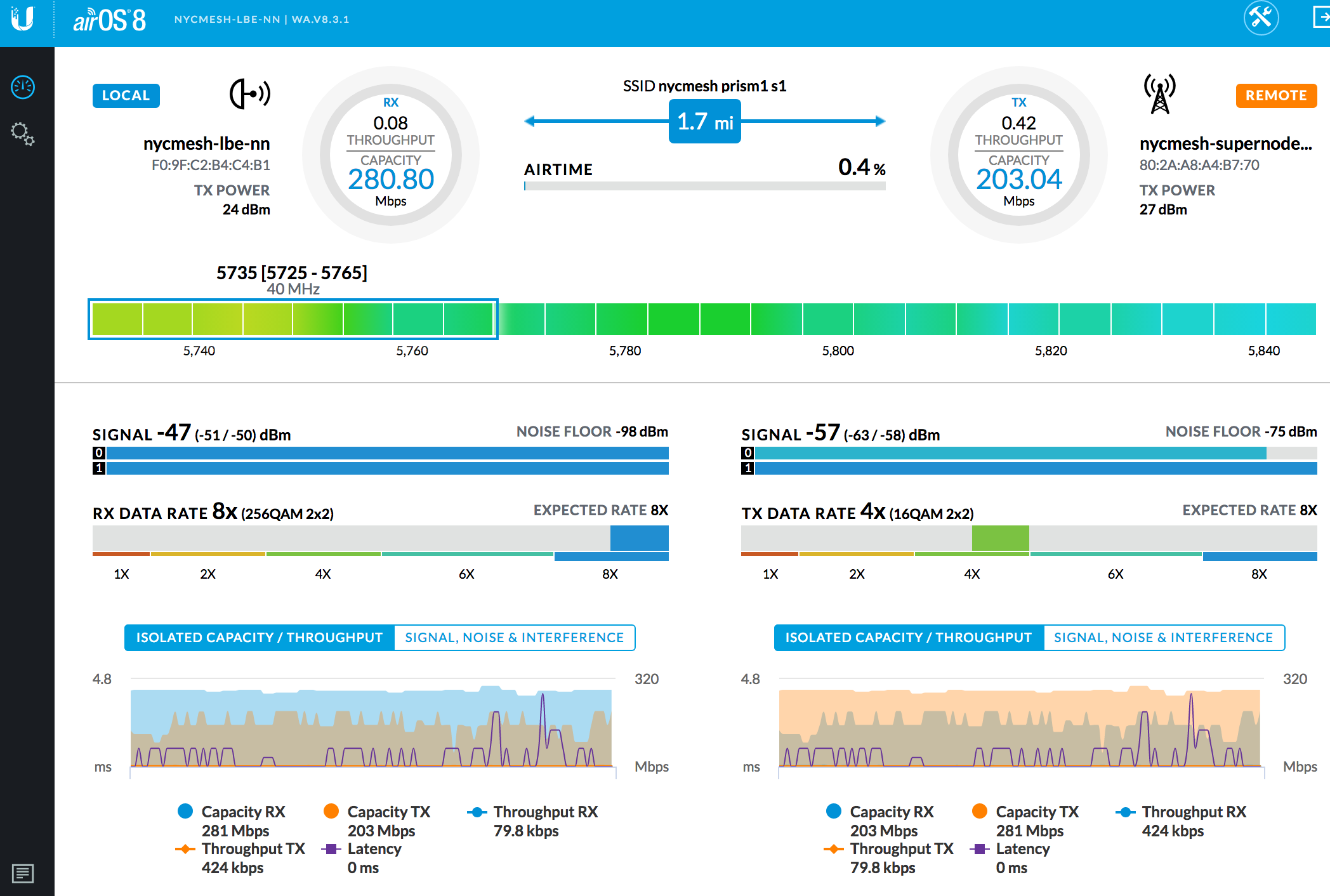
That's a LiteBeam Gen1 installed in the east village on 5th St connected to 375 Pearl St downtown. The gen1 actually has a stronger signal than the gen2, so this is a bit better than our usual connection.
Volunteers donate their time because they enjoy it. We have so many volunteers it is hard to keep track of them all. Obviously it is more efficient to use volunteers if there are enough. We are considering using contractors for some huge projects we are planning.
Netflix standard streaming is 3Mbps, so even with your math (which isn't how bandwidth works) everyone is happy.
We've never come anywhere near saturating our gig connection. We monitor it. Each building is limited to their own rooftop connection which is an average 100Mbps, so they can't do more than that if they tried. The thing is not everyone is downloading a file at the same time, and streaming uses much less bandwidth than downloading. From Netflix site-
0.5 Megabits per second - Required broadband connection speed
1.5 Megabits per second - Recommended broadband connection speed
3.0 Megabits per second - Recommended for SD quality
5.0 Megabits per second - Recommended for HD quality
25 Megabits per second - Recommended for Ultra HD quality
There are about 10 fiber providers in the city. We've spoken to most of them. It's pretty much impossible for us to lay fiber, so we have to lease it. We'd like to eventually lease a fiber ring across the city so we can cut costs when connecting multiple buildings. If you don't have a ring then you have to pay for the run all the way back to a coloc.
We originally used the qMp/OpenWRT package that included mdns, which is a version of zeroconf for the internal network. It isn't scaling so we now use our own DNS server to resolve internal addresses on our 10/ network.
We get a lot of support from the NYC networking community, and we have a lot of friends at the NYNOG meetups. Everyone is very helpful and they also want the big ISPs to have some competition, so we get donations from quite a few people. Some also join our network and get nodes on their own roofs and help with other installs!
DE-CIX is the biggest IXP and they measure their network in terabits/sec. It is not a big deal for them to donate us a 1 gig connection. (it's a big deal for us!) Eventually we may upgrade it to 10 gig.
Mainly logistics. We've had a huge influx of people wanting to be connected since December, so we've had to add stuff like a ticketing system, inventory tracking and also we're training people to lead installs. It's normal scaling problems that fast growing organizations have.
We bypass traditional ISPs by connecting directly at an internet exchange point (DE-CIX IXP) and peering with other networks. This is basically how the internet is formed, by networks peering with each other. We don't need this ISP layer.
Yes the noise floor is bad, but we get about a 2 mile range which covers a huge amount of people in Manhattan. The Ubiquiti sector antennas use TDMA so it is not standard 802.11ac.
Our recurring costs are only for the lease at supernode1, which is around $1000/month. Divide that by our member node count (158) multiplied by users of each node ~4, 1000/(158*4)gives you under $2/month per user. Members usually pay for their own routers so that isn't included. To set up the supernode was about a $10K one-off charge for install fees, servers and antennas.
DE-CIX, our IXP, donated bandwidth to us, and we have transit also donated from Packet Host and WebAir. We actually pay nothing for bandwidth. Probably one day we will pay but it is not that expensive if you do this at an IXP and use peering.
We have an AirFiber pair that is 24Ghz, but all of our sectors are 5Ghz wifi.
No you don't need hundreds of thousands. You do need tens of thousands. We've had no downtime this year at supernode1. Yes reliability is a big priority, but it is not a big priority for the big ISPs in NYC. Time Warner Cable (now Spectrum) has barely two nines. In Manhattan it would go down in the East Village after every large storm. We are already providing faster more reliable connections than this.