A lot of the ease and benefits depends on your style.
If your code pattern was to have variables holding your state and rendering html based on that, you will have an easy transition to React ( and likely didn't suffer horrible pains with jQuery).
If your code style is to update the DOM to reflect your state, and when you need to know something about state, you read the DOM, then React will feel odd and complex (and you likely have had jQuery projects work great until they hit a level of complexity and then they suddenly become brittle and hard to change)
This is why I prefer React - the best practices if React are just the best practices for functions. (That and I don't like the pseudo js syntax of Vue with the mysterious scoping)
> In retrospect it's fairly typical behaviour for less literate types to adopt a word that sounds sophisticated beyond their standard repertoire
This seems an excessively negative take on it.
How do we learn new words? Sure, we COULD look up the definitions, but (1) who bothers, and (2) we have plenty of evidence that definitions are so vague as to be useless. (I recall arguing with my high school english teacher about "moot", which we had as aa vocab word with a definition that didn't match my colloquial understanding).
So as adults, as teens, tweens, and before, most of our language is learned from contextual usage. Which is a terrible way to maintain accuracy. When I get stumped with newer terminology, my friends that USE the new words are often at a loss to explain them (one spent 30 mins trying to explain "kappa") because they don't know a formal definition, they know it when they see it.
We can be smug and superior about the "less literate" trying to be impressive, but honestly, that applies to all of us, we are just mocking those that get caught.
> I'd say there is more transparency around unethical behavior by elected officials
And that's what worries me - note in my post above I was careful to talk about "public". Before there was a veil of deniability, the idea that at least a pretense of innocence had to be maintained.
Now it feels like there is little care to hide it. Sure, many of us are outraged, but that outrage has done nothing to translate into stopping the actions.
How many things have been aberrant and denounced, only to become the regrettable norm in the last few years?
When I was a child, the US wouldn't open admit to torture. It didn't have publicly known programs to ship prisoners to other jurisdictions so the U.S. rules of conduct could be bypassed. It didn't have a (publicly known) prison filled with non-U.S. people that were denied a civil trial. It didn't have a president that actively preached for or against public companies outside of criminal matters. When I was a child, a president openly violating ethics concerns WAS a matter of that president getting removed - with such certainty they'd step down to avoid the inevitable result.
I'm totally willing to believe that an aberrant behavior doesn't have to become the norm, but I won't believe that should be expected. I've been told all my life to expect that dramatic reactions and concerns are overstated and not the case, that we should all be calm and expect things to work out well, but if I look at the actual events of my life, I see the opposite lessons being taught: Unless we react strongly, clearly, and persistently, progress will not happen and things will slide for the worse.
It's not the lesson I want to learn, it's not a lesson I am comfortable with, but it does appear to be what I've seen in the last few decades.
I struggle to understand the target audience for this. I'm currently crushed by lack of productivity, and overthinking is definitely a large part of the problem. But I can't just "not think" - I'm painfully aware of how behind I am, how much I don't understand in my current workload, and any time taken to understand it quickly overwhelms me with frustration and fear. This means I don't get any progress made, I understand things no better, the fear is heightened, and it all gets worse.
Logically I'm aware that I'm my own enemy here - that my natural evasion of dealing with the problem is amplifying the problem. But that logic doesn't translate to action. Like an adult that tells a child to not let someone teasing them bother them, the child doesn't really have the option to NOT feel the humiliation of the teasing. When I go to try and tackle the problem, within minutes my brain shuts down except for that active amygdala, pumping fear hormones into my system and blocking any actual learning.
So avoiding the problem doesn't help. Attempting to tackle the problem doesn't help.
The problem is real, but who are the people that just go "oh, I just need to relax!" and that WORKS?!
> Consistent style is more important than each block of code being perfectly pretty
"Pretty", yes, but we're literally talking about using language to communicate. Consistency taken to extremes is harmful to communication.
I don't understand the worship that people have for consistency. STUPID inconsistencies are bad, yes, and yes, there are certainly arguments that about subjective matters that are a waste of time. But distilling everything down to the lowest common denominator of grunt-talking is very consistent and terrible communication. (Does that feel like a strawman? I'd love for it to be! Once people stop talking about consistency uber-alles we'll be discussing the things that I consider important.) Right now, the most common reaction is to dismiss any idea of communication through language as irrelevant, subjective, and a waste of time."
I forget where I saw it, but I appreciate a comment that says: When faced with extreme inequality, you can redistribute wealth through taxation or you can redistribute poverty through revolution.
They'll find out how much of the rhetoric the company feeds them is true or not. They'll know for themselves when they deemed it important to draw a line.
As a matter of calculation, the timing isn't ideal. None of them seem to be saying it is a matter of calculated timing to leverage their market value though.
This is my key question, and I ask with minimal assumption that either one is better.
What are the criteria we are even using to judge? Clarity that there is state is one. Elsewhere there are arguments about ABI that I fail to have practical knowledge of. There was some discussion of the data structure describing your program that completely lost me. Explicitness is lost when discussing closures.
What makes one better than the other in ways that arent entirely subjective?
> Our company moved to it and its been horrible with any third party application or marketing pixel.
Isn't that part of the point though? 3rd party marketing and tracking pixels are NOT things that improve the experience or performance for the visitor.
The article assumes that the policymakers (and public) AREN'T considering the drawbacks. I disagree with that.
Many non-US countries have acted to minimize those drawbacks, so it is misleading to act as if those drawbacks are unavoidable and the lockdown is illogical.
I'm not a psychologist so I should probably shut up, but I'll continue:
It seems like it does hit the tech field more often, yet overwhelmingly I see leading people in tech get softer, more empathetic, and more open to outside ideas the longer they work and the more experience they gain.
Perhaps this is selection bias (the people I see are the "popular" ones, so of course they are the ones with more social awareness), or perhaps there is no hard and fast "genius requires ego". Note: I'm aware you didn't say that it did, you only mentioned that abrasive-ness seems disproportionately frequent in the tech field.
I'm all for improving our understanding and ways of communication - I've definitely known people in the "asshole" category that were surprised and bothered to discover that was how they came across - but I'm not interested in normalizing abuse as a necessary cost. Which, again, you didn't say nor imply, but the concepts are related to what you've brought up, so I mention it here because the topic is interesting, not as a counterpoint.
> if you can't explain the earlier oscillation, why should I accept the later oscillation
Clearly women in the 1970s had no other obstacles - they couldn't obtain credit(!), much less be on equal footing in so many other ways. The issue is not "but there is an earlier oscillation", it's "if women have been slowly moving in direction of equality, what reversed that?" or "If women were able to 'be interested' back then, how can we claim they aren't now"?
As of this writing, a lot of comments are sharing their varied personal experiences in WFH.
Which is good, because they are all more interesting and valuable than the article, which skips the "varied" part and basically lumps everything in to "if you have troubles working from home, you need more willpower" (paraphrase).
I found it insulting and was a bit surprised to see what I assumed to be American work-fetish from a BBC article.
There are LOTS of reasons because people are very different and our environments are very different. I don't have kids, I am easily distracted by visuals or sounds in my periphery, I have a separate room for my home office, I don't have neighbors that share a wall or live above my ceiling, I have good internet service, I'm an introvert...so yeah, I have an easier time working from home. But those that don't, they obviously just lack dedication to work. Garbage.
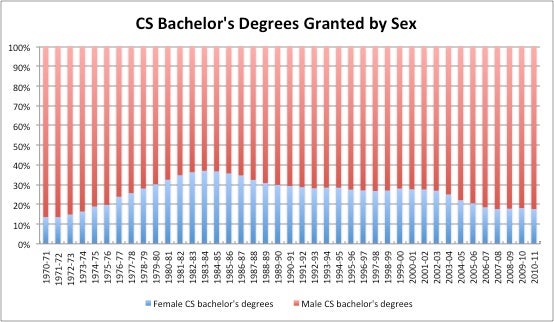
Reread their comment - they are pointing out that CS classes had a DROP in women attending them, and that decline does line up with the rise of computer gaming. They weren't saying women have never had an interest as a result of gaming, but rather as gaming rose there is a corresponding decline. Hardly proof, but as the poster above was stating their personal opinion, they aren't wrong (and they aren't alone in that belief - I've seen it many places).
Here's once quote:
"Starting when computer technology first emerged during World War II and continuing into the 1960s, women made up most of the computing workforce. By 1970, however, women only accounted for 13.6% of bachelor's in computer science graduates. In 1984 that number rose to 37%, but it has since declined to 18% -- around the same time personal computers started showing up in homes. According to NPR, personal computers were marketed almost exclusively to men and families were more likely to buy computers for boys than girls."
( from https://www.computerscience.org/resources/women-in-computer-... )
Those are only talking about successful degrees, there are plenty of more datapoints to look at when you consider entry vs completion, and similar stats from post-graduation careers. This doesn't prove causality, but their statement stands as viable.
> 1) Women in absolute aggregate seem to not like CompSci.
Based on what? They don't end up there, but we have evidence (based on decreasing enrollment in degrees) that they USED to be "more interested" (If you use that as criteria). Do you think they generationally are just more aware of what it really is now?
How would that happen without ALSO becoming more aware of the absolute vile GamerGate-type shit women have to face, from the smallest "let me assume you don't know anything" to the "let's make rape jokes" to the "Can a woman have confidence she probably won't be groped"?
If you start with the premise that women "seem to not like CompSci", you've already assumed the problem and normalized a lot of factors that don't have to be normalized.
A lot of the ease and benefits depends on your style.
If your code pattern was to have variables holding your state and rendering html based on that, you will have an easy transition to React ( and likely didn't suffer horrible pains with jQuery).
If your code style is to update the DOM to reflect your state, and when you need to know something about state, you read the DOM, then React will feel odd and complex (and you likely have had jQuery projects work great until they hit a level of complexity and then they suddenly become brittle and hard to change)
This is why I prefer React - the best practices if React are just the best practices for functions. (That and I don't like the pseudo js syntax of Vue with the mysterious scoping)