Don't Be Anti Car. Be Pro Something Else.(eclogiselle.com)
eclogiselle.com
Don't Be Anti Car. Be Pro Something Else.
https://www.eclogiselle.com/2021/07/the-hot-new-thing.html
319 comments
Sorry, no. Cars are the problem. The reason why other transit modes are a solution isn't because they in particular are the best option, generally it's because they aren't cars.
Cars aren't individual choices. They are a societal choice that costs a trillion dollars a year to make work. The issue is cars. No matter which way you slice it, we need to remove cars, and that will necessarily mean making driving a car worse.
I don't think that hiding your goals or intentions is politically a good option. Don't argue something you don't believe in. If you (correctly) identify that cars and car-supporting infrastructure is one of the biggest problems in North America, you have to call it like it is.
We don't actually want other options. We want better other options. The only way to get that is to de-incentivize cars. That's the reason why cars suck to begin with, the proliferation of cars makes every other mode of transport worse, except for inter-city rail, if only by sheer mass effect.
Now I agree that we shouldn't other people by putting them in categories and identifying them with the car. That doesn't mean that we stop opposing the real policies that make cars a good personal option and counter them with policies that make alternatives better, generally at their expense in some way or another. I agree that inter-personally the matter can be approached better, but that does not carry to changing your policy positions or goals, and that should never justify lying about what those are.
Cars aren't individual choices. They are a societal choice that costs a trillion dollars a year to make work. The issue is cars. No matter which way you slice it, we need to remove cars, and that will necessarily mean making driving a car worse.
I don't think that hiding your goals or intentions is politically a good option. Don't argue something you don't believe in. If you (correctly) identify that cars and car-supporting infrastructure is one of the biggest problems in North America, you have to call it like it is.
We don't actually want other options. We want better other options. The only way to get that is to de-incentivize cars. That's the reason why cars suck to begin with, the proliferation of cars makes every other mode of transport worse, except for inter-city rail, if only by sheer mass effect.
Now I agree that we shouldn't other people by putting them in categories and identifying them with the car. That doesn't mean that we stop opposing the real policies that make cars a good personal option and counter them with policies that make alternatives better, generally at their expense in some way or another. I agree that inter-personally the matter can be approached better, but that does not carry to changing your policy positions or goals, and that should never justify lying about what those are.
The thing is, most of the cycling advocacy I see is pro solution yet the opposition response is largely anti problem. Those who want to ride safely typically propose infrastructure based solutions and rarely treat the automobile itself as the problem. For example: while you may see advocacy for protected lanes or traffic calming, almost no one is arguing that cars should be removed from the roads. Contrast that to the opposition response, which often seeks to have bikes removed from the roads and never supports accommodation for different modes of transportation.
I'm anti-car (cars as a regular transit method, parking lots, urban sprawl, burning up hydrocarbons, etc), but I love my car. I love working on it, I love driving it, I love the fact that I can go anywhere with it at any time without consulting a bus or train schedule.
I'm anti-smoking. I'd tell anyone not to smoke. But I love cigarettes.
I'm in favor of gun control. But I own guns.
See where I'm going with this?
I'm happy to have a conversation with anyone about the better alternative ways to live, but about 99% of the responses in this thread rub me the wrong way because they're sanctimonious, pompous and aggrieved, and want to explain the right and wrong way to live from the perspective of a child.
One major thing they fail to take into account is that people have grown accustomed to certain freedoms (like not asking permission to go somewhere, or waiting for a bus), and a naive attempt to start solving the world's problems by curtailing other people's freedoms is a non-starter.
Ultimately, you can convince people why these things are bad for society and why there are better alternatives (or why they should be given up completely), but there are major reasons why society adopted these things in the first place and when you come at it from the angle of "you're wrong, you're terrible and you suck and you need to quit smoking / stop working on your car / give your guns to the government", you're going to hit a huge amount of resistance compared with trying to make incremental changes and presenting a case for better lifestyle alternatives.
I'm anti-smoking. I'd tell anyone not to smoke. But I love cigarettes.
I'm in favor of gun control. But I own guns.
See where I'm going with this?
I'm happy to have a conversation with anyone about the better alternative ways to live, but about 99% of the responses in this thread rub me the wrong way because they're sanctimonious, pompous and aggrieved, and want to explain the right and wrong way to live from the perspective of a child.
One major thing they fail to take into account is that people have grown accustomed to certain freedoms (like not asking permission to go somewhere, or waiting for a bus), and a naive attempt to start solving the world's problems by curtailing other people's freedoms is a non-starter.
Ultimately, you can convince people why these things are bad for society and why there are better alternatives (or why they should be given up completely), but there are major reasons why society adopted these things in the first place and when you come at it from the angle of "you're wrong, you're terrible and you suck and you need to quit smoking / stop working on your car / give your guns to the government", you're going to hit a huge amount of resistance compared with trying to make incremental changes and presenting a case for better lifestyle alternatives.
"Don't be anti-Axis-powers. Be pro something else."
"Don't be anti-HIV. Be pro something else."
"Don't be anti-crime. Be pro something else."
"Don't be anti-(house|city|wild)-fire. Be pro something else."
"Don't be anti-discrimination. Be pro something else."
"Don't be anti-software-defect. Be pro something else."
Cheap and meaningless rhetorical techniques are best exposed by substituting in other terms.
It's useful to note that problem solving has a number of stages. That generally involves identification of a problem, a goal, a path-to-goal, and a mechanism for achieving said path. That said, which you focus on (problem, goal, path, mechanism) is best determined by where focus is most effectively attended. And that varies by the problem. Blanket prescriptions rarely work.
The automobile has created the modern urban landscape and its characteristics. That's the primary focus in reversing or correcting many of those faults.
https://old.reddit.com/r/dredmorbius/comments/2fsr0g/hierarc...
"Don't be anti-HIV. Be pro something else."
"Don't be anti-crime. Be pro something else."
"Don't be anti-(house|city|wild)-fire. Be pro something else."
"Don't be anti-discrimination. Be pro something else."
"Don't be anti-software-defect. Be pro something else."
Cheap and meaningless rhetorical techniques are best exposed by substituting in other terms.
It's useful to note that problem solving has a number of stages. That generally involves identification of a problem, a goal, a path-to-goal, and a mechanism for achieving said path. That said, which you focus on (problem, goal, path, mechanism) is best determined by where focus is most effectively attended. And that varies by the problem. Blanket prescriptions rarely work.
The automobile has created the modern urban landscape and its characteristics. That's the primary focus in reversing or correcting many of those faults.
https://old.reddit.com/r/dredmorbius/comments/2fsr0g/hierarc...
"please dont present a united voice against the source of the problem. Balkanize yourselves into a dozen little groups so no change ever happens!"
The conservative chant, as if space in a city is not an ultimate zero-sum game. Any "pro something else" eventually butts up against having 80% of space and 110% of government drone mindshare allocated to cars.
As much as I agree with the strategy (it's just good marketing) I have to say that I've never met anyone who thinks that bikes (or any other mode of transport) can replace cars 100%. And I know a lot of cyclists. Every single one of them uses a mix of transportation modes, which include: cycling, walking, public transit, and sometimes even cars!
The only people I know that think we can build cities around a single mode of transport are (a subset of) car drivers.
And in my experience, the most successful way to talk to these people isn't to be "pro-bike", it's to be pro transit choice. But I always have to explain this very carefully, because most people assume that anyone who talks about bike lanes or trains is anti-car.
The only people I know that think we can build cities around a single mode of transport are (a subset of) car drivers.
And in my experience, the most successful way to talk to these people isn't to be "pro-bike", it's to be pro transit choice. But I always have to explain this very carefully, because most people assume that anyone who talks about bike lanes or trains is anti-car.
This immediately makes me think of the role attacking pedestrians played in the rise of the automobile.
https://www.vox.com/2015/1/15/7551873/jaywalking-history
The auto companies played dirty. Maybe it's time to make it clear that they're the source of so much illness in American people and cities.
https://www.vox.com/2015/1/15/7551873/jaywalking-history
The auto companies played dirty. Maybe it's time to make it clear that they're the source of so much illness in American people and cities.
> Don't make it a moral argument that frames drivers as sinners and pedestrians, cyclists, etc as The Good Guys.
So much this.
I live in a US city that has an atypically large number of people who bicycle as their primary transportation. I do as well, but I also have a car and drive when that's more appropriate.
The years have taught me some things about the car vs bike divide: car drivers tend to be real jerks toward bicyclists, and bicyclists tend to be real jerks toward car drivers.
It's lose-lose, particularly because it's not rare that either the car or the bike (or both) navigate dangerously as a result, increasing the chances that someone's going to have an accident, and reaffirming the negative stereotypes each has toward the other.
So much this.
I live in a US city that has an atypically large number of people who bicycle as their primary transportation. I do as well, but I also have a car and drive when that's more appropriate.
The years have taught me some things about the car vs bike divide: car drivers tend to be real jerks toward bicyclists, and bicyclists tend to be real jerks toward car drivers.
It's lose-lose, particularly because it's not rare that either the car or the bike (or both) navigate dangerously as a result, increasing the chances that someone's going to have an accident, and reaffirming the negative stereotypes each has toward the other.
"Don't be anti X. Be pro something else" this mentality can and should be applied to all issues in my opinion. Being "pro solution" is far more productive than being "anti problem".
I live in a dense city center where there is a severe shortage of space for dedicated infrastructure. As more people ride their bikes, the logical next step is to remove cars from the roads to ensure cyclists have ample space and cars can’t pass recklessly or otherwise discourage further uptake by newcomers. A four-lane street that has one lane for buses and taxis, two regular traffic, and a two way cycling lane separated by a low curb is perhaps the most dangerous place I’ve had to ride here, and that’s because cyclists are all packed into such tiny areas. Closing roads to further discourage commuting would go a long way to wrestle back control of the streets.
Being anti-car isn’t the best first step, but it is inevitable that we take up this position when viable alternatives — not just cycling — are available and convenient.
Being anti-car isn’t the best first step, but it is inevitable that we take up this position when viable alternatives — not just cycling — are available and convenient.
The real key to this post is how to message and advocate effectively for major social change. (I totally missed this on my first read as well.)
Cars, like much else in modern life, aren't purely functional objects and totems, but are very strongly linked with lifestyle, status, and identity. A campaign that directly attacks these ... probably won't go well.
There have been similar campaigns in the recent past, though, which have been highly effective. The campaign against smoking, begun in earnest in 1961, is probably among the more successful.
https://content.gallup.com/origin/gallupinc/GallupSpaces/Pro...
That involved a lot of approaches. Education was one prong, but increasing costs, decreasing the opposition's abiity to propagandise (the tobacco firms), increasing costs, reducing the number of places where smoking was acceptable, changing attitudes toward whether or not smoking was "cool" or a status signal, etc., all contributed. It took literally decades. But it worked, with US rates now less than half their 1945 peak.
Cars, like much else in modern life, aren't purely functional objects and totems, but are very strongly linked with lifestyle, status, and identity. A campaign that directly attacks these ... probably won't go well.
There have been similar campaigns in the recent past, though, which have been highly effective. The campaign against smoking, begun in earnest in 1961, is probably among the more successful.
https://content.gallup.com/origin/gallupinc/GallupSpaces/Pro...
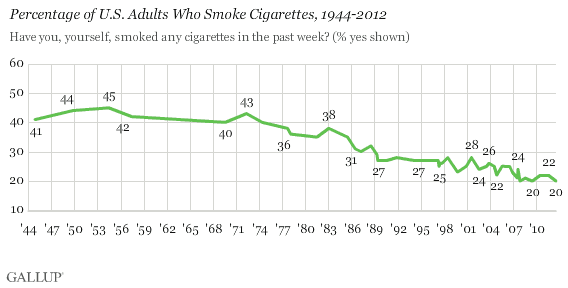
That involved a lot of approaches. Education was one prong, but increasing costs, decreasing the opposition's abiity to propagandise (the tobacco firms), increasing costs, reducing the number of places where smoking was acceptable, changing attitudes toward whether or not smoking was "cool" or a status signal, etc., all contributed. It took literally decades. But it worked, with US rates now less than half their 1945 peak.
That's a wonderful way to divide all of the people who are anti-car into thousands of different voices shouting for different things at once.
As an aside, pointing all those don'ts at the reader is awfully hypocritical.
As an aside, pointing all those don'ts at the reader is awfully hypocritical.
The article is really about messaging and strategy then caring about cars. Specifically the author says:
> But the project won't grow beyond my town if I can't attract other participants.
So basically, I think the author is saying don’t “other” people because they happen to live in a town that relies on cars, rather invite them into something cooler and hip
> But the project won't grow beyond my town if I can't attract other participants.
So basically, I think the author is saying don’t “other” people because they happen to live in a town that relies on cars, rather invite them into something cooler and hip
There's a lot of people who live in suburbs and commute by car into cities. Most anti-car proposals are all downside and no upside for these people. We should look for proposals that give them appealing alternatives to cars, rather than just making their lives worse.
What about the old cycling elitists who are anti car and anti ebike?
I remember when I was still surprised by the amount of old cyclist dudes who hate the existence of ebikes. Now it feels commonplace when interacting with that community
I remember when I was still surprised by the amount of old cyclist dudes who hate the existence of ebikes. Now it feels commonplace when interacting with that community
Offense beats defense.
This OC's advice is completely, utterly, logically, emotionally, psychologically, economically, and in all other ways thoroughly correct. Any one who disagrees has obviously not done any policy work.
Other perks when advocating for progress:
Messaging is generally easier. If you're explaining, you're losing.
Focus! Avoid getting dragged into pedantic slap fights, distracting side quests, arguing about details and semantics.
It's hard to win fights on enemy turf.
Everyone is already complaining about everything. Be the one who has a plan, something positive to say. Honey vs vinegar.
This OC's advice is completely, utterly, logically, emotionally, psychologically, economically, and in all other ways thoroughly correct. Any one who disagrees has obviously not done any policy work.
Other perks when advocating for progress:
Messaging is generally easier. If you're explaining, you're losing.
Focus! Avoid getting dragged into pedantic slap fights, distracting side quests, arguing about details and semantics.
It's hard to win fights on enemy turf.
Everyone is already complaining about everything. Be the one who has a plan, something positive to say. Honey vs vinegar.
What mirrors my visceral full-body negative reaction to large swathes of asphalt and often extremely noisy and apparently aggressive (look at modern autos front-ends and tell me they are not designed to look like predators) swarms of vehicles speeding by as quickly as they possibly can, most emitting vast clouds of bad-smelling exhaust gasses that are carcinogenic and contributing to climate change as well as general poor air quality for the unfortunate humans nearby, anyway, I was saying: what mirrors my revulsion at the inelegance of cars and their road support system is a love of treelined paths.
A love of trees. A love of well designed botanical gardens. A love of 100 year old walnut trees, or mango trees large enough to provide shade for an entire housing block.
We can have a paradise on earth here, as soon as it stops being "cool" and "normal" to turn this planet into a wasteland.
We can design our transport around a sensible way of life that doesn't involve all the human ants having to shuffle themselves 100km from their dwellings each day, in pursuit of informatic careers of deep personal meaning.
etc.
We can have a paradise on earth here, as soon as it stops being "cool" and "normal" to turn this planet into a wasteland.
We can design our transport around a sensible way of life that doesn't involve all the human ants having to shuffle themselves 100km from their dwellings each day, in pursuit of informatic careers of deep personal meaning.
etc.
Public traffic space is limited (and in major cities exhausted) supply. Being "pro something else" is automatically anti-something. If do not make the latter part explicit it will just hurt the weakest group (typically reducing space for pedestrians).
I think this only works if it isnt opinionated and finger-wagging prescriptive to masses. I'll provide an example, I'm pro-cylcing. I rarely drive and mostly cycle to work, or use mass transit during rain/snow.
...but, some of the anti-car pro-cycling rhetoric I hear in my hometown of NYC is insane -- there are calls to ban cars on large sections of the city and have people bicycle. I say insane because it suggests people have never been around elderly folks. What are the disabled supposed to do? What about those with infants? What happens if you are carrying groceries? What about those with bad knees? What happens on the day when all the bikes have been borrowed and there are no options but a cab?
...but, some of the anti-car pro-cycling rhetoric I hear in my hometown of NYC is insane -- there are calls to ban cars on large sections of the city and have people bicycle. I say insane because it suggests people have never been around elderly folks. What are the disabled supposed to do? What about those with infants? What happens if you are carrying groceries? What about those with bad knees? What happens on the day when all the bikes have been borrowed and there are no options but a cab?
It's fine to be anti car, I think the "concession" you do need to make is that the context is really important, I live in the middle of a busy city that really suffers from traffic problems
When I'm talking about pedestrianising or bike lanes or e-scooters etc it's from the perspective of a busy city that does not have enough room for cars
It's important to acknowledge that most car alternatives are not an option for people like farmers or people who live out in the sticks and so people in the country are typically not who I'm talking about when talking about anti car ideas
When I'm talking about pedestrianising or bike lanes or e-scooters etc it's from the perspective of a busy city that does not have enough room for cars
It's important to acknowledge that most car alternatives are not an option for people like farmers or people who live out in the sticks and so people in the country are typically not who I'm talking about when talking about anti car ideas
[deleted]
This is a good advice but on gov level. Governments don't need to be anti car, they just need to stop being pro car and incentivise their use. Stop subsidies, stop tax benefits for both users/producers, stop building new roads, stop turning free spaces into parking lots etc. and be pro something else.
Just make 99% of the car traffic infeasible (slow, expensive...) and market will come up with alternative ways to make 99% of activities that today require a car feasible without them.
Just make 99% of the car traffic infeasible (slow, expensive...) and market will come up with alternative ways to make 99% of activities that today require a car feasible without them.
A big part of the problem is that all existing alternatives are objectively inferior on an individual level.
Cars provide long or short distance uninterrupted point-to-point transportation in a private environment with climate control and a large cargo capacity. Every alternative is worse in some or all of these ways, and the few advantages they do offer are usually only worth those drawbacks in rather niche circumstances.
Cars provide long or short distance uninterrupted point-to-point transportation in a private environment with climate control and a large cargo capacity. Every alternative is worse in some or all of these ways, and the few advantages they do offer are usually only worth those drawbacks in rather niche circumstances.
I'm pro working from home.
What I'd love is changing the road safety rules in favor of bikes (because bikes lanes can't do everything, sometimes they are terrible or not existing)
  1. High priority vehicles firemen/police/amulance
  2. Shared transports (bus/tram)
  3. Bikes
  4. Other motorized vehicles - cars
I love cars. Not only how they look and work, but because it can bring me to places where other people don't usually go. It gives me the ultimate freedom feeling. Going far in car to some remote country/region is such a nice thing to do.
I don't want to live in a city from where I rarely leave.
I need my cars.
How "just ban" won't work: https://www.nytimes.com/2018/12/04/world/europe/france-fuel-...
The car-dependent are so exceptionally good at spinning every pro-something into anti-car (unless it's pro car) that any attempted distinction between pro-something and anti-car is futile. Embrace the antagonism they force on you, be anti-car.
Take smoking as an example. How did we reduce smoking? (arguably one of the most successful public health campaigns in recent history). Did we stop being anti-smoking and instead promoted something else? No! We banned smokers from bars, we told people that smoking sucked, we plastered ugly pictures of black lungs on boxes and we taxed the crap out of smokers.
Ironically, the big change is often easier than the small one. Cars are the problem, point it out. Haggling about bike lanes is a colossal waste of time. We need to completely revamp how we commute and how we life, communicate that clearly, and point out whoever stands in the way.