It's funny to me as well. Being initially inspired by Yelp's dockersh I wrote a functional MVP of the same concept around 2 years ago. It used a custom Go sshd-proxy to spawn kata-container backed pods in kubernetes. I used it personally for a very brief period of time, and found it useful as a small timesaver for testing things. I wasn't comfortable with monetizing it though. After seeing a few of these pop up, I realize maybe I missed my chance to be early.
As far as self-hosting goes, it looks like there are some FOSS projects now, eg https://containerssh.io/
I think it may be in use by tools without people being aware.
I decided to check my workstation for it just in case, figuring the file would be empty, or not exist.
Instead it seems to be populated with what seem to be Heroku API and git credentials.
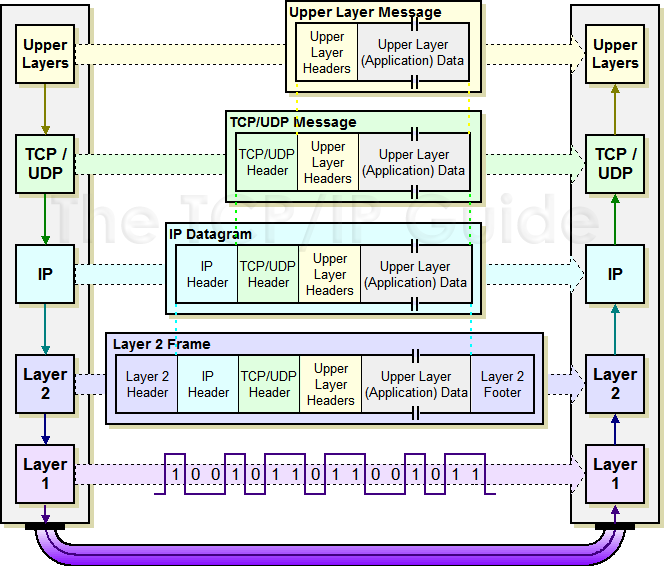
Something that I've noticed that somehow ends up lost when people learn "the model" is the encapsulation aspects.
I don't know if it's missing in people's course work or what, but I've had to use http://www.tcpipguide.com/free/diagrams/ipencap.png many a times to explain how stuff like VPNs work, correct statements like "firewalls don't have a routing table, firewalling is layer 4", explain things like MTU and payload size, or why certain traffic doesn't go beyond a broadcast segment normally.
Personally I think this is one of the better visualizations.
Am I missing something here? People are talking as if there is some new backdoor that's somehow avoided detection. Did everyone just miss this discussion in 2015?
Discussion of the "Sigint Enabling Project" goes as far back as 2013 on HN itself.
They're basically THE company for buying cheap, but functional, networking bits-and-bobs-- either in bulk, or as an alternative to prowling ebay for smaller purchases.
I use them all the time for transceivers, cables, DACs, etc.
I'm not sure I'd describe the golang community's attitude as a complete write-off of frameworks. I don't think I personally know a Go developer who doesn't use some sort of web framework (I personally use Echo, for example).
Rather I think it'd be better phrased as "frameworks should use simple abstractions and methods as often as possible", which the language naturally pushes people towards imo. I believe this causes most Go frameworks to be referred to as "microframeworks".
You can get some of properties you describe with the behavior most people would want via a combination of anycast, some route exchange protocol (probably BGP), and ECMP.
* "Good enough" expressivity-- nothing that's considered "missing" has been a true blocker for most projects.
* An easily accessible concurrency primitive, with the bonus that the runtime can choose to execute goroutines in parallel (when able)-- this comes with no required function coloring or split in a code base.
* A well opinionated environment packaged with the compiler: default formatter, default method for fetching remote deps, default documentation generator, default race detector, default profiler, default testing system.
* Decent portability-- can cross compile relatively easily from one platform to another, doesn't require a larger runtime pre-installed on the foreign host.
* "Batteries included" standard library.
* Inertia-- enough of an active community to pull what you need from the Internet, whether it's guides or code.
* A "good enough" type system to catch some errors before they become runtime errors.
* A "good enough" abstraction for operating on data with: structs, interfaces, and methods. With composition being preferred over inheritance, and embedding bringing handy sugar.
No language is perfect, everyone has an opinion, but for many people this is "close enough" to what they prefer to work with.
> This is the !very first! statement of the opening paragraph of my comment. Why are you saying that I have not said it. Have you not read the actual comment?
> Why would they be relied upon if they exist, even further, why would they be the basis of the actual law?
I said you didn't use it in the statement describing civil law.
I didn't bother tackling "common law is based ..." because frankly if I tackled every inaccuracy in your statements, I'd be here all day.
You were opining on the merits of civil law, by describing an "ideal" model of system which doesn't exist in any of the countries you've mentioned.
You attempted to exclude principles, which even if they don't exist in the same form, that are still present in those other country's judicial apparatus-- just with different weights and state supervisory organs.
> I will respond to that comment here because HN rate limits me, making any productive discussion totally infeasible, which is why I almost totally stopped participating on this platform. Seeing how it makes actual discussions impossible, I should altogether stop participating here. But here goes the reply:
The site is actually having problems at the moment for many, including me, you're likely not being targeted specifically-- unless you're getting an explicit error indicating so.
> The term exists, its an important term in history, political science, diplomacy for a very long while, the very Cambridge university uses it itself. At this point you should be aware that even you would be able to find many references using the term. So dont sweat it. The rest of the world is not going to stop using it just because you people have a beef with some country that uses it.
They used it to describe how it goes un-used, outside of France in this specific instance, don't misrepresent the article.
> At this point, seeing that you have claimed that I said various things I have not said and also claimed that I didnt say things that are the very first things that I said, I have no other option but to conclude that you are an insincere debater. Which concludes our discussion since I will spare both of us of a potential unproductive discussion by disengaging...
Where? Don't blame me for your inability to articulate.
An entire article describing the: absence of its usage in scholarly contexts outside of specific cultural domains, and also simultaneously points out its usage as a ideological label.
I'll admit my error in being unable to find this, but it's not legal analysis specific, and the paper probably isn't what you were hoping for.
> Long standing in history, long standing in diplomacy, long standing in actual freaking Louis XIV administration communique, long standing in practically everything.
That's neat, the dead are welcome to their opinions. That doesn't change where or why it's used primarily by certain parties in their English facing media.
> No offense but just because you people have a beef with Russia at the moment and they are using the term, the rest of the world is not going to change how they speak so that you dont get offended.
I never asked them to-- if that's the phrasing in their native language, then so be it. Same reason why we can call Germany the name "Germany".
But it clearly has a different meaning in English.
> Obviously you are not a student of history.
I'll admit error if you can find a source, that's not Russian, that uses it to refer to modern US law-- even if it's just a translation from another language.
The problem is I'm having a hard time finding one on my own.
> civil law system ... does not rely on agreements, contracts, negotiations or precedents. It cannot be 'interpreted'
betrays that they've never examined legal proceedings in either system.
Contracts apparently don't exist in civil law, and when asked to explain the differences between "Jurisprudence Constante" and "Stare Decisis", I guess "Jurisprudence Constante" means precedent doesn't exist!
I think they're confused on the differing weight and roles of case law in rendering decisions between the two systems, and over corrected.
As far as self-hosting goes, it looks like there are some FOSS projects now, eg https://containerssh.io/