One of the ones I hate most is Reddit, which actually has a pretty good web interface. The worst part about their app is I can't search for words in threads.
The typical reasons why people moved to cities in 1980 are way different than the reasons why people are flocking to cities in 2018.
What Austin is experiencing is a severe case of what's happening to cities all over the country. For many this is uniformly good thing but for a place like Austin, with a strong identity and cultural history (and, since the 60s, a liberal enclave in a deeply conservative state), it has very specific costs.
lobste.rs is usually pretty fast but they have a silly and annoying April fools thing going on right now. I once did a dive into their CSS to see how they were doing collapsible tree style comments without any JS whatsoever.
All I'm saying is if anyone reads this and is one day standing at a rental station considering the liability waiver and remembers someone referring it to a scam, they might wholesale dismiss it. People do it all the time because there seems to be a widespread belief that credit cards cover everything.
Insurance, waiver, whatever, it will save your ass if you purchase it when you need it and one should seriously understand whether they need it or not. It's that value that makes me question whether one should call it a scam.
I feel like your original phrasing is a little ambiguous. To say they are a scam sounds like they are fraudulent, but they are not (as you clearly understand), they are in all but a handful of cases a necessity.
This is not true. _Most_ cards do _not_ cover at fault general liability, most cover the damage to the car and that's usually secondary coverage, which is to say if you have insurance already, you will have to utilize that first in case a claim is required.
If you fall asleep and drive a car into a house or hit a pedestrian, you better have to have some third party liability coverage. If you have car insurance already you probably have this coverage, but if you don't... you don't.
This is a pretty complicated topic and I've done some deep dives into it and found it's not as clear cut as most people seem to believe. What kind of card you have matters, whether you have insurance already matters and even with both of those you need to understand what exactly is covered by who and when. If you don't have insurance you should always get liability. If you don't have insurance and rent a lot you should call up Progressive or National and request a quote for non-owner liability coverage.
What one shouldn't do is go around telling people to waive all coverage and that rental car insurance is a scam.
The law asserts justice, it does not protect against negligence in the moment it is happening. In the case of crossing the road, with a many thousand pound hunk of metal vs a human being, the human will overwhelmingly bear the brunt of the immediate harm.
It seems pretty obvious to me that being a mindful pedestrian is simply a matter of self preservation
> Journalist cannot keep portraying the rise of the Chinese tech industry [...]
In the United States anyway, Trumps pandering mercantilism has all but ensured that all global trade will be treated as an axiomatic good by an adversarial press (WaPo and NYT, primarily), nuance be damned.
I can barely stand to use this busted keyboard. 90% of the time I use a full size magic keyboard. I routinely hit the touch bar and mute the computer. The trackpad is too big and will catch my palm.
Would rather have a Thinkpad running Linux or an old MBP/MB Air. This likely could be the last Apple laptop I get, 14 or so years after I bought a 12.1" Powerbook G4.
I finally understand what you are saying: it's as if Uber is like Kozmo.com and Uber's service of safe, convenient, affordable transportation, despite existing in reality now, won't exist in some near future, much like Kozmo's subsidized service of same day turnaround of food, groceries, alcohol, coffee, home goods, etc. was part of a fleeting moment never to be realized again...
Ultimately no one did anything about the experience I brought up in the OP until Uber. This isn't an endorsement of Uber, more of a statement of fact. That anyone can now avoid all the old PITA of moving around NYC is good.
I generally don't consider the long term sustainability of the companies I purchase goods from. I do try to apply a vague and probably non-uniform ethical filter to them.
That said, I'm a software developer and my very generous salary is the indirect (via the demand curve) result of the destruction of manifold entrenched business models at the hands of VC subsidies. If I spent all day hailing yellow cabs it wouldn't make a difference.
> This is so utterly false. You're essentially claiming that the value of these services is all based on the innovation of the _hailing_ functionality, but there are countless apps that recreate this functionality _exactly_ whether for 'regular' taxis or separately licensed cars.
There wasn't before Uber showed up. Last time I took a Juno, the driver asked me if he could text me a promo code so I could send it to me friends, that's when I stopped shopping around
> Separately from this, it ignores the fact that there are cost-based reasons for these kinds of behaviors. Drivers, for example, have to think about round-trip cost. If you ask me to drive you from Washington Sq. Park to Astoria, I have to think about what fare to charge you such that it covers my expenses on the longer trip _as well as_ the likely problem of not picking up a return fare that takes me back to a high-traffic area.
It's illegal in NYC for a yellow cab to refuse a ride request to any of the five boroughs. As for the livery cabs, the pricing was inconsistent for the same trips, over and over. Doubt any of it had to do with anything other than maximizing fare, which is their prerogative, since there there are no checks in place for that kind of behavior.
> This is all discussed with much greater statistical depth in the Naked Capitalism articles on Uber, but the basic problem is that none of the ride hailing services have found a way to make this any cheaper, except through massive subsidy...
I understand this. It doesn't invalidate the sea change in the experience of moving around NYC, particularly in the evening and late night.
> And if it busts, you'll see that all the niceties you describe in this comment are mostly the product of either (a) massive investor subsidy, or (b) easy and cheap-to-copy innovations like a map and location-enabled hailing app.
Let's hope (b). I doubt these innovations would have spontaneously arose from the taxi commission or the livery cabs.
7 years ago you'd have to jump into a yellow cab before telling the rider if you were going from Manhattan to Brooklyn or Brooklyn to Brooklyn. If you told them before you got in, they'd speed off.
You used to have to walk to arterial roads in hopes of finding a yellow cab (in the outer boroughs). That is if you lived in neighborhoods that the article points out now skews towards Lyft. Well to do, post gentrification areas. If you didn't live in those neighborhoods, forget finding a yellow cab.
If you didn't find a yellow cab, you call a car service like Arecibo or Eastern. You say "73 Atlantic Ave, at Hicks st.", they say "10 minutes" and hang up. 25 minutes later a beat up town car with an illegal tint job pulls up, and you walk to the passenger door and knock on the window, or, if the window no longer works, open the rear passenger door -- but you don't get in. Instead you say the neighborhood you are going and the guy sort of waffles and says... 20. You say, forget it and go to close the door (but you don't), he says 18. You say 12, he says 15. You get in the car. Last week you paid 10 for the same ride.
The last time I called an UberT, a few years ago, the green taxi pulled up and someone ran over and threatened to fight me since they'd hailed the cab first. That's the last time I messed around with the old way of doing things and it sounds like a lot of New Yorkers feel the same way.
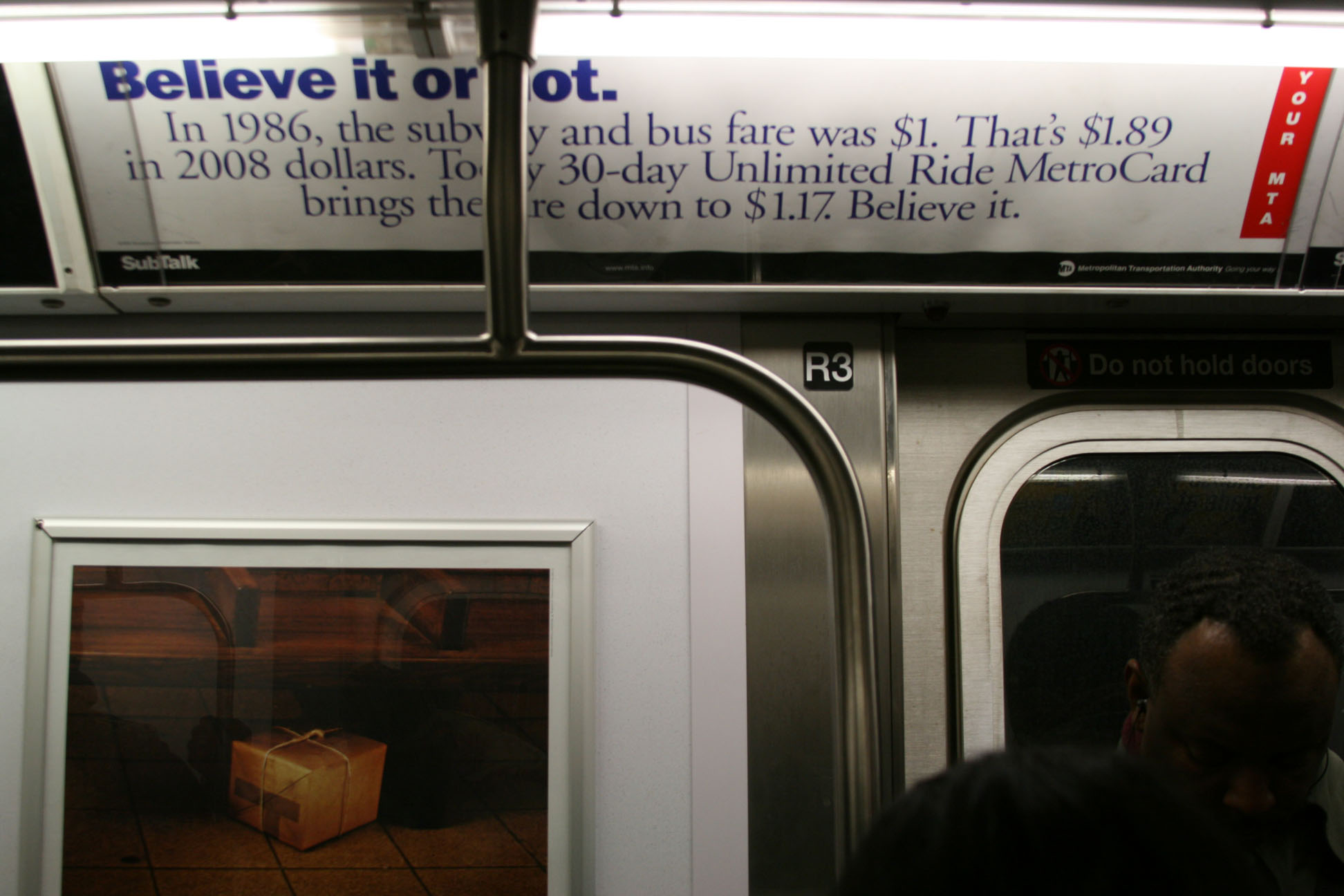
About 8 years ago there were a few house ads in the cars that were effectively gaslighting riders. It was one of the craziest things I'd ever seen as a consumer -- borderline antagonistic. The agency, and the workers to some extent, can be pugilistic when criticized.
After living there for 10 years I moved on from NYC at the end of last year. My last apartment was in a neighborhood in Brooklyn that is still heavily African American but will probably look significantly different in 5 year. The number of European tourists that just show up and come and go on the subway platform there was wild. I have lived in post-gentrification neighborhoods mostly and had not seen anything like this. The only reasonable explanation was AirBnB.