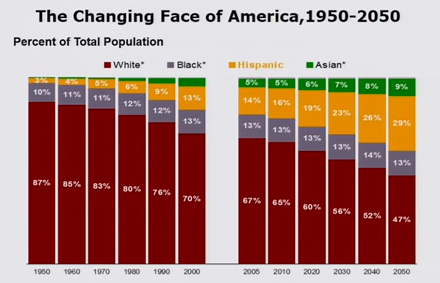
Asian CEOs and VCs do exist, but I would guess those demographics are underrepresented. I would guess this is due to the first few waves of entrepreneurs being mostly white (Fairchild and Microsoft company photos were much paler than a typical company today). Remember, the whole country was much whiter then, and the United States as a whole has over 5x the proportion of Asians today as compared to when SV was getting started[1]. Asian VCs I can think of made money off of late 90s companies and Facebook.
When successful hackers from the last generation stick around, that probably helps the culture more than if they disappeared, even if the hierarchical structure thereby created is less aesthetically pleasing to some.
On the one hand, Asians don't count as "minorities" because there are too many successful Asians. Your startup isn't "diverse" because you have 30% Chinese engineers. On the other hand, their success isn't dismissed as the fruits of unfair privilege like white people (this accusation comes mostly from other white people). Part of the reason that writers ignore Asians is that they upset social justice narratives.
On the ground, there are few social barriers between whites and Asians. The exception is that I seldom saw an Asian man dating a white woman, as a commenter mentions below.
In the tech blogs, the large contributions of Asian people and culture to the Valley are just ignored. It is easier to find a noodle shop than a breakfast place. I think Cupertino had the first majority-Asian city council in the US.
"Let’s deconstruct the common misuse of the word “diversity” as thrown around. In Silicon Valley the word means “non whites”."
"The fact is that we don’t have enough black and latino founders"
I'm not sure why, but South and East Asians are often ignored in discussions of Silicon Valley's diversity. If you expect that Silicon Valley's "lack of diversity" means that tech workers are immersed in white American culture all day, you are greatly mistaken. It's the kind of place where it is easy to hear 5 languages sitting at a coffee shop.
It is incredibly difficult to untangle the effects of culture from those of biology, especially when dealing with the measured psychological differences between men and women. But when the effects are purely biological, as in this article, a cultural explanation is extremely un-parsimonious. The burden is on the proposer if he wants me to believe that the age of brain structure maturation is determined by which toys a child plays with.
> "Why are we so obsessed with finding genetic reasons to explain thinking differences in gender(or race) when there are obvious social/cultural pressures?"
Isn't that another way of saying "Why do people care about science, when its findings might make us uncomfortable? And besides, my ideology already tells me how the world works."
To understand the call for equal representation in tech, you have to understand cultural marxism. My previous thoughts on the issue: https://news.ycombinator.com/item?id=6509118
Some social scientists are skeptical of the validity of stereotype threat. John List, in a paper coauthored with Steven Levitt at the University of Chicago, was unable to reproduce it[1]. Some scholars suspect publication bias[2]. Also see another failure to reproduce by the Educational Testing Service[3].
Wow, I never knew that the male-female Math gap was so robust. Look at the tables in the last three pages you linked. Except for Israel, nearly every country has a male-biased Math score gap on standardized tests.
Sexual dimorphism is incredibly common in the animal kingdom, and humans are not an exception.
You are setting up a non-falsifiable belief system that asserts that men and women cannot be different above the neck. If that's what lets you sleep at night, who am I to deny you your comforting faith?
But you are fighting against mountains of evidence for cognitive differences between men and women. Are they all cultural? I'm friends with a few post-treatment transgendered people, and I'm inclined to believe at least that hormones have a powerful impact on personality.
Startups try to keep a "high bar", only hiring people with sterling academic credentials or proven work in the field.
So I would expect the gender ratio to be less equal at startups that draw from the far right-hand side of the graph, and more equal at big firms that are willing to hire from the middle.
> "Is it really wrong to say that women could be better or worse (in general) at one thing or another? Is it sexist to even point out that men and women are different?"
Yes to both questions. On the other hand, it's science[1][2]! There's lots of proven differences in personality and ability between the sexes.
When the official ideology is against reality, you have to choose between being a "good person" and a good scientist. It's best for your career to choose the first.
Men do better than women at the Math SAT[1]. The male/female ratio is especially high in the higher Math percentiles, where you would expect your best engineers to come from. The polite way to explain this is some kind of "expectations effect", which is possible, but females do dominate at all other aspects of education. We cannot rule out simple innate ability, combined with higher male interest in abstract things.