Imagine you're a 16th century Italian mathematician who is trying to solve cubic equations. You notice that when you try to solve some equations, you end up with a sqrt(-1) in your work. If you're Cardano, you call those terms "irreducible" and forget about them. If you're Bombelli, you realize that if you continue working at the equation while assuming sqrt(-1) is a distinct mathematical entity, you can find the real roots of cubic equations.
So I would say that it's less that "Complex numbers were invented so that we can take square roots of negative numbers", and more "Assuming that sqrt(-1) is a mathematical entity lets us solve certain cubic equations, and that's useful and interesting". Eventually, people just called sqrt(-1) "i", and then invented/discovered a lot of other math.
For small scale circuits, I like Scherz's "Practical Electronics for Inventors". For a good high level overview of the grid, along with other civil engineering topics, Grady Hillhouse's "Engineering in Plain Sight" is good. Hillhouse's videos pop up on HN occasionally (e.g., https://news.ycombinator.com/item?id=34472122)
Home automation or LEDs are always a good start in my opinion. Home automation because it's something that will affect your life and you'll notice, LEDs because they're pretty (e.g. https://news.ycombinator.com/item?id=29468919).
I got a pair of AfterShokz (https://aftershokz.com/us/) for swimming and in some ways it’s more convenient than an iPod shuffle because the headphones are integrated. I really like the bone conduction tech too.
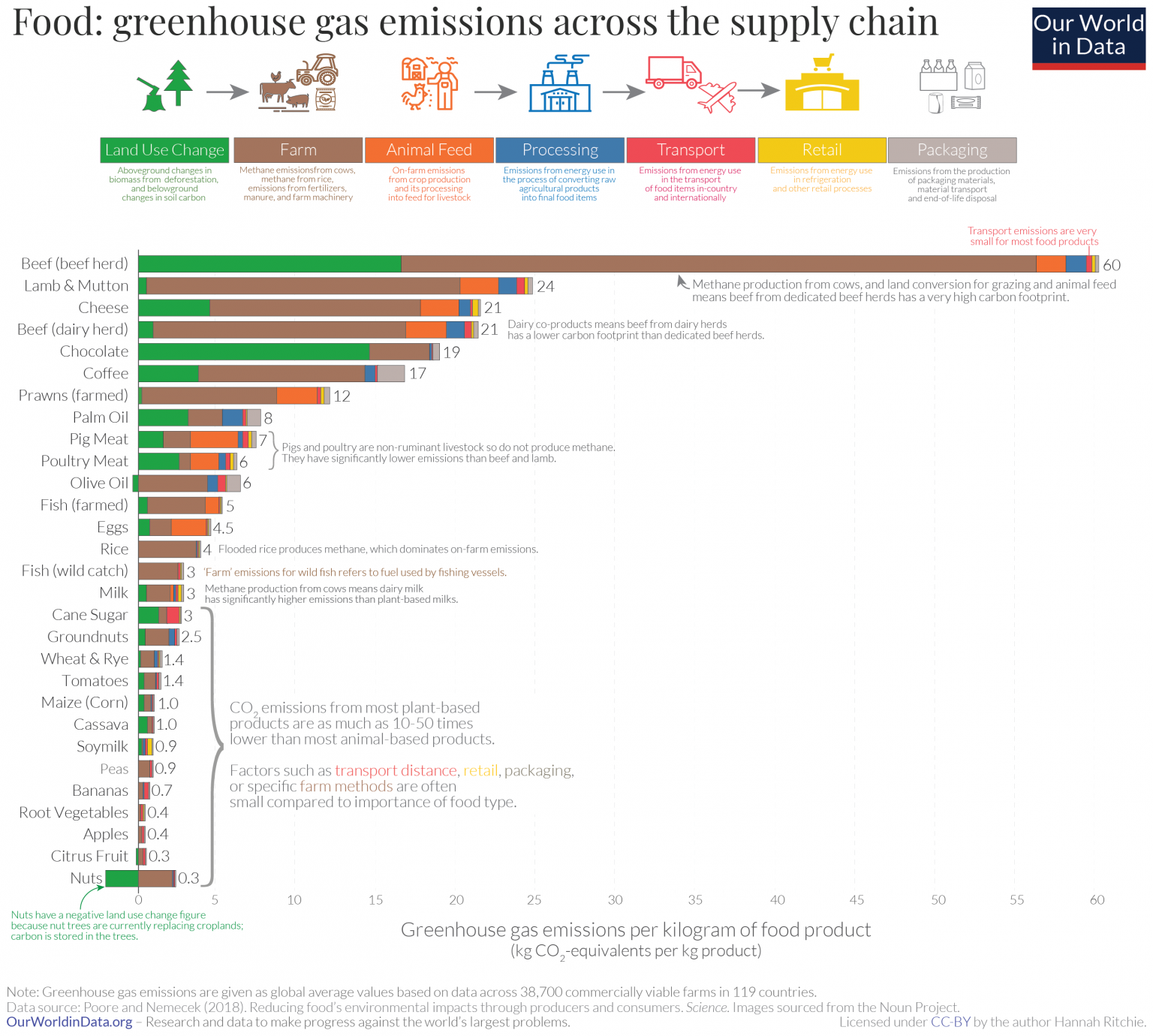
I actually think what you eat is the dominating factor in food CO2 production: https://ourworldindata.org/uploads/2020/02/Environmental-imp... Transport and processing are fairly minor components overall for all foods. The claim about pesticides and fertilizers I know nothing about though.
I'm planning on buying a printer soon elevation maps are one of the things I was hoping to print - thank you for the awesome tool! Assuming the users are okay with it I think it would be cool to show some of the pics people send you for inspiration.
"Generally" could mean what you mentioned, or it could mean straight slavery - as the article said there is not good stats. Forced labor is prevalent in many industries, using the US definition of slavery: https://www.dol.gov/sites/dolgov/files/ILAB/ListofGoods.pdf Your original claim was that decriminalizing drugs would prevent this sort of behavior. I think the linked report shows that is not necessarily true.