Looks like a less feature-full version of livecode [0], which I'd argue is more of a HyperCard successor", since they were formerly revolution & MetaCard, and can import HyperCard stacks.
I found a path from Piano to Volcano with 40 generated topics!
Piano → Instrument (broader)
Instrument → Juilliard School (places)
Juilliard School → American conservatories (past)
American conservatories → Historic music conservatories (past)
Historic music conservatories → Paris Conservatoire (places)
Paris Conservatoire → European conservatories (broader)
European conservatories → Europe (broader)
Europe → Sicily (places)
Sicily → Mount Etna (similar)
Mount Etna → Volcanoes of Italy (similar).
I've been looking forward to watching these, since last year's. Some really interesting projects this year. The feeling of computing[0] (formerly future of coding) community is also a great place for live programming and related topics.
Interesting, if unsurprising, to see that a large factor in the interest in YouTube was based purely on location, as well as knowledge of the people working there, their backgrounds, and who specifically they were funded by.
Where you are and who you know often outweighs having the best product, features, etc.
It is hard, but only if you try to find the general solution. If instead you think in the way the problem designer (who had a target audience of 3rd graders in mind) intended the solution to be found, then it becomes easy to find a solution: one of each toy from the yo-yo to the car (inclusive). That gets you $5.18 from the goal of $43.94, so get another car (the problem doesn't state you can't have repeats).
It depends what you mean by "very limited". All the code is provided to you, so you can get through the book by simply copying and pasting the provided code snippets. As long as you understand what the code is actually doing just by reading it, you'll be okay. The book has some "challenges" where you can implement additional features if you want to, but you don't need to. However if your knowledge of Java or C is so limited that you'll have a hard time even understanding what the code is doing, then it's probably not worth the effort going through the book. It will be too confusing, and you won't learn much.
Yes. I'm halfway through it now, and while I do have a degree in CS, all that's really needed is knowledge of Java and C. If anything, it's less formal than a compiler / PL course one would normally take during undergrad.
> Most research (plus the 2016 results) confirms that money has little effect on victory
Maybe money in the form of "contributions", okay. But having money is still the largest predictor for policy direction.
"The central point that emerges from our research is that economic elites and organized groups representing business interests have substantial independent impacts on U.S. government policy, while mass-based interest groups and average citizens have little or no independent influence"[0]
> Why should our taxes be handed out for risky business endeavors with no direct public benefit, when the private sector already has the means to handle this.
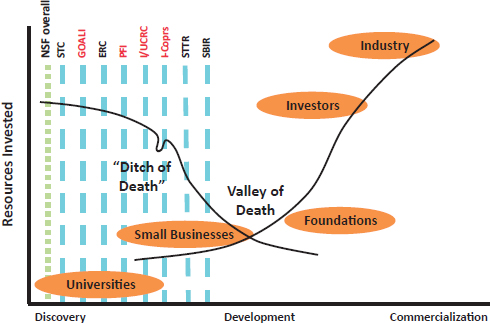
SBIR/STTR money is primarily used for R&D work for high risk technology. The risk being that it might not work, or might not solve the problem you're trying to solve. You don't spend the money on marketing and sales. It's meant for technologies precisely in the stage that the private sector is not good at handling, for similar reasons that the private sector isn't good at funding basic research. This stage is referred to as the funding gap or the valley of death[0][1].
> Government agency usually gets perpetual use license of your product.
Misleading. The agency, in this case NSF, obtains march in rights for patents (not data) developed using funds received from them. They will only exercise that right in the most extraordinary circumstance. Basically, if you develop a cure to cancer and then decide not to commercialize it or make it publicly available, they may exercise march in rights and take it over. No agency, not even the DoD, has ever exercised it, to my knowledge.
This whole article is a bit baffling to me. I'm having trouble understanding what the message is. That advertisers are using technology in their ads? Why wouldn't they? That they are trying to "normalize" the influence that code and technology has on our lives? It's already normalized. There isn't a dark conspiracy where advertisers subliminally incorporate language to drown out the luddites. There are big tech companies that want to advertise their brand and their tech. And there are non-tech companies that want to advertise using the language and norms we're already familiar with.
I lived in Orlando for 20+ years, and got Western (mostly neutral). In my experience, Floridians south of Jacksonville do not speak with a southern accent.
I use it for my bookmarks, and I find it is a suitable balance between having some kind of hierarchy, while allowing for resources to be classified under several categories.
Not sure if the "Maps of X" games are titled appropriately. They should be called "Shapes of X". Even after learning shapes of various countries, I don't learn where they are on a map, though I can recognize them by searching a map and
eventually identifying them by their shape. Maybe in the info section after you guess it right, you can show a map and show the country you just identified highlighted on the map.
> the programming assignments were not challenging. I didn't really feel like I gained anything from them
I was in the first cohort of the front-end nanodegree, and I also took the full-stack shortly after. I'm pretty shocked by this statement. For me, the vast majority of learning happened by implementing the topics that were discussed in the short videos. Given that the videos are very brief summaries of the topics you're meant to implement in the projects, It's pretty odd you gained nothing from doing them. Did you know the material before starting the nanodegree? If so, I'd argue the fault is on you for choosing a curriculum meant for beginners whilst being intermediate or above. Otherwise you're a very rare person for being able to learn more from watching videos and reading articles than by actually practicing what is taught.
[0] https://livecode.com/