Author here… I wrote it, I used Claude for proofreading/editing as mentioned at the end. Anyway point is, real human here!
I do still read the code _except_ when I am consciously vibe coding a non production thing where I will know empirically that it worked or not by using it.
I’m definitely not using agents to do all my coding (as I hope is reasonably) clear from the post. But they have crossed this line from pointless to try to genuinely useful for many real world problems in just the last couple of months in my experience.
Author of the piece here :-). We are not building coding agents and focused on quite different stuff… I am just trying to share my personal experience as a software person!
Author of the post here… Cool to see this back on HN! I was trying to provide instructions that anyone could use regardless of platform, hence the choice of web tools (both those linked process the data locally). If you know of a base32 decoder that’s easily available on Windows, Mac and Linux I’d be delighted to update the post.
>This year’s Advent of Code has been brutal (compare the stats of 2023 with that of 2022, especially day 1 part 1 vs. day 1 part 2).
I enjoyed completing AoC this year. While it was very clear that day 1 (esp. part 2) was significantly harder than previous years (I wrote about this among other things [0]), OP's claim seemed not obviously self evident when comparing _current_ 2022 stats to _current_ 2023 stats, as folks have had an additional full year to complete the 2022 puzzles.
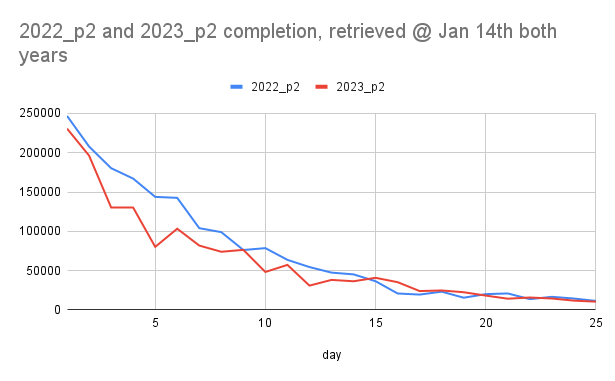
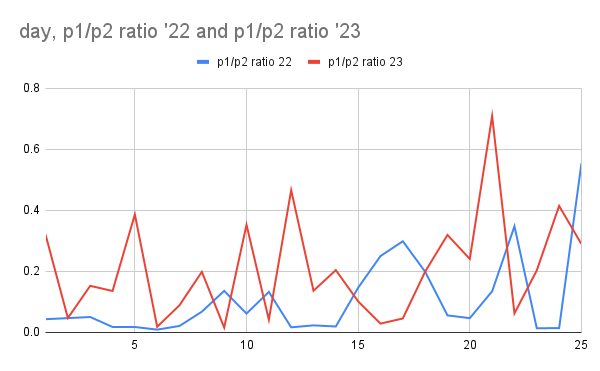
I grabbed the 2022 stats from Jan 14th 2023 [1] and, indeed, the difference is quite stark. Graphing the part two completion stats[2] for both years, there was a relatively similar starting cohort size on day 1, but 2023 looks clearly harder than 2022 up until day 15. As OP observes, the ratio[3] of folks completing pt1 but not going on to complete pt 2 is way higher for a lot of days in 2023 and suggests the day 5, 10, 12 and especially day 22 part 2s were particularly difficult.
I've been making wine at home in California for the past few years. Finding grapes on Craigslist/via friends, picking them myself and fermenting/storing/bottling wine in my basement. It's great fun, and tastes pretty good too! I wrote up a guide for anyone who'd like to try here - https://wine.singleton.io/
That's a reasonable question. We wrote this RCA to help our users understand what had happened and to help inform their own response efforts. Because a large absolute number of requests with stateful consequences (including e.g. moving money IRL) succeeded during the event, we wanted to avoid customers believing that retrying all requests would be necessarily safe. For example, users (if they don’t use idempotency keys in our API) who simply decided to re-charge all orders in their database during the event might inadvertently double charge some of their customers. We hear you on the transparency point, though, and will likely describe events of similar magnitude as an "outage" in the future - thank you for the feedback.
Thanks for the questions. We have testing procedures and deploy mechanisms that enable us to ship hundreds of deploys a week safely, including many which touch our infrastructure. For example, we do a fleetwide version rollout in stages with a blue/green deploy for typical changes.
In this case, we identified a specific code path that we believed had a high potential to cause a follow-up incident soon. The course of action was reviewed by several engineers; however we lacked an efficient way to fully validate this change on the order of minutes. We're investing in building tooling to increase robustness in rapid response mechanisms and to help responding engineers understand the potential impact of configuration changes or other remediation efforts they're pushing through an accelerated process.
I think our engineers’ approach was strong here, but our processes could have been better. Our continuing remediation efforts are focused there.
I'm Stripe's CTO and wrote a good deal of the RCA (with the help of others, including a lot of the engineers who responded to the incident). If you've any specific feedback on how to make this more useful, I'd love to hear it.
(stripe head of engineering here)
I hosted the open house in Dublin, thanks for coming and sorry to hear about your experience; even if it doesn't end up being a fit, we always want candidates to feel respected rather than demoralized. Without knowing the specifics of your situation, I do want to be clear that there are obviously a lot of factors for us to consider when evaluating candidates, but age isn't one of them.
Does the combination of hypothermic state and medically induced coma (“hibernation”) have a prolonging impact on life expectancy? The lower metabolic rate would intuitively suggest that’s a possibility. It’s interesting to think about how this technology, even ahead of use in travel to deep space could be used as a forward only time machine.
If you already use pocket, then Pocket 2 Kindle https://p2k.co/manage/home is a good service to send stuff from your reading list, nicely formatted to your Kindle.
I wrote something similar (taking lists of URLs) a couple of years ago and it's still live at www.kindlized.com but when think about the next step of grabbing my Pocket article list I found Pocket 2 Kindle and never bothered to update my own - kind of fun and sad at the same time to discover that someone has already built the thing you just thought of :-)
“Making (Up) an Archive: What Could Writing History Look Like in a Digital Age?” - outernet://dash.harvard.edu/handle/1/11297828
There Can Be No Turing-Test--Passing Memorizing Machines - outernet://dash.harvard.edu/handle/1/11684156
Corbett Report Episode 293 - The Ebola Effect - uternet://www.corbettreport.com/episode-293-the-ebola-effect/
The Place of the Gospel of Philip in the Context of Early Christian Claims about Jesus’s Marital Status - outernet://dash.harvard.edu/handle/1/11041837
The Activity of Reason - outernet://dash.harvard.edu/handle/1/3415961
Corbett Report Episode 293 - The Ebola Effect - outernet://www.corbettreport.com/episode-293-the-ebola-effect/
Two Randomized Trials Provide No Consistent Evidence for Nonmusical Cognitive Benefits of Brief Preschool Music Enrichment - outernet://dash.harvard.edu/handle/1/11276120
The Collage of Humanity - https://collage.outernet.is/
Civilization Starter Kit v0.01 - outernet://opensourceecology.org/outernet://opensourceecology.org/Civilization_Starter_Kit_v0.01.pdf
The Parable of Google Flu: Traps in Big Data Analysis - outernet://dash.harvard.edu/handle/1/12016836
"Learning from utopia: contemporary architecture and the quest for political and social relevance." - outernet://dash.harvard.edu/handle/1/10579145
Middle-Period Discourse on the Zhong Guo: The Central Country - outernet://dash.harvard.edu/handle/1/3629313
Be Careful What You Ask For: Reconciling a Global Internet and Local Law - outernet://dash.harvard.edu/handle/1/9696322
Thinking about prestige, quality, and open access - outernet://dash.harvard.edu/handle/1/4322577
Posting to see what HN make of this. A friend backed the Lantern Indiegogo campaign yesterday [https://www.indiegogo.com/projects/lantern-one-device-free-d...] which sounded exciting and useful. I love the idea here - core knowledge, news, crisis response stuff broadcast globally.
While I'm excited about this and will probably back the Lantern myself, the current Outernet could really use help with content. I downloaded the whole of the Outernet [328 MB compressed] and most of the stuff is of pretty dubious interest: "Two Randomized Trials Provide No Consistent Evidence for
Nonmusical Cognitive Benefits of Brief Preschool Music Enrichment", or advances a pretty niche non-mainstream media outlook (the Corbett report podcast).
Fun to see this post from the deep archive get some interest - thanks for reading!