- When you hit something that doesn't make sense in one source, try referencing it in another source.
- When you have some experience writing programs in Haskell, refer to some older books like Real World Haskell. There may be a few issues compiling the examples, but nearly all the techniques in the book are still widely used and you learn about the language has progressed in the last few years. This gives you a compass to read and maintain older Haskell source code).
- Read as much Haskell code as you can from popular libraries (Pandoc, XMonad, and smaller libs as well).
Awesome, glad to hear it. Definitely email me (Christopher - admin at assertible dot com) if you have any other questions or requests. I'd love to hear more of your feedback.
The "Codeless" part is of course referring to the tests themselves, which are defined in Assertible.
Basically, ngrok is used to create a dynamic localhost tunnel to the web app which is built and run on CI. The dynamic ngrok URL is passed to an Assertible trigger which will run the API tests when executed.
Using this method allows you to reuse the same tests for monitoring and testing deployments.
Assertible (https://assertible.com) can do this. Designed to be a simple API testing solution with flexible automation and monitoring. Disclaimer - I am a founder.
GitHub apps are slightly different than OAuth Apps.
GitHub Apps are per-repository "integrations" that don't perform actions on behalf of a specific user and are installed directly to a repo (with fine-grained permissions).
OAuth Apps are the classic "integrations" installed by a specific user and perform actions on behalf of that user.
I imagine they have lower requirements because they are new, more specialized, and likely to be installed a little less.
You mention CI so I'm curious. Do you have an automated continuous delivery process? Does testing fit into that (e.g. integration testing staging or dev services after deployments)?
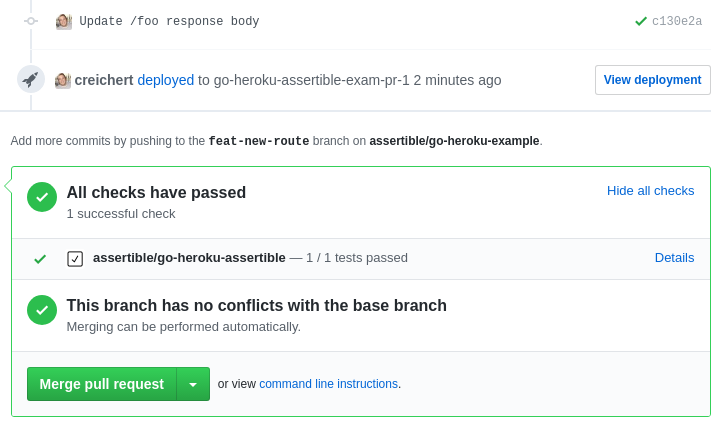
I love how trivial it is to get unique disposable environments for each branch automatically w/ Heroku. This post enhances review apps with automated post-deploy QA testing. In short,
> Most people (at least myself) got into coding because they enjoy creating something from nothing. Maintaining and testing code is boring because it doesn't really do anything new, it's mostly fixing edge cases.
A good testing setup can be an alternative to redundant manual testing. This can really help speed up the creation process (for me, at least).
Have you ever tried to make a business out of selling an app online or in an app store? How did you get users?
I definitely don't agree with "tons" of e-mails but a few promotional emails is understandable. I also don't agree with the tactics used in the article, to be clear.

Definitely overstated and not good advice for beginners.
My advice to beginners would be:
- Read all the Haskell books available at your disposal. (In addition to LYAH and the Hutton book, I would say Learning Haskell From First Principles and Get Programming with Haskell are great, https://www.manning.com/books/get-programming-with-haskell, http://haskellbook.com/)
- When you hit something that doesn't make sense in one source, try referencing it in another source.
- When you have some experience writing programs in Haskell, refer to some older books like Real World Haskell. There may be a few issues compiling the examples, but nearly all the techniques in the book are still widely used and you learn about the language has progressed in the last few years. This gives you a compass to read and maintain older Haskell source code).
- Read as much Haskell code as you can from popular libraries (Pandoc, XMonad, and smaller libs as well).