Microsoft aims at Amazon with Azure virtual Windows (and Linux) IaaS(arstechnica.com)
arstechnica.com
Microsoft aims at Amazon with Azure virtual Windows (and Linux) IaaS
http://arstechnica.com/information-technology/2013/04/microsoft-aims-at-amazon-with-azure-virtual-windows-and-linux-iaas/
14 comments
Another BizSpark Plus member here :) It's an awesome program!
What were the "hiccups"? That can't be good?
P.S. what's your start-up do?
P.S. what's your start-up do?
Disclaimer: I work for MS.
The hiccups I've had have been DNS routing issues early on. It seems to have been solved, but for a while I was experiencing periodic enormous increases in latency (I think at one point the delay was 26 seconds). From what I heard they were specific to their linux VPSs (which is what I'm using), but those were solved around three or four months ago. I haven't had any issues since.
As far as the VPS goes, overall it's decent. I do a lot of my development over ssh so small latency blips are almost always immediately noticeable. Linode seems to still be more consistent, but just barely.
The hiccups I've had have been DNS routing issues early on. It seems to have been solved, but for a while I was experiencing periodic enormous increases in latency (I think at one point the delay was 26 seconds). From what I heard they were specific to their linux VPSs (which is what I'm using), but those were solved around three or four months ago. I haven't had any issues since.
As far as the VPS goes, overall it's decent. I do a lot of my development over ssh so small latency blips are almost always immediately noticeable. Linode seems to still be more consistent, but just barely.
We've had several issues over the past few months. To be fair, I should note that they did brand the Linux VMs as "preview" (which is just another word for beta). Even though they were already charging for the product, they didn't guarantee an up-time SLA either so we were well-aware it would be a risk using the product.
The biggest issue by far? Random VM Reboots
We thought our applications or some particular package was causing our VMs to randomly reboot. After thorough investigating, we found out that our code was perfectly fine. The folks on the Azure team were rebooting our VMs for internal upgrades. They oddly were doing this without any advance notice. This would affect our application servers, database servers, and even our development/staging instances. Another frustrating aspect was the fact that they would often do these upgrades during peak traffic hours (9 AM - 5 PM Pacific Time).
Without a better solution, we just wrote some code to ensure that our application supervisor would auto-start if the system were to reboot which helps mitigate the problem. Hopefully these issues no longer occur now that they offer an 99.95% SLA.
As for your other question, my start-up is Pepperdeck https://pepperdeck.com/
The biggest issue by far? Random VM Reboots
We thought our applications or some particular package was causing our VMs to randomly reboot. After thorough investigating, we found out that our code was perfectly fine. The folks on the Azure team were rebooting our VMs for internal upgrades. They oddly were doing this without any advance notice. This would affect our application servers, database servers, and even our development/staging instances. Another frustrating aspect was the fact that they would often do these upgrades during peak traffic hours (9 AM - 5 PM Pacific Time).
Without a better solution, we just wrote some code to ensure that our application supervisor would auto-start if the system were to reboot which helps mitigate the problem. Hopefully these issues no longer occur now that they offer an 99.95% SLA.
As for your other question, my start-up is Pepperdeck https://pepperdeck.com/
Azure is pretty nice, but just a warning for those. If you trial it for the 90 days. If any any time during that trial you go over your allocated "specs" your VM will be deleted. This does not mean your data is gone, it's just stored as a "disk image" and you can create a new one. But there has been times where the "disk image" became corrupted or something and people lost everything they did during their trial.
Just a note that if you plan on using it, I'd suggest signing up for Pay as you go (you get the trial stuff, but if you go over it doesn't delete your VM, it just charges you).
Another thing that is annoying, on AWS if you turn off your VM it doesn't charge you for cycles. On Azure you need to delete your VM, turing it off still charges you the exact same amount as if you had it on. Something I found really weird.
Overall though Azure control panel is amazing, and the system is very nicely built. Even with the troubles I had (as stated above) I still recommend it to people.
Just a note that if you plan on using it, I'd suggest signing up for Pay as you go (you get the trial stuff, but if you go over it doesn't delete your VM, it just charges you).
Another thing that is annoying, on AWS if you turn off your VM it doesn't charge you for cycles. On Azure you need to delete your VM, turing it off still charges you the exact same amount as if you had it on. Something I found really weird.
Overall though Azure control panel is amazing, and the system is very nicely built. Even with the troubles I had (as stated above) I still recommend it to people.
Any idea what happens if you do not renew and/or do not delete your free trial account at the end of free trial? Mine is going to run out soon. I signed up only to play around (have no serious need). I have deleted my VMs.
They eventually will delete your data. You'll receive plenty warnings by email and you can open a support ticket for assistance at any time.
They don't "eventually" delete your data, the second the trial is over they delete the instance completely (but it still shows up in your control panel). Trying to switch to a paid subscription won't restore it and their support team can't help either.
I got burned by this, I let a trial lapse with a VM that I would have preferred not been nuked, it's totally my fault but from a customer service/goodwill perspective you'd think they would just disable access for a period of time to give you the chance to re-up.
I got burned by this, I let a trial lapse with a VM that I would have preferred not been nuked, it's totally my fault but from a customer service/goodwill perspective you'd think they would just disable access for a period of time to give you the chance to re-up.
Wow, their dashboard looks pretty neat!
http://weblogs.asp.net/blogs/scottgu/image_thumb_65504243.pn...
http://weblogs.asp.net/blogs/scottgu/image_thumb_7486AB10.pn...
http://weblogs.asp.net/blogs/scottgu/image_thumb_65504243.pn...

http://weblogs.asp.net/blogs/scottgu/image_thumb_7486AB10.pn...
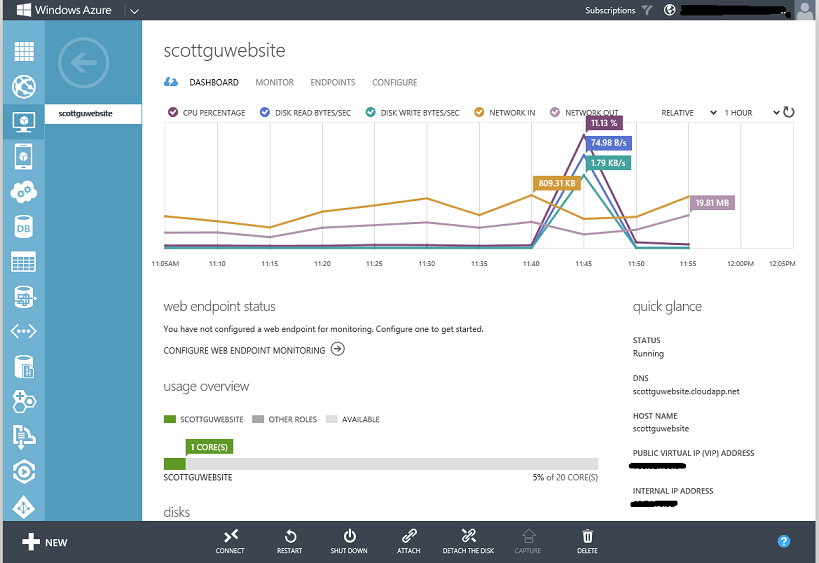
It is neat, and usually works pretty well... but occasionally I've run into issues where the dashboard 'freezes' for no apparent reason. Looking at the console revealed a backend service threw a 500 error, and because there was no error handling in the front end, the dashboard appeared to freeze. A little bit frustrating to hit this every so often.
As usual, there's a good write up on these changes from Scott Gu as well.[1] As someone who has been using Azure for 3+ years now, I'm pretty excited about the direction Microsoft is going with Azure.
But for crying out loud can Microsoft please officially release Azure Websites? It's been in 'preview' for so long. I would really like to use it in production and have SSL support. :)
[1] http://weblogs.asp.net/scottgu/archive/2013/04/16/windows-az...
But for crying out loud can Microsoft please officially release Azure Websites? It's been in 'preview' for so long. I would really like to use it in production and have SSL support. :)
[1] http://weblogs.asp.net/scottgu/archive/2013/04/16/windows-az...
I've been running a Rails app on Azure IaaS on Ubuntu with a MySQL instance for 6 months and it has been totally solid.
In particular, I don't have hard numbers but the underlying filesystem feels much more performant than EBS on AWS - and it is nice that the storage underlying the filesystem is automatically georeplicated for you.
In particular, I don't have hard numbers but the underlying filesystem feels much more performant than EBS on AWS - and it is nice that the storage underlying the filesystem is automatically georeplicated for you.
I am finding Azure really great,the platform itself has good integration with publishing from both github and tfs.... The setup with .net solutions is tight obviously.
I am using SQL azure, blob storage for files, persistent queues for background processing, tables for diagnostics, MVC 4 webapi restful services and a custom built single page app hosted as web role with automatic scale out cloud services, plus worker roles handling background queue processing, so all in all, scalability as a service, hard to beat... I couldn't imagine doing this without Azure with such a small team. Yes I work mainly with the Microsoft stack and this kinda ties me a little for now, but that shouldn't be an issue if the business succeeds as it has economies of scale.
Price reductions are always welcome..
I am using SQL azure, blob storage for files, persistent queues for background processing, tables for diagnostics, MVC 4 webapi restful services and a custom built single page app hosted as web role with automatic scale out cloud services, plus worker roles handling background queue processing, so all in all, scalability as a service, hard to beat... I couldn't imagine doing this without Azure with such a small team. Yes I work mainly with the Microsoft stack and this kinda ties me a little for now, but that shouldn't be an issue if the business succeeds as it has economies of scale.
Price reductions are always welcome..
Interesting that they're supporting OpenSUSE, CentOS, Ubuntu. Quick glance, the pricing seems competitive with Amazon EC2.
Indeed. I've got a couple Ubuntu VMs on Azure running XWiki and TeamCity (Java apps) and it's quite smooth. I like the virtual disk management (dynamically increasing block blobs on Azure storage).
Also, you could easily take advantage of IaaS for VMs combined with PaaS-like services, for instance for relational databases, reporting, identity management, service bus, media encoding and streaming, etc.
Also, you could easily take advantage of IaaS for VMs combined with PaaS-like services, for instance for relational databases, reporting, identity management, service bus, media encoding and streaming, etc.
They also offer setting up of simple website/blogs for free, as in totally free (there must be some limitation, I have not investigated further).
Yes, Azure Websites has a free version. The only downsides are that you have limited storage and bandwidth, and that you can't use a custom domain name for you website (so your URL will always be xxxx.azurewebsites.net). You can upgrade to a shared hosting version of Azure Websites, that costs €5~€10/month.
I think it's really awesome stuff, I'm using the free azure website for a couple of tools that I created.
I think it's really awesome stuff, I'm using the free azure website for a couple of tools that I created.
Makes sense. I think as a least minimum, for people in IT, Azure wouldn't be a bad place to host online resume.
This is one space that I don't mind Microsoft trying to wedge themselves into. Seems like they are building a great platform that will be competitive in price and features with the other providers.
Anyone have any benchmarks comparing Azure to Rackspace and AWS? Especially their storage over EBS?
Yes sir, Azure actually won these benchmarks in 2013. See the full benchmarks here; http://www6.nasuni.com/rs/nasuni/images/2013_Nasuni_CSP_Repo...
or the summarized infographic here: http://visual.ly/state-cloud-storage-2013
or the summarized infographic here: http://visual.ly/state-cloud-storage-2013
To be clear, that's an object storage benchmark.
Interesting. Now I'd like to see a CPU benchmark, but I imagine that would be influenced heavily by who else is on your machine.
There have been a ton of cloud CPU benchmarks, e.g. http://cloudharmony.com/benchmarks If the cloud is implemented properly there should be minimal interference from neighbors, but it would be an interesting thing to check.
Those benchmarks are for S3, not EBS.
I'm sorry, I don't have experience with the Amazon cloud, I don't know what EBS is :)
For me, it's only really going to get interesting when one of the Amazon competitors launches a spot market. To my (non-expert) knowledge, EC2's spot market is still the only one.
Too bad they still charge more for Windows instances than Amazon EC2 does.
I don't trust them not because they let their certs expire earlier this year causing an extended outage, it's that they didn't have a robust process for managing and preventing such an issue.
"As a part of the normal operation of the Secret Store, scanning occurs on a weekly basis for the certificates being managed. Alerts of pending expirations are sent to the teams managing the service starting 180 days in advance. From that point on, the Secret Store sends notifications to the team that owns the certificate. The team then refreshes a certificate when notified, includes the updated certificate in a new build of the service that is scheduled for deployment, and updates the certificate in the Secret Store’s database. This process regularly happens hundreds of times per month across the many services on Windows Azure."
http://blogs.msdn.com/b/windowsazure/archive/2013/03/01/deta...
IMO they had a rather extensive process in place. That process had a flaw, though, in which a specific kind of human error (forgetting to set up a flag) was not double-checked.
As disruptive as that was, it's growing pains and overall they've had few issues for a service that is scaling up and out so quickly.
http://blogs.msdn.com/b/windowsazure/archive/2013/03/01/deta...
IMO they had a rather extensive process in place. That process had a flaw, though, in which a specific kind of human error (forgetting to set up a flag) was not double-checked.
As disruptive as that was, it's growing pains and overall they've had few issues for a service that is scaling up and out so quickly.
Just don't forget to renew the certificates.
Just about every start-up I knew was using AWS or RackSpace. I was a bit concerned to go with them at first, but it was clear after investigating further that we wouldn't be locked-in. We're using Ubuntu VMs which are essentially identical to the ones we would have been using on AWS or RackSpace. Our app is fairly portable enough that we could switch if we had to do so.
There have been a few occasional hiccups, but we've been happy with them so far.