Filing taxes: It shouldn't be so hard(economist.com)
economist.com
Filing taxes: It shouldn't be so hard
http://www.economist.com/blogs/democracyinamerica/2013/04/filing-taxes?fsrc=scn/rd_ec/it_shouldnt_be_so_hard
57 comments
> Every time it gets simpler to file, it also becomes simpler to add more taxes and people don't notice the difference.
Can you point out a time where complicated tax forms prevented a new tax, or are we just saying it's better for people to bitch about every tax they have to pay instead of just some of them? Basically I can't see where this statement could come from.
Can you point out a time where complicated tax forms prevented a new tax, or are we just saying it's better for people to bitch about every tax they have to pay instead of just some of them? Basically I can't see where this statement could come from.
>Personally, I don't want filing to be simpler. Every time it gets simpler to file, it also becomes simpler to add more taxes and people don't notice the difference. It's only when people have to do their taxes that they realize how screwy our system is. The 1099 independent contractors understand this one.
Empirical evidence from countries where tax forms are prefilled doesn't seem to support this notion very much.
Empirical evidence from countries where tax forms are prefilled doesn't seem to support this notion very much.
It's only when people have to do their taxes that they realize how screwy our system is. The 1099 independent contractors understand this one.
Maybe. . . but why should a person need to hire a CPA if he is, say, a construction worker who earns < $25K per year?
The actual problem is that the core tax code focuses on deductions rather than income. That is, the tax code has become more complicated over time because all the incentives are going to businesses and individuals to maximize deductions in order to attain as low of a taxable income as possible. The "maximizing deductions" side of the coin almost creates something of a stack overflow problem because of the the recursion.
I've thought for a long time; definitely time to refactor. One idea from awhile back -- http://ink.hackeress.com/2012/11/re-engineering-tax-code-par...
Maybe. . . but why should a person need to hire a CPA if he is, say, a construction worker who earns < $25K per year?
The actual problem is that the core tax code focuses on deductions rather than income. That is, the tax code has become more complicated over time because all the incentives are going to businesses and individuals to maximize deductions in order to attain as low of a taxable income as possible. The "maximizing deductions" side of the coin almost creates something of a stack overflow problem because of the the recursion.
I've thought for a long time; definitely time to refactor. One idea from awhile back -- http://ink.hackeress.com/2012/11/re-engineering-tax-code-par...
Here's the basic problem with tax code simplification: the thing you're trying to compute (income = net change in wealth) is inherently complicated to compute. Sure, the special giveaways and whatnot don't help, but a lot of the special giveaways are also related to the theoretical understanding of what should be taxed.
Consider complications like calculating depreciation for capital equipment. All the schedules aren't there because of kicks--they're there because allowing an immediate deduction for an expense that creates a capital asset usable for years is just a mathematically incorrect way to measure "net change in wealth" when considering the time value of money. Other complexity comes from using discrete sampling periods (yearly tax returns) for what is a continuous phenomenon (changes in wealth). That's where things like net loss carry-forwards comes from. Other complexity comes from the intricacies of the "net" (versus gross) part of the equation. You can think of things like childcare deductions as a sop to the fact that childcare is something people buy so they can work, and thus not consumption.
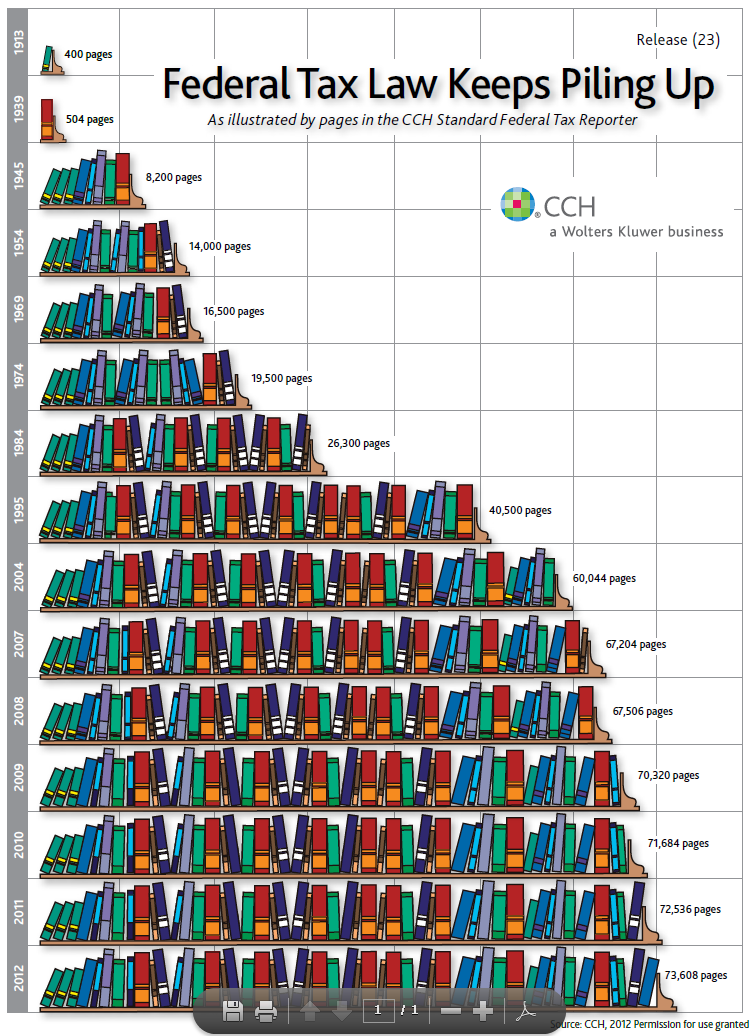
The software analogy is really apropos. I'm pretty sure Windows is over 50 million lines of code at this point, and Linux is over 15 million. That's a million printed pages for Windows, and 300,000 printed pages for Linux. In comparison, the entire U.S. federal tax code is 73,000 pages: http://3.bp.blogspot.com/-3zoNtmhcQmE/T41zkm0VE6I/AAAAAAAAFM....
Are Linux and Windows unnecessarily complex? Or is there just inherent complexity in creating an operating system that runs on everything from supercomputers to cell phones (Linux), or is bug-for-bug compatible back to the 80's (Windows)?
Don't get me wrong, the tax code should be simplified in every way possible. But when people say stuff like it only exists because "we haven't stopped to consider what might be better" that sounds a lot to me like the guy on every engineering team who wants to scrap the big, time-tested system and do a rewrite. Go to Microsoft, tell them that their system is just "patch after patch" and then volunteer to rewrite the whole thing. See what they say.
Consider complications like calculating depreciation for capital equipment. All the schedules aren't there because of kicks--they're there because allowing an immediate deduction for an expense that creates a capital asset usable for years is just a mathematically incorrect way to measure "net change in wealth" when considering the time value of money. Other complexity comes from using discrete sampling periods (yearly tax returns) for what is a continuous phenomenon (changes in wealth). That's where things like net loss carry-forwards comes from. Other complexity comes from the intricacies of the "net" (versus gross) part of the equation. You can think of things like childcare deductions as a sop to the fact that childcare is something people buy so they can work, and thus not consumption.
The software analogy is really apropos. I'm pretty sure Windows is over 50 million lines of code at this point, and Linux is over 15 million. That's a million printed pages for Windows, and 300,000 printed pages for Linux. In comparison, the entire U.S. federal tax code is 73,000 pages: http://3.bp.blogspot.com/-3zoNtmhcQmE/T41zkm0VE6I/AAAAAAAAFM....
Are Linux and Windows unnecessarily complex? Or is there just inherent complexity in creating an operating system that runs on everything from supercomputers to cell phones (Linux), or is bug-for-bug compatible back to the 80's (Windows)?
Don't get me wrong, the tax code should be simplified in every way possible. But when people say stuff like it only exists because "we haven't stopped to consider what might be better" that sounds a lot to me like the guy on every engineering team who wants to scrap the big, time-tested system and do a rewrite. Go to Microsoft, tell them that their system is just "patch after patch" and then volunteer to rewrite the whole thing. See what they say.
What do you think about setting the corporate tax to 0% and making up for it by taking capital gains and dividends like normal income?
We could get rid of most of the corporate tax code that way -- and corporate taxes, as you point out, are always gonna be complex.
We could get rid of most of the corporate tax code that way -- and corporate taxes, as you point out, are always gonna be complex.
I think it's theoretically inelegant but may be what is most practical, especially in a race to the bottom global economy. More than one company has reincorporated in high-tax countries like the UK and Switzerland, because of favorable corporate taxes. The executives pay more, but it gooses earnings which is what the analysts want to see. We don't get much revenue from them anyway and it'd be better to keep the companies and the capital here.
Amen. The fairtax.org proposal or a flat tax would appear to be much better from a filing, management, & administrative perspective.
For those who care about progressive vs regressive - the fairtax proposal actually proposes a pre-bate to families to allow for income disparities and the affect on lower income families.
One would think it would be possible to create a similar pre-bate system to assuage concerns for a flat tax.
For those who care about progressive vs regressive - the fairtax proposal actually proposes a pre-bate to families to allow for income disparities and the affect on lower income families.
One would think it would be possible to create a similar pre-bate system to assuage concerns for a flat tax.
The elegance of the Flat Tax idea is not the flatness of the tax, but the fact that it's a straight line tax.
There's no reason why this essential feature can't be combined with a progressive (read: more humane) system by adding a gentle slope.
There's no reason why this essential feature can't be combined with a progressive (read: more humane) system by adding a gentle slope.
I have filed as a 1099 independent contractor for years and I resent the time wasted on filing taxes. Of course we have stopped to consider what might be better, it's a regular topic at election time. The reality is that a lot of people have a vested interest in exploiting the current inefficiency and invest money in keeping it that way. Change is possible, but it's going to cost.
I wish we could apply a UNIX approach here. Everything in text format, simple scripts. 99% of the form-filling-out of taxes is copying and pasting or simple arithmetic.
Input: Personal information, deductions, W2s, 1099-Rs, and other relevant forms in standardized ASCII text format.
Script: A python version of form 1040 or whatever you are using.
Output: All relevant columns filled in (amount owed, refund size, etc.)
Time taken each year: < one hour.
Input: Personal information, deductions, W2s, 1099-Rs, and other relevant forms in standardized ASCII text format.
Script: A python version of form 1040 or whatever you are using.
Output: All relevant columns filled in (amount owed, refund size, etc.)
Time taken each year: < one hour.
I've actually been wanting to write a series of Python classes to encapsulate tax forms and schedules. You know -- for fun. Haven't quite thought the whole thing out yet.
Take a look at OpenTaxSolver:
http://opentaxsolver.sourceforge.net/
http://opentaxsolver.sourceforge.net/
That looks awesome!
What I would really like (in my vision of a perfect world) is that companies would be required to issue W-2s and similar forms already in this text format. But anyway OpenTaxSolver looks really cool and thanks for the link!
What I would really like (in my vision of a perfect world) is that companies would be required to issue W-2s and similar forms already in this text format. But anyway OpenTaxSolver looks really cool and thanks for the link!
Do you have a way to get in touch? (I'm also a python guy and I just started learning how to create pdfs in LaTeX too. This project is totally do-able.) I'm: pconerly at gmail
Sorry, that sounds awesome, but I don't think I can commit the time or have the expertise to be very useful ... but please see the other replies to my comment! It sounds like http://opentaxsolver.sourceforge.net/ attempts to address this problem!
In Sweden the most basic variant of doing your taxes - i.e. you have no business, stocks, properties, etc - only requires that you send a SMS (SSN + auth code) verifying the pre-filled data that the tax authority has filled out for you.
It's the same in France. Simple. No arguments, no stress, no fuss.
The complexity in the US tax law is largely due to the kickbacks inherent in the system. People donate money to congressmen, who shove favorable tax clauses into legislation.
The result is a tax system even the IRS can't understand.
The complexity in the US tax law is largely due to the kickbacks inherent in the system. People donate money to congressmen, who shove favorable tax clauses into legislation.
The result is a tax system even the IRS can't understand.
In the USA the 1040EZ is the nearest equivalent, it's one page and takes about 10 minutes to complete by hand. Most people with any real assets or income can't use it though.
Here's how it should work: http://en.wikipedia.org/wiki/Taxation_in_Estonia
or like this http://en.wikipedia.org/wiki/Salaries_tax
Frankly, more complex tax systems are fine if most people don't have to do the calculations themselves
http://en.wikipedia.org/wiki/Pay-as-you-earn_tax
To those who prefer manual filing, or think online filing is not practical, for at least second year California now promotes filing online. It's 2013 and only about 15 years late. Yes, they already have the information or will get it, so the privacy complaints are moot.
You log in to the website, and go through a 20 (or so) step wizard where you confirm or add a missing item, etc. Next, next, finish. Done, and entered into their system. No studying instructions, licking envelopes, buying stamps, or writing checks, waiting months for a refund, or any of that bs.
Meanwhile it's the Dark Ages over in IRS-land. Unless you want to type all your financial information into an unknown third-party site (I don't), you better get out your pencil and calculator, and/or enter it into a PDF for printing.
Not to mention wading thru 70 pages of useless instructions for the blind, disabled, parents, pensions, veterans, itemizing, AMT, self-employed, health savings accounts, paying alimony, etc, etc. You may be one of those, but likely not more than one or two. The rest are wasted time, energy, and cognitive load. Worksheets, schedules, forms++ that could be automated.
If it's not obvious I find the IRS process disgusting. To those that say it is the tax-code that is the problem, while partially true, doesn't take into account the wizard process. The wizard simply doesn't ask you for information that doesn't apply, e.g. if you have no kids it doesn't ask about child care credits. It makes the process much easier.
You log in to the website, and go through a 20 (or so) step wizard where you confirm or add a missing item, etc. Next, next, finish. Done, and entered into their system. No studying instructions, licking envelopes, buying stamps, or writing checks, waiting months for a refund, or any of that bs.
Meanwhile it's the Dark Ages over in IRS-land. Unless you want to type all your financial information into an unknown third-party site (I don't), you better get out your pencil and calculator, and/or enter it into a PDF for printing.
Not to mention wading thru 70 pages of useless instructions for the blind, disabled, parents, pensions, veterans, itemizing, AMT, self-employed, health savings accounts, paying alimony, etc, etc. You may be one of those, but likely not more than one or two. The rest are wasted time, energy, and cognitive load. Worksheets, schedules, forms++ that could be automated.
If it's not obvious I find the IRS process disgusting. To those that say it is the tax-code that is the problem, while partially true, doesn't take into account the wizard process. The wizard simply doesn't ask you for information that doesn't apply, e.g. if you have no kids it doesn't ask about child care credits. It makes the process much easier.
Perhaps we could just get rid of income taxes altogether? No forms, no fuss. Instead, just have a sales tax. Income credits could be used for any social welfare issues.
To replace income tax, sales tax would have to be 18%. If you exclude housing, medical, and food you'd need a 30% rate.
Even if you give credits to the poor (which means we still track all income) how would you ever take a 'fair' amount of tax from the rich? The current tax on someone making $400K from a job is ~37% with federal/state/local. So you're reducing their tax burden more than half (if they spend 100% of what they make). In fact, they spend much less than they save, so if they buy $50K of stuff a year, their taxes are nearly eliminated ($8K in taxes versus $400K income). You can't provide the lower income people enough relief without adding to the debt (or raising the sales tax to something absurd, in which case low income people would need weekly credits or something).
This idea is insane.
Even if you give credits to the poor (which means we still track all income) how would you ever take a 'fair' amount of tax from the rich? The current tax on someone making $400K from a job is ~37% with federal/state/local. So you're reducing their tax burden more than half (if they spend 100% of what they make). In fact, they spend much less than they save, so if they buy $50K of stuff a year, their taxes are nearly eliminated ($8K in taxes versus $400K income). You can't provide the lower income people enough relief without adding to the debt (or raising the sales tax to something absurd, in which case low income people would need weekly credits or something).
This idea is insane.
> To replace income tax, sales tax would have to be 18%.
Finland has a VAT of 24%. We also get taxed for income, and there are lots of other hefty taxes too. Strangely enough, this doesn't seem to be enough for our little country to live within its means though. Go figure.
> Even if you give credits to the poor (which means we still track all income) how would you ever take a 'fair' amount of tax from the rich?
What's a "fair tax" on "the rich"? Do you deserve to get raped harder just because you've made a few hundred thousand dollars for yourself?
Finland has a VAT of 24%. We also get taxed for income, and there are lots of other hefty taxes too. Strangely enough, this doesn't seem to be enough for our little country to live within its means though. Go figure.
> Even if you give credits to the poor (which means we still track all income) how would you ever take a 'fair' amount of tax from the rich?
What's a "fair tax" on "the rich"? Do you deserve to get raped harder just because you've made a few hundred thousand dollars for yourself?
Having to pay more taxes because you can afford it is the same thing as getting sexually assaulted. This is a very reasonable comparison.
In case it wasn't obvious, the word "rape" was used metaphorically. Taxes represent forcefully taking your money away from you. "Rape" seems fitting.
Oh, and it's not about "affording" anything. If it were, it would be a voluntary transaction, much like buying a Retina MacBook Pro if you can afford one.
Oh, and it's not about "affording" anything. If it were, it would be a voluntary transaction, much like buying a Retina MacBook Pro if you can afford one.
>What's a "fair tax" on "the rich"? Do you deserve to get raped harder just because you've made a few hundred thousand dollars for yourself?
Yes.
Yes.
Regardless of how "progressive" you think an optimal tax system should be, it's neither equitable nor sensible to tax income far in excess of that an individual/family/estate's consumption needs over any conceivable period of time at a zero rate whilst taxing income from a person who (for whatever reason) spends more than they earn at a high marginal rate.
Fairtax.org
dramatically-reduce-taxes-on-the-wealthiest-while-raising-them-brutally-on-the-middle-class.org
Sounds pretty fair to me. I'm not using an order of magnitude more government services, so why should I pay an order of magnitude more taxes?
Yes, yes, I get that a graduated income tax might be necessary to pay for the things our society has decided to pay for, but calling the current situation fair is Orwellian.
Yes, yes, I get that a graduated income tax might be necessary to pay for the things our society has decided to pay for, but calling the current situation fair is Orwellian.
Unspinning the FairTax:
"With the prebate program in effect, those earning less than $15,000 per year would see their share of the federal tax burden drop from -0.7 percent to -6.3 percent. Of course, if the poorest Americans are paying less under the FairTax plan, then someone else pays more. As it turns out, according to the Treasury Department, “someone else” is everybody earning between $15,000 and $200,000 per year." [1]
No thanks.
[1] http://www.factcheck.org/taxes/unspinning_the_fairtax.html
"With the prebate program in effect, those earning less than $15,000 per year would see their share of the federal tax burden drop from -0.7 percent to -6.3 percent. Of course, if the poorest Americans are paying less under the FairTax plan, then someone else pays more. As it turns out, according to the Treasury Department, “someone else” is everybody earning between $15,000 and $200,000 per year." [1]
No thanks.
[1] http://www.factcheck.org/taxes/unspinning_the_fairtax.html
Given the current tax code, I really don't want the IRS to have enough information to properly fill out my taxes for me.
Ideally, we get past the lobbyists and create a simple tax system. I do wonder what the revenue neutral standard deduction + flat tax rate would have to be.
Ideally, we get past the lobbyists and create a simple tax system. I do wonder what the revenue neutral standard deduction + flat tax rate would have to be.
Do they not have [nearly] all that information already? How else can the IRS verify your filing is accurate without essentially doing your tax calculations automatically?
Most people's significant sources of income are already reported to the IRS.
Most people's significant sources of income are already reported to the IRS.
It isn't the income part, its the deductions. They don't know, until I tell them what I give at various places. If I don't want to report the money I give to a charity / church, I don't have to.
I only skimmed over the article... but being from the UK, I've never understood the tax system in the US. In the UK I work for an employer, so I have a single source of income like the vast majority of people. The employer must pay their portion of the tax and at the same time they pay my portion of the tax. At the end of the year I get a P60 which states my income for the year, how much tax I have paid and under which tax code I paid. Assuming I only have the single job, there is nothing else for me to do.
If I have a secondary income (and I was inclined to declare it) then I would have to file a return with this info, I think it is all done online now.
I guess it just has always been the norm over here in the UK and so no one complains about it...
If I have a secondary income (and I was inclined to declare it) then I would have to file a return with this info, I think it is all done online now.
I guess it just has always been the norm over here in the UK and so no one complains about it...
Complain about it? What's to complain about? Compared to others, the majority of people in the UK have it remarkably easy. As you say, each month the tax is taken off your pay and sent directly to the taxman, and that's it. Zero effort on the part of the person being paid.
If you've got more complicated affairs, you have to do some paperwork, but that'd be also true if the UK had the US system; it's very easy for most.
There's a middle-ground to be found between easy taxes and telling the government everything. The UK government knows monthly pay and takes tax from that accordingly. If one has any other taxable income, or any reason why one should pay less tax, it's up to that individual to tell them. This makes taxes easy (most people never talk to the tax office at all), and maintains privacy.
If you've got more complicated affairs, you have to do some paperwork, but that'd be also true if the UK had the US system; it's very easy for most.
There's a middle-ground to be found between easy taxes and telling the government everything. The UK government knows monthly pay and takes tax from that accordingly. If one has any other taxable income, or any reason why one should pay less tax, it's up to that individual to tell them. This makes taxes easy (most people never talk to the tax office at all), and maintains privacy.
It's hell in the UK if your tax affairs are more than simple. I have three incomes, two with benefits and own a limited company. Tax return is hell as I'm on PAYE with two companies (yes this is legal). Usually end up owing HMRC a grand or two and have to spend 5 days a year working it all out (I won't hire an accountant as they're shysters and I've been screwed by two so far - bring on RDR).
I think it's hell everywhere, the UK is not alone in this... tax law is complex, hence the reason big corporations take advantage of it!
I just did my taxes last night. Every single source number there was already on a form 1099-something, w2, or other form that's been submitted to the irs.
If they can't do it properly, I can't do it properly. (because IANATL)
If they can't do it properly, I can't do it properly. (because IANATL)
The part that they can't do correctly is mostly deduction-side.
I bet that they can get it correct for 90% of the taxpayers. They certainly could do it for me, using sensible defaults.
(e.g. mortgage interest is reported, real estate taxes are reported, local sales tax is a calculation in most cases).
Where they're not going to get it right is if you've got a Schedule C, since none of that is reported elsewhere.
(e.g. mortgage interest is reported, real estate taxes are reported, local sales tax is a calculation in most cases).
Where they're not going to get it right is if you've got a Schedule C, since none of that is reported elsewhere.
For simple purchases of common stock, the purchase price is NOT reported to the IRS. Although, many brokers may provide it for your information.
while your comment hints at lying and omitting information, i have some concrete anecdote on doing exactly that.
when i moved to the US, ernerst&young (the most incompetent financial firm i've ever worked with) besides doing several things wrong out of incompetence, told me to fill a form listing my overseas banking account. i checked that it was almost mandatory (the wording is not very clear) so i filled and submitted it.
then now, a few years later, checking the IRS website, they call you to fill that form and boast that "since some 3 years 30.000 people informed the IRS of their overseas accounts"
...really? 3 yrs... and there's 30.000 people in the US with overseas accounts?
So yeah, i can understand why people do not want the IRS to be informed of everything. it seems that trying to leave it in the dark is the way to go.
when i moved to the US, ernerst&young (the most incompetent financial firm i've ever worked with) besides doing several things wrong out of incompetence, told me to fill a form listing my overseas banking account. i checked that it was almost mandatory (the wording is not very clear) so i filled and submitted it.
then now, a few years later, checking the IRS website, they call you to fill that form and boast that "since some 3 years 30.000 people informed the IRS of their overseas accounts"
...really? 3 yrs... and there's 30.000 people in the US with overseas accounts?
So yeah, i can understand why people do not want the IRS to be informed of everything. it seems that trying to leave it in the dark is the way to go.
"while your comment hints at lying and omitting information, i have some concrete anecdote on doing exactly that."
I do not lie to the IRS (you are guilty and have to prove yourself innocent), and as a general rule in life, I try not to lie to people.
If the IRS has all the information it needs to fill out my taxes, then several parts of the Bill of Rights are being violated. I cannot fathom how the IRS would force churches to report each contributor for example.
I do not lie to the IRS (you are guilty and have to prove yourself innocent), and as a general rule in life, I try not to lie to people.
If the IRS has all the information it needs to fill out my taxes, then several parts of the Bill of Rights are being violated. I cannot fathom how the IRS would force churches to report each contributor for example.
whats the difference of:
- they getting the info
- you being forced by law to send them the info? (after paying a tax preparator just to fill in the forms)
nobody is talking about IRS knowing think you DON'T have to report to them to begin with. It's about the IRS just presenting you the information they already have.
My point is. Many, many, many people outright omit required* information to the IRS based on that number i saw earlier.
*required= info you would have to give out, otherwise you would be lying.
- they getting the info
- you being forced by law to send them the info? (after paying a tax preparator just to fill in the forms)
nobody is talking about IRS knowing think you DON'T have to report to them to begin with. It's about the IRS just presenting you the information they already have.
My point is. Many, many, many people outright omit required* information to the IRS based on that number i saw earlier.
*required= info you would have to give out, otherwise you would be lying.
We can have a progressive tax rate that is simple. Unfortunately, people such as Grover Norquist make it extremely hard. They want our current tax system to be as complicated as possible so then they can say, "Hey! Let's just do a flat tax." Thus shifting the burden of taxes from the rich to the middle class. He actually raised heavy objections when California implemented the ReadyReturn system. [1]
[1] http://www.nbcnews.com/id/8134597/ns/business-motley_fool/t/...
[1] http://www.nbcnews.com/id/8134597/ns/business-motley_fool/t/...
They already have the majority of the information and will get any additional the moment you file. In almost every system current and proposed you will log on and confirm/modify.
Please don't conflate the tax code and filing, they are separate issues. It would be nice to solve both, but the solving of one doesn't require the other.
Please don't conflate the tax code and filing, they are separate issues. It would be nice to solve both, but the solving of one doesn't require the other.
[deleted]
Simpletax.ca
I used it this year. Make an account and try it out, let's you dig into the original tax forms themselves too. Only in Canada though :)
I used it this year. Make an account and try it out, let's you dig into the original tax forms themselves too. Only in Canada though :)
household income less than $100k/yr
I work, wife works, own a (very) small business, rent two houses = 40+ PAGE 1040
Tax code = INSANE
I work, wife works, own a (very) small business, rent two houses = 40+ PAGE 1040
Tax code = INSANE
Personally, I don't want filing to be simpler. Every time it gets simpler to file, it also becomes simpler to add more taxes and people don't notice the difference. It's only when people have to do their taxes that they realize how screwy our system is. The 1099 independent contractors understand this one.
When you have a buggy piece of software, it's considered foolish and short-sighted to just add patch after patch after patch without stopping to consider that the underlying system itself might be flawed. Then you either scrap the system or refactor the worst/most complex pieces into something simpler and more reliable.
The tax code is IE6 circa 2002. It's still "the standard" because we haven't stopped to consider what might be better.