Ask HN: What non-obvious tech/market may take off in the next few years?
175 comments
No code/low code. People here underestimate the work it requires to craft a production CRUD app and keep it working.
The problem these tools solve are more related to infrastructure rather than one's ability to code. Learning to code might be the easiest part but deploying it, maintaining it, scaling it, securing it and integrating it with thousands of other services remains a huge task even for experienced folks. It's wasted time and effort for something that is cookie cutter in functionality and limited in scope (vast majority of web).
Some of them provide collaboration tools, development environment and experts on call which is neat.
Add ease of outsourcing, too. The employer doesn't have to worry about maintenance once the product is finished. Many good platforms will allow you an easy migration path and better security controls. That comes at a vendor lock in. That's the price but given the life expectancy of smaller companies and startups, it may as well be worth it.
The problem these tools solve are more related to infrastructure rather than one's ability to code. Learning to code might be the easiest part but deploying it, maintaining it, scaling it, securing it and integrating it with thousands of other services remains a huge task even for experienced folks. It's wasted time and effort for something that is cookie cutter in functionality and limited in scope (vast majority of web).
Some of them provide collaboration tools, development environment and experts on call which is neat.
Add ease of outsourcing, too. The employer doesn't have to worry about maintenance once the product is finished. Many good platforms will allow you an easy migration path and better security controls. That comes at a vendor lock in. That's the price but given the life expectancy of smaller companies and startups, it may as well be worth it.
Every VC in the world right now is betting on this becoming a thing... problem is that No Code/ Low Code as a product doesn't actually solve the problem that they are trying to solve.
The overarching concept of No Code/ Low Code is that "code" is the hard part of building software, ergo if we can make it so "normal" people don't have to code the problem is solved. Of course we all know that code isn't the hard part of the job- if code was the issue software developers would all be using No Code/ Low Code solutions already (as it's been pointed out, they've been around forever).
No Code/ Low Code is about selling accessibility to the wantrepreneur crowd... the same people that have an "app idea" that they want you to build. It's a huge market, but it isn't going to have an impact on software development any more than model rockets would have on the aerospace industry.
If the No Code/ Low Code tools were any good software developers would already be using them.
(When I am talking about No Code/ Low code, I am not talking about things like Webflow / Dreamweaver NOT solutions like Serverless.)
The overarching concept of No Code/ Low Code is that "code" is the hard part of building software, ergo if we can make it so "normal" people don't have to code the problem is solved. Of course we all know that code isn't the hard part of the job- if code was the issue software developers would all be using No Code/ Low Code solutions already (as it's been pointed out, they've been around forever).
No Code/ Low Code is about selling accessibility to the wantrepreneur crowd... the same people that have an "app idea" that they want you to build. It's a huge market, but it isn't going to have an impact on software development any more than model rockets would have on the aerospace industry.
If the No Code/ Low Code tools were any good software developers would already be using them.
(When I am talking about No Code/ Low code, I am not talking about things like Webflow / Dreamweaver NOT solutions like Serverless.)
I came here to write basically this. I agree, and by the way, "wantrepreneur" is perfect.
As a counterpoint, my ML team regularly dumps data into Google Sheets for review / note taking, and we build dashboards using some SQL dashboarding tools.
I've cobbled together email sign up forms for some non-technical side projects with Google Forms, App Script and MailChimp.
I'm not a frontend developer so maybe frontend folks will tell me it's super easy, but my feeling is that there is a lot of space for low code tools that produce software that is not polished, but good enough.
I've cobbled together email sign up forms for some non-technical side projects with Google Forms, App Script and MailChimp.
I'm not a frontend developer so maybe frontend folks will tell me it's super easy, but my feeling is that there is a lot of space for low code tools that produce software that is not polished, but good enough.
That's not code, it is software usage. The same way a gamer is not a coder when he type some small things in the console or add some script.
Some of these tools are successful in larger companies, basically to handle demand for crud apps for somewhat technical business groups. Quickbase is doing quite well, for example.
It's also been something a lot of investors have put their hopes in before and had them dashed (probably starting from the early 80s).
It might be that This Time Is Different, but there were a lot of times in the past when "This Time Was Different" too.
It might be that This Time Is Different, but there were a lot of times in the past when "This Time Was Different" too.
isn't there wordpress devs that don't code and make (for now) slow loading websites?
I think low-code is basically just graphical programming. If you want it more powerful/universal you need to code just the same. There might just be more or less big library helpers/blocks. Maybe it's just the next step of being "high-level" and now is indeed the time for it.
Also if you manage to write something as a nice XML/yaml/json you might as well put a nice UI on it.
I think low-code is basically just graphical programming. If you want it more powerful/universal you need to code just the same. There might just be more or less big library helpers/blocks. Maybe it's just the next step of being "high-level" and now is indeed the time for it.
Also if you manage to write something as a nice XML/yaml/json you might as well put a nice UI on it.
Technology is no longer a tool for economic growth, it is now almost entirely a tool for economic control. So investors should adjust their strategy to the new reality.
"Does this technology provide a means for seizing control of the existing economy?" That's the question which investors should be asking.
I think cryptocurrency is the only technology which can achieve this due to the way it transcends existing legal frameworks in terms of ownership rights; a bit like the notion of corporate personhood allowed corporations to gain an upper hand and transcend the legal frameworks of its time.
Corporate stocks were vehicles for inter-generational wealth transfer and the next vehicles will be cryptocurrencies.
"Does this technology provide a means for seizing control of the existing economy?" That's the question which investors should be asking.
I think cryptocurrency is the only technology which can achieve this due to the way it transcends existing legal frameworks in terms of ownership rights; a bit like the notion of corporate personhood allowed corporations to gain an upper hand and transcend the legal frameworks of its time.
Corporate stocks were vehicles for inter-generational wealth transfer and the next vehicles will be cryptocurrencies.
I agree with this. I do wonder if low/no-code products will ever become good enough that you'd feel comfortable actually using one. I believe a part of this is having infrastructure/system that can describe itself in sufficient detail. Then the ability to modify itself with sufficient variety. Fundamentally I've seen ORMs/APIs/integrations that are more or less a crap shoot as to whether or not they're going to work, god forbid if a version of something is upgraded. The fallibility of it all will prevent this from happening.
they totally will... but it's probably going to show up the way you would expect it to... some open source project will get really good at helping you configure 95% of your app with a CLI or something... then you'll mod some methods etc. Eventually that will transform into something that can predict what you'll need.
IMO stuff like serverless, OpenAPI, some of the boilerplates out there, etc are already heading in that direction. It used to take me a week to build a standard CRUD API with a handful of models, now I can do it circa 15-30min.
IMO stuff like serverless, OpenAPI, some of the boilerplates out there, etc are already heading in that direction. It used to take me a week to build a standard CRUD API with a handful of models, now I can do it circa 15-30min.
I have been reading the same prediction my whole life so I'm sure this will be a boom at some point by pure chance. But I tend to think that those solutions already exists, and the typical tool coming to mind is WordPress. You literally don't need to know code, just install some plugins that give what you want and go ahead. Pay someone to maintain it (there are tons of companies already). It doesn't need to be WordPress, there are many other platforms. For low code Django comes to mind.
For the very typical use cases there are well suited SaaS tools e.g. Shopify for shops.
I do think that the very typical cases are well covered. Sure, there's room for improvement but not sure if a real boom is around the corner but as I said I heard this so many times (and also seen so many tries) that well, at some point something may actually happen I guess.
For the very typical use cases there are well suited SaaS tools e.g. Shopify for shops.
I do think that the very typical cases are well covered. Sure, there's room for improvement but not sure if a real boom is around the corner but as I said I heard this so many times (and also seen so many tries) that well, at some point something may actually happen I guess.
For the past month I've been working on remaking one of our company's internal apps in ReTool. Retool is definitely "lo-code" and not "no-code": you will need to write a few lines of JS, and more than a few lines of SQL, so you do need an actual developer to do the work. However, I was able to replicate about 90% of the functionality of the existing app in a little over a month working by myself, while the full-fledged React app required a team of 3 and had been ongoing for several years.
The downside to the user is that certain kinds of UI polish and more complex behaviors aren't possible. From the developer's side, there is limited ability to share code between apps, so you wind up cutting and pasting a lot, and the work is much more boring that regular dev work. Still, it's a lot less work than building up a regular CRUD app.
The downside to the user is that certain kinds of UI polish and more complex behaviors aren't possible. From the developer's side, there is limited ability to share code between apps, so you wind up cutting and pasting a lot, and the work is much more boring that regular dev work. Still, it's a lot less work than building up a regular CRUD app.
What a lot of people replying to this are missing is that nobody wants visual drag & drop systems. Not coders, not "no-coders". Not anybody.
This is the root cause of an endless series of failed ventures and products.
The successful no-code products are something else entirely, merely masquerading as no-code. Excel is probably the prototypical example of this: it is a reactive dataflow system, but you'll never find any dragable widgets with little input ports and output ports you can connect.
It's trivial to get started with Excel. It's trivial to connect cells and get some computations going. It's then a nice smooth transition all the way up to multidimensional analysis, and not once do you have to break out into a full programming language.
That's what people want.
What you imagine they want is something childish and useless. To be honest, it's simply arrogance. By assuming the user can't code, it's natural to assume that they think at a level of a young child and need only toys.
For fuck's sake, Excel is 64-bit and fully parallel! Did you know that? I've seen 60 year old ladies from accounting produce spreadsheets that can bring a 16-core terminal server to its knees, and that spreadsheet was doing entirely legitimate, useful, productive computation. Show me the last system you built that can efficiently utilise a modern high-core CPU for a single user!
Your market is adults. They need power tools, not toys.
Start thinking like that, and you'll have a successful product.
This is the root cause of an endless series of failed ventures and products.
The successful no-code products are something else entirely, merely masquerading as no-code. Excel is probably the prototypical example of this: it is a reactive dataflow system, but you'll never find any dragable widgets with little input ports and output ports you can connect.
It's trivial to get started with Excel. It's trivial to connect cells and get some computations going. It's then a nice smooth transition all the way up to multidimensional analysis, and not once do you have to break out into a full programming language.
That's what people want.
What you imagine they want is something childish and useless. To be honest, it's simply arrogance. By assuming the user can't code, it's natural to assume that they think at a level of a young child and need only toys.
For fuck's sake, Excel is 64-bit and fully parallel! Did you know that? I've seen 60 year old ladies from accounting produce spreadsheets that can bring a 16-core terminal server to its knees, and that spreadsheet was doing entirely legitimate, useful, productive computation. Show me the last system you built that can efficiently utilise a modern high-core CPU for a single user!
Your market is adults. They need power tools, not toys.
Start thinking like that, and you'll have a successful product.
No code/low code is snake oil that gets sold to us every few years, and always fails to take hold. The reason why is because by the time you get the GUI widgets, hand gestures, whistled tones, or whatever in your low-code solution specific enough to be interpretable by computer, what you've come up with is isomorphic to constructs in some programming language. (And don't say "But AI will solve this problem!": anything intelligent enough to turn vague requirements into working programs outside very well specified constraints is intelligent enough to demand compensation negotiations for continued output.)
So you really haven't made the code go away; you've disguised it as something that isn't code. This actually works well for tricking people into programming when they otherwise wouldn't. And this itself is a viable strategy: consider the secretaries in the 1970s who used Lisp to "customize" Multics Emacs and were never told they were programming it. But it doesn't eliminate the complexity of coding. And most "no-code/low-code" platforms have disadvantages (vendor lock, extremely limited applicability, zero portability) that are almost guaranteed to bite you in the ass later.
So you really haven't made the code go away; you've disguised it as something that isn't code. This actually works well for tricking people into programming when they otherwise wouldn't. And this itself is a viable strategy: consider the secretaries in the 1970s who used Lisp to "customize" Multics Emacs and were never told they were programming it. But it doesn't eliminate the complexity of coding. And most "no-code/low-code" platforms have disadvantages (vendor lock, extremely limited applicability, zero portability) that are almost guaranteed to bite you in the ass later.
[deleted]
I think the real shift will be in "no code experts" who get paid more than actual programmers because they learn how to deal with the limitations and extend them for businesses who already have sunk costs in them. A perfect example is Excel experts who can do very well because Excel has symbiotically intertwined with how many businesses operate. Or COBOL experts who get paid because nobody learns COBOL but places refused to upgrade.
Servicing software debt is an industry in itself.
Servicing software debt is an industry in itself.
I am predicting this at the large firm where i work. They use terms like "robotics" and "ai robots". The primary line of thought being touted across the firm is "easier to transfer and maintain than traditional code", but there is substantial gatekeeping occurring. I assume license prices are high, because there are not many per department. I am guessing that some of the "automators" holding these scarce licenses will develop a nice moat for themselves if they can prove their value. I sat in on a meeting where the "automator" and his manager said they were seeking to automate high-time-savings/high-risk tasks first (risk being large potential dollar loss, legal exposure, etc. upon failure), which is odd but great for visibility and moat-building (given that fear of traditional code brought them to this point, fear of being unable to properly maintain the ""robots"" could easily come next)
I feel like this will be like WordPress at best, and Cordova at worst.
WP lets someone with no formal CS training do wonders, and I think it's a good thing.
Cordova tries to save time and cost, but you need people with above average skill to hack things, know all the gotchas and bugs of the no-code system, all the undocumented bits, but still deal with the risks. Nobody wants to do the plumbing, nobody wants to dedicate their career to it, and so it ends up overpriced to the buyer and underpriced to the seller.
You could also end up with something like Parse, which had some of the best handovers from closed into open source, but the stigma of being dropped by a major tech company made people avoid it.
WP lets someone with no formal CS training do wonders, and I think it's a good thing.
Cordova tries to save time and cost, but you need people with above average skill to hack things, know all the gotchas and bugs of the no-code system, all the undocumented bits, but still deal with the risks. Nobody wants to do the plumbing, nobody wants to dedicate their career to it, and so it ends up overpriced to the buyer and underpriced to the seller.
You could also end up with something like Parse, which had some of the best handovers from closed into open source, but the stigma of being dropped by a major tech company made people avoid it.
No code = someone else's code, it's been around forever, used to be called cots
And "cloud" means someone else's computer, been around forever, used to be called mainframes. Didn't stop it from being a marketing explosion.
In the "cloud" space I think the difference was being able to sell it as a commodity and in as large or small chunks as the client wanted, not the concept itself.
Not sure what the equivalent in no/low-code would be.
Not sure what the equivalent in no/low-code would be.
In my mind, "the cloud" came into existence when it became practical to rent servers (virtual or physical) by the hour, rather than by the month.
It's one of those things where a difference in degree in implementation terms (leasing in smaller time increments) allowed a difference in kind in usage terms (on-demand server allocation over advance provisioning).
It's one of those things where a difference in degree in implementation terms (leasing in smaller time increments) allowed a difference in kind in usage terms (on-demand server allocation over advance provisioning).
[deleted]
In the 80s it used to be called CASE. It flopped then too.
And 4GLs. About the same time period.
As an example, the best and most successful no-code low-code product was and is Excel.
Excel is spreadsheet application. It is not related to the parent post, which discusses networked CRUD application, with various integration points, DB, caching, redundant deployments, etc..
I've experienced Excel being used with all of those in bigger non-tech companies.
Integration points: Everyone sends their version to Person A, and they integrate it, filter it, postprocess it, extracts parts into another sheet, etc.
Caching: Everyone has their own version of the excel sheet in their local inbox.
Redundant: There's typically plenty of shared directories on which you can find the same excel sheet in different versions.
Integration points: Everyone sends their version to Person A, and they integrate it, filter it, postprocess it, extracts parts into another sheet, etc.
Caching: Everyone has their own version of the excel sheet in their local inbox.
Redundant: There's typically plenty of shared directories on which you can find the same excel sheet in different versions.
lol, HN melodrama-purists downvoting
No, Excel is not relevant to the conversation. Excel is a standalone desktop application. No, Excel is not an example of a "no-code" webapp. Do you seriously need another adult to tell you these things?
No, Excel is not relevant to the conversation. Excel is a standalone desktop application. No, Excel is not an example of a "no-code" webapp. Do you seriously need another adult to tell you these things?
[deleted]
No-code/low-code is definitely reaching a crescendo of buzz in the legal tech market right now. Which is funny because it’s an idea as old as computers themselves, but there’s a lot of low-hanging fruit still left.
They tried this in the 90s and 00s.
It was such a spectacular failure it's funny to see it recycled.
And for you to claim you wouldn't have to worry about maintenance is especially comical. It was extremely high maintenance and expensive, and it often broke.
Programmers don't just code a problem, they solve the problem. Teasing out the actual business logic is as much a part of the job as anything else, and one that most employees and managers are so clueless and utterly useless at that any no code solution will require a programmer to actually use it any way.
But without any of the flexibility code gives, you end up with tons of dumb, manual, expensive, hacks and a sub-standard product. Eventually the 'no-code' platform adds the ability to use some code and you end up with a really shitty software platform that delivers 80%, but the effort required to get that last 20% is far in excess of just starting again and writing it from scratch in code.
Ask any programmer who remembers workflow software their experience and you will learn from the mistakes of two decades ago.
It was such a spectacular failure it's funny to see it recycled.
And for you to claim you wouldn't have to worry about maintenance is especially comical. It was extremely high maintenance and expensive, and it often broke.
Programmers don't just code a problem, they solve the problem. Teasing out the actual business logic is as much a part of the job as anything else, and one that most employees and managers are so clueless and utterly useless at that any no code solution will require a programmer to actually use it any way.
But without any of the flexibility code gives, you end up with tons of dumb, manual, expensive, hacks and a sub-standard product. Eventually the 'no-code' platform adds the ability to use some code and you end up with a really shitty software platform that delivers 80%, but the effort required to get that last 20% is far in excess of just starting again and writing it from scratch in code.
Ask any programmer who remembers workflow software their experience and you will learn from the mistakes of two decades ago.
Tried it in the '80s too, here's an ad from around 1981
https://thedailywtf.com/images/ads/All-programs-you-need-sma...
https://en.wikipedia.org/wiki/The_Last_One_%28software%29
https://thedailywtf.com/images/ads/All-programs-you-need-sma...
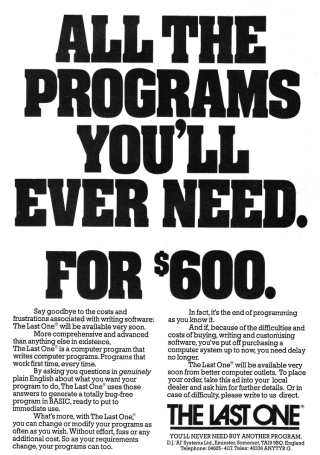
https://en.wikipedia.org/wiki/The_Last_One_%28software%29
"Teasing out the actual business logic is as much a part of the job as anything else..."
That's the definition of a programmer analyst or business analyst. If the business is too cheap or clueless to create business process maps or hire someone as a process efficiency expert, then they are certainly too cheap fund properly developed software and too clueless to intelligently answer the questions that an IT resource has to use to tease out an answer.
I do agree that no-code is not going to replace the need for software professionals.
That's the definition of a programmer analyst or business analyst. If the business is too cheap or clueless to create business process maps or hire someone as a process efficiency expert, then they are certainly too cheap fund properly developed software and too clueless to intelligently answer the questions that an IT resource has to use to tease out an answer.
I do agree that no-code is not going to replace the need for software professionals.
I think low code/no code could really change thing if they can figure out how to make declarative code fast.
Think Prolog etc
Think Prolog etc
You're on to something.
Low code platforms, at their core, allow you to define the software with data (from predefined components usually through UI) and that's how they enable super productivity, until you hit a wall.
Data Declarative programming paradigm could potentially achieve the same levels of productivity without its limitations but it's very difficult to get the right implementation.
The most interesting development in this area I had found, is Fulcro Rapid Application Development Tools [1] - a fullstack clojure framework that's performant, declarative and extensible. RAD is still alpha but it bases on battle-proved Fulcro. Once you hit the limits of declarative RAD you can easily extend it with regular Fulcro components which are, in their essence, a cheap abstraction over React/React Native components - offering industry standard performance.
[1] https://github.com/fulcrologic/fulcro-rad
Low code platforms, at their core, allow you to define the software with data (from predefined components usually through UI) and that's how they enable super productivity, until you hit a wall.
Data Declarative programming paradigm could potentially achieve the same levels of productivity without its limitations but it's very difficult to get the right implementation.
The most interesting development in this area I had found, is Fulcro Rapid Application Development Tools [1] - a fullstack clojure framework that's performant, declarative and extensible. RAD is still alpha but it bases on battle-proved Fulcro. Once you hit the limits of declarative RAD you can easily extend it with regular Fulcro components which are, in their essence, a cheap abstraction over React/React Native components - offering industry standard performance.
[1] https://github.com/fulcrologic/fulcro-rad
Kinda like MS Access ? I am only half joking :)
I’ve been part of a couple no code/low code platforms. They pop up every decade and do ok for a while and then wither and die, only to be replaced by the next gen of them.
4GL (fourth gen languages), BPM systems, things like clipper or dbase, access, even VB is a low code kind of platform.
The new generation focuses on web tech and mobile, and they’ll do well for a while, until the landscape changes enough and they accumulate enough cruft to become unwieldy to use.
In 10 years or so we’ll be talking about something like that again.
4GL (fourth gen languages), BPM systems, things like clipper or dbase, access, even VB is a low code kind of platform.
The new generation focuses on web tech and mobile, and they’ll do well for a while, until the landscape changes enough and they accumulate enough cruft to become unwieldy to use.
In 10 years or so we’ll be talking about something like that again.
I like, and use these tools. Getting it right is hard though. Google just shuttered their AppMaker, which I thought was one of the better attempts.
I think one of the issues of nolocode is it doesn't actually help people think like programmers, but the tools are often created with the implicit need to do that, a need which the creators don't see because they are coders.
People get spreadsheets and word documents. I don't really know why. But they get them. But while it might seem like the step from doc/xls to nolocode is small or even non-existent, I think it actually is really big for most people who are supposed to be the audience for that (complete non developers).
I think one reason is because people don't want the responsibility to make a system that can break. I'm not too sure if this is the only or the biggest reason, but I think non-coders don't have the sense that they can build things, and even if you show them they can using some hot tool, it seems they're still scared it's going to break and it will be on them.
Maybe one reason is because if you break an Excel doc, there's usually someone around in your org who knows how to fix it. But the same can't be said for some random new hot nocode tool.
I think for specific use cases, yes. But for general, web and mobile apps, I just think it is too much complexity you can't simplify away, or at least none of the box-dragging UIs seem to have achieved that.
I agree this can be a big market, but a shift is needed to make it actually easy, not "look how easy it is" easy. Taking a different tac, maybe there's just not a market for it. The browser/HTML/JS is everywhere. It's not that hard to build a simple tool or app, but people in orgs use Excel, they don't build a simple page, even. It's not because they couldn't learn how, but somehow that just now what people in orgs do. I don't know why.
People get spreadsheets and word documents. I don't really know why. But they get them. But while it might seem like the step from doc/xls to nolocode is small or even non-existent, I think it actually is really big for most people who are supposed to be the audience for that (complete non developers).
I think one reason is because people don't want the responsibility to make a system that can break. I'm not too sure if this is the only or the biggest reason, but I think non-coders don't have the sense that they can build things, and even if you show them they can using some hot tool, it seems they're still scared it's going to break and it will be on them.
Maybe one reason is because if you break an Excel doc, there's usually someone around in your org who knows how to fix it. But the same can't be said for some random new hot nocode tool.
I think for specific use cases, yes. But for general, web and mobile apps, I just think it is too much complexity you can't simplify away, or at least none of the box-dragging UIs seem to have achieved that.
I agree this can be a big market, but a shift is needed to make it actually easy, not "look how easy it is" easy. Taking a different tac, maybe there's just not a market for it. The browser/HTML/JS is everywhere. It's not that hard to build a simple tool or app, but people in orgs use Excel, they don't build a simple page, even. It's not because they couldn't learn how, but somehow that just now what people in orgs do. I don't know why.
The tool I use has three user types: Maker, Editor, and Viewer. Only Makers can make the kinds of changes that would be code. Editors can manipulate the underlying data. Viewers, of course, get read only.
The nice thing about this model is that it implies there's a bar to be a Maker and other users can't break your work. You need to be able to reason about concepts like DRY, star schema, cardinality, etc. As a Maker in my org (15-30K people depending on where we are with the pandemic) I can support many no-code apps painlessly in addition to my primary responsibilities, whereas one CRUD app on Heroku had me feeling spread pretty thin.
The nice thing about this model is that it implies there's a bar to be a Maker and other users can't break your work. You need to be able to reason about concepts like DRY, star schema, cardinality, etc. As a Maker in my org (15-30K people depending on where we are with the pandemic) I can support many no-code apps painlessly in addition to my primary responsibilities, whereas one CRUD app on Heroku had me feeling spread pretty thin.
Part of it is probably that editing a spreadsheet feels much like a direct manipulation of the medium, where programming is much more abstract, made of descriptions.
> The problem these tools solve are more related to infrastructure rather than one's ability to code.
So... SaaS?
So... SaaS?
One idea I've had (heavily influenced by The Diamond Age, I must admit) - a premium video game experience where NPCs you meet are sometimes voiced/acted by actors hired real-time on-demand with face or even body mocap. The NPCs revert back to regular AI versions if an actor is unable to be hired at that time. The player could interact by speaking with their own voice, naturally role-playing the scene. This would of course be astonishingly expensive, but people are clearly willing to spend a lot of money on video games these days so there might be a market. You could create the company providing the real-time on-demand acting service to whatever game company wants to integrate with your services, either contracting or hiring actors to wait around for requests. They could even work from home if their internet setup is good enough.
Reasons this sector might take off: recent greater consumer spending on video games (especially with the pandemic) & their normalization as a field of entertainment, recent greater consumer spending on online services where you pay to interact with actors (although they're all of the, er, amorous type), and the growing popularity of mixed reality driven by the release of Half Life: Alyx.
Reasons this sector might take off: recent greater consumer spending on video games (especially with the pandemic) & their normalization as a field of entertainment, recent greater consumer spending on online services where you pay to interact with actors (although they're all of the, er, amorous type), and the growing popularity of mixed reality driven by the release of Half Life: Alyx.
I don't think this makes sense for a number of reasons.
1. As you said, the costs involved. You'd probably need to charge people something like $10 per interaction with a voice actor, plus $2 per minute. This makes for a very limited market.
2. Actors need to be waiting for a request on a wide range of characters since there would not be enough demand for them to consistently play the same character all the time. So, when a player triggers an interaction, there's going to be a delay as the actor is brought up to speed on their role, the person they're interacting with, the world they're in, etc.
3. When players return to a NPC, they'll likely be assigned a different actor since the previous one is either in another call or not working. This kind of ruins the premium interactions since the player remembers the voice and small details of the last conversation, but now the NPC has suddenly changed.
4. You're in the business of matching up adult voice actors with children playing games. You'll need a record of every single conversation because it's only a matter of time before you get reports of inappropriate conversations unfolding.
5. This isn't a long term business. Technology gets better each day at speaking and understanding human voice. It will replace the voice actors and it also solves all of the above issues.
1. As you said, the costs involved. You'd probably need to charge people something like $10 per interaction with a voice actor, plus $2 per minute. This makes for a very limited market.
2. Actors need to be waiting for a request on a wide range of characters since there would not be enough demand for them to consistently play the same character all the time. So, when a player triggers an interaction, there's going to be a delay as the actor is brought up to speed on their role, the person they're interacting with, the world they're in, etc.
3. When players return to a NPC, they'll likely be assigned a different actor since the previous one is either in another call or not working. This kind of ruins the premium interactions since the player remembers the voice and small details of the last conversation, but now the NPC has suddenly changed.
4. You're in the business of matching up adult voice actors with children playing games. You'll need a record of every single conversation because it's only a matter of time before you get reports of inappropriate conversations unfolding.
5. This isn't a long term business. Technology gets better each day at speaking and understanding human voice. It will replace the voice actors and it also solves all of the above issues.
None of this is a problem for immersive theater experiences. I think in this case you build a product that doesn't scale. This way you don't have to think about children playing games because you can enforce 18+. The cost per sessions doesn't matter if you find product market fit with your experiences. I know that SV startup types see games as disposable time wasters to sell microtransactions to whales, but if you think of it at ondemand high quality TTRPG sessions or scalable immersive theater I think there is a profitable business with a good sized market. Matching actors don't matter because you can do short form content and sessions, etc. The last point #5 puts the business in an even better position. If you can eventually automate the product you can scale parts of it much better. Also remember players aren't paying for voice actors to read lines, they're paying for someone that can react and be improvisational. If you play AI Dungeon (which is state of the art), you'll see that AI is still a ways off from this.
I think the best approach is to arrange the game so that players are rewarded for acting in the appropriate ways. I saw one game where to level up you had to complete tasks that included social components (like helping another player). Rather than needing to pay someone real money to act, you can probably pay players in XP or in game gold and they might even think it's fun...
I could imagine having a very small number of paid actors for key roles, maybe the two opposing kings of a region or something, but eve online doesn't need to pay the heads of corporations, and plenty of interesting stories emerge naturally.
I could imagine having a very small number of paid actors for key roles, maybe the two opposing kings of a region or something, but eve online doesn't need to pay the heads of corporations, and plenty of interesting stories emerge naturally.
Oh yeah, these are all great points for sure. (2) could probably be solved with game design (like how Mass Effect hides loading screens behind elevator rides and such). Actors are quite good at improv, but regardless they can restrict their availability to a certain number of characters they've learned. (3) is definitely an issue, could probably only be solved by having actors write notes after each interaction for the next ones to read. We have to remember that there are a lot of very, very talented actors out there and they can deal with all sorts of curveballs like that - benefits of having smart humans in the loop! Voices could possibly be postprocessed to all sound similar for a particular NPC. For (4) given the price I think the target market is mostly adults, but yes of course this would be a concern. For (5) I agree this enterprise is to some extent a bearish take on the near-term possibilities of AI.
A lot of these issues can be solved with ML ala “deepfakes”
Purchase a license to use an actor’s voice/likeness. Have them complete a training set. Now you have their digital doppleganger who can act almost any role required of them.
Purchase a license to use an actor’s voice/likeness. Have them complete a training set. Now you have their digital doppleganger who can act almost any role required of them.
As the other commenter said, the big appeal of this approach is the ability to improvise dialogue or even actions.
I've seen working demos of this in early stage stealth format. I'm a pretty strong believer that it will happen. It requires some cultural shifts and won't be a big market instantly. We'll probably see a few players try and fail at first
That's a really cool idea. You should pursue it.
Sadly my specialty is in formal methods and distributed systems and I don't think I have any domain expertise:
* No knowledge of acting or actors; never even been to LA
* Never worked with mocap technology
* Never worked with video game development
* Never worked with voice or streaming services
Maybe I can pick up some of this as a hobby. Anyway it's not really a novel idea (like I said, you can read this exact concept in The Diamond Age, a very popular novel among the tech crowd) so I'm sure someone is trying it. Who knows, we'll see in a few years!
* No knowledge of acting or actors; never even been to LA
* Never worked with mocap technology
* Never worked with video game development
* Never worked with voice or streaming services
Maybe I can pick up some of this as a hobby. Anyway it's not really a novel idea (like I said, you can read this exact concept in The Diamond Age, a very popular novel among the tech crowd) so I'm sure someone is trying it. Who knows, we'll see in a few years!
Augmented Reality. Apple seems poised to release some AR Glasses based on the patents they've been registering and the investment they've made in the ARKit framework. This will probably become another iPhone-like platform for developing apps on, and will likely present opportunities like the early days of the App Store.
There's a cool project trending on Github right now showing how magic-like some of the technology in this space is: https://github.com/cyrildiagne/ar-cutpaste
There's a cool project trending on Github right now showing how magic-like some of the technology in this space is: https://github.com/cyrildiagne/ar-cutpaste
The cut and paste example is really cool. Its the idea of seamless physical and digital spaces merging that make it compelling. Obviously its a one way street in the phone example, but with AR glasses then it goes in two directions.
I think it has been tried unsuccessfully many times. There is even a Silicon Valley episode about it. Certainly it does not fit the "non-obvious" criterion.
Apart from gamers, people just don't want it.
Apart from gamers, people just don't want it.
I would disagree. Before iPhone, all the phone vendors and telecom vendors tried to create their own sketchy "platform".
Also I would say "apart from gamers, people just don't want it" is the same reaction as people who didn't understand what a "horseless carriage" would be used for when it was invented.
Also I would say "apart from gamers, people just don't want it" is the same reaction as people who didn't understand what a "horseless carriage" would be used for when it was invented.
Aside from gamers, shopping apps are starting to use AR to preview items in one's own house. I think the IKEA app currently does this for furniture.
This might be somewhat niche area though.
This might be somewhat niche area though.
I'd be interested in something for a desktop. Currently, I have 3 monitors and having an extra 2 at the market open would be perfect then put away the headset after 30 minutes and just watch the market. If anyone has a recommendation.
Would those additional monitors be used for web based access or would you want them to directly connect to your machine? If the former, you could pick up a mixed reality headset and spin up web browsers and use them as additional "monitors". Something like this: https://quipscom-my.sharepoint.com/:i:/g/personal/chris_caru...
If you end up seeing this, which headset is this?
Chris, thanks for this. I completely missed this comment. I will look into that as an option. Right now my trading platform is an old windows app as most stock trading applications are and the web browser version doesn't allow all the features, but this looks like something I will have to try.
I thought that too(just for gamers) except I think Apple has some early examples of AR up its sleeve that have convinced it that it is the next big thing. Should be fun to see.
Another thing is half of the planet are "gamers."
If you target gamers only your max addressable market is pretty good.
can you recommend some AR people i should follow on Twitter?
Anyone at PTC should be good:
https://www.ptc.com/
https://www.ptc.com/
This isn't non-obvious
I think small to mid scale farm ag-tech is going to become huge in the next decade. We already see large industrial farms making use of more and more tech what happens when that tech scale shrinks down.
I work on this. Ai driven garden appliances. Biogensis accelerators.
This type of tech is hard to make reliable and user friendly.
Requires a lot of sensors and lab equipment to be engineered, mass produced, user friendly and reliable. One discrete failure and it kills the crop.
Whats your company called? I'm very interested in this as a hobby. Farmbot, small robot co, etc
Same. I think covid has made a lot of people question the idea of relying on a few large suppliers for all their needs, and expect we'll start seeing neighborhood farms to provide supplemental produce in preparation for future events that cause long-term disruptions to daily life.
Electric aircraft for shorter trips instead of trains. The battery energy density still needs to improve somewhat but that is happening.
They’d allow for serving more direct (point to point) routes than trains as the infrastructure cost is so much lower than laying and maintaining tracks. Rail serving high volume routes still makes sense, especially while electric plans remain relatively small.
They’d allow for serving more direct (point to point) routes than trains as the infrastructure cost is so much lower than laying and maintaining tracks. Rail serving high volume routes still makes sense, especially while electric plans remain relatively small.
I might be wrong but this seems like a very US-centric idea. For most of the developed world trains fill this need very well, while the US has had problems with their rail network for reasons partially based on geography, partially based on population density, and partially based on their own fault. I think this explains it pretty well: https://www.youtube.com/watch?v=mbEfzuCLoAQ
The solution is not aircraft, the solution is more and better trains. Or perhaps autonomous buses/trucks depending on how far out you look.
The solution is not aircraft, the solution is more and better trains. Or perhaps autonomous buses/trucks depending on how far out you look.
I'm not from the US, and I think this is valid basically anywhere, although the lack of rail infrastructure in the states makes this perhaps particularly appealing.
The basic logic is two-fold:
First, it's much faster, cheaper, and less contentious to create new routes, and capacity can quickly be switched (even seasonally or in response to events) thanks to neither needing to pay for nor lay tracks.
Secondly, it shortens a lot of journeys. Even in countries with pretty extensive rail infrastructure it is common to combine two or more trips via "hub" cities in order to complete a journey. This adds time because you travel further and have to change trains and wait around. The difference could be particularly extreme given that only longer distance intercity trains tend to be high speed, and electric planes will eventually be faster even than high speed rail.
A similar change happened with long haul air travel: as twin engine planes have been able to fly further over water due to safety improvements, the traiditional hub model has lost out as many more point-to-point international routes were created.
While I think they might re-shape regional transport in some pretty important ways, electric planes won't replace high speed rail (and kerosene burning jets) on more popular routes, at least not for a while (and perhaps, debatably, never). Trains are incredibly efficient and hard to beat when you need to regularly move a lot of people, and electric aircraft, while they're about to become useful, are going to remain relatively small and range limited for quite a while.
The basic logic is two-fold:
First, it's much faster, cheaper, and less contentious to create new routes, and capacity can quickly be switched (even seasonally or in response to events) thanks to neither needing to pay for nor lay tracks.
Secondly, it shortens a lot of journeys. Even in countries with pretty extensive rail infrastructure it is common to combine two or more trips via "hub" cities in order to complete a journey. This adds time because you travel further and have to change trains and wait around. The difference could be particularly extreme given that only longer distance intercity trains tend to be high speed, and electric planes will eventually be faster even than high speed rail.
A similar change happened with long haul air travel: as twin engine planes have been able to fly further over water due to safety improvements, the traiditional hub model has lost out as many more point-to-point international routes were created.
While I think they might re-shape regional transport in some pretty important ways, electric planes won't replace high speed rail (and kerosene burning jets) on more popular routes, at least not for a while (and perhaps, debatably, never). Trains are incredibly efficient and hard to beat when you need to regularly move a lot of people, and electric aircraft, while they're about to become useful, are going to remain relatively small and range limited for quite a while.
Tough to say how the pandemic will affect this, but EasyJet and the like were absolutely changing the game in Europe up to this spring for medium-length trips. Flying from Nice to Rome is way faster and way cheaper than any of the train options.
I thought it would be more appealing in cities with horrid traffic jams like Jakarta. Public transport exists, but can never be as good as it could be in a place without city planning. We've had staff from there work remote, because commuting to the office would take half a day (one-way). We've literally flown them to an office in another country to get access to the hardware they were working on because it was easier than getting into the main office.
IDK, high-speed rail doesn't seem to be taking off outside of Europe and a handful of Asian countries.
That leaves most of Asia outside India/China/Korea/Japan, and pretty much all of Australia/Oceania, Africa, the Middle East, and the entire New World.
I would love to see high-speed rail take over the world, but there's a lot of sparsely-populated places out there, and it makes sense to investigate technologies to support them.
That leaves most of Asia outside India/China/Korea/Japan, and pretty much all of Australia/Oceania, Africa, the Middle East, and the entire New World.
I would love to see high-speed rail take over the world, but there's a lot of sparsely-populated places out there, and it makes sense to investigate technologies to support them.
Sparsely-populated places are the cheapest places to build rail, both because of land prices and also the cost of labour. I think that for any volume of passengers over shorter distances that would be large enough to mandate a regular airway it would be cheaper to build high-speed rail. At least over the long term the economics of scale should take over and besides that a rail network is more useful for shipping of goods than a airport would be.
In the US it'd require similar effort/cost as the Interstate Highway System did, but would probably yield equal economic benefit.
In the US it'd require similar effort/cost as the Interstate Highway System did, but would probably yield equal economic benefit.
The problem is that train routes are fixed So it only makes sense to connect regions with high populations. Aircraft can go anywhere, including places with small populations.
Sure, they could, but they don't. Aircraft require airports, ATC, large land areas for landing/takeoff and so on.
In general aircraft for passenger or cargo routes take a few routes and don't shift much.
In general aircraft for passenger or cargo routes take a few routes and don't shift much.
> The battery energy density still needs to improve somewhat but that is happening.
"Somewhat"? The energy density needs to get better by a factor of like, an order of magnitude to be competitive.
And it's still going to require human pilots for at least 10 years even aside from that.
"Somewhat"? The energy density needs to get better by a factor of like, an order of magnitude to be competitive.
And it's still going to require human pilots for at least 10 years even aside from that.
Elon’s been thinking about this a lot apparently.
https://youtu.be/RyS92KPQnjk
https://youtu.be/RyS92KPQnjk
Sounds like "flying motorcycle". Just find a way to go from work to the office, without all the turns, speed bumps and traffic. A friend's company did a prototype of this and it was quite good, but all the negative publicity demotivated them.
It's worth understanding the kind of disruption you mean - product to product, or product to commodity. Simon Wardley has a blog with lots of posts about this.
Also his free book about Wardley Mapping is useful for understanding the phase changes of bespoke to warring products to commodity.
For specific ideas, see "Figure 2 - Wars" in this Simon Wardley blog post (written five years ago, diagram is I think ten years old so you can validate early parts of it): https://blog.gardeviance.org/2015/02/on-two-forms-of-disrupt...
We're currently just come through war phase (when there's fierce competition to own commodity versions and lots of new innovation gets built on top) of Big Data.
From the diagram, the next wars Simon reckons should happen about now (and I can't find a post where he explains how he made that diagram) are:
For slightly longer term, worth knowing the word "spime" as something to head for as well.
Also his free book about Wardley Mapping is useful for understanding the phase changes of bespoke to warring products to commodity.
For specific ideas, see "Figure 2 - Wars" in this Simon Wardley blog post (written five years ago, diagram is I think ten years old so you can validate early parts of it): https://blog.gardeviance.org/2015/02/on-two-forms-of-disrupt...
We're currently just come through war phase (when there's fierce competition to own commodity versions and lots of new innovation gets built on top) of Big Data.
From the diagram, the next wars Simon reckons should happen about now (and I can't find a post where he explains how he made that diagram) are:
  * Sensor as a Service (think radically better health or environment sensors, detecting important trace molecules cheaply)
  * Robotics (I guess think Ocado warehouses, or Shenzhen factories)
  * Currency (digital can change this in ways other than Bitcoin, depending on your politics too)
  * Internet of Things (I'm guessing by then the microcomputers might be *so* cheap and network *so* easy they literally go in everything)
  * Immersive (VR/AR I think)
  * 3D printing (it's not very good or cheap yet, it will be)
  * Genetic Engineering, GMO
  * Social Change (not clear what this means, but certainly you can look around the world and see the demand)
For slightly longer term, worth knowing the word "spime" as something to head for as well.
Distributed IT/office that services remote workers in their homes.
Pay a fee and you get access to a pool of desks, chairs, computers, and an IT/office staff to come to your house and maintain it and set it up.
In that vein: tooling to manage remote workers.
Pay a fee and you get access to a pool of desks, chairs, computers, and an IT/office staff to come to your house and maintain it and set it up.
In that vein: tooling to manage remote workers.
A potential game changer in the 3D printing space is Rapid Liquid Printing or (RLP). Why is it exciting? Normal 3D printers have to build from the ground up, one layer at a time. It wastes a lot of energy and time because the print head paths are restricted to one plane. In RLP, by contrast, prints are made in a bath of gelatin, the printer head is freely able to move in 3 dimensions allowing it to take the most direct path to form prints. No wasted movement = less time and more structurally sound parts.
RLP was developed by MIT a few years back and I haven't heard much from it since. Maybe that will change over the next few years. https://selfassemblylab.mit.edu/rapid-liquid-printing
RLP was developed by MIT a few years back and I haven't heard much from it since. Maybe that will change over the next few years. https://selfassemblylab.mit.edu/rapid-liquid-printing
Neural input devices could become a thing in the next few years. I, for one, would love to have a wearable which could translate neural signals into text and directional input - in lieu of a keyboard and mouse. My inevitable carpal tunnel could stop advancing.
Thanks to newly available hardware like MyoWare, affordable neural sensors have become available to garage tinkerers. I think it's simply a matter of time before we're all interfacing with our computers and phones via wearables. http://www.advancertechnologies.com/p/myoware.html
Thanks to newly available hardware like MyoWare, affordable neural sensors have become available to garage tinkerers. I think it's simply a matter of time before we're all interfacing with our computers and phones via wearables. http://www.advancertechnologies.com/p/myoware.html
Space tech, things for mars. (Elon is going to need a lot of help)
VR development. It really hasn’t hit mainstream yet and when it changes how we work that could be huge.
I think AI based procedural generation of games. Seeing how good gpt3 is getting this seems like it could be huge.
AI based personalized education. Have you seen how well gpt3 can explain concepts? Could something like that also evaluate your understanding, come up with custom learning plans?
VR development. It really hasn’t hit mainstream yet and when it changes how we work that could be huge.
I think AI based procedural generation of games. Seeing how good gpt3 is getting this seems like it could be huge.
AI based personalized education. Have you seen how well gpt3 can explain concepts? Could something like that also evaluate your understanding, come up with custom learning plans?
Video games of some sort, where the game map is a 1:1 replica of the real world using streamed GIS data.
The new microsoft flight simulator is already kinda there.
The new microsoft flight simulator is already kinda there.
Using AI to identify breakout technology or trends that are set to go mainstream.
The benefit is that the operators of said technology can 'invest' in that bandwagon and reap piggy-back profits, while mitigating the inherent risk of actually developing those technologies or trends from scratch.
The benefit is that the operators of said technology can 'invest' in that bandwagon and reap piggy-back profits, while mitigating the inherent risk of actually developing those technologies or trends from scratch.
Hombrew advanced material fabrication (especially with graphene)
Open lab equipment. Open Sensor designs.
Open lab equipment. Open Sensor designs.
Also demand for solarpunk architecture and design themes, also those incorporating smart biological controls (probably uv filters and Biocidal surfaces) for at least a few years after covid.
Privacy - Duck Duck Go may overtake Google at some point.
Better Email management tools, use existing transport but allow you to manage 1,000 to 10,000 inbound messages in an hour of work. Note: this is not mean to offer encouragement for more to send 10,000 outbound messages or fall into Uncanny Valley of Email Automation (see https://www.skmurphy.com/blog/2015/03/25/the-uncanny-valley-...)
IoT / Mirror World / Smart City / Digital Twin / Cyberspace is everting Sensors are woven into more of the natural world and the built world. Opportunities for services and better management and governance of natural and built world. Implications for Privacy. See https://www.skmurphy.com/blog/2017/04/19/cyberspace-everts-i...
Better Email management tools, use existing transport but allow you to manage 1,000 to 10,000 inbound messages in an hour of work. Note: this is not mean to offer encouragement for more to send 10,000 outbound messages or fall into Uncanny Valley of Email Automation (see https://www.skmurphy.com/blog/2015/03/25/the-uncanny-valley-...)
IoT / Mirror World / Smart City / Digital Twin / Cyberspace is everting Sensors are woven into more of the natural world and the built world. Opportunities for services and better management and governance of natural and built world. Implications for Privacy. See https://www.skmurphy.com/blog/2017/04/19/cyberspace-everts-i...
> Duck Duck Go may overtake Google at some point.
You're insane.
You're insane.
It can happen one of two ways, Google may shrink. Consider AOL, Kodak, Sears as examples of other dominant players who did not react to changes in the zeitgeist.
See also https://news.ycombinator.com/item?id=24245817 for an example of another potential trend.
See also https://news.ycombinator.com/item?id=24245817 for an example of another potential trend.
> Better Email management tools, use existing transport but allow you to manage 1,000 to 10,000 inbound messages in an hour of work.
What single person receives that many emails in any given hour?
What single person receives that many emails in any given hour?
It's not a question of receiving that many emails an hour, but only having to spend an hour to process 1,000 emails that you may receive in a day. With spam filters many have already passed a threshold of processing that many emails a day, the challenge is managing and responding to the "non-spam" portion.
Exactly. the problem with email tools is that it's built by people who think everyone receives thousands of emails. 99.999% of the world only receives less than 10 emails per day. They have no such problem as "information overload" when it comes to email.
The people and businesses who have the problem are willing to pay a lot to solve it. It's a high value problem to solve.
If your competitor(s) could process the equivalent of 10,000 inbound messages a day would they be able to maintain a higher level of situational awareness on early trends and harbingers? Could they uncover and address opportunities before you became aware of them?
If your competitor(s) could process the equivalent of 10,000 inbound messages a day would they be able to maintain a higher level of situational awareness on early trends and harbingers? Could they uncover and address opportunities before you became aware of them?
Disaster mitigation products and services. Tools that enable better management of things that go bad. Nat disasters are obvious but also think ransomware, medical disasters, covid of course. Think insurance but also detection, contact mapping, probability models for fires, resource dispatching, hedging for financial impact, remediation planning.
Disasters seem to be regrettably a growth market these days.
Disasters seem to be regrettably a growth market these days.
Threads like this is cause 2/3rds of it will end up being “what’s something that folks have heard about in the news but hasn’t gotten big (enough for more press) yet”.
Rephrased, this question is also more of a product-market fit one (“which market exists/will exist but doesn’t have its demand satisfied yet”), whereas a lot of answers are focused on the tech.
Rephrased, this question is also more of a product-market fit one (“which market exists/will exist but doesn’t have its demand satisfied yet”), whereas a lot of answers are focused on the tech.
X-as-a-service platforms that allow companies to perform segments of their oprations either with ease, or outsource it.
It's been the big thing for a while, but still continues to grow.
Basically, these are tools to make it faster and faster to spin up a business from scratch, by allowing those companies to focus more on the product itself rather than refactorable non-essentials. They may also offer value-added features such as "network effect" ability to optimize that packaged solutions, or a platform that allows them to provide quicker no code/low code Analytics to identify trends to be able to make business decisions accordingly.
Examples of companies that do this.
* AWS (infrastructure) * Salesforce * Azure * Pagerduty * Splunk * DevOps as a service companies * HR as a service
Also, I recommend not caring about what's new, hot, and shiny; it's best to really understand market fit, and market potential; and build something "useful"
It's been the big thing for a while, but still continues to grow.
Basically, these are tools to make it faster and faster to spin up a business from scratch, by allowing those companies to focus more on the product itself rather than refactorable non-essentials. They may also offer value-added features such as "network effect" ability to optimize that packaged solutions, or a platform that allows them to provide quicker no code/low code Analytics to identify trends to be able to make business decisions accordingly.
Examples of companies that do this.
* AWS (infrastructure) * Salesforce * Azure * Pagerduty * Splunk * DevOps as a service companies * HR as a service
Also, I recommend not caring about what's new, hot, and shiny; it's best to really understand market fit, and market potential; and build something "useful"
Social media retirement services.
What do you mean by this one? Retirement homes for social media influencers? Cleaning up social media posts from defunct platforms a la Myspace?
Is this social media for the elderly, or services to help you close down your social media accounts?
This sounds logical but do you think it will be mainstream as in Instagram level mainstream? Maybe a bit more explanation will be helpful.
Whole cottage industry of this following AA/NA model called Social Media Anonymous. You could have camps, meetings, therapy, etc
And you'd definitely want an app, where people could chat, share their stories... :)
Existing technology business models will be adapted and re-launched as services which are coupled to cryptocurrency tokens.
Also, we may see the rise of cryptocurrency communities which attempt to manipulate company insiders and governments to gain control of the proceeds of production to drive the value of their cryptocurrencies. Private property rights will be eroded (due to lack of enforcement and increasing systemic corruption) and so cryptocurrency, which offers a cryptographic means of ownership (which does not rely on law), will gain increasing significance.
The proceeds of production will no longer go to shareholders, they will be diverted to cryptocurrency holders. The shareholders who embrace this mindset of moving profits to cryptocurrencies will see their ownership stake of company profits increase at the expense of those who resist this shift. In the end, nobody will want to own stocks since they will no longer yield profits. Corporations will behave like non-profits; the profits will be funneled to cryptocurrencies.
All of this will be completely legal and almost everyone will support it. In 10 years, this will be completely obvious.
We are in a post-scarcity economy. Wealth creation will have little to do with productivity and everything to do with redefinition and redistribution of existing ownership rights. We will see cryptographic ownership rights surpass legal ownership rights. Once this new, highly fluid, decentralized financial infrastructure is firmly in place, the transfer of wealth will end up facilitating a new wave of massive decentralized productivity with a stronger focus on social principles.
Also, we may see the rise of cryptocurrency communities which attempt to manipulate company insiders and governments to gain control of the proceeds of production to drive the value of their cryptocurrencies. Private property rights will be eroded (due to lack of enforcement and increasing systemic corruption) and so cryptocurrency, which offers a cryptographic means of ownership (which does not rely on law), will gain increasing significance.
The proceeds of production will no longer go to shareholders, they will be diverted to cryptocurrency holders. The shareholders who embrace this mindset of moving profits to cryptocurrencies will see their ownership stake of company profits increase at the expense of those who resist this shift. In the end, nobody will want to own stocks since they will no longer yield profits. Corporations will behave like non-profits; the profits will be funneled to cryptocurrencies.
All of this will be completely legal and almost everyone will support it. In 10 years, this will be completely obvious.
We are in a post-scarcity economy. Wealth creation will have little to do with productivity and everything to do with redefinition and redistribution of existing ownership rights. We will see cryptographic ownership rights surpass legal ownership rights. Once this new, highly fluid, decentralized financial infrastructure is firmly in place, the transfer of wealth will end up facilitating a new wave of massive decentralized productivity with a stronger focus on social principles.
If you're downvoting this, you are probably missing the fact that this already started.
Ethereum has already managed to infiltrate many companies and these companies already started diverting some of their profits to buying up Ethereum. Even Reddit is getting into Ethereum. This is just the beginning.
HN crowd has a lot of crypto deniers. The funny thing is that HN leaders like literally PG, Googl Bosses, Zuck and Marc Andreasen are very bullish on it. So it doesn't take much to realize who is right
Like the rest of SV, they are blinded by hubris and their own blindness to the downsides of tech.
Crypto currency is a disaster.
Crypto currency is a disaster.
I got into crypto because of all the problems which technology companies and governments created which made it impossible for me to succeed in the mainstream tech industry. Crypto industry is no walk in the park, but I can speak from experience and say that success there is definitely possible. I would think that people like Mark Andreessen and Mark Zuckerberg have a pretty good view of what's wrong with the current mainstream tech industry given that they have been directly benefiting from its flaws. Even if they had come into their situations by accident, by now they would have figured out what's going on and that would make them bullish on crypto. I don't think these people have much ego when it comes to business; my experience is that they will switch sides at the flick of a switch and follow the money as soon as it's profitable.
You mean you know better than everyone that has been extremely Successful right? OK :)
Survivorship bias is a real thing, and very relevant when discussing tech magnates.
If you want to make this argument it should also hold for everyone. Einstein was lucky, Newton didn't get killed by accident etc. But if you are in denial you can make a lot of arguments.
Starlink+Drones.
People using apps like cashapp to ditch traditional banks leading to loans and other financial activity to be done over these newer apps.
People using apps like cashapp to ditch traditional banks leading to loans and other financial activity to be done over these newer apps.
Check out https://practicum.substack.com and also this Twitter thread of futurist sites https://threader.app/thread/1296654041569570819
Generically engineered plants for the home
You mean "genetically"?
They already are.. Like roses, or most patented strains. Lots of research into cannabis. What do you think these plants do?
This is what genetic recombination has made possible in tropical fish in just the last ten years:
https://www.glofish.com/
I don't doubt we will see CRISPR and friends applied to ornamental plants the way they are already applied to food crops.
https://www.glofish.com/
I don't doubt we will see CRISPR and friends applied to ornamental plants the way they are already applied to food crops.
Beyond meat, fake milk, etc.
Web 3/Dweb minus the crypto built on IPFS (or something similar).
I believe many developers will soon come to realize that you don't need a blockchain to build most decentralized applications. Products like like Google Docs, social networks, messaging app, etc don't depend on a proof of stake, and we shouldn't be running miners to power such simple operations. All these applications need isa decentralized form of message distribution and log storage paired with public-key cryptography in order to build a CRDT log. I understand why IPFS in itself at first glance often seems over-hyped, since it is essentially just a hyper-distributed caching layer. However, I highly recommend looking at technologies built on top of it like [OrbitDB](https://github.com/orbitdb/orbit-db) and [Textile](https://textile.io/). When they work reliably, their API is as easy if not easier than other "server-less" products like Firebase or Parse to use. Once libraries like these become mature, I believe the way we build software will be flipped on its head within 10-15 years to be completely client focused with minimal backend infrastructure.
The main advantages I see are:
* Increased reliability. This allows developers to remove almost all of their centralized servers and rely instead on a common infrastructure and protocol.
* Much simpler codebases and infrastructure. You only need to write a frontend for most applications. Building on u/searchableguy's comment: I can see no/low code tooling really taking off with decentralized-first applications, since there is no need to manage a complicated backend infrastructure with vendor lock-in.
* Real-time by default. Since IPFS databases run off of CRDT logs which rely on realtime syncing of new operations, they are benefit from immediate updates at all times – even when not connected to the main swarm out in the boonies. * Offline-first by default.
* Cost/resource efficiency. No technology is magical, but [this](https://withblue.ink/2019/03/20/hugo-and-ipfs-how-this-blog-...) article from March is an early real world demonstration of how well this technology works already.
* Transport agnostic. It's completely feasible to have your watch, your phone, and your laptop have their IPFS nodes connected over Bluetooth, but never have to worry about if and how they're connected together since IPFS takes care of handling that P2P connectivity automatically. Instead of writing code that says "my watch created a reminder, upload this to the cloud for my laptop and also tell my phone this happened if we're connected," I can just write "my watch created a reminder, broadcast this operation to the IPFS network" and your phone and laptop will automatically receive this update.
* Security. The less that is stored on centralized servers, the better. While OrbitDB is not built to work off an encrypted database yet (it's in the roadmap for v1), Textile already is. Having everything be encrypted by default and optionally never leaving my device has many advantages.
The main challenges I see blocking this from going mainstream:
* Reliability still feels like the early days of the internet. The database-level libraries are still young, IPFS is slow/unreliable at times, and browser support is fairly strong but still has a way to go, and native mobile/native support is nonexistent.
* Filecoin is not ready yet. You still need to run your own IPFS node/swarm in order to do anything serious. Existing pinning services can only go so far if you're working with something like OrbitDB.
* Education. Security is of upmost important when designing technologies like this, so developers need to understand how a CRDT log works, how to build with merge conflicts in mind, and how to write/manage custom ACL for complex interactions. It also takes a different way of thinking to design networks like this.
* Reliability and security audits.
* Transport protocols. At the moment, many of the advantages of P2P over things like Bluetooth have not been realized yet since the IPFS core is still where most of the development is focused at the moment.
* Cross-platform support. IPFS only has an official Go and JavaScript node implementation with a Rust implementation in the works. While Go has become fairly portable in recent years, it still has a very bloated runtime that doesn't embed well on mobile and web. Once we have a reliable Rust port and some OrbitDB-like Rust-based libraries ports, I suspect we'll start seeing ergonomic mobile and web APIs that bind to these popping up.
To be clear, I'm not saying centralized servers will vanish in to thin air. There are many tasks like indexing large amounts of data that are incredibly difficult and not beneficial to build on a distributed network. The decentralized web – if done right – will make developers' lives much easier for many common applications, but there should not be a need to port things that aren't practical to run on the Dweb.
[Edit: Formatting]
I believe many developers will soon come to realize that you don't need a blockchain to build most decentralized applications. Products like like Google Docs, social networks, messaging app, etc don't depend on a proof of stake, and we shouldn't be running miners to power such simple operations. All these applications need isa decentralized form of message distribution and log storage paired with public-key cryptography in order to build a CRDT log. I understand why IPFS in itself at first glance often seems over-hyped, since it is essentially just a hyper-distributed caching layer. However, I highly recommend looking at technologies built on top of it like [OrbitDB](https://github.com/orbitdb/orbit-db) and [Textile](https://textile.io/). When they work reliably, their API is as easy if not easier than other "server-less" products like Firebase or Parse to use. Once libraries like these become mature, I believe the way we build software will be flipped on its head within 10-15 years to be completely client focused with minimal backend infrastructure.
The main advantages I see are:
* Increased reliability. This allows developers to remove almost all of their centralized servers and rely instead on a common infrastructure and protocol.
* Much simpler codebases and infrastructure. You only need to write a frontend for most applications. Building on u/searchableguy's comment: I can see no/low code tooling really taking off with decentralized-first applications, since there is no need to manage a complicated backend infrastructure with vendor lock-in.
* Real-time by default. Since IPFS databases run off of CRDT logs which rely on realtime syncing of new operations, they are benefit from immediate updates at all times – even when not connected to the main swarm out in the boonies. * Offline-first by default.
* Cost/resource efficiency. No technology is magical, but [this](https://withblue.ink/2019/03/20/hugo-and-ipfs-how-this-blog-...) article from March is an early real world demonstration of how well this technology works already.
* Transport agnostic. It's completely feasible to have your watch, your phone, and your laptop have their IPFS nodes connected over Bluetooth, but never have to worry about if and how they're connected together since IPFS takes care of handling that P2P connectivity automatically. Instead of writing code that says "my watch created a reminder, upload this to the cloud for my laptop and also tell my phone this happened if we're connected," I can just write "my watch created a reminder, broadcast this operation to the IPFS network" and your phone and laptop will automatically receive this update.
* Security. The less that is stored on centralized servers, the better. While OrbitDB is not built to work off an encrypted database yet (it's in the roadmap for v1), Textile already is. Having everything be encrypted by default and optionally never leaving my device has many advantages.
The main challenges I see blocking this from going mainstream:
* Reliability still feels like the early days of the internet. The database-level libraries are still young, IPFS is slow/unreliable at times, and browser support is fairly strong but still has a way to go, and native mobile/native support is nonexistent.
* Filecoin is not ready yet. You still need to run your own IPFS node/swarm in order to do anything serious. Existing pinning services can only go so far if you're working with something like OrbitDB.
* Education. Security is of upmost important when designing technologies like this, so developers need to understand how a CRDT log works, how to build with merge conflicts in mind, and how to write/manage custom ACL for complex interactions. It also takes a different way of thinking to design networks like this.
* Reliability and security audits.
* Transport protocols. At the moment, many of the advantages of P2P over things like Bluetooth have not been realized yet since the IPFS core is still where most of the development is focused at the moment.
* Cross-platform support. IPFS only has an official Go and JavaScript node implementation with a Rust implementation in the works. While Go has become fairly portable in recent years, it still has a very bloated runtime that doesn't embed well on mobile and web. Once we have a reliable Rust port and some OrbitDB-like Rust-based libraries ports, I suspect we'll start seeing ergonomic mobile and web APIs that bind to these popping up.
To be clear, I'm not saying centralized servers will vanish in to thin air. There are many tasks like indexing large amounts of data that are incredibly difficult and not beneficial to build on a distributed network. The decentralized web – if done right – will make developers' lives much easier for many common applications, but there should not be a need to port things that aren't practical to run on the Dweb.
[Edit: Formatting]
Without blockchain, what do you see being the incentive for people to host nodes?
Filecoin is a blockchain which Protocol Labs is using to (a) creating a decentralized way to pay miners to pin your file (i.e. store a permanent copy of your file) and (b) partially used as a funding source for the core project through its ICO.
Beyond that, [here](https://discuss.ipfs.io/t/ipfs-incentives/2456/2) is a good explanation.
To elaborate a bit more: When you set up a node using an unmodified version of their program at the moment, you tell it how much storage to allocate and it will automatically fill the remaining space that you're not using with cached chunks of other peoples' files, essentially "donating" your extra resources. When you fetch a file, your computer will purge the LRU chunks and replace it with that data you just fetched and store that in the cache. This way, the more people who access a file, the more widely distributed that file is cached.
For example, Cloudflare hosts an [IPFS gateway](https://blog.cloudflare.com/distributed-web-gateway/). Since it's in their interest to deliver these files as fast as possible, their nodes which fetched these files from the IPFS network will have them cached and available to anyone else who requests said files. While it's definitely not the same concept in terms of incentive/resource intensiveness/authority, my hope is that IPFS will work well for the same reason things like DNS works effectively. Time will tell on this one.
Beyond that, [here](https://discuss.ipfs.io/t/ipfs-incentives/2456/2) is a good explanation.
To elaborate a bit more: When you set up a node using an unmodified version of their program at the moment, you tell it how much storage to allocate and it will automatically fill the remaining space that you're not using with cached chunks of other peoples' files, essentially "donating" your extra resources. When you fetch a file, your computer will purge the LRU chunks and replace it with that data you just fetched and store that in the cache. This way, the more people who access a file, the more widely distributed that file is cached.
For example, Cloudflare hosts an [IPFS gateway](https://blog.cloudflare.com/distributed-web-gateway/). Since it's in their interest to deliver these files as fast as possible, their nodes which fetched these files from the IPFS network will have them cached and available to anyone else who requests said files. While it's definitely not the same concept in terms of incentive/resource intensiveness/authority, my hope is that IPFS will work well for the same reason things like DNS works effectively. Time will tell on this one.
I agree with most of what you described. However I feel that CRDTs aren’t quite there yet. I also see IPFS becoming internally useful but externally I see L8 multiplexed H3 as a possibility.
How is IPFS different from torrent?
[This](https://github.com/ipfs/notes/issues/208) summarizes it well. [Related.](https://news.ycombinator.com/item?id=18650670)
TLDR: IPFS acts as a single swarm (i.e. universal deduping) and has more projects like IPNS, IPLD, and Filecoin under its umbrella.
In my opinion, the project is more of an effort to evolve of decentralized technologies to a point where they can be used for mainstream products.
TLDR: IPFS acts as a single swarm (i.e. universal deduping) and has more projects like IPNS, IPLD, and Filecoin under its umbrella.
In my opinion, the project is more of an effort to evolve of decentralized technologies to a point where they can be used for mainstream products.
There is some potential for commodity hardware with AI to spawn some innovation in the maker space.
[deleted]
Rapid tests you can do at home for a variety of viral illnesses, initially for COVID-19, but expanding to a wider variety of viruses and virus types. Being able to track viruses in real-time will become a priority to attempt to thwart future pandemics.
Human body sensors -> API -> ML for diagnostics, neural control, etc.
Smart Tattoos. Color E-ink displays. Eventually: holographic VR.
I tried to get a smart tattoo (design my own, long story). Metallic inks aren't safe. Nonstarter. All sorts of nasty issues with xray, cat scanners and airport backscatter machines.
SpaceX's Starlink
+
Increasing acceptance of remote work
= A significant shift away from congested cities towards more rural areas
Open agriculture.
Every farmer i talk to about this doesn't store their data in compatible formats (yet)
There are no standards.
That's not what I mean.
Commercial agriculture is heavily dependent on, and influenced by, companies that zealously guard what they see as their intellectual property.
When I say "open agriculture," I'm referring to protecting free experimentation and open seed culture.
Commercial agriculture is heavily dependent on, and influenced by, companies that zealously guard what they see as their intellectual property.
When I say "open agriculture," I'm referring to protecting free experimentation and open seed culture.
More likely we'll move away from seeds towards sharing clones of rooted cuttings.
Much more predictable.
Open cutting exchange is a good idea actually. Trace genetics.
Open cutting exchange is a good idea actually. Trace genetics.
why is that?
Requires skills in both science and tech that only commercial farmers have, big companies don't share good.
Plus Lots of data points, proper measurements require self calibrating "field suitable" lab equipment that doesn't exist or is highly cost prohibitive.
Im actively spend 60+ hour weeks solving this.
Have been for almost three years (im solving for spacex/mars missions, but it'll work here on terra firma too)
Expect to see early prototypes in 2022.
any links to your work or way I can follow what you are doing?
In the crypto world there is a lot of hype around DeFi (decentralised finance) like everything in crypto it a mix of good technical ideas, lots of marketing bd, and a host of obnoxious bros. At the heart of it though there are really interesting things around liquidity.
I will be boring now and say that Cloud services will continue to expand, it's effectively a tax on doing work on the internet and start-ups love using cloud, the idea of maintaining your own servers is considered silly unless their is some particular reason to. I expect to see growth of 20% yoy in that sector for the top 3 players. Azure, GCP and AWS.
I will be boring now and say that Cloud services will continue to expand, it's effectively a tax on doing work on the internet and start-ups love using cloud, the idea of maintaining your own servers is considered silly unless their is some particular reason to. I expect to see growth of 20% yoy in that sector for the top 3 players. Azure, GCP and AWS.
Personal home servers
[deleted]
webassembly
Lol, I wish as well but people have been saying this for the past 3 years.
I think there still performance issues when manipulating the DOM. When those get worked out (and they will), it may change the velocity of adoption.
Why will it take off in the next couple of years? Any changes coming?
see my comment above re DOM.
Specialized Accounting / Bookkeeping Services.
Can you elaborate? And why do you think it will go mainstream in the next few years?
probably AI
Film photography.
Agreed. This is definitely a growing market today, I don't see why it wouldn't continue to grow. There are many areas that haven't been improved upon in decades as well. Things like..
+ Negative Scanning Technology (the most revered scanners are from 10+ years ago)
+ New Film Emulsions
+ Moving from gelatin to a plant-based substitute for gel emulsions
+ Opportunities for automation in film processing
+ Negative Scanning Technology (the most revered scanners are from 10+ years ago)
+ New Film Emulsions
+ Moving from gelatin to a plant-based substitute for gel emulsions
+ Opportunities for automation in film processing
[deleted]
Asteroid mining.
Elysium
Honestly, why would anyone share a good idea here? I get it that ideas are cheap, but if someone actually thinks they have slam dunk they're not going to share it on HN.
Some folks--including many on HN--have many more insights or "good ideas" than they can execute on. If they want to see them come to fruition they are not harmed by giving away a substantial fraction of them that they don't plan to execute on but still see the possibility of and need for.
See http://blog.fogus.me/2015/11/04/the-100101-method-my-approac... or https://www.nickbentley.games/the-100-10-1-method-for-game-d... for two descriptions of a 100:10:1 model. There are other models.
See http://blog.fogus.me/2015/11/04/the-100101-method-my-approac... or https://www.nickbentley.games/the-100-10-1-method-for-game-d... for two descriptions of a 100:10:1 model. There are other models.
[deleted]
Well I was asking for technology/market, not ideas. Unlike most people who say ideas are worth nothing, i do believe both ideas and execution matter. That said, just sharing information on what market looks attractive and what tech looks promising is not even an "idea".
I think the argument is about market trends not IP/company ideas... still a valid criticism though
The slam dunk will look like meh to everyone else. It’s the idea AND the insight that counts.
Ideas may be cheap but they can be insanely valuable.
For the last couple of years I've been completely focused on one field and have not been staying on top of what the latest hot tech trend is, so kind of lost what I should be looking at. Note that I'm not just chasing some tech hype, but just want to know what I've been missing out on.
This doesn't have to be brand new tech per se, but could be a re-application of a previously failed technology which makes sense now because the world has changed.
Please share anything you think is really cool that may take off soon. Also would be nice if you shared the reason for why you think it will be the next couple of years when they take off to mainstream. Thank you!