Cave discoveries suggest humans reached Americas much earlier than thought(nature.com)
nature.com
Cave discoveries suggest humans reached Americas much earlier than thought
https://www.nature.com/articles/d41586-020-02190-y
6 comments
It seems like there are other bits of evidence of pre-clovis human habitation, but taken individually they could be dismissed as due to some sort of misidentification, contamination of the site, etc. One the other hand this site seems to have very extensive evidence of long term habitation, backed up by several independent but mutually consistent dating methods. Add back in all those 'one off' finds as well and the clovis first theory starts to really break down.
I've been fascinated by this one since visiting the Natural History Museum in San Diego:
"A 130,000-year-old archaeological site in southern California, USA"
https://www.nature.com/articles/nature22065
"A 130,000-year-old archaeological site in southern California, USA"
https://www.nature.com/articles/nature22065
Interesting. MIS5e [1] would be a parallel to our current interglacial period. I think the evidence for 50-60 kya out-of-africa event for Homo sapiens is solid so I'm assuming this site would support the global reach of another Homo species like Neanderthals.
[1] https://en.wikipedia.org/wiki/Marine_Isotope_Stage_5
[1] https://en.wikipedia.org/wiki/Marine_Isotope_Stage_5
I’ve never understood that number. I’ve read that modern humans have been around for 200k years, but I’m supposed to believe that for 3/4 of that time they stayed in Africa? BS. Maybe proof hasn’t been found, yet. But we know from our own experience that modern humans love to explore. I don’t believe that love of travel and adventure and exploration is cultural. Our modern ancestors would’ve been exploring out of Africa long before 50kya.
There's an important distinction between anatomically modern humans and behaviorally modern humans. Behaviorally modern humans were the ones that were able to migrate all over the world.
https://en.wikipedia.org/wiki/Behavioral_modernity
https://en.wikipedia.org/wiki/Behavioral_modernity
AFAIK, the best (first?) popular science book that tackles this question is Before the Dawn [1] by Nicholas Wade.
[1] https://en.wikipedia.org/wiki/Before_the_Dawn_(book)
[1] https://en.wikipedia.org/wiki/Before_the_Dawn_(book)
I think Neanderthals traveled out earlier so at least to some degree humans may have had to fight their way out with and ice age assist?
Look at Göbekli Tepe as well. The general trend seems to be pushing human history back, which makes sense as the human species has existed in its near modern form for quite a bit longer than the history we know. There is no reason to believe these ancient humans lacked critical cognitive faculties that we have.
From what I've read of the debate on humans in North and South America, it seems that both sides are ignoring the possibility of multiple colonizations and that earlier colonizations may have either failed entirely or resulted in only very small populations in limited areas.
If genetic evidence suggests that Native Americans are descendants of a stock that migrated here around 10K years ago, maybe they were just a later migration that really "took" and expanded across the whole land mass (until Europeans).
Or maybe the newcomers or their diseases exterminated the existing indigenous peoples? Maybe the story of the last colonization of these lands has occurred multiple times? If so, we're really screwed when the extraterrestrials arrive.
From what I've read of the debate on humans in North and South America, it seems that both sides are ignoring the possibility of multiple colonizations and that earlier colonizations may have either failed entirely or resulted in only very small populations in limited areas.
If genetic evidence suggests that Native Americans are descendants of a stock that migrated here around 10K years ago, maybe they were just a later migration that really "took" and expanded across the whole land mass (until Europeans).
Or maybe the newcomers or their diseases exterminated the existing indigenous peoples? Maybe the story of the last colonization of these lands has occurred multiple times? If so, we're really screwed when the extraterrestrials arrive.
Question: how do experts tell something like this might be a tool? As a layman it looks like a rock to me:
https://media.nature.com/lw800/magazine-assets/d41586-020-02...
https://media.nature.com/lw800/magazine-assets/d41586-020-02...
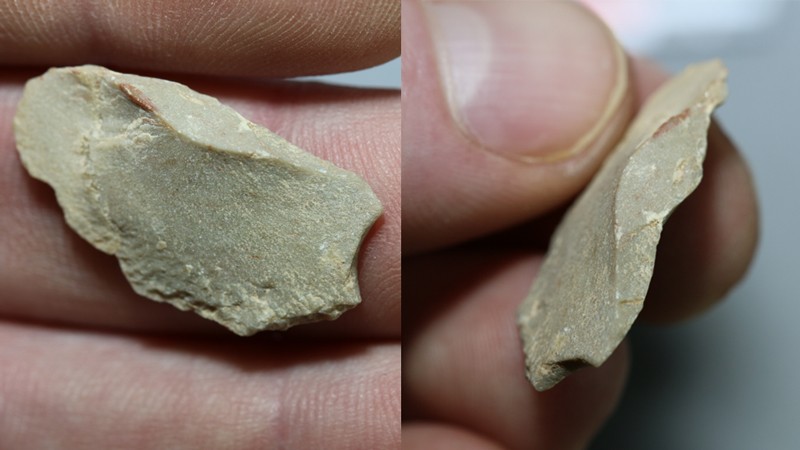
These kind of tools have multiple fracture all running in the same direction. This means they are not a by product of accidentally tumbling against other rocks. Something has banged that rock over and over in the same position.
I think they look for "Conchoidal fractures", and then where they find the thing.
https://www.sandatlas.org/conchoidal-fracture/
https://www.sandatlas.org/conchoidal-fracture/
Not always, but it's one of the common indicators. The general process for survey identification goes like this: you walk around looking at the ground and notice the unnatural ones. This is a purely intuitive sense, so you pick one up and look closer to see that yep straight edges, conchoidal fractures, common material, found in a bed with other clear lithics, etc. Bag and tag.
I haven't tried knapping yet myself, but it apparently takes planning several flakes in advance, because one needs to leave well-positioned striking platforms for each flake.
Single-click shopping sounds much less mentally taxing than stone age technology.
https://peterborougharchaeology.org/archaeology-skills-techn...
http://www.pugetsoundknappers.com/how_to/how_to_instruction/...
Single-click shopping sounds much less mentally taxing than stone age technology.
https://peterborougharchaeology.org/archaeology-skills-techn...
http://www.pugetsoundknappers.com/how_to/how_to_instruction/...
“If an artefact is a stone tool, you see numerous chips removed from the edge,” says Rademaker. He sees no clear evidence of this in the images in the paper — a point echoed by archaeologist Ben Potter at Liaocheng University in China.
See my comment above (made before I read yours :-() asking whether cutting tools would ever have been made out of limestone.
The examples in that article are pretty poor, possibly selected because someone is shown handling them. Here’s a more comprehensive selection of tools from the same site.
http://www.sci-news.com/archaeology/stone-tools-chiquihuite-...
http://www.sci-news.com/archaeology/stone-tools-chiquihuite-...
An interesting question related to this is the exact time period of the "last glacial maximum", at which point in time northern latitude glaciers were at their maximum extent, and sea levels were considerably lower. Related to the Bering strait land bridge.
https://en.wikipedia.org/wiki/Last_Glacial_Period
https://en.wikipedia.org/wiki/Last_Glacial_Maximum
If the claim of 30,000 years is true (vs 11,000 years) this would mean people crossed the Bering strait at a time when the terrain was different, or possibly even when it was submerged.
https://en.wikipedia.org/wiki/Beringia
https://en.wikipedia.org/wiki/Last_Glacial_Period
https://en.wikipedia.org/wiki/Last_Glacial_Maximum
If the claim of 30,000 years is true (vs 11,000 years) this would mean people crossed the Bering strait at a time when the terrain was different, or possibly even when it was submerged.
https://en.wikipedia.org/wiki/Beringia
Hoping along the Commander Islands, Near Islands then Aleutian Islands chain from Kamchatka was likely possible with primitive tech. And those places must have been hunting paradises to neolithic people so reasons to settle them.
Humans made it to Australia without any Land Bridge. Island hopping is completely plausible: once you have crossed one waterway, the next is easier.
We know that populations of humans subsisted on coastal shellfish 50kya. There is no reason to assume they stayed at one place on a coast that had shellfish everywhere along it.
Of course all those shell middens are now 30-50m below sea level.
If there is an Atlantis, that is, too, for identically the same reason, although the timing would differ. It would be hard to credit an Atlantis originating before, say, 12,000 years ago--sometime in the Younger Dryas cold spell--although up to 20,000 years ago is conceivable.
We know that populations of humans subsisted on coastal shellfish 50kya. There is no reason to assume they stayed at one place on a coast that had shellfish everywhere along it.
Of course all those shell middens are now 30-50m below sea level.
If there is an Atlantis, that is, too, for identically the same reason, although the timing would differ. It would be hard to credit an Atlantis originating before, say, 12,000 years ago--sometime in the Younger Dryas cold spell--although up to 20,000 years ago is conceivable.
> There is no reason to assume they stayed at one place on a coast that had shellfish everywhere along it.
Food is important but so is shelter from the elements. Prior to the development of textiles, an ample supply of animal skins and furs for clothing was important, I think.
> If there is an Atlantis...
I've tried to address the misconception about what the delta-O-18 data represents with respect to ancient civilization pseudo-science in a separate comment [1]. Delta-temperature Equivalents are misleading.
[1] https://news.ycombinator.com/item?id=23821726
Food is important but so is shelter from the elements. Prior to the development of textiles, an ample supply of animal skins and furs for clothing was important, I think.
> If there is an Atlantis...
I've tried to address the misconception about what the delta-O-18 data represents with respect to ancient civilization pseudo-science in a separate comment [1]. Delta-temperature Equivalents are misleading.
[1] https://news.ycombinator.com/item?id=23821726
As noted elsewhere, seals are available in many places that don't support ruminants.
What "ancient civilization pseudo-science" are you referring to? Younger Dryas lowland civilization is as testable as anything else in science. At the moment it is as hypothetical as existence of humans in the Americas before that time was, until recently, and as life on Mars still is. Does the name "Atlantis" distract you? It's as good a name as any for the phenomenon of an inundated civilization.
What are you saying the delta-O18 data implies, or fails to imply? Are you suggesting the caves were dry much later than reported in the article, and therefore could have been worked much more recently?
What "ancient civilization pseudo-science" are you referring to? Younger Dryas lowland civilization is as testable as anything else in science. At the moment it is as hypothetical as existence of humans in the Americas before that time was, until recently, and as life on Mars still is. Does the name "Atlantis" distract you? It's as good a name as any for the phenomenon of an inundated civilization.
What are you saying the delta-O18 data implies, or fails to imply? Are you suggesting the caves were dry much later than reported in the article, and therefore could have been worked much more recently?
> seals are available in many places that don't support ruminants.
My point about shellfish subsistence is that, compared to the island hopping along the Malay Archipelago, any hypothesis about a migration along Beringia has to consider clothing/shelter due to the challenging temperatures. A focus on food energy alone is not sufficient. It was a reminder, not a falsification.
The "ancient civilization pseudo-science" I'm referring to is implied from the parent comment [1] that I replied to [2]:
> This episode of the Joe Rogan podcast is with "master builder and architectural designer, teacher, geometrician, geomythologist, geological explorer and renegade scholar" Randall Carlson. [1]
Randal Carlson and Graham Hancock are my target pseudo-scientists. Carlson cites the Younger Dryas era delta-O-18 Greenland ice core data as evidence that a cataclysmic event may have occurred to account for the drastic temperature fluctuations. My point was that delta-O-18 data is often graphed as delta-temperature-equivalents and it is a mistake to interpret this value as true temperature independent of the influx of meltwater into the Atlantic.
If you mention an ancient civilization like Atlantis in the context of the Younger Dryas, I'm going to assume that you flirting with Randal-Carlson-like topics that pop-up in HN comments. I'm aware that you are intrigued by the possibility of discovering archeological artifacts covered by the rising sea levels since the last glacial maximum; a valid assumption.
[1] https://news.ycombinator.com/item?id=23820540
[2] https://news.ycombinator.com/item?id=23821726
My point about shellfish subsistence is that, compared to the island hopping along the Malay Archipelago, any hypothesis about a migration along Beringia has to consider clothing/shelter due to the challenging temperatures. A focus on food energy alone is not sufficient. It was a reminder, not a falsification.
The "ancient civilization pseudo-science" I'm referring to is implied from the parent comment [1] that I replied to [2]:
> This episode of the Joe Rogan podcast is with "master builder and architectural designer, teacher, geometrician, geomythologist, geological explorer and renegade scholar" Randall Carlson. [1]
Randal Carlson and Graham Hancock are my target pseudo-scientists. Carlson cites the Younger Dryas era delta-O-18 Greenland ice core data as evidence that a cataclysmic event may have occurred to account for the drastic temperature fluctuations. My point was that delta-O-18 data is often graphed as delta-temperature-equivalents and it is a mistake to interpret this value as true temperature independent of the influx of meltwater into the Atlantic.
If you mention an ancient civilization like Atlantis in the context of the Younger Dryas, I'm going to assume that you flirting with Randal-Carlson-like topics that pop-up in HN comments. I'm aware that you are intrigued by the possibility of discovering archeological artifacts covered by the rising sea levels since the last glacial maximum; a valid assumption.
[1] https://news.ycombinator.com/item?id=23820540
[2] https://news.ycombinator.com/item?id=23821726
It seems to me that pseudo-science requires a pseudo-scientist. I don't know anything more about Carlson than your link suggests, but scientist doesn't seem to be in the list.
Graham Hancock certainly makes no pretense of being a scientist. He is a mythographer, forthright about seeking evidence for a factual basis of received myth. Unusually among writers in his genre, in print he is very careful to distinguish established fact from speculation.
But I am still trying to understand your implication about the O-18 data. The graph encompassing the YD period showing a period of sharply lower temperature is commonplace. Are you saying that should be interpreted, instead, as a sharp increase in terrestrial water retention at YD onset, followed by a sharp reduction at the end, rather than a change in temperature? What do you interpret as might cause such retention?
Or does it, instead, refer to a change in the rate of release of terrestrial water to the ocean, pausing for millennia, then resuming at the end?
Thank you for your patience. This is not my field.
Graham Hancock certainly makes no pretense of being a scientist. He is a mythographer, forthright about seeking evidence for a factual basis of received myth. Unusually among writers in his genre, in print he is very careful to distinguish established fact from speculation.
But I am still trying to understand your implication about the O-18 data. The graph encompassing the YD period showing a period of sharply lower temperature is commonplace. Are you saying that should be interpreted, instead, as a sharp increase in terrestrial water retention at YD onset, followed by a sharp reduction at the end, rather than a change in temperature? What do you interpret as might cause such retention?
Or does it, instead, refer to a change in the rate of release of terrestrial water to the ocean, pausing for millennia, then resuming at the end?
Thank you for your patience. This is not my field.
The Younger Dryas (YD) delta-O-18 changes are most extreme in the Greenland ice core values; the result of precipitation from Atlantic surface evaporation. There are multiple variables that influence this value like 1. Sea Surface Temperature, 2. delta-O-18 of the surface water, and 3. distance from source to destination (how monsoon data is extracted from Asian cave stalactites).
The YD was initiated by massive meltwater pulses. Depending on the fluid dynamics of freshwater mixing in the Atlantic, the early YD should logically result in delta-O-18 spikes due to the influx of freshwater. The meltwater pulses are not caused by sudden temperature spikes though it is plausible that the freshwater influx disrupts the major Atlantic currents and has localized temperature impacts.
YD-style spikes occur after each glacial termination in the era of 100-ky glacial cycles as seen in the LR04 data set; parallel meltwater pulse events every 100 ky. You are correct, the graphs showing sharply lower temperatures are common and these graphs are technically correct because they are plotting delta-temperature-“equivalents”, but drastic changes can be the result of freshwater changes alone at a constant temperature.
The YD was initiated by massive meltwater pulses. Depending on the fluid dynamics of freshwater mixing in the Atlantic, the early YD should logically result in delta-O-18 spikes due to the influx of freshwater. The meltwater pulses are not caused by sudden temperature spikes though it is plausible that the freshwater influx disrupts the major Atlantic currents and has localized temperature impacts.
YD-style spikes occur after each glacial termination in the era of 100-ky glacial cycles as seen in the LR04 data set; parallel meltwater pulse events every 100 ky. You are correct, the graphs showing sharply lower temperatures are common and these graphs are technically correct because they are plotting delta-temperature-“equivalents”, but drastic changes can be the result of freshwater changes alone at a constant temperature.
> Humans made it to Australia without any Land Bridge. Island hopping is completely plausible: once you have crossed one waterway, the next is easier.
Note that, due to lower sea levels, the largest gap of water they would have had to cross would have been about 100km.
Note that, due to lower sea levels, the largest gap of water they would have had to cross would have been about 100km.
> Humans made it to Australia without any Land Bridge.
For that matter they also made it to Hawaii without any land bridges. Polynesian navigators and sailors proved that neither land bridges nor high technology are needed for these sort of daring ocean crossings. Who is to say that other early seafaring cultures couldn't have accomplished similar feats?
For that matter they also made it to Hawaii without any land bridges. Polynesian navigators and sailors proved that neither land bridges nor high technology are needed for these sort of daring ocean crossings. Who is to say that other early seafaring cultures couldn't have accomplished similar feats?
The Pacific settlement happened much later (during European middle age for Hawaii), benefiting from 40000 year of technological improvement...
What specific technology are you referring to? I'm unaware of any Polynesians technology that couldn't plausibly been independently used tens of thousands of years earlier. The accomplishments of the Polynesians seafarers was primarily a matter of skill and oral tradition (something like 4,000 years of seafaring experience, not 40,0000.)
Their most important technology was sea-worthy outrigger canoes. Numerous independent canoe cultures exist around the world dating back thousands of years ago. While canoes 40,000 years old haven't been found, I see no real reason to discount the possibility. For navigation they may have used stick charts, although that's not known for sure and the Polynesians may have relied on oral tradition instead. Either way, these technologies or their functional equivalents were plausibly available to cultures predating the Polynesians by thousands of years. There is no evidence that the Polynesians were using astrolabs, sextants, or any other instrument like that, so the relative level of technology used by contemporary European/Islamic/Classical navigators doesn't seem relevant. They used Mark 1 Eyeballs to collect information and processed that information into navigational guidance using their brains, packed with experience.
Edit: I've been thinking about the matter of canoes some more. It seems to me that sea-fairing canoes would not preserve well; the earliest known canoe is from around 10,000 years ago and was found in a peat bog in the Netherlands. Peat bogs are well known for preserving buried organic matter. Conversely the oldest polynesian canoes found are only hundreds of years old. We know they were using canoes thousands of years before that because of their oral tradition and clear evidence that they were traveling in the area somehow during that time period, but archeological evidence for the boats is scarce. I don't think sea-fairing canoes are likely to be preserved for thousands of years, so I don't think the lack of archeological evidence for sea-fairing cultures thousands of years ago means much of anything.
https://en.wikipedia.org/wiki/Pesse_canoe
https://www.ncbi.nlm.nih.gov/pmc/articles/PMC4205625/
Their most important technology was sea-worthy outrigger canoes. Numerous independent canoe cultures exist around the world dating back thousands of years ago. While canoes 40,000 years old haven't been found, I see no real reason to discount the possibility. For navigation they may have used stick charts, although that's not known for sure and the Polynesians may have relied on oral tradition instead. Either way, these technologies or their functional equivalents were plausibly available to cultures predating the Polynesians by thousands of years. There is no evidence that the Polynesians were using astrolabs, sextants, or any other instrument like that, so the relative level of technology used by contemporary European/Islamic/Classical navigators doesn't seem relevant. They used Mark 1 Eyeballs to collect information and processed that information into navigational guidance using their brains, packed with experience.
Edit: I've been thinking about the matter of canoes some more. It seems to me that sea-fairing canoes would not preserve well; the earliest known canoe is from around 10,000 years ago and was found in a peat bog in the Netherlands. Peat bogs are well known for preserving buried organic matter. Conversely the oldest polynesian canoes found are only hundreds of years old. We know they were using canoes thousands of years before that because of their oral tradition and clear evidence that they were traveling in the area somehow during that time period, but archeological evidence for the boats is scarce. I don't think sea-fairing canoes are likely to be preserved for thousands of years, so I don't think the lack of archeological evidence for sea-fairing cultures thousands of years ago means much of anything.
https://en.wikipedia.org/wiki/Pesse_canoe
https://www.ncbi.nlm.nih.gov/pmc/articles/PMC4205625/
The main one is the outrigger canoe, but celestial navigation must have taken a while to master too. The earliest examples of astronomy come way later than 40000 year ago...
Outrigger canoes have already been mentioned, but other specific technologies used by the Polynesians include multiple different types of cordage, sewn Planck construction, wooden clamps, woven sails and rigging, drills and several dozen different types of adze.
This sort of construction is extremely sophisticated, and we simply don’t see anything like it anywhere prior to single digit thousands of years ago.
Furthermore if anyone tens of thousands of years ago had this sort of technology, we’d expect to see physical evidence of those people in places only reachable with it. If it was used to populate America, why not Polynesia? Why did they wait another 30k years to go anywhere else?
This sort of construction is extremely sophisticated, and we simply don’t see anything like it anywhere prior to single digit thousands of years ago.
Furthermore if anyone tens of thousands of years ago had this sort of technology, we’d expect to see physical evidence of those people in places only reachable with it. If it was used to populate America, why not Polynesia? Why did they wait another 30k years to go anywhere else?
One of the interesting things I learned in my cursory and brief research of this. Proponents of the theory of migration 10,000 to 12,000 point out that at the glacial maximum, the strait is theorized to have been a grassland. Part of their theory is that people could not have crossed beforehand because of the absence of animals to hunt and eat along the way.
I'm not sure how much I believe that the presence of grasslands would be an absolute requirement. In an island hopping theory, killing and eating seals and other beach dwelling large mammals seems equally plausible.
I'm not sure how much I believe that the presence of grasslands would be an absolute requirement. In an island hopping theory, killing and eating seals and other beach dwelling large mammals seems equally plausible.
> and other beach dwelling large mammals
Like walruses? Sorry..
Like walruses? Sorry..
The picture in the article is of an alleged limestone tool; it looks like the tool was shaped like a scraper or cutter of some sort, and is fairly small. But afaik, no one ever made scrapers or cutters out of limestone; that rock is far too soft. They were preferentially made of flint, but in regions where there wasn't flint, obsidian or quartz could substitute for smaller tools, and hard metamorphic or igneous rocks for larger tools (axes).
But surely an archeologist would not make such a mistake. So is my assumption about the uselessness of limestone for cutting tools wrong?
But surely an archeologist would not make such a mistake. So is my assumption about the uselessness of limestone for cutting tools wrong?
Googling for limestone stone tools came up with plenty of hits, like this one.
https://indianexpress.com/article/technology/science/mysteri...
This article shows a much more comprehensive collection of tools from Chiquihuite.
http://www.sci-news.com/archaeology/stone-tools-chiquihuite-...
https://indianexpress.com/article/technology/science/mysteri...
This article shows a much more comprehensive collection of tools from Chiquihuite.
http://www.sci-news.com/archaeology/stone-tools-chiquihuite-...
Thanks, but I'm still skeptical.
The first article, in an Indian news site (and reproduced in several similar sites) is about some stones that a group of amateur archeologists found. It doesn't appear to have been published in any professional journal, and the comments make it clear that these are unlike anything seen elsewhere, and their purpose is unknown. My guess: they're not tools, they're random rocks.
The other article, as you point out, shows a greater variety of the alleged tools from Chiquihuite. I'm no archaeologist, but to me they look like rocks that were carefully chosen out of a bunch of randomly shaped rocks. The picture of the cave entrance show that it is full of breakdown (caver for "rocks that fell off the ceiling of the cave"), and I wouldn't be surprised to discover things that look sort of like blades or points in such a pile of rocks.
So I'm afraid I'm still skeptical.
The first article, in an Indian news site (and reproduced in several similar sites) is about some stones that a group of amateur archeologists found. It doesn't appear to have been published in any professional journal, and the comments make it clear that these are unlike anything seen elsewhere, and their purpose is unknown. My guess: they're not tools, they're random rocks.
The other article, as you point out, shows a greater variety of the alleged tools from Chiquihuite. I'm no archaeologist, but to me they look like rocks that were carefully chosen out of a bunch of randomly shaped rocks. The picture of the cave entrance show that it is full of breakdown (caver for "rocks that fell off the ceiling of the cave"), and I wouldn't be surprised to discover things that look sort of like blades or points in such a pile of rocks.
So I'm afraid I'm still skeptical.
> Today, the average water depth of the Bering Strait is 40–50 m (130–160 ft), therefore the land bridge opened when the sea level dropped more than 50 m (160 ft) below the current level. A reconstruction of the sea-level history of the region indicated that a seaway existed from c. 135,000 – c. 70,000 BP, a land bridge from c. 70,000 – c. 60,000 BP, intermittent connection from c. 60,000 – c. 30,000 BP, a land bridge from c. 30,000 – c. 11,000 BP, followed by a Holocene sea-level rise that reopened the strait.
30-25 kya fits the data OK and there may have been open north-south corridors at that time. The question is how solid the Mexican evidence is.
[1] https://en.m.wikipedia.org/wiki/Beringia#Geography