A paragraph from the previous essay by the OP comes to mind:
> Less sardonically, there is a lesson here: systems which intermediate between cultures are useful. Intermediating between cultures is a thing the world urgently needs and is extremely prepared to pay for.
I don't think decentralized currency will actually solve the issues travelers have with this, at least without reproducing much of the infrastructure already in place for traditional currencies.
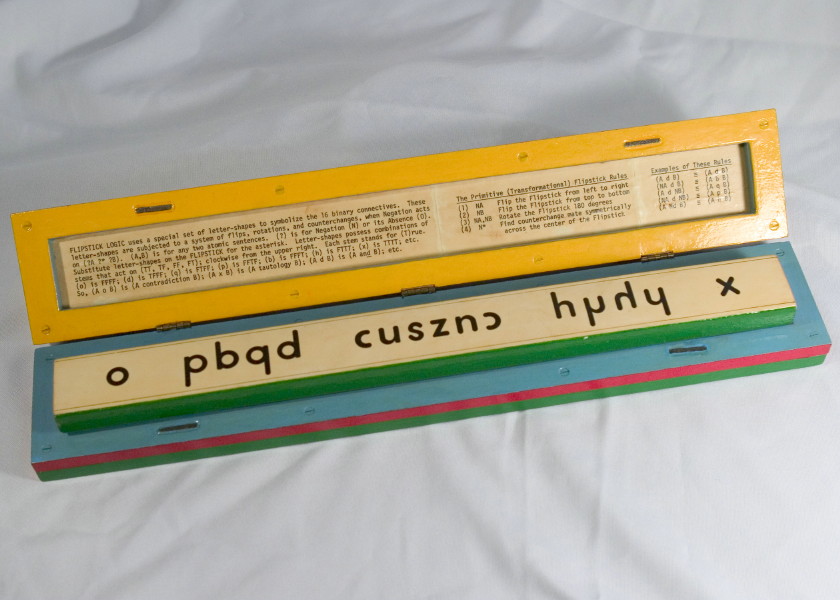
The Logic Alphabet (linked to above at http://www.logic-alphabet.net/images/flipstick_2347_2.jpg), which has a similar concept, seems to have better support: it can represent twelve of the symbols using Latin letters (o, p, b, q, d, c, u, s, z, n, h, and x, although z, u and n seem a bit forced) and the others seem to have decent Unicode equivalents (ɔ or ⊃ (superset), μ (Greek letter mu), ɥ or ч, and maybe ʎ).
A bit late to the party, but you have written excellent documentation at https://hubris.oxide.computer/reference/. It immediately answered the questions I had after reading 'Animats several comments on IPC. This is particularly impressive since "right now we are laser focused on shipping Oxide's product": I, at least, often don't prioritize documentation.
I once sent him a letter (snail mail) addressed to Donald Knuth, c/o Stanford Computer Science Department (address at bottom of http://www-cs.stanford.edu/). He got back within a couple of weeks, so it seems to have reached him fairly efficiently.
FiveThirtyEight had an interesting piece on how politicians have stronger incentives to provide relief after disasters than prepare for them before hand.
Anecdotally, the professor of my algorithms class had us all sort cards manually and asked us to describe the algorithm we used when we began studying sorting algorithms. Most of us used either selection sort or insertion sort.
That's true, but many users are still affected by that Python 2 remains the default. Any user can install a tool for Python 2 with pip install --user but the user might need root privileges to install a tool for Python 3 if the system administrator never intentionally installed it.
Your untrained eye took the # for comments, but I'm not sure that generalized to anyone's. Plenty of languages use # for other things: Smalltalk uses them for symbols, Clojure uses them for reader macros, OCaml uses them for method calls, Haskell can use them as an arbitrary operator, Lua uses them for length, C and C++ use them for compiler directives. See https://en.wikipedia.org/wiki/Number_sign#In_computing for a list.
Admittedly, Python, Bash, Perl, and Ruby use # for comments, so you do have a point, especially since Python is such a common teaching language.
> Gibraltar is adjacent to known drug trafficking and human smuggling routes, but the territory is heavily policed on land and at sea due to the risk of these activities occurring within its borders or territorial waters
Could you give an example of "problems you'd otherwise use AES passphrase-encrypted ZIP files to solve"? Do any of them involve sending the data anywhere (i.e., the sender and receiver are the same person)?
   All throughout the talk there were statements like "Let p be an odd prime and…"

   My friend asked, “what is an odd prime?”—thinking it must be special in some way. The answer back was: not 2.
Could you point to a reference for the non-confluence of logic without excluded middle? It sounds interesting and a quick Google search did not find anything.