"Elites have basically rigged all of society so that, increasingly, one must deploy the cognitive skills possessed by elites to successfully navigate the social world."
I had always wondered whether there was a missile that was spin stabilized with minimal control surfaces like this one. They mentioned it only had two control fins, but not whether they are independent. It seems possible to steer a spinning missile using a single actuator if the control pulses are precise enough.
Last week I watched an old Nova episode[0] about a harrowing attempt to restore a B-29 that had been abandoned 50 years prior a few hundred miles outside Thule. It turns out that Greenland is a difficult place to do basic things, let alone repair a massive decaying old warbird.
1. Start a company
2. Issue 1_000_000 shares to yourself
3. Find a friend who owes you a favor, then issue another share in the company and sell it to them for $1000
This is an extreme example, but most of the people on the world's richest list have been able to similarly inflate their net worth through illiquidity. Market caps are a misleading way to measure wealth. To take another example, the market cap of Tesla is based less on the company's physical assets than the anticipation of earnings over the next 20-30 years. My own net worth would look a lot better if it was calculated using the same methodology.
I'm not trying to argue that inequality doesn't exist, but I think this obsession with the paper value of the 1-percenters is a distraction from the fact that reducing inequality needs to ultimately involve the redistribution of physical assets and labor.
If we get obsessed with confiscating the abstract financial assets of billionaires, we will likely find out they don't have much buying power when being traded for real things like housing or energy.
I remember seeing a documentary a long time ago called Overland to America that documents similar travails, including a failed attempt at driving across the Bering Strait in one of these things: https://www.arktoscraft.com/
This makes a lot of sense if you consider that increasing the supply of money is not enough to cause inflation on its own- there also has to be scarcity.
Healthcare is scarce because it is tied to the availability of highly skilled labor and has seen significant cost increases in recent years as a result.
Housing has been scarce because the amount of land near job opportunities has decreased as our economy has become more service-oriented.
And this brings me to the one big item that was missing from the list in the OP: the pandemic has eased the housing crisis by encouraging everyone to spread out. The exodus of upper and middle class people moving into smaller cities and towns will bring more opportunities for service jobs to places with lower construction costs and a higher availability of land. The only question is whether the drawbacks of telecommuting are big enough to push everyone back into offices in a few years, reversing the trend.
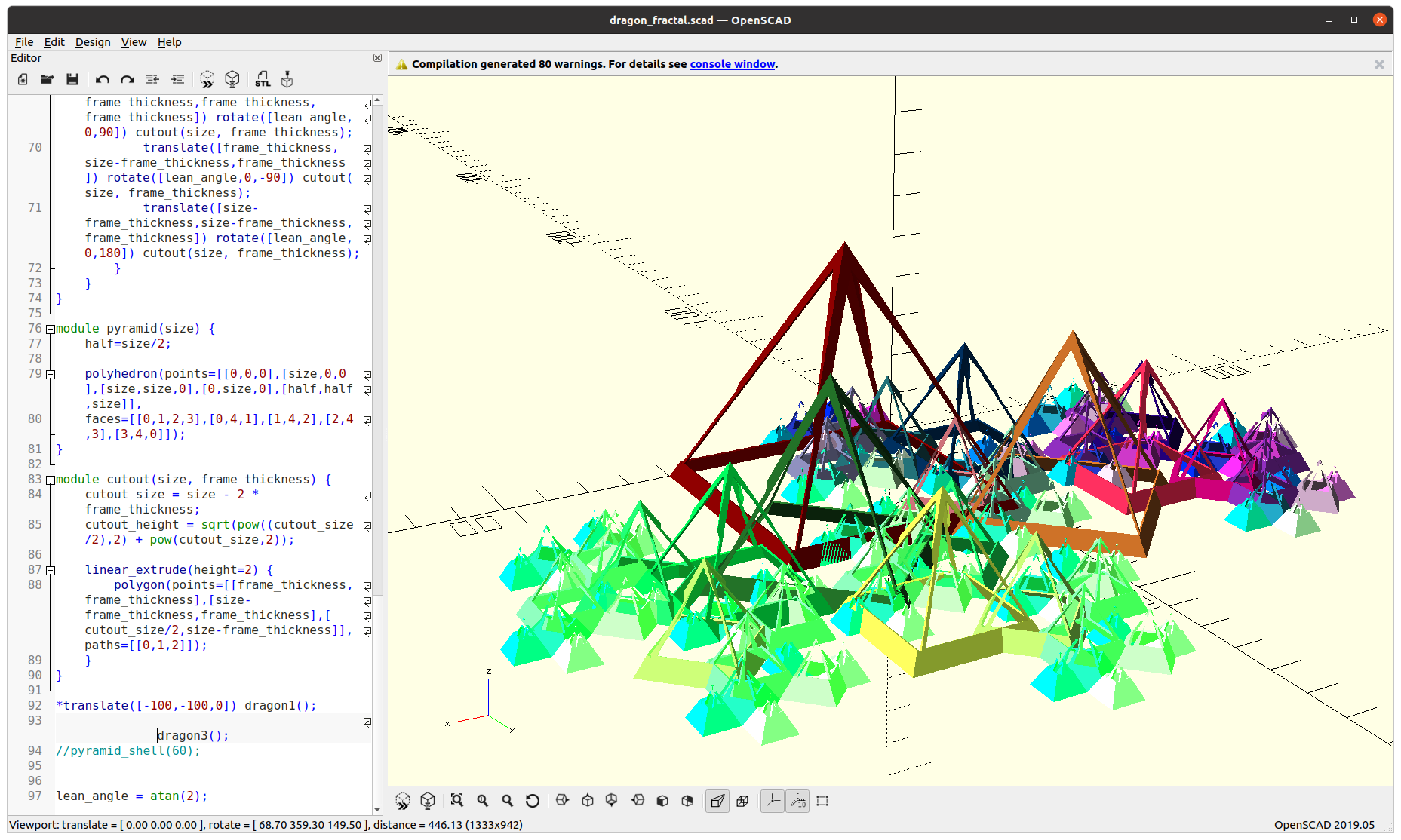
When I played around with 3d printers a number of years back, I tried a few free programs such as Blender, FreeCAD and Sketchup, but I found OpenSCAD for modeling and Meshlab for post-processing to be the best pipeline for my needs.
OpenSCAD is particularly effective for making replacement parts where precision is more important than aesthetics.
However I did find ways to have fun with it, such as building a printable dragon fractal: https://s3.amazonaws.com/www.subalpinetech.com/images/dragon...https://s3.amazonaws.com/www.subalpinetech.com/images/dragon...
I recommend it for anyone who wants to think more deeply about all things, including those which we previously might have considered unworthy of our mind cycles, such as the Taco Bell breakfast menu.
I'm finding the article's arguments pretty unconvincing.
eBook prices might be high, but as I've grown older I've realized that the price of the content is typically well below the opportunity cost of consuming it. If a good portion of that money makes it back into creators' hands, I'm satisfied.
The author spends some time complaining about the lack of first-sale doctrine, which is just a relic from the time when all content came on costly physical media. It would be wasteful to be forbidden from selling a book that you no longer want to read, so the reasoning went.
The arguments get even more nonsensical ("eBooks don't appreciate in value", "You can't photocopy them")
Meanwhile, they totally miss my biggest issue with eBooks: that they give significant power to platform providers, who may demand unreasonable concessions from authors and publishers.
It kind of frustrates me that I keep seeing UBI being described as a sort of unemployment assistance. Unless you drop the "U", a UBI is something EVERYONE receives- the separation between givers/takers would not be obvious, especially if the unemployment rate remains low. And I think the unemployment rate would remain low because workers would be willing to accept lower pay if it is bolstered by a UBI.
A UBI that is aggressive enough would actually create jobs by lowering the cost of labor in this manner.
The thing that prevents people from having jobs isn't a lack of demand for labor- it's the unwillingness of companies to pay for a worker's full cost of living. A UBI could correct for that.
I think it was that same article that inspired me to write an iOS app that displays your running average speed and notifies you if you deviate from it.
Back in the early 'oughts, the advent of peer-to-peer filesharing systems inspired a number of projects and companies to be founded with the goal of applying P2P technologies to more general applications.
At the time, P2P architecture offered 2 primary advantages:
1. Since the infrastructure of a P2P system was provided by its users, it would be self-hosting and self-scaling.
2. Having no central point of control, P2P systems are difficult for law enforcement to censor or shut down.
Unfortunately, it turned out that P2P had one big downside, which was complexity of implementation. In theory everything would smoothly scale to millions of users, but it required some serious expertise and investment to achieve that in practice. As hosting prices dropped and AdWords was launched, the conventional client-server website approach reasserted itself as the most sensible way to build networked applications.
Thus, P2P's only remaining reason to exist was for the evasion of the authorities. And even this had its caveats- law enforcement may not be able to shut down a decentralized system, but it certainly can shut down the company(s) that pay for the system's ongoing development and maintenance.
While decentralized technologies still have a lot going against them, I think the thing that has changed this time around is the presence of cryptocurrencies. Cryptocurrencies offer the possibility to fund the development of decentralized software using micropayments, but considering the amount of work required to design the architecture of such software before even being able to think about usability concerns, I am skeptical as to whether micropayments or even ICOs will result in the investment necessary to make decentralized systems appealing to the general public.
The Mindful Geek (http://a.co/egwKvoo) could be a good starting point for the HN crowd. I'm about halfway through it and I enjoy the no-frills explanations of various meditation techniques.
In my experience, the most difficult part is keeping the practice in my daily routine. Just like with exercise, it's easier to absorb it into your lifestyle if you have a coach or a group of people with which you regularly train.
I had more questions about the specific parameters they were using, so I followed the link (http://carboncounter.com/) in the article and checked out the "Customize" tab. Pretty sweet.
The conclusions of this article have far more implications for the future of blockchain technologies than for the future of databases.
Bitcoin and Ethereum and their ilk have, out of necessity, valued ACID qualities above all else- including availability and responsiveness. Does it make sense that completing a $1 transaction would require the same amount of resources as a $100,000 transaction? The traditional banking system has the flexibility to expend fewer resources on the $1 transaction, but Bitcoin does not- by design.
Interestingly, I think it is the inconvenience of the traditional banking system that gives it this flexibility. If financial transactions were something that could be done instantaneously, by a computer, without having to provide personal information to set up an account, then stealing money in 100,000 $1 transactions might be easier than stealing $100,000 in one big heist. Add a little inconvenience to each transaction and this problem goes away.
Unless blockchain transactions are extremely cheap, it will limit their competitiveness with the traditional banking system for this reason.
Artificially-lit indoor farming is neato and will be a great technology to bring into space, but makes almost no sense on earth.
Basically, it requires expensive infrastructure and way too much electricity (https://gigaom.com/2015/12/29/indoor-farming-good-for-cannab...).
Maybe robotically-farmed greenhouses won't have this problem.