I got some PCBs made a couple of years ago from JLCPCB and it wasn't that expensive, with shipping, 5 boards of small size (cheapest ones, not suitable for every project) was about €10 or €12.
Of course for hobbyists who are going to need several tries it makes it expensive, still it's a lot cheaper than before where I could only get PCBs for a much higher price.
I've been prototyping for some time now and never really focused on getting my projects into PCBs.
But yeah I guess you're right I can't really argue with you, I should improve my electronic design skills.
A Mister uses a more powerful FPGA + ARM CPU board along with extra SDRAM (I believe) to simulate known retro systems.
This was a personal project to make a custom video game console in this case using an FPGA, a couple of years back I finished one using microcontrollers and an actual CPU.
This project uses just enough SRAM and external components and a just enough powerful FPGA to be a retro-styled video game console.
I wanted to learn how to use FGPAs and continue to learn how video game consoles worked while building something unique.
So in a way, in terms of the technology, they're similar, except of course a Mister is something a lot more useful, I would say, as it simulates "real devices" and has a huge game library and this is just an educational project.
Well, I think it isn't that hard to get an analog video signal going.
Having a TV that took an RGB analog signal, meant that I could connect the microcontroller directly to the TV (using resistors to convert the voltage and for the color DAC).
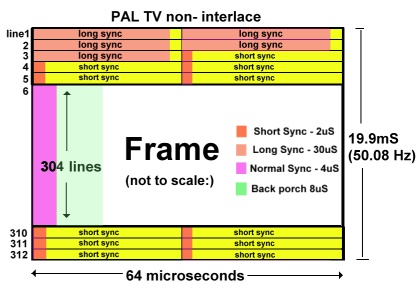
Then all I did was get the timing right, especially with the sync signal. Along with other resources, I used this image ( http://martin.hinner.info/vga/pal_tv_diagram_non_interlace.j... ) to understand when to set the Sync signal to 0 or to 1.
When using a microcontroller you can use interrupts or you can have well-timed instructions to set the sync signal on or off at the correct time, I chose the latter. The micros I used are AVR 8-bit architecture based, so most instructions always take 1 cycle, others take from 2 to 4 cycles to execute, simply by looking up in the manual I could calculate when certain instructions would execute and build a program in assembly that would generate the sync signal successfully. And if everything was right, my TV picture would switch to black, meaning it detected a valid PAL signal.
Of course, it wasn't always this easy, for example, I had a bug when I started, I wasn't setting one of the registers correctly and it took me a day to solve it, I had to look at the code over and over until I figured out what was wrong. Not having an oscilloscope nor a logic analyzer certainly made it harder.
Another lucky thing for me, was that the TV I have (an old CRT TV) is actually quite forgiving and even if I don't feed the timings exactly, it will still show a picture, so that helped.
Once I had a valid signal going I tested sending pixels to the screen, and I did use patterns to see if I had the timing right for each pixel, if I took too long switching pixels they would get wide. So I tried some checker patterns and stuff like that, but nothing fancy.
I hope this answers your question. It really isn't that difficult to generate a video signal and also I was quite lucky to get it working early on.
I probably didn't do things like they should be done, but it worked for me.
I would say that best thing is have a logic analyzer or oscilloscope to check if the signal you're generating corresponds to what it should be, that makes it a lot easier.
Like I've said in a few other comments (I've been trying to answer some of the comments, everyone has been really nice and really interested), one book that got me started was "Make: Electronics", I believe there's a second one now, I really like how the book explains the very basics in a pratical way.
Other than that there's a lot of info online nowadays. EEVblog aside from the forums has a nice youtube channel with videos with topics that range from beginner to advanced, GreatScott! is another one that explains things really well. Ben Eater has also a very interesting channel.
Also check other people's projects similar to things you would like to make.
As for kits, I started with the Arduino starter kit, it comes with a project book and a few varied components, after that I started buying components locally or from major international component shops and going towards the things that interested me the most in electronics.
I hope this helps :).
Actually they are still being manufactured to this day, that's one thing I didn't mention in the blog post is that you can get a brand new Zilog Z80 today, the 6502 (the CMOS version, 65C02) is also available.
You can probably get them from all the major electronic components stores (Digikey, Mouser, etc).
First of all thanks :)
And if you do find some time that project seems really cool, I never really got to work with the STM32 micros, but they are really powerful and cool.
Answering your question, well, even thought this is an electronics engineering project, I don't feel qualified to work with electronics professionally, for example, there's a lot of knowledge I lack.
I do work as a software engineer and I have done a couple of interviews myself to hire people and I do believe this helps when applying to a job, I'm not saying it completely replaces your qualifications but it might at least give you an edge. I'm seeing this as someone who would want to hire someone skillful. A technical project certainly is on the very least a nice thing to have in a CV. Of course this is just my opinion.
And if you are feeling like applying for a job based on your projects, just give it a go.
One advice I can give is: if you do have projects of your own, big or small, don't do it like me and keep them to yourself for years :P.
I really had no idea so many people would appreciate my pet project.
Yeah I did put more memory than the old school consoles had, absolutely, however the RAM in those days was only used for data mostly because they also had the cartridge ROM (or ROMs) to store the code. In my case I need to load the code to RAM, so I would always need a larger RAM.
But yeah, they also had less colors to work with and palettes (which were costier to implement in a software renderer). And this CPU is also faster than of those consoles.
I did give myself a more confortable system in terms of RAM and computational power.
But my aim was for a machine that would sit somewhere between the 3rd and 4th generation.
The double buffering I understand as well, if I was working with an FPGA I would not have gone with frame buffers, for sure, but that was the solution I found at the time using the components I was using and it worked.
The attention this has gotten, especially here in HN is still a bit unbelievable to me (and amazing of course). I don't want people to think this is an optimal console design or anything.
This is by no means a perfect project or "the way to go" in terms of homebrew video game consoles, it's just the way I found to do one while learning electronics along the way.
I am considering doing a series of blog posts, I don't know how often I could write them or if I could keep them going, but I will try.
I'm not big in social media and I have never written any posts or anything like before this one, which is weird, I'll admit it, so all this is kind of new, but I think I'll give it go.
Old systems used line-buffers like the Neo Geo or no buffers like the NES, for example.
So yeah, going with a frame-buffered approach was definitely easier, but this was not the only reason I chose this way.
I had a lot of restrictions, I was learning a lot of stuff, I didn't know how to work with FPGAs and I stuck with DIP package ICs that I could put on breadboards and experiment. And that's why I picked the AVR microcontrollers, which are awesome but have their disavantages. They have good performance (20Mhz), but not many pins and I had to bit-bang things like external RAM access (actually the PPU accesses 3 RAMs with only 32 IO pins available), which meant that it takes "some time" to access external memory.
That's why I chose 2 microcontrollers for video instead of just one, one of them could take "all the time in the world" (one frame) to fetch information and write a frame to the frame buffer while the other would generate the video signal and dump the a frame to the TV. Connecting the two, I felt a double buffer was better.
I definitely would have preferred doing a more "traditional" non-buffered render system, but this was the solution I found with what I had to work with.
I hope serves as a good explanation and maybe I'll get to explain these details better in another post :).
I would love to learn more and be able to work with faster circuits like you.
Yes it's way easier to work with "slow" digital circuits I had very little issues using breadboards and really long wires, that probably look cringy to you and others.
I'm actually a bit overwhelmed with all the comments and I'm trying to answer at least a few of them.
Just wanted to say that, even without knowing you, I think you could absolutely be a tinkerer or creator, just choose something you would like to build, start small and go from there. :)
Thank you, if it's something you like, you should try a hardware project, for sure :)
And yes I am Portuguese, born and raised and I do know what you mean, there are mistakes that are somewhat common for Portuguese speaking English and I do make an effort not to make the same mistakes. However I know my English is far form perfect and it's always easier when it's in written form.
I think that the fact that I've always spent too much time watching american/british movies and TV shows made me pay more attention to how English should be spoken :).
But anyway, thank you for saying I speak perfect English, it's actually a great compliment. :)
Yeah, I already have another ongoing project based on a cheap FPGA board with a Cyclone II (quite old but it does the job), the idea is to keep it cheaper and much less complex.
The FPGA has a Z80 implementation, video, sound and handle the game controllers. An external Atmega328 is used to handle the SD Card and then just RAM, an ICs for composite video and an op-amp.
I also have some ideas for a better console, maybe a generation forward and an 8-bit computer, but...these are just ideas, I doubt I'll actually get around to do them.