Will the next German parliament have a gigantic size? A law and coding challenge(r-bloggers.com)
r-bloggers.com
Will the next German parliament have a gigantic size? A law and coding challenge
https://www.r-bloggers.com/2021/09/will-the-next-german-parliament-have-a-gigantic-size-a-law-and-coding-challenge-2/
39 comments
This seems great to me, but does this make the ballot more confusing? That's a large list of candidates, no?
Germany already has much more complicated options [1] [2] for communal elections (but if you are confused by them, you don't need to use them).
The reasoning is that voters would know the communal candidates a lot better, so having more choice there would be an informed decision.
[1] https://en.wikipedia.org/wiki/Cumulative_voting
[2] https://en.wikipedia.org/wiki/Panachage
The reasoning is that voters would know the communal candidates a lot better, so having more choice there would be an informed decision.
[1] https://en.wikipedia.org/wiki/Cumulative_voting
[2] https://en.wikipedia.org/wiki/Panachage
Finland also has voter-decided party list order, but here you still vote for a single candidate - the party list gets ordered according to votes received by individual members.
Seats are distributed to party lists according to their vote share, and then within a party list according to the individual vote amounts.
And you just write the candidate number on the ballot (see e.g. photo in this news article: https://yle.fi/uutiset/osasto/news/yle_news_explains_voting_...), so it is quite simple. The voting booth has a list of candidate numbers if you don't know yours.
Seats are distributed to party lists according to their vote share, and then within a party list according to the individual vote amounts.
And you just write the candidate number on the ballot (see e.g. photo in this news article: https://yle.fi/uutiset/osasto/news/yle_news_explains_voting_...), so it is quite simple. The voting booth has a list of candidate numbers if you don't know yours.
Here in Brazil it works this way and unfortunately we found out it is kind of bad idea.
We had a couple corrupt parties convince inexperienced people that were wildly popular to run for them, these people (for example one guy is a circus clown that wrote some music that went viral) then get massive amounts of votes, and drag with them to the parliament all the corrupt politicians.
We had a couple corrupt parties convince inexperienced people that were wildly popular to run for them, these people (for example one guy is a circus clown that wrote some music that went viral) then get massive amounts of votes, and drag with them to the parliament all the corrupt politicians.
Sounds like proportional representation working as intended?
You have a set of ballots, each with a list for a single party. You throw away all the ballots save the one that is your choice, then make your preference circles there.
They are recycled, so no waste. (The politicans are often recycled too, some having 4-5 party affiliations in their CV.)
They are recycled, so no waste. (The politicans are often recycled too, some having 4-5 party affiliations in their CV.)
We have a similar system in Germany for local elections. In cities it can get crazy. Here is a a ballot from Frankfurt: https://www.fr.de/bilder/2021/02/11/90200944/25026648-28-lis...

This should be updated to link to the original website, rather than to R-bloggers, which is a blog aggregator.
http://skranz.github.io/r/2021/09/24/bundestag2021.html
http://skranz.github.io/r/2021/09/24/bundestag2021.html
I don't get why the district seat doesn't simply use approval voting. If I look at my local district, Nuremberg North, the relative majority with fptp is always with the CSU. However the more or less left leaning parties, SPD, Grüne, Linke always have a combined solid majority over the neolib spectrum FW, CSU, FDP.
With approval voting, my educated bet would be a higher approval for one of SPD or Grüne than for any in the neoliberal/conservative spectrum.
Same goes for many districts which produce paradoxical overhang seats, in both directions, like SPD in NRW, and CSU in Bavaria districts.
With approval voting, my educated bet would be a higher approval for one of SPD or Grüne than for any in the neoliberal/conservative spectrum.
Same goes for many districts which produce paradoxical overhang seats, in both directions, like SPD in NRW, and CSU in Bavaria districts.
> the relative majority with fptp is always with the CSU.
I feel like this is part of the reason. CDU/CSU currently seem to profit most from this system and they have been governing for 16 years. Before that, SPD got the most direct mandates and was governing.
Even if the governing parties wanted a change, it would probably be hard to convince their MPs to vote for a law that would endanger their own re-election.
I feel like this is part of the reason. CDU/CSU currently seem to profit most from this system and they have been governing for 16 years. Before that, SPD got the most direct mandates and was governing.
Even if the governing parties wanted a change, it would probably be hard to convince their MPs to vote for a law that would endanger their own re-election.
An mathematical perspective on this problem is if you consider the German system as a transformation from a FPTP to a Popular Vote system:
Let's say you have a FPTP system with a total of D direct seats. To evaluate how distorted the FPTP vote is, you run a PV election in parallel. Let's say a party wins 'd' out of the 'D' FPTP seats. The party is over-represented if
This year, the CSU is predicted to get around 43 (out of 299) direct seats, but less then 5% of the popular vote. So:
Imo, the solution would be to reduce D (the number of direct seats) and increase the number of list seats (s'). For example: D=200 and s'=400 (implying s>=3), which leaves more headroom for over-represented parties. Another lever would be to change from FPTP to approval voting as froh said.
Let's say you have a FPTP system with a total of D direct seats. To evaluate how distorted the FPTP vote is, you run a PV election in parallel. Let's say a party wins 'd' out of the 'D' FPTP seats. The party is over-represented if
d/D > PV_percentage
d/(s*D) <= PV_percentage
(d+x)/(s*D) == PV_percentage
s*D == ((s'/D)+1)*D == s'+D
This year, the CSU is predicted to get around 43 (out of 299) direct seats, but less then 5% of the popular vote. So:
43/(s*299) == 0.05 // s=2.88 and sizeof(parliament)=s*299=861
Imo, the solution would be to reduce D (the number of direct seats) and increase the number of list seats (s'). For example: D=200 and s'=400 (implying s>=3), which leaves more headroom for over-represented parties. Another lever would be to change from FPTP to approval voting as froh said.
Is there any electoral system that has both representatives for districts and fully proportional representation that doesn't have this problem? It seems this kind of problem is inherent in combining the two.
I believe localized-list proportional representation avoids the problem of variable-sized and potentially very large legislatures, while maintaining fully proportional representation and representatives for districts:
https://en.m.wikipedia.org/wiki/Localized_list
As far as I can tell:
1) each voter expresses a single preference for a candidate in a single-member district
2) when the votes are counted, each party is allocated a share of seats proportional to its candidates' votes combined
3) that many of its candidates are allocated their districts, such that they are the party's best performers (not necessarily plurality winners in their own districts)
I believe biproportional apportionment can also satisfy these criteria: https://en.m.wikipedia.org/wiki/Biproportional_apportionment
I'm not sure these are the only systems that satisfy these criteria. Scandinavian-style systems have a broadly proportional district system and a small proportion of "levelling" seats to make the results more proportional. I don't have detailed knowledge of any Scandinavian system, but I believe they could be tweaked to be more proportional and/or localized, and levelling seats could be allocated to districts according to where the parties winning levelling seats are most under-represented. This is more of an approximation than the preceding two, but:
1) the district system for German federal elections is very far from proportional, so the other part of the system has more to compensate for than in scandinavian-style systems
2) proportionality is necessarily approximate under any system where each party has an integer number of representatives, with achieving outcomes "within quota" being the best that can be hoped for
3) most proportional systems don't even produce results within quota, with the Dutch system a notable exception
My impression isn't that the variable number of seats in German federal elections is intended to limit accidental disproportionality, but that it's intended to prevent gaming the system by splitting a party into a district party and a list party, in order to be allocated list seats even if overrepresented in district seats. I doubt would that kind of manipulation would work if each district was multi-member with proportional representation.
As far as I can tell:
1) each voter expresses a single preference for a candidate in a single-member district
2) when the votes are counted, each party is allocated a share of seats proportional to its candidates' votes combined
3) that many of its candidates are allocated their districts, such that they are the party's best performers (not necessarily plurality winners in their own districts)
I believe biproportional apportionment can also satisfy these criteria: https://en.m.wikipedia.org/wiki/Biproportional_apportionment
I'm not sure these are the only systems that satisfy these criteria. Scandinavian-style systems have a broadly proportional district system and a small proportion of "levelling" seats to make the results more proportional. I don't have detailed knowledge of any Scandinavian system, but I believe they could be tweaked to be more proportional and/or localized, and levelling seats could be allocated to districts according to where the parties winning levelling seats are most under-represented. This is more of an approximation than the preceding two, but:
1) the district system for German federal elections is very far from proportional, so the other part of the system has more to compensate for than in scandinavian-style systems
2) proportionality is necessarily approximate under any system where each party has an integer number of representatives, with achieving outcomes "within quota" being the best that can be hoped for
3) most proportional systems don't even produce results within quota, with the Dutch system a notable exception
My impression isn't that the variable number of seats in German federal elections is intended to limit accidental disproportionality, but that it's intended to prevent gaming the system by splitting a party into a district party and a list party, in order to be allocated list seats even if overrepresented in district seats. I doubt would that kind of manipulation would work if each district was multi-member with proportional representation.
Having had to experience the Canadian federal election this week and seeing a resulting parliament that has very little to do with what the people actually voted for, I yearn for Germany's system and it's kind of challenges.
Monday's election resulted in 5.9% of people being completely unrepresented in parliament and the now (again) governing Liberals representing 32.6% of the populace, even less than it's Conservative competitor [0]. Sure they need the NDP for a majority vote but it's nothing like the coalitions in a Government like Germany where parties come up with a formal coalition agreement.
Seeing how people's research leading up to the election consisted of figuring out how to vote strategically for the opposing party in their riding to be defeated, instead of comparing party platforms and deciding who they agree with instead, made me want to barf honestly. There is a significant chance that we'll just get called to another election a year or 18 months from now, for what, another $600m minor shuffle of seats [1]?
[0] https://newsinteractives.cbc.ca/elections/federal/2021/resul...
[1] https://elections.ca/content.aspx?section=res&dir=rep/off/co...
Monday's election resulted in 5.9% of people being completely unrepresented in parliament and the now (again) governing Liberals representing 32.6% of the populace, even less than it's Conservative competitor [0]. Sure they need the NDP for a majority vote but it's nothing like the coalitions in a Government like Germany where parties come up with a formal coalition agreement.
Seeing how people's research leading up to the election consisted of figuring out how to vote strategically for the opposing party in their riding to be defeated, instead of comparing party platforms and deciding who they agree with instead, made me want to barf honestly. There is a significant chance that we'll just get called to another election a year or 18 months from now, for what, another $600m minor shuffle of seats [1]?
[0] https://newsinteractives.cbc.ca/elections/federal/2021/resul...
[1] https://elections.ca/content.aspx?section=res&dir=rep/off/co...
Tangential point but Germany's parliament has a 5% public vote threshold for parties to enter parliament (some exceptions apply).
According to current polls, that means between of 6%-9% of votes (for minor parties) will end up without parliamentary representation (5% at the last federal election).
NB: The number of not represented people is of course much higher, even discounting non-voters and underage citizens, since most(all?) foreign residents don't have the right to vote in federal elections.
According to current polls, that means between of 6%-9% of votes (for minor parties) will end up without parliamentary representation (5% at the last federal election).
NB: The number of not represented people is of course much higher, even discounting non-voters and underage citizens, since most(all?) foreign residents don't have the right to vote in federal elections.
That's true and probably exacerbated by the huge number of political parties. 5.9% in Canada is not that bad then maybe? I don't know.
Same applies here, only citizens of age are allowed to vote.
Same applies here, only citizens of age are allowed to vote.
I don't know either, therefore I considered it a pretty tangential point. It feels like the choice is a bit more diverse here because there are six(+1*) parties all but guaranteed to enter parliament, so you wouldn't waste a vote if you voted for any of them.
*) seven actually, one party (CSU) only standing in Bavaria instead of the conservative party CDU.
*) seven actually, one party (CSU) only standing in Bavaria instead of the conservative party CDU.
> Sure they need the NDP for a majority vote but it's nothing like the coalitions in a Government like Germany where parties come up with a formal coalition agreement.
Coalition agreements are 'formal' in the sense that they last until they get broken. And they get broken whenever it is politically convenient for the participants therein. They are alliances of convenience, not suicide pacts.
The libs will now govern as long as they have support of at least one other party in parliament. It's not that different from a formal coalition.
Trudeau promising electoral reform in his first election, and delivering not a damn thing is the real travesty, here. Had he done that, the country would be ran by a Lib-NDP coalition from now until the end of time.
Coalition agreements are 'formal' in the sense that they last until they get broken. And they get broken whenever it is politically convenient for the participants therein. They are alliances of convenience, not suicide pacts.
The libs will now govern as long as they have support of at least one other party in parliament. It's not that different from a formal coalition.
Trudeau promising electoral reform in his first election, and delivering not a damn thing is the real travesty, here. Had he done that, the country would be ran by a Lib-NDP coalition from now until the end of time.
So what's the maximum amount of seats that would be possible?
If one party won all districts 299, and had 0% of the party vote. You would come up with 897 seats in the Bundestag... which is not far from the expected seat number new week.
So it is pretty much a worst case already... I have some friends who might become Members of the Bundestag because of this, but even they are kind of irritated by that and know that nobody they will be talking to about their new seat will be happy about it.
So it is pretty much a worst case already... I have some friends who might become Members of the Bundestag because of this, but even they are kind of irritated by that and know that nobody they will be talking to about their new seat will be happy about it.
Hm, as I understand it, if one party won all 299 direct mandates at 0% 2nd vote share, the other parties' seats would have to be increased until 299 == 0%. Depending on how you round, that would be at least 30,000 seats (there's some tolerance allowed that I did not consider here but that's the ballpark for that unlikely scenario).
The linked site lists a (more realistic) scenario already, where the number of seats comes out to more than 900. How did you end up at your 897 seat upper bound?
The linked site lists a (more realistic) scenario already, where the number of seats comes out to more than 900. How did you end up at your 897 seat upper bound?
Actually, I should add that even in the unlikely extreme scenario, the upper bound would be the number of candidates on the parties' lists (Landeslisten). Even if a party would have a right to more seats, they cannot fill more than they have approved candidates on their lists. One could determine this actual upper bound by looking at each state's lists, which are public of course, but I haven't quickly found them compiled in one place, so I won't bother.
(Berlin's pirate party once won a surprisingly high share in the state parliament but wasn't able to fill all seats, because they were polling way lower when compiling their list.)
(Berlin's pirate party once won a surprisingly high share in the state parliament but wasn't able to fill all seats, because they were polling way lower when compiling their list.)
> (Berlin's pirate party once won a surprisingly high share in the state parliament but wasn't able to fill all seats, because they were polling way lower when compiling their list.)
That's not correct. They had 15 candidates and won 15 seats.
For all the nitty-gritty details check paragraph 4.5 on page 67 of the official election results [1].
[1]: https://www.berlin.de/wahlen/historie/berliner-wahlen/ergebn...
That's not correct. They had 15 candidates and won 15 seats.
For all the nitty-gritty details check paragraph 4.5 on page 67 of the official election results [1].
[1]: https://www.berlin.de/wahlen/historie/berliner-wahlen/ergebn...
Apparently, this might actually happen this time. (https://twitter.com/mneunho/status/1435887122649686024).
If the Bundestag becomes as massive as predicted (800+), the CDU and AfD lists are too short.
If the Bundestag becomes as massive as predicted (800+), the CDU and AfD lists are too short.
As a funny aside - if the current Bundestag is 709 seats... where the hell are they planning to fit all these chairs?
(I know that lots of politicians never or rarely show up to parliament anyway, but I think the idea is that they have a fixed seat such that it becomes clear which segment of the parliament is physically taken up by which party)
(I know that lots of politicians never or rarely show up to parliament anyway, but I think the idea is that they have a fixed seat such that it becomes clear which segment of the parliament is physically taken up by which party)
Search for "Bundesversammlung" (the constitutional body that elects the German president) to see some pictures of the Bundestag with 1260 seats. It's pretty crowded.. but not impossible. Although I doubt that they would have all these chairs permanently in the Bundestag.
Wow, TIL! Thanks!
It's definitely a crowded house, and much more of a temporary arrangement (it looks like they had to take out most of the desks and swivel chairs)!
It's definitely a crowded house, and much more of a temporary arrangement (it looks like they had to take out most of the desks and swivel chairs)!
http://europedirect.cut.ac.cy/wp-content/uploads/sites/4/201...
Fill in the visitor's balcony, I guess.
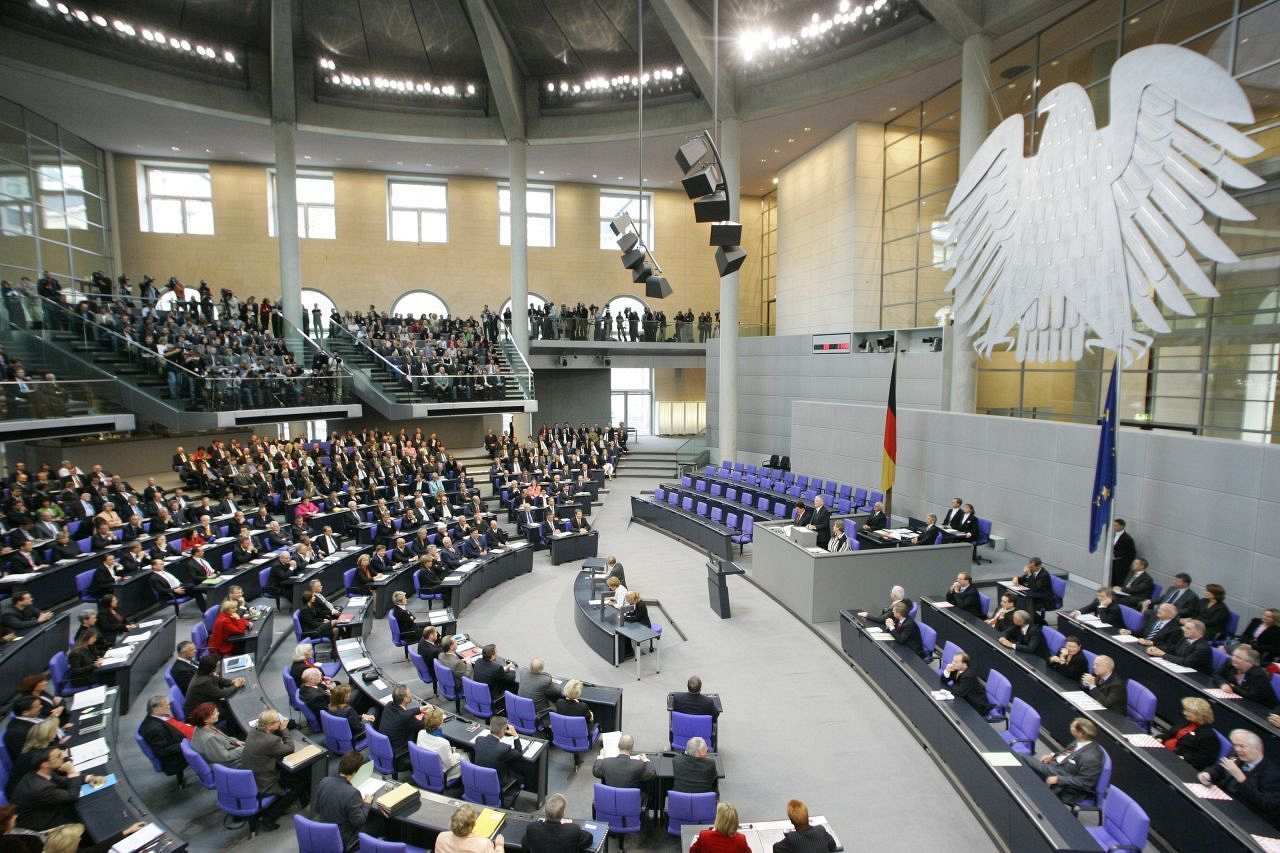
Fill in the visitor's balcony, I guess.
It's been a while since I visited in school, but IIRC the whole balcony is in a different security area. Also, I'm not sure the press would appreciate getting uninvited either.
Reroute the security zones. Tell the press to quit crying.
What's the other option, fill in the aisles? Given the frequency of terrorist attacks in Europe, preserving the ability of lawmakers to quickly leave a room seems more important than the feelings of journalists.
What's the other option, fill in the aisles? Given the frequency of terrorist attacks in Europe, preserving the ability of lawmakers to quickly leave a room seems more important than the feelings of journalists.
That's not correct, the upper limit is much higher. If you win 299 districts and get 0.1% of the party vote, the Bundestag needs enough seats to properly represent 99.9% of the other parties. So you basically (it's somewhat more complicated in practice) need to multiply 299 by 999 to get the proper amount of seats..
Interesting system. How are districts boundaries defined?
They were defined by law. They are supposed to have roughly equal populations and must be re-assigned if the difference in population exceeds 25% (I don't know what that means in practice, e.g., what the reference is.)
Here's a list: https://en.wikipedia.org/wiki/List_of_Bundestag_constituenci...
Here's a list: https://en.wikipedia.org/wiki/List_of_Bundestag_constituenci...
They start "re-districting" if a district deviates from the average population by ±15%.
The new districts are proposed by an independent commission and have to be approved by parliament. Here is the proposal for 2021 (pdf warning): https://www.bundeswahlleiter.de/dam/jcr/b1752d5e-aecd-4cff-9...
And here is the decision by parliament, I guess: https://dip.bundestag.de/vorgang/.../261890
The new districts are proposed by an independent commission and have to be approved by parliament. Here is the proposal for 2021 (pdf warning): https://www.bundeswahlleiter.de/dam/jcr/b1752d5e-aecd-4cff-9...
And here is the decision by parliament, I guess: https://dip.bundestag.de/vorgang/.../261890
The US wrote the German constitution. We should just drop any clauses that are Germany-specific (the ones about reunification and so on) and adopt it wholesale as our constitution. Our current constitution is very bad and leading us slowly into dysfunction and possible civil conflict…
No, the US did not write the German constitution. It was written by German politicians and lawyers. The Allied forces definitely had an influence on the constitution and requested certain things to be in the constitution (human rights, federalism). But the constitution is definitely a properly "self-made" document (building on existing constitutions in other democratic states and the Weimarer Reichsverfassung).
Edit: also, it would be absolutely impossible to "simply take the German constitution and apply it to the US". To somebody who knows a bit about constitutional law that's like saying "the computer isn't working, let's just use this bicycle instead."
Edit: also, it would be absolutely impossible to "simply take the German constitution and apply it to the US". To somebody who knows a bit about constitutional law that's like saying "the computer isn't working, let's just use this bicycle instead."
Germans wrote their own Grundgesetz, it only had to be approved by the Allies.
Are you possibly confusing Germany and Japan? Japanese constitution was mostly written by Americans, though with some review and input from the Japanese, and with a lot of respect to the previous Meiji constitution.
Are you possibly confusing Germany and Japan? Japanese constitution was mostly written by Americans, though with some review and input from the Japanese, and with a lot of respect to the previous Meiji constitution.
How do you come to that assumption? https://en.wikipedia.org/wiki/Parlamentarischer_Rat
In Czechia, you can circle up to four candidates on the list as your preference. As a result, several important politicians flew out of the parliament even when they were #1 or #2, because people from lower ranks outcompeted them.
Parties hate this one weird trick... but fortunately cannot agree on abolishing it.