The Mystery of the Vanishing Pay Raise(nytimes.com)
nytimes.com
The Mystery of the Vanishing Pay Raise
http://www.nytimes.com/2015/11/01/sunday-review/the-mystery-of-the-vanishing-pay-raise.html
13 comments
This problem exist outside the US too even in Denmark were health care is free.
The reason why it's not so obvious is that countries like Denmark redistributes wealth much more and have fairly high wages. Denmark doesn't have a minimum wage but instead it's based on negotiations between unions and employers (and sometimes the government if they cant agree). The model is know as Flexicurity[1].
The problem is that that model keeps a lot of people outside the working market because their skills simply aren't worth the salaries they would have to get because of this model. And so in Denmark the problem instead is that companies just move the production out or take in cheap east european labour.
The problem isn't about any specific political prioritization but about something more underlying (my claim is technology).
[1]https://en.wikipedia.org/wiki/Flexicurity
The reason why it's not so obvious is that countries like Denmark redistributes wealth much more and have fairly high wages. Denmark doesn't have a minimum wage but instead it's based on negotiations between unions and employers (and sometimes the government if they cant agree). The model is know as Flexicurity[1].
The problem is that that model keeps a lot of people outside the working market because their skills simply aren't worth the salaries they would have to get because of this model. And so in Denmark the problem instead is that companies just move the production out or take in cheap east european labour.
The problem isn't about any specific political prioritization but about something more underlying (my claim is technology).
[1]https://en.wikipedia.org/wiki/Flexicurity
> The problem is that that model keeps a lot of people outside the working market because their skills simply aren't worth the salaries they would have to get because of this model.
I'm not sure what you mean by "a lot of people", but Denmark has one of the highest employment rates among OECD countries, so it's actually doing great at keeping people in employment (comparably).
http://www.stats.govt.nz/browse_for_stats/income-and-work/em...
I'm not sure what you mean by "a lot of people", but Denmark has one of the highest employment rates among OECD countries, so it's actually doing great at keeping people in employment (comparably).
http://www.stats.govt.nz/browse_for_stats/income-and-work/em...
Yeah please see how many people work in the public sector and you start to realize the problem. Also as with most other countries the way employment is measured it's usually based on who is deemed available for the job market. In Denmark a lot of people simply stop being part of the statistics after a while even if they are in theory available for the job market.
Fever and fever people in the private sector providing for an increasing public sector and an increasing senior population.
Denmark pays for it's gigantic wellfare system via income taxation and through a number of taxes on goods (180% on cars for instance)
The current situation right now is that public sector while still growing the public sector year over year is now beginning to cut from areas it used to held almost holy. (Education for instance)
Fever and fever people in the private sector providing for an increasing public sector and an increasing senior population.
Denmark pays for it's gigantic wellfare system via income taxation and through a number of taxes on goods (180% on cars for instance)
The current situation right now is that public sector while still growing the public sector year over year is now beginning to cut from areas it used to held almost holy. (Education for instance)
This problem exist outside the US too even in Denmark were health care is free
Well yes and no. Even in European countries someone is paying for it, no? In the UK there is NI and employer's NI - consider the percentages below: https://www.gov.uk/national-insurance-rates-letters/contribu...
Well yes and no. Even in European countries someone is paying for it, no? In the UK there is NI and employer's NI - consider the percentages below: https://www.gov.uk/national-insurance-rates-letters/contribu...
In Denmark it's paid through taxes and therefore in the context of this discussion literally free for the individual. Or put another way.
They don't have to insure themselves against sickness instead everyone pays in order to spread out the risk across generations. (which is the problem that Obamacare amongst others tries to solve)
They don't have to insure themselves against sickness instead everyone pays in order to spread out the risk across generations. (which is the problem that Obamacare amongst others tries to solve)
Sure, but there is still the effect it has on what it costs an employer to create a job, that's the point I'm making.
Not sure what you mean. Can you elaborate?
From the OP:
Most people in the USA don't realize how much of their total compensation is health insurance since you don't typically see this cost as a line item on your paycheck. The last time I checked, an employer sponsored health plan for a family of 3 from Aetna was close to $2000/month
You might not see it on your paycheque but it's there and it has to be paid from somewhere, and that money isn't therefore available to be given to you in the form of a raise. Which means your cost to the employer can go up without you seeing any of it. That will only get worse.
Most people in the USA don't realize how much of their total compensation is health insurance since you don't typically see this cost as a line item on your paycheck. The last time I checked, an employer sponsored health plan for a family of 3 from Aetna was close to $2000/month
You might not see it on your paycheque but it's there and it has to be paid from somewhere, and that money isn't therefore available to be given to you in the form of a raise. Which means your cost to the employer can go up without you seeing any of it. That will only get worse.
This is why I always negotiate health care. If you can reduce the percentage of the premium that you pay(or eliminate it entirely) then you get a raise every time your health insurance plan raises it rates. It's often an easy thing to negotiate because it is orthoganal to salary and people usually dont compare all the minor compensation variables when comparing to other similar employees and often a hiring manager is working with a salary range that doesn't include other compensation.
Interesting. I've never worked at a place that didn't have standard packages for everyone. They even give everyone the same tables of what they will pay with different plans. What size were these companies?
All under 100 employees. I suppose some things might not be up for negotiation at larger companies but I bet not as many as you think.
Employer provided "health insurance" is a terrible idea that needs to go. It creates friction in the job market. It shifts costs to the government - companies pay lower premiums because working people are on average healthier. As OP says, it hides the full cost from the employee. I really don't understand how this practice came to be or why people think it should continue.
After WWII wages were frozen for years, but companies still had to compete for workers. Company-paid health insurance isn't considered wages, so companies were able to entice people with it. Same with "company cars" and various other fringe benefits. Over time health insurance became institutionalize and necessary, which led to the situation we're in today.
Several years ago some economists in the Bush administration researched the issue and concluded that pretty much all of the "wage growth" in his two terms came in the form of health coverage.
> Federal Reserve officials hoped wages would begin rising at today’s 5.1 percent, but economists are increasingly saying the rate might need to fall to 4.9 percent or lower to push wages higher
Whenever I read something like this I have to wonder: do these economists have a server farm running models to backup statements like this or do they just pull it out of their asses?
Whenever I read something like this I have to wonder: do these economists have a server farm running models to backup statements like this or do they just pull it out of their asses?
Well I don't know about the Fed but this is how we do it in England https://en.m.wikipedia.org/wiki/MONIAC_Computer
The best part is that economists always use 2 significative algarisms. And then, when reality sets down it's not rare that they are wrong by an order of magnitude or signal. (No, what it rare is them getting the most significative algarism right.)
No, nowadays I'm going for the explanation that those numbers are dishonest at their inception, and are just formated on the way that will decieve the biggest number of people.
No, nowadays I'm going for the explanation that those numbers are dishonest at their inception, and are just formated on the way that will decieve the biggest number of people.
They pull it out of a simple linear model in Excel .
just an educated guess based on my occasional economics study.
just an educated guess based on my occasional economics study.
I wonder if deep learning could be more accurate for this kind of problem
Deep learning works well when you have a ton of data and don't care about interpreting the parameters of your model. My understanding is this is pretty much the opposite of the typical situation in econ research.
From talking to economic grad students, it appears hard to obtain enough data for typical machine learning approaches. Basically all parameters end up being set from "theory" and "intuition"
Probably but the conversion rate between expert recommendations and policy is already so abysmal it's probably not worth it.
OK, so capitalism is fundamentally about choices. Market players compete to bring products / services to the market that both a) people want to choose, and b) is cheap to provide. Because it is not the case that the most desirable service is the most expensive to provide, that allows for competition. Markets "learn" over time, advantages gained by one firm are copied by others requiring constant innovation.
The job market is no different, but the second quality, being cheap to provide, means there is going to be a constant degrading in the monetary compensation offered to workers, while the desired benefits those workers are getting is paradoxically going to increase. You can most clearly see this in companies like Uber where compensation gets slashed every year, but there's no truly mass uprising of drivers taking place.
You can treat this as a failure of union outreach, that Uber drivers should unionize and demand relief. But it's not like they can't organize. They were perfectly capable of organizing a march at Uber headquarters. No, most Uber drivers choose to keep driving, the arguments that they're being exploited seem a little thin when you realize that Uber drivers could be doing just about anything else to make more money if they were really truly being exploited. Workers in America have unparalleled ability, compared to other countries, to try out other industries and occupations.
What I think is happening, is that the information age has brought unmatched and unmeasurable utility to common people, in the form of free services provided by tech companies, to everyone (take a second to let it sink in just how unprecedented this is, historically, for a hugely valuable service, like Google search, to be provided to anybody with a Internet connection) and the job market is simply adjusting to meet the new status quo.
Being poor in America isn't nearly as horrible as it used to be. You don't need to expend unreal amounts of effort to increase your station just to have a more-or-less happy life anymore. Homeless people all can get online somehow. And that access provides them with incalculable value. There's a reason that everywhere you go, you see people buried in their smartphones. They're choosing smartphone interaction over everything else they could be doing right now.
So the labor market is adjusting to fit. People can choose to be poorer, and are doing that rather than expending extraordinary efforts to climb ladders that have, all of a sudden, become so much harder to climb. Because with these services, being poor isn't nearly as onerous.
The job market is no different, but the second quality, being cheap to provide, means there is going to be a constant degrading in the monetary compensation offered to workers, while the desired benefits those workers are getting is paradoxically going to increase. You can most clearly see this in companies like Uber where compensation gets slashed every year, but there's no truly mass uprising of drivers taking place.
You can treat this as a failure of union outreach, that Uber drivers should unionize and demand relief. But it's not like they can't organize. They were perfectly capable of organizing a march at Uber headquarters. No, most Uber drivers choose to keep driving, the arguments that they're being exploited seem a little thin when you realize that Uber drivers could be doing just about anything else to make more money if they were really truly being exploited. Workers in America have unparalleled ability, compared to other countries, to try out other industries and occupations.
What I think is happening, is that the information age has brought unmatched and unmeasurable utility to common people, in the form of free services provided by tech companies, to everyone (take a second to let it sink in just how unprecedented this is, historically, for a hugely valuable service, like Google search, to be provided to anybody with a Internet connection) and the job market is simply adjusting to meet the new status quo.
Being poor in America isn't nearly as horrible as it used to be. You don't need to expend unreal amounts of effort to increase your station just to have a more-or-less happy life anymore. Homeless people all can get online somehow. And that access provides them with incalculable value. There's a reason that everywhere you go, you see people buried in their smartphones. They're choosing smartphone interaction over everything else they could be doing right now.
So the labor market is adjusting to fit. People can choose to be poorer, and are doing that rather than expending extraordinary efforts to climb ladders that have, all of a sudden, become so much harder to climb. Because with these services, being poor isn't nearly as onerous.
To be poor - to really be poor - is to live under the constant stress of unexpected payments and unexpected interruptions in your ability to pay the bills you see comming. To be poor is to have to really think about every small purchase, every half mile driven. Living from paycheck to three days before the next paycheck is not a pain that can be pacified with distraction. (Those people buried in their smartphones aren't reading the Wikipedia page on Haskell...)
Have you ever seen the interest on a payday loan? What situation would someone have to be in to make that a good idea? Surely, if the internet could help people that much, nobody would go for it.
I've seen both - you are confusing poor with idle.
Have you ever seen the interest on a payday loan? What situation would someone have to be in to make that a good idea? Surely, if the internet could help people that much, nobody would go for it.
I've seen both - you are confusing poor with idle.
The calculated interest rate on payday loans is misleading. Poor people don't think of it that way. When they borrow $300 for a short-term loan and have to pay $30 for the privilege, they're making a rational decision that the $30 later isn't worth as much as the $300 now. There's a recent article on the payday loan industry that confirmed my hunch that the people using them aren't total imbeciles and know what they're doing.
I use credit as a management tool, it gives me options I wouldn't have otherwise. Payday loans are the same, they're just more expensive. I would still use credit if it were more expensive, up to a point where it would be more advantageous to just change the way I perceive money.
Also payday loans are only available to a certain class of the working poor. People with temp jobs or other kinds of inconsistent income can't avail themselves of this kind of credit. They get a lot of press but are really just a niche in the vast constellation of services, both legal and illegal, legible and illegible, that sustain the poor.
I used to use a payday loan business to cash my paychecks when I couldn't get a bank account. The experience struck me as benignly capitalistic, you don't really want to be in the position of having to use these services, but having access to them is way better than the alternative.
> every half mile driven
Poor people here aren't that constrained, mostly because gas is and will probably forever be really cheap. In other countries that aren't oil-states gas is an order of magnitude more expensive. Keeping gas costs down is a priority, but not as big of one as meeting housing costs. Housing is the biggest expense most Americans, not just the poor ones, have to contend with. Transportation in comparison is treated as a cost of doing business.
> Living from paycheck to three days before the next paycheck is not a pain that can be pacified with distraction.
What poor people do on their phones constantly is cultivate the relationships that sustain them. It is not a distraction the way we think of playing silly games. They are texting, facebooking, even their game playing is done with their friends / family. Poor people are way more social than the middle / upper class could ever be, because they have to.
I use credit as a management tool, it gives me options I wouldn't have otherwise. Payday loans are the same, they're just more expensive. I would still use credit if it were more expensive, up to a point where it would be more advantageous to just change the way I perceive money.
Also payday loans are only available to a certain class of the working poor. People with temp jobs or other kinds of inconsistent income can't avail themselves of this kind of credit. They get a lot of press but are really just a niche in the vast constellation of services, both legal and illegal, legible and illegible, that sustain the poor.
I used to use a payday loan business to cash my paychecks when I couldn't get a bank account. The experience struck me as benignly capitalistic, you don't really want to be in the position of having to use these services, but having access to them is way better than the alternative.
> every half mile driven
Poor people here aren't that constrained, mostly because gas is and will probably forever be really cheap. In other countries that aren't oil-states gas is an order of magnitude more expensive. Keeping gas costs down is a priority, but not as big of one as meeting housing costs. Housing is the biggest expense most Americans, not just the poor ones, have to contend with. Transportation in comparison is treated as a cost of doing business.
> Living from paycheck to three days before the next paycheck is not a pain that can be pacified with distraction.
What poor people do on their phones constantly is cultivate the relationships that sustain them. It is not a distraction the way we think of playing silly games. They are texting, facebooking, even their game playing is done with their friends / family. Poor people are way more social than the middle / upper class could ever be, because they have to.
>Poor people don't think of it that way. When they borrow $300 for a short-term loan and have to pay $30 for the privilege, they're making a rational decision that the $30 later isn't worth as much as the $300 now.
They're not making a rational decision. It's an amygdala based decision. The same part of your brain that deals with panic, fight / flight, etc. The resource constraints they are under make it impossible to think long term the same way that you stop thinking about your pension plan when you're running away from a bear.
This is why it's such a profitable business (non-rational decisions -> profit), and why, when you take payday loans away, poor people actually end up better off (there have been studies on this that I know for a fact you will not attempt to research).
They're not making a rational decision. It's an amygdala based decision. The same part of your brain that deals with panic, fight / flight, etc. The resource constraints they are under make it impossible to think long term the same way that you stop thinking about your pension plan when you're running away from a bear.
This is why it's such a profitable business (non-rational decisions -> profit), and why, when you take payday loans away, poor people actually end up better off (there have been studies on this that I know for a fact you will not attempt to research).
Could you provide said research please - looks useful
Again, it sounds like you believe poor people cannot actually make any decisions at all. It's true, their options are limited by lack of means. But they are not automatons that have their every choice made for them by greedy capitalists.
> It's an amygdala based decision.
That's utterly silly. To be eligible for a payday loan, you have to have a paycheck. One cannot hold down a job long enough to qualify for a payday loan if you are constantly in fight-flight mode.
Again, there's a recent article you should read about payday loans. The vast majority of people use them in the same way and for the same reasons we use a credit card, to handle unexpected expenses, and pay them off within a few weeks. The number of people carrying balances is only a few percent. Obviously, they would be better off if you could just give them credit cards, maybe, but that's not an option.
You're allowing your beliefs about what it's like to be poor override the glaringly-obvious fact that 99% of all the people in the entire world are poor. If it were really the mind-crushingly awful thing you're portraying it as, then we never would have built civilization at all because none of us would have any long-term thinking at all.
I'm not going to go look the payday loan studies you point to because it's a side-show to the main disagreement we're having about what it's like to be poor.
> It's an amygdala based decision.
That's utterly silly. To be eligible for a payday loan, you have to have a paycheck. One cannot hold down a job long enough to qualify for a payday loan if you are constantly in fight-flight mode.
Again, there's a recent article you should read about payday loans. The vast majority of people use them in the same way and for the same reasons we use a credit card, to handle unexpected expenses, and pay them off within a few weeks. The number of people carrying balances is only a few percent. Obviously, they would be better off if you could just give them credit cards, maybe, but that's not an option.
You're allowing your beliefs about what it's like to be poor override the glaringly-obvious fact that 99% of all the people in the entire world are poor. If it were really the mind-crushingly awful thing you're portraying it as, then we never would have built civilization at all because none of us would have any long-term thinking at all.
I'm not going to go look the payday loan studies you point to because it's a side-show to the main disagreement we're having about what it's like to be poor.
>Again, it sounds like you believe poor people cannot actually make any decisions at all
What you said to yourself in your head while reading my words is immaterial.
>> It's an amygdala based decision. >That's utterly silly.
Because the limbic system does not engage if one has a job?
What's utterly silly is the firmly held and unquestioning assumption that you hold that decisions made by humans under extreme pressure are always rational.
Despite the evidence to the contrary.
Nonetheless, I suppose it is a convenient assumption to make should one wish to engage in exploitation of the poverty stricken for profit.
What you said to yourself in your head while reading my words is immaterial.
>> It's an amygdala based decision. >That's utterly silly.
Because the limbic system does not engage if one has a job?
What's utterly silly is the firmly held and unquestioning assumption that you hold that decisions made by humans under extreme pressure are always rational.
Despite the evidence to the contrary.
Nonetheless, I suppose it is a convenient assumption to make should one wish to engage in exploitation of the poverty stricken for profit.
> What you said to yourself in your head while reading my words is immaterial.
No, it's me trying to articulate the overall impression you're giving me so that we can have a real discussion rather than just talk around each other's ideology. But you don't seem to want to do that.
> Because the limbic system does not engage if one has a job?
Fight-flight responses are temporary. Way more temporary than it takes to wait in line at a payday loan shop.
No, it's me trying to articulate the overall impression you're giving me so that we can have a real discussion rather than just talk around each other's ideology. But you don't seem to want to do that.
> Because the limbic system does not engage if one has a job?
Fight-flight responses are temporary. Way more temporary than it takes to wait in line at a payday loan shop.
>No, it's me trying to articulate the overall impression you're giving me so that we can have a real discussion rather than just talk around each other's ideology. But you don't seem to want to do that.
I'm not "talking around" your ideology. I'm highlighting the deficiencies in the assumptions that structurally underpin it (i.e. the myth of the rational investor/consumer), pointing to research that supports the disproval of that presumption.
Your lack of desire to examine those wrong assumptions which your own ideology relies upon is the actual reason why we are not having a real discussion.
>Fight-flight responses are temporary.
Fight/flight mode is as temporary as the threat which you are responding to. Ask a soldier suffering from PTSD if it's "only ever temporary". Seriously. Do.
>Way more temporary than it takes to wait in line at a payday loan shop.
We've already established pretty well that your self-professed ability to analyze the psychology of poverty mainly revolves around gawping at it from a distance on the Pablo Escobar tour and maybe being short of money once or twice in your life.
I'm not "talking around" your ideology. I'm highlighting the deficiencies in the assumptions that structurally underpin it (i.e. the myth of the rational investor/consumer), pointing to research that supports the disproval of that presumption.
Your lack of desire to examine those wrong assumptions which your own ideology relies upon is the actual reason why we are not having a real discussion.
>Fight-flight responses are temporary.
Fight/flight mode is as temporary as the threat which you are responding to. Ask a soldier suffering from PTSD if it's "only ever temporary". Seriously. Do.
>Way more temporary than it takes to wait in line at a payday loan shop.
We've already established pretty well that your self-professed ability to analyze the psychology of poverty mainly revolves around gawping at it from a distance on the Pablo Escobar tour and maybe being short of money once or twice in your life.
Being poor is actually not something that can be coped with through consistent social behavior. The chronic stress that defines the experience of poverty have lasting effects on a brain.
Depends on what you mean by coping. I was poor, I managed to escape it. The brain effects studied, in my experience, aren't a life sentence fundamentally destroying your ability to survive and be happy. It's absolutely relative, having a $60K a year salary is going to be much better than $30K inconsistent. But it's not like you can't carve out a fulfilling existence with limited resources. I believe that's a way more damaging belief about the poor than the (wrong) belief that the poor are only poor because they are inherently incapable of being rich. Which is how I see people interpreting those recent research results.
The poor are poor at least in part because they're prevented from being rich by a combination of poor education, media distraction, and lack of access to working capital.
A few individuals can always break out of the ghetto. But the ghetto is a human trash heap - the graveyard of much raw talent and potential collective prosperity.
It really shouldn't exist in the first place.
A few individuals can always break out of the ghetto. But the ghetto is a human trash heap - the graveyard of much raw talent and potential collective prosperity.
It really shouldn't exist in the first place.
$30k is not poor. Most definitions of poverty are $28k for a family of four.
Poverty also has significant negative effects on the physical, mental and social development of children.
> There's a recent article on the payday loan industry that confirmed my hunch that the people using them aren't total imbeciles and know what they're doing.
You may be thinking of this recent article:
http://libertystreeteconomics.newyorkfed.org/2015/10/reframi...
You may be thinking of this recent article:
http://libertystreeteconomics.newyorkfed.org/2015/10/reframi...
Thanks, yes, that's the article.
>OK, so capitalism is fundamentally about choices.
Not so much. Capitalism is really about the pre-eminence of capital (it's right there in the name).
Treating the labor market as an undifferentiated commodity to be exploited is one way in which the needs of those who own capital (capitalists/rentiers) are placed above those who are part of that labor market. That's how we get QE, austerity, TTIP, bank bailouts, extra strong patents and a bunch of other gifts from government to billionaires.
This is part of what has caused the rise of the professional managerial classes.
>You can treat this as a failure of union outreach, that Uber drivers should unionize and demand relief. But it's not like they can't organize.
Unionizing is a constant uphill battle. Uber drivers' lack of success at it says no more about the merits of unionization than the failure of 95% of entrepreneurs does about entrepreneurship.
>No, most Uber drivers choose to keep driving, the arguments that they're being exploited seem a little thin when you realize that Uber drivers could be doing just about anything else to make more money if they were really truly being exploited.
The fact that they choose to do it says more about the other choices they have available than it does about Uber. What can they do? Go $150,000 in debt to get an education and still not be able to get a middle class job? Learn javascript and discover that the tech industry is exactly as cliquey as it says that it isn't? Source $1 million in capital from thin air and start their own business and take those 1 in 20 odds?
The major failure any economic model designed to "prove" that we're living in a fair society demonstrates is an underlying assumption that is completely, utterly and stupidly wrong. This is your presumption.
>Being poor in America isn't nearly as horrible as it used to be.
Try living on a minimum wage for three months and then start lecturing us about how easy it is. With dependents.
>People can choose to be poorer
You know that your ideas are half witted when they demand that you believe that people choose to be poorer.
Not so much. Capitalism is really about the pre-eminence of capital (it's right there in the name).
Treating the labor market as an undifferentiated commodity to be exploited is one way in which the needs of those who own capital (capitalists/rentiers) are placed above those who are part of that labor market. That's how we get QE, austerity, TTIP, bank bailouts, extra strong patents and a bunch of other gifts from government to billionaires.
This is part of what has caused the rise of the professional managerial classes.
>You can treat this as a failure of union outreach, that Uber drivers should unionize and demand relief. But it's not like they can't organize.
Unionizing is a constant uphill battle. Uber drivers' lack of success at it says no more about the merits of unionization than the failure of 95% of entrepreneurs does about entrepreneurship.
>No, most Uber drivers choose to keep driving, the arguments that they're being exploited seem a little thin when you realize that Uber drivers could be doing just about anything else to make more money if they were really truly being exploited.
The fact that they choose to do it says more about the other choices they have available than it does about Uber. What can they do? Go $150,000 in debt to get an education and still not be able to get a middle class job? Learn javascript and discover that the tech industry is exactly as cliquey as it says that it isn't? Source $1 million in capital from thin air and start their own business and take those 1 in 20 odds?
The major failure any economic model designed to "prove" that we're living in a fair society demonstrates is an underlying assumption that is completely, utterly and stupidly wrong. This is your presumption.
>Being poor in America isn't nearly as horrible as it used to be.
Try living on a minimum wage for three months and then start lecturing us about how easy it is. With dependents.
>People can choose to be poorer
You know that your ideas are half witted when they demand that you believe that people choose to be poorer.
You're ignoring the broader point to focus on specifics you don't agree with.
> Not so much. Capitalism is really about the pre-eminence of capital (it's right there in the name).
Capital is what distinguishes capitalism from other, similar economic forms. Choice is what undergirds capitalism and all these other types of economy.
Also, capital == choices. Not having choices == not having capital.
> That's how we get QE, austerity, TTIP, bank bailouts, extra strong patents and a bunch of other gifts from government to billionaires.
What makes capitalism successful is that it is pursued by people. You seem to believe that abstract legal principles, such that might keep things like QE and austerity from happening, are stronger than people's desires to route around those principles. They're not. Despite this, our system manages to evolve anyway.
Also, if you think corporate socialism in the US is bad, you should check out Russia.
> Uber drivers' lack of success at it says no more about the merits of unionization than the failure of 95% of entrepreneurs does about entrepreneurship.
Why are you saying, "lack of success" at unionizing? That implies they actually tried.
> The fact that they choose to do it says more about the other choices they have available than it does about Uber. What can they do?
Uber drivers have access to the entire city they serve and are capable of moving around this city at will. They could find a better job.
> The major failure any economic model designed to "prove" that we're living in a fair society demonstrates is an underlying assumption that is completely, utterly and stupidly wrong.
You're going to have to rephrase this because I have no idea what you're trying to say.
> Try living on a minimum wage for three months and then start lecturing us about how easy it is. With dependents.
Try doing it in the outskirts of a Colombian city with no minimum wage. Have you seen how those people live? Homelessness in America is a cakewalk. Food is everywhere. Government services abound. It's hard compared to being middle class or even working class, but relatively speaking compared to everywhere else in the world that it's possible to be poor in, it's easy.
> You know that your ideas are half witted when they demand that you believe that people choose to be poorer.
It sounds like you believe poor people can make no meaningful choices at all. That's a sad, depressing world-view, you're essentially equating poor people with animals.
> Not so much. Capitalism is really about the pre-eminence of capital (it's right there in the name).
Capital is what distinguishes capitalism from other, similar economic forms. Choice is what undergirds capitalism and all these other types of economy.
Also, capital == choices. Not having choices == not having capital.
> That's how we get QE, austerity, TTIP, bank bailouts, extra strong patents and a bunch of other gifts from government to billionaires.
What makes capitalism successful is that it is pursued by people. You seem to believe that abstract legal principles, such that might keep things like QE and austerity from happening, are stronger than people's desires to route around those principles. They're not. Despite this, our system manages to evolve anyway.
Also, if you think corporate socialism in the US is bad, you should check out Russia.
> Uber drivers' lack of success at it says no more about the merits of unionization than the failure of 95% of entrepreneurs does about entrepreneurship.
Why are you saying, "lack of success" at unionizing? That implies they actually tried.
> The fact that they choose to do it says more about the other choices they have available than it does about Uber. What can they do?
Uber drivers have access to the entire city they serve and are capable of moving around this city at will. They could find a better job.
> The major failure any economic model designed to "prove" that we're living in a fair society demonstrates is an underlying assumption that is completely, utterly and stupidly wrong.
You're going to have to rephrase this because I have no idea what you're trying to say.
> Try living on a minimum wage for three months and then start lecturing us about how easy it is. With dependents.
Try doing it in the outskirts of a Colombian city with no minimum wage. Have you seen how those people live? Homelessness in America is a cakewalk. Food is everywhere. Government services abound. It's hard compared to being middle class or even working class, but relatively speaking compared to everywhere else in the world that it's possible to be poor in, it's easy.
> You know that your ideas are half witted when they demand that you believe that people choose to be poorer.
It sounds like you believe poor people can make no meaningful choices at all. That's a sad, depressing world-view, you're essentially equating poor people with animals.
>You're ignoring the broader point to focus on specifics you don't agree with.
The specifics you used to support your "broader point" are all wrong, so it should come as no surprise that the point is too.
>Also, capital == choices
Capital is money or resources that make money. Nothing more.
>What makes capitalism successful
Perhaps you should re-examine your assumptions rather than reveling in them.
>Also, if you think corporate socialism in the US is bad, you should check out Russia.
Russia is a model for what the US is becoming. It is neither truly socialist nor truly capitalist. It is kleptocratic.
>Why are you saying, "lack of success" at unionizing? That implies they actually tried.
Which they did:
https://mashable.com/2014/10/23/uber-san-francisco-protest/
>Uber drivers have access to the entire city
Are you talking about Uber or grand theft auto?
>You're going to have to rephrase this because I have no idea what you're trying to say.
You make bad assumptions and base your arguments upon them.
>Try doing it in the outskirts of a Colombian city with no minimum wage. Have you seen how those people live?
Yes. I spent one month in Colombia. I'm well aware of how those people live. I've seen worse, too.
>Homelessness in America is a cakewalk.
You act like you've experienced either one rather than just gawked at both.
The specifics you used to support your "broader point" are all wrong, so it should come as no surprise that the point is too.
>Also, capital == choices
Capital is money or resources that make money. Nothing more.
>What makes capitalism successful
Perhaps you should re-examine your assumptions rather than reveling in them.
>Also, if you think corporate socialism in the US is bad, you should check out Russia.
Russia is a model for what the US is becoming. It is neither truly socialist nor truly capitalist. It is kleptocratic.
>Why are you saying, "lack of success" at unionizing? That implies they actually tried.
Which they did:
https://mashable.com/2014/10/23/uber-san-francisco-protest/
>Uber drivers have access to the entire city
Are you talking about Uber or grand theft auto?
>You're going to have to rephrase this because I have no idea what you're trying to say.
You make bad assumptions and base your arguments upon them.
>Try doing it in the outskirts of a Colombian city with no minimum wage. Have you seen how those people live?
Yes. I spent one month in Colombia. I'm well aware of how those people live. I've seen worse, too.
>Homelessness in America is a cakewalk.
You act like you've experienced either one rather than just gawked at both.
> Russia is a model for what the US is becoming.
Alright, this is ridiculous and I'm done with this discussion. You have no idea how economies actually work and no inclination to learn, so trying to drill down into fundamentals is only going to go nowhere.
Alright, this is ridiculous and I'm done with this discussion. You have no idea how economies actually work and no inclination to learn, so trying to drill down into fundamentals is only going to go nowhere.
>You have no idea how economies actually work and no inclination to learn
I think that accusation might be a little rash in light of your own refusal to re-examine the assumptions that underpin your rather normative economic ideology.
>trying to drill down into fundamentals is only going to go nowhere.
Those fundamental assumptions that you persist in believing despite all evidence to the contrary are largely the reason why you are so wrong.
I think that accusation might be a little rash in light of your own refusal to re-examine the assumptions that underpin your rather normative economic ideology.
>trying to drill down into fundamentals is only going to go nowhere.
Those fundamental assumptions that you persist in believing despite all evidence to the contrary are largely the reason why you are so wrong.
Regarding Uber: are the majority of its drivers part time, or full time? If the majority of drivers are part time, I wouldn't suspect there's as much of a chance of a march on Uber Headquarters, as it may not be their main source of income. There's also the problem of geography: the majority of Uber drivers are not close to it.
I'm a little shakier commenting on your poor people/homeless ideas. Have you experienced being homeless/poor recently? I hate to think your perspective on this is from, ahem: an ivory tower.
I'm a little shakier commenting on your poor people/homeless ideas. Have you experienced being homeless/poor recently? I hate to think your perspective on this is from, ahem: an ivory tower.
I specifically tried to omit the homeless from my analysis. Americans have largely excluded homeless people from being able to participate meaningfully in the economy, for various reasons. I am in Colombia right now, and homeless people here play critical roles in maintaining city infrastructure. I saw a homeless guy once fixing water piping out in the street. It felt like the street was his home, he had a pride obligation to making sure his home was in good repair. I also see them doing things like trash sorting, things nobody else wants to do at reasonable rates.
I think Americans, if they could moderate their sense of social justice, could find win-win solutions with the really hard-up that makes everybody's lives better. But they don't, so industries such as sanitation become hotbeds of corruption instead.
But I grew up lower class, white privilege made my life much more palatable than it otherwise would have been. But I am very familiar with the psychological burdens of the working poor. Life is hard, but they are not stupid people. There's a tendency in America to equate lower-class with unintelligent. Just because you don't have an education doesn't make you stupid.
Hard life makes you hard, eventually poor people become unable to climb the social ladder. I've met people who willingly chose less affluent environs over more affluent ones because the poorer ones were places they knew. They felt richer because of their knowledge than because of their opportunity.
I think Americans, if they could moderate their sense of social justice, could find win-win solutions with the really hard-up that makes everybody's lives better. But they don't, so industries such as sanitation become hotbeds of corruption instead.
But I grew up lower class, white privilege made my life much more palatable than it otherwise would have been. But I am very familiar with the psychological burdens of the working poor. Life is hard, but they are not stupid people. There's a tendency in America to equate lower-class with unintelligent. Just because you don't have an education doesn't make you stupid.
Hard life makes you hard, eventually poor people become unable to climb the social ladder. I've met people who willingly chose less affluent environs over more affluent ones because the poorer ones were places they knew. They felt richer because of their knowledge than because of their opportunity.
>I wouldn't suspect there's as much of a chance of a march on Uber Headquarters
Didn't that already happen?
Didn't that already happen?
"the information age has brought unmatched and unmeasurable utility to common people, in the form of free services provided by tech companies, to everyone (take a second to let it sink in just how unprecedented this is for a hugely valuable service, like Google search, to be provided to anybody with a Internet connection)"
Google's value is in driving ads to search, perhaps you refer the Google of old that gave results less weighted in commerce. Utility? Perhaps, it is out there if one can find a signal through all the noise. I do agree, it is indeed unprecedented. At the cost of privacy, however, it is hardly "free":
http://adage.com/article/datadriven-marketing/24-billion-dat...
Google's value is in driving ads to search, perhaps you refer the Google of old that gave results less weighted in commerce. Utility? Perhaps, it is out there if one can find a signal through all the noise. I do agree, it is indeed unprecedented. At the cost of privacy, however, it is hardly "free":
http://adage.com/article/datadriven-marketing/24-billion-dat...
At the same time a lot of things that used to be regarded as commonly available utility have been removed or privatized/enclosed. For example, community - cf "Bowling for Columbine", green spaces, time to spend with family, affordable housing.
I think that the crisis in mental health services kinda undermines your thesis.
I think that the crisis in mental health services kinda undermines your thesis.
Uber drivers can afford to own cars. My guess is they are not poor. They're lower middle class.
> Homeless people all can get online somehow. And that access provides them with incalculable value.
But not enough value to prevent their homelessness.
> Homeless people all can get online somehow. And that access provides them with incalculable value.
But not enough value to prevent their homelessness.
Yes, most people have smartphones and they're valuable in a variety of ways. That doesn't mean good jobs are easy to find. I'd want to see some evidence for that.
"I suspect this might have something to do with the rising cost of health insurance"
"Whenever there's an article about the lack of jobs or pay for the middle class, the first thing I do is hit Ctrl+F and start typing 'immigration'."
"I have one word. Technology."
"It's simpler than they make it out to be: there is no demand uptick."
An awful lot of theories and certainty here on Hacker News...
"Whenever there's an article about the lack of jobs or pay for the middle class, the first thing I do is hit Ctrl+F and start typing 'immigration'."
"I have one word. Technology."
"It's simpler than they make it out to be: there is no demand uptick."
An awful lot of theories and certainty here on Hacker News...
Yeah they are called perspectives which is one of the things I love about HN :)
The discussions on here are mostly of very high quality even when people disagree furiously.
The discussions on here are mostly of very high quality even when people disagree furiously.
He's pointing out that every other poster is cocksure with their pithy silver-bullet explanations.
I know what he is doing but he doesn't know about how sure anyone is just based on what they write and even how they write it.
Also people are talking about different aspects and so to even compare them as they are all trying to answer the same question is well an interesting perspective but hardly fair.
Also people are talking about different aspects and so to even compare them as they are all trying to answer the same question is well an interesting perspective but hardly fair.
I'm not complaining. Just amused.
It's simpler than they make it out to be: there is no demand uptick.
People are already spending at 100%+ of their income so they have no way to increase what they are buying even as the economy improves for some people. So, employers have no reason to hire more or extend hours.
This is why we see the minimum wage increases also stimulating the economy where they occur. They result in demand increases.
People are already spending at 100%+ of their income so they have no way to increase what they are buying even as the economy improves for some people. So, employers have no reason to hire more or extend hours.
This is why we see the minimum wage increases also stimulating the economy where they occur. They result in demand increases.
The entire purpose of a demand uptick is to cause inflation and lower real wages. Google Keynesian economics - its a fix for unemployment and output gaps, not low wages.
Given that we are already at the natural rate of unemployment, further demand creation is pointless anyway.
Given that we are already at the natural rate of unemployment, further demand creation is pointless anyway.
I would suggest you take your own advice and spend some time on Google.
The purpose of stimulating demand is to break a "coordination failure" where falling demand->hiring cutbacks->cutting consumption->falling demand. That's Keynesian (neo-Keynesian actually).
As for "natural rate of unemployment", there is no particular evidence that we are at one, and, in fact, there is lots of evidence that there is probably not a single "natural rate of unemployment" and mounting evidence against the concept in general.
The purpose of stimulating demand is to break a "coordination failure" where falling demand->hiring cutbacks->cutting consumption->falling demand. That's Keynesian (neo-Keynesian actually).
As for "natural rate of unemployment", there is no particular evidence that we are at one, and, in fact, there is lots of evidence that there is probably not a single "natural rate of unemployment" and mounting evidence against the concept in general.
You aren't disagreeing with me - the coordination failure you refer to is nominal rigidities. To disagree with me, demonstrate involuntary unemployment and outout gaps together with flexible wages.
Considering what happened with the ratio of people that participate in the labour market, further demand creation could very well pull some of those people in work though.
As for Keynes, it is good to remember that he (later on - Keynes in the 20s hadn't reached these insights yet) didn't believe in a natural rate of unemployment (or well, he believed the equilibrium point was determined by a three dimensional equation rather than the two dimensional one that create a single natural rate).
As for Keynes, it is good to remember that he (later on - Keynes in the 20s hadn't reached these insights yet) didn't believe in a natural rate of unemployment (or well, he believed the equilibrium point was determined by a three dimensional equation rather than the two dimensional one that create a single natural rate).
The enormous amount of immigrants (both legal and illegal) to the US is definitely a huge factor.
They say the current population won't do the unpleasant jobs that immigrants do because the pay is too low. It seems no one has stopped to consider that those jobs pay so low because there is a seemingly endless supply of cheap immigrant workers to do them. It drives wages down and provides little incentive for automation.
The ancient Greeks invented the steam engine but never really used it because they had no shortage of slave labor. There was no incentive to further develop that technology.
They say the current population won't do the unpleasant jobs that immigrants do because the pay is too low. It seems no one has stopped to consider that those jobs pay so low because there is a seemingly endless supply of cheap immigrant workers to do them. It drives wages down and provides little incentive for automation.
The ancient Greeks invented the steam engine but never really used it because they had no shortage of slave labor. There was no incentive to further develop that technology.
I have one word. Technology.
Think about technology as outsourcing and you realize what the problem is because you are realizing the trend; Technology will compete with higher and higher levels of abstraction and so you either have to be really skilled in an increasingly competitive space or you need to accept taking jobs at wages that are as low as they are because of the increased competition from technology.
And until economist stop treating technology as an externality they wont understand whats going on and we will keep debating this as if its a political problem. In my opinion its not.
http://www.technologyreview.com/sites/default/files/images/d...
Think about technology as outsourcing and you realize what the problem is because you are realizing the trend; Technology will compete with higher and higher levels of abstraction and so you either have to be really skilled in an increasingly competitive space or you need to accept taking jobs at wages that are as low as they are because of the increased competition from technology.
And until economist stop treating technology as an externality they wont understand whats going on and we will keep debating this as if its a political problem. In my opinion its not.
http://www.technologyreview.com/sites/default/files/images/d...
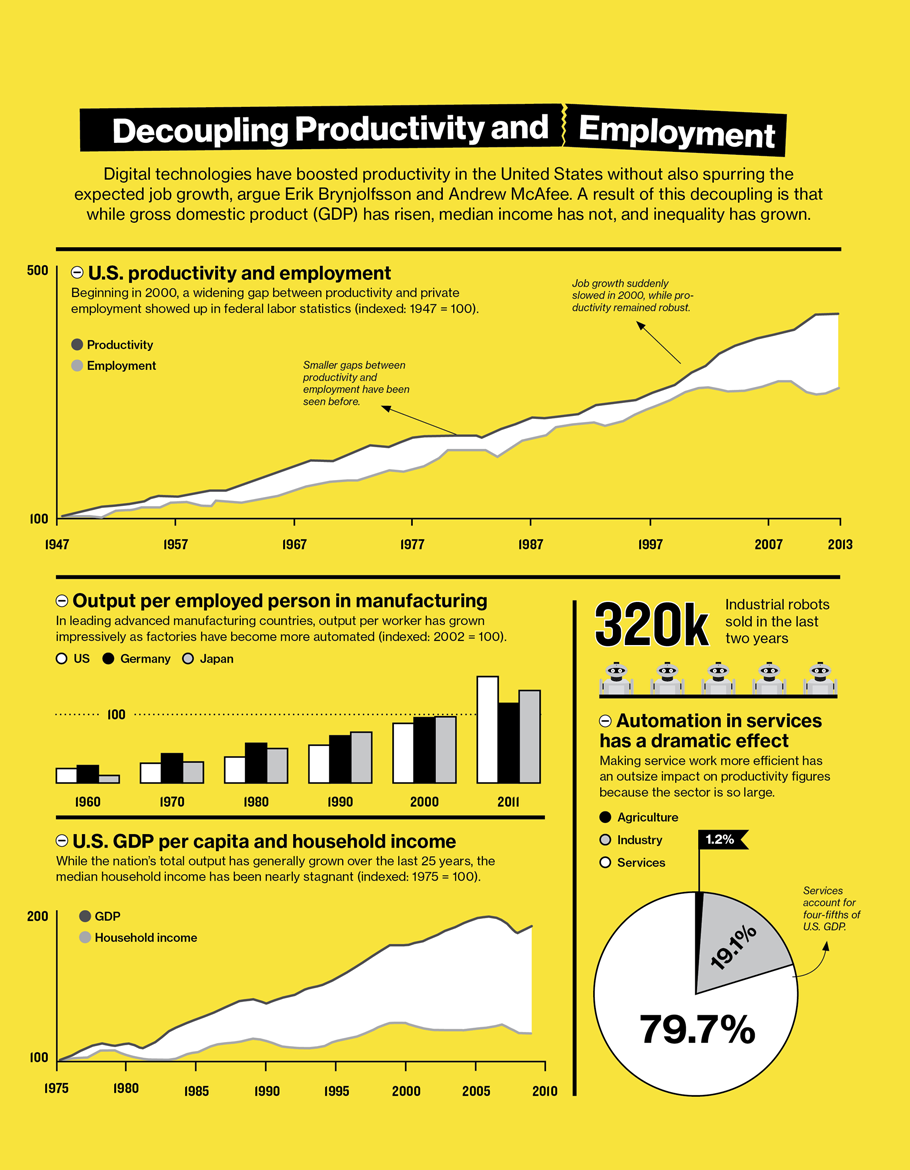
Yes but there's no evidence that links higher technology to greater productivity. All the accountants who were automated out of existence by COBOL programs, simply became COBOL programmers, and the net amount of accounting done per person involved didn't change!
Thats the wrong way of looking at it.
The point isn't just whether it leads to higher productivity the point is that it removes the need for certain industries almost completely.
Just think about the amount of areas that digitalization have completely removed. Those are jobs lost that aren't created somewhere else in the same phase as it's destroying them. And most of those jobs are being outsourced.
With regards to your cobol example I would like to see where you get that idea from. There is a huge demand of cobol programmers today because of all the old financial/banking systems which no one really dares touching. So that's an unlikely claim.
The point isn't just whether it leads to higher productivity the point is that it removes the need for certain industries almost completely.
Just think about the amount of areas that digitalization have completely removed. Those are jobs lost that aren't created somewhere else in the same phase as it's destroying them. And most of those jobs are being outsourced.
With regards to your cobol example I would like to see where you get that idea from. There is a huge demand of cobol programmers today because of all the old financial/banking systems which no one really dares touching. So that's an unlikely claim.
Such as what?
Things are done because they need doing, i.e. there is demand for them to be done, whether they are digital or analogue won't change that. Outsourcing is a better explanation of what's happening.
The demand for COBOL programmers proves my point. Computers didn't eliminate those jobs. They just transformed them. So where a company might have employed 100 accountants to do their accounting, now they employ 50 accountants and 50 programmers or 10 accountants and 90 programmers... Anyone who could do one job could probably pick up the other.
Things are done because they need doing, i.e. there is demand for them to be done, whether they are digital or analogue won't change that. Outsourcing is a better explanation of what's happening.
The demand for COBOL programmers proves my point. Computers didn't eliminate those jobs. They just transformed them. So where a company might have employed 100 accountants to do their accounting, now they employ 50 accountants and 50 programmers or 10 accountants and 90 programmers... Anyone who could do one job could probably pick up the other.
Outsourcing is just the step before automation. The US lost 4 million jobs to China between 98-2004 in the same period the Chinese lost 18 million jobs to the robots. This trend isn't stopping, instead it will only continue faster and faster.
The tings that digitalization kills are things like the camera, the walkman, the video-recorder, the video-camera, the post-processing machines, instruments, the studio musician and I could go on.
These aren't jobs that then are created somewhere else. In most of the cases where new industries or new areas are made they either require extremely highly specialized education or they are very hard for most people to make any money in. The app store being a good example.
Your Cobol example isn't proving anything at all and your claim was wrong to begin with. You claimed accountants just became cobol developers which is simply a false claim. And the reason why there is a need for cobol isn't because of a new demand but because of a dwindling availability of an existing demand which is also going down until a new technology makes that completely redundant.
The tings that digitalization kills are things like the camera, the walkman, the video-recorder, the video-camera, the post-processing machines, instruments, the studio musician and I could go on.
These aren't jobs that then are created somewhere else. In most of the cases where new industries or new areas are made they either require extremely highly specialized education or they are very hard for most people to make any money in. The app store being a good example.
Your Cobol example isn't proving anything at all and your claim was wrong to begin with. You claimed accountants just became cobol developers which is simply a false claim. And the reason why there is a need for cobol isn't because of a new demand but because of a dwindling availability of an existing demand which is also going down until a new technology makes that completely redundant.
Not sure why you think economists treat technology as externality. I've seen many macroeconomic models that specifically are attempting to model change in technology.
Because they mostly do. Especially the economist that advice countries. And you can see it on the way they basically forecast and use various tools to stimulate the economy.
You would see far more politicians propose a Unconditional Basic Income solution if technology were factored into the models regardless of whether you think UBI works or not.
Problem is that technology is now moving at a pace where it will eat up most attempt to stimulate the economy whether it's Keyness philosophy or Austerity philosophy.
You would see far more politicians propose a Unconditional Basic Income solution if technology were factored into the models regardless of whether you think UBI works or not.
Problem is that technology is now moving at a pace where it will eat up most attempt to stimulate the economy whether it's Keyness philosophy or Austerity philosophy.
We have had continous improveents in technology up to the recession.
Job creation in the US have gone down decade after decade since WWII.
https://plot.ly/~BethS/8/job-growth-by-decade-in-the-united-...
There comes a point where technology starts to compete not just with our muscle but with our brains. And even though there of course are going to be some jobs you can make a living off. Digitalization and automation is disrupting at an ever increasing speed.
You need to look at the trend not the current scenario to understand this.
https://plot.ly/~BethS/8/job-growth-by-decade-in-the-united-...
There comes a point where technology starts to compete not just with our muscle but with our brains. And even though there of course are going to be some jobs you can make a living off. Digitalization and automation is disrupting at an ever increasing speed.
You need to look at the trend not the current scenario to understand this.
Whenever there's an article about the lack of jobs or pay for the middle class, the first thing I do is hit Ctrl+F and start typing "immigration". This being the New York Times, it doesn't show up, for a variety of partisan and ownership-related reasons.
Supply and demand applies just as much to labor markets as it does to any other. The "vanishing pay raise" makes a lot more sense when you consider the deliberate increase in labor supply for the explicit purposes of lining the pockets of crooked billionaires like Mark Zuckerberg and Carlos Slim.
Supply and demand applies just as much to labor markets as it does to any other. The "vanishing pay raise" makes a lot more sense when you consider the deliberate increase in labor supply for the explicit purposes of lining the pockets of crooked billionaires like Mark Zuckerberg and Carlos Slim.
It is nothing to do with immigration really, since the H1B is explicitly not an immigration visa.
> although some fear that inflation will climb if the jobless rate is that low
AFAIK the reason why inflation climbs when the jobless rate is very low is because with few jobless the cost of labor usually increases, and THEN prices increase to reflect higher costs. But if there are no wage increases, there is no reason for a low jobless rate to increase inflation...
AFAIK the reason why inflation climbs when the jobless rate is very low is because with few jobless the cost of labor usually increases, and THEN prices increase to reflect higher costs. But if there are no wage increases, there is no reason for a low jobless rate to increase inflation...
Over the long term, wages in first world countries will remain flat or decline and meet the third world countries in the middle.
briandear(5)
Seems like the solution to this problem is to keep raising the minimum wage until Google, Apple, etc. who have BILLIONS locked up away from the economy start spending it.
But companies with vast savings are sucking the growth out of the economy. Same a high tax rate sucks economic power out of the economy.
But companies with vast savings are sucking the growth out of the economy. Same a high tax rate sucks economic power out of the economy.
Since the government has tried as vigorously as possible to make it expensive and legally risky to employ people, there is really no mystery here.
You're kidding, I hope, if not, try visiting some non-US jurisdictions and see how they do it. The US has very weak protection for employees - the "At-will" employment practise being a striking example.
Most people in the USA don't realize how much of their total compensation is health insurance since you don't typically see this cost as a line item on your paycheck. The last time I checked, an employer sponsored health plan for a family of 3 from Aetna was close to $2000/month