What people in 1900 thought the year 2000 would look like(washingtonpost.com)
washingtonpost.com
What people in 1900 thought the year 2000 would look like
http://www.washingtonpost.com/news/wonkblog/wp/2015/10/04/what-people-in-1900-thought-the-year-2000-would-look-like/
20 comments
It's a bit of a stretch to call these predictions of the year 2000 from 1900. In reality, these were likely just a fun way to put cartoons on cigar boxes in order to get people to buy the next in the set. I don't think 1900's Parisians really believed in a future of whale-powered busses and people riding super-sized sea-horses.
Yep, seems more like pure fiction without even much effort put into it, just that some things turned out semi-true.
I find the first set of pictures the most interesting, because they all display various forms of what we would think of as automation -- machines to do house cleaning, farming, barbering, grooming -- but none of them actually automate anything. The floors do not clean themselves, nor do the tractors navigate their own course. All of the machines are still controlled by levers and pedals. The barber is still required to cut hair, although his efforts seem magnified. The housewife still must carefully control the cleaning machine, perhaps saving some elbow grease but not very much in the way of leisure time.
A century ago, we thought that machines were going to be multipliers of the effectiveness of human effort. Now, it seems clear that they will inevitably replace it.
A century ago, we thought that machines were going to be multipliers of the effectiveness of human effort. Now, it seems clear that they will inevitably replace it.
A century ago, we thought that machines were going to be multipliers of the effectiveness of human effort. Now, it seems clear that they will inevitably replace it.
Interesting point, though despite the development of automation/AI I think the main setback is the same today as it was back then - complex tasks require complex mechanical systems. Moving parts are required and lots of them, making them an expensive, fragile system prone to failure.
If you could have a system that rarely broke down that could say, perform a manicure all by itself, you'd then have to overcome cost vs ROI. We need to break the point where complex mechanical systems with intelligence are worthwhile for the service that they provide vs cost and maintenance. It's more an economic problem than it is technological.
The best form of AI that we have at the moment lives in your pocket, has essentially zero moving parts and also acts as a communications device, source of information, clock/calendar/alarm/diary and source of entertainment. People have no problem dropping USD 700 on something that can add that much value with a low failure rate. The smartphone's success was rooted in economics as much as it was technological.
Interesting point, though despite the development of automation/AI I think the main setback is the same today as it was back then - complex tasks require complex mechanical systems. Moving parts are required and lots of them, making them an expensive, fragile system prone to failure.
If you could have a system that rarely broke down that could say, perform a manicure all by itself, you'd then have to overcome cost vs ROI. We need to break the point where complex mechanical systems with intelligence are worthwhile for the service that they provide vs cost and maintenance. It's more an economic problem than it is technological.
The best form of AI that we have at the moment lives in your pocket, has essentially zero moving parts and also acts as a communications device, source of information, clock/calendar/alarm/diary and source of entertainment. People have no problem dropping USD 700 on something that can add that much value with a low failure rate. The smartphone's success was rooted in economics as much as it was technological.
Actually floor do clean themselves with a Roomba, and while they aren't ubiquitous yet driverless tractors do exist.
Also washing machines are pretty much automatic. The human intervention is now limited to "put clothes inside and push a button" which does bring a lot of free time in exchange, compared to the time where housewives had to do all the laundry manually.
Also washing machines are pretty much automatic. The human intervention is now limited to "put clothes inside and push a button" which does bring a lot of free time in exchange, compared to the time where housewives had to do all the laundry manually.
I think you misunderstood ender7's comment. The robots in the drawings of the article don't work automatically, while the robots of today cerntainly do.
I still find it amazing that we went from first flight 1903 and 65 years later landed on the moon.
My great aunt remembered the first motorcar to arrive at her village, and lived to fly across the Atlantic in a jetliner.
My great aunt remembered the first motorcar to arrive at her village, and lived to fly across the Atlantic in a jetliner.
I always find that comparison disingenuous as flight has nothing to do with rocketry. I think it might be less exciting but more instructive to talk about time between first submarines (keeping humans alive in a hostile environment) to spacecraft.
Rocketry grew out of the aviation industry, not the submarine industry.
The principles of rocketry were powering fireworks and guns a long time before they were powering flight. :)
Sure it does. They're both complicated feats of engineering.
> 1903 and 65 years later landed on the moon.
65 years and Two World Wars later...
This quote [1] from the movie 'The Third man' might be relevant.
>in Italy for 30 years under the Borgias they had warfare, terror, murder, and bloodshed, but they produced Michelangelo, Leonardo da Vinci, and the Renaissance. In Switzerland they had brotherly love - they had 500 years of democracy and peace, and what did that produce? The cuckoo clock?
[1]http://www.imdb.com/title/tt0041959/quotes?item=qt0359443
65 years and Two World Wars later...
This quote [1] from the movie 'The Third man' might be relevant.
>in Italy for 30 years under the Borgias they had warfare, terror, murder, and bloodshed, but they produced Michelangelo, Leonardo da Vinci, and the Renaissance. In Switzerland they had brotherly love - they had 500 years of democracy and peace, and what did that produce? The cuckoo clock?
[1]http://www.imdb.com/title/tt0041959/quotes?item=qt0359443
Nice quote, but also wrong. The Swiss had tons of wars, both internally and externally [1] and provided many other countries' armies with their mercenaries [2]. Also, the cuckoo clock comes from Germany, specifically the Black Forest [3].
Full disclosure - I'm Swiss. As our history teacher put it: "The Swiss were always fighting, and if they weren't fighting each other they were hired by others and fought other Swiss mercenaries on the battlefield under different banners."
[1]: https://en.wikipedia.org/wiki/List_of_wars_involving_Switzer...
[2]: https://en.wikipedia.org/wiki/Swiss_mercenaries
[3]: https://en.wikipedia.org/wiki/Cuckoo_clock
Full disclosure - I'm Swiss. As our history teacher put it: "The Swiss were always fighting, and if they weren't fighting each other they were hired by others and fought other Swiss mercenaries on the battlefield under different banners."
[1]: https://en.wikipedia.org/wiki/List_of_wars_involving_Switzer...
[2]: https://en.wikipedia.org/wiki/Swiss_mercenaries
[3]: https://en.wikipedia.org/wiki/Cuckoo_clock
My 2 cents:
- Tech predictions tend to be incremental. Back then things were made of levers and pulleys, so all the tech predictions are solutions to problems using this particular hammer. In our time, it's an app. Would anyone pre 1950 have predicted that just about everything is going to be turned into numbers? Even our mechanical stuff like servos and combustion engines are controlled by calculating machines. At the same time, you tend to think you're at a fundamental level, wherever you are: who here doesn't think that information science (algorithms, Shannon limits, calculability) are fundamental advances that will continue to be relevant forever? Well, 100 years ago people also thought they'd figured it out and that we were just about to finish physics. Then quantum and relativity came about and turned everything over. (Heck, the Romans thought they'd figured it out.)
- A rather major revolution during the last 100 years is in materials. This changes what just about everything is made of, what can be made, and what it costs to make. Also strangely unappreciated.
- Aesthetics are hard to predict. People in the pics are wearing similar clothes and living in similar style houses to the illustrators. Ultimately economics and social memes open up various kinds of aesthetics, but it's still very hard to say what people will think is nice. Look at flat UI. We can have skeumorphic, but for some reason we stopped that.
- Similarly, moral opinions change. Our view of execution has changed. Homophobia is now wrong. Premarital sex is easier to get. There's a whole load of atheists out in the open. Seahorse racing is considered animal cruelty.
- Economics has changed enormously. Both the theory and the demographics. Keynes was years from writing the Consequences of the Peace. Friedman was not born yet. Most people don't have servants. Automation did happen with washing machines and dishwashers. Still waiting for a thing that folds and stacks clothes.
- Tech predictions tend to be incremental. Back then things were made of levers and pulleys, so all the tech predictions are solutions to problems using this particular hammer. In our time, it's an app. Would anyone pre 1950 have predicted that just about everything is going to be turned into numbers? Even our mechanical stuff like servos and combustion engines are controlled by calculating machines. At the same time, you tend to think you're at a fundamental level, wherever you are: who here doesn't think that information science (algorithms, Shannon limits, calculability) are fundamental advances that will continue to be relevant forever? Well, 100 years ago people also thought they'd figured it out and that we were just about to finish physics. Then quantum and relativity came about and turned everything over. (Heck, the Romans thought they'd figured it out.)
- A rather major revolution during the last 100 years is in materials. This changes what just about everything is made of, what can be made, and what it costs to make. Also strangely unappreciated.
- Aesthetics are hard to predict. People in the pics are wearing similar clothes and living in similar style houses to the illustrators. Ultimately economics and social memes open up various kinds of aesthetics, but it's still very hard to say what people will think is nice. Look at flat UI. We can have skeumorphic, but for some reason we stopped that.
- Similarly, moral opinions change. Our view of execution has changed. Homophobia is now wrong. Premarital sex is easier to get. There's a whole load of atheists out in the open. Seahorse racing is considered animal cruelty.
- Economics has changed enormously. Both the theory and the demographics. Keynes was years from writing the Consequences of the Peace. Friedman was not born yet. Most people don't have servants. Automation did happen with washing machines and dishwashers. Still waiting for a thing that folds and stacks clothes.
Interesting enough, novelist E.M. Forster anticipated the Internet as well as other trends in his 1907 story "The Machine Stops"[1]. Note the Forster describes qualities of modern internet discussion with eerie precision as well as predicting a world wide network with poor-quality video resolution.
[1] http://archive.ncsa.illinois.edu/prajlich/forster.html
[1] http://archive.ncsa.illinois.edu/prajlich/forster.html
What I find really curious is that how, at every decade, we were living in "modern" times. We were living in "modern times" in 1950's, in the 1970's, in the 90's and now in 2015. It means that we are living in "recent times" with "recent discoveries", but does it mean anything?
Other thing I have found curious is when people ask things like, "Ghosts? Do you believe ghosts in 2015?", no really, what do we know about ghosts not existing, in 2015 that we don't know in 1900? It is as if people assume that, since we have been searching for things like this for 100s of years, and we haven't found them, they should not exist at all. People seem to assume that we are standing in a room where we can see the bounding walls, when in reality we are standing in a mist with very limited visibility and we have no idea where the walls are...
Periods like 'a year' is just an arbitrary time span. It which is big from human perspective. A 100 year span is big in terms of human existence. It might be a blink of an eye for another being which experience time differently. So I think It is a fallacy to attribute such time periods some kind of absolute size, and make assumptions on that basis..
Other thing I have found curious is when people ask things like, "Ghosts? Do you believe ghosts in 2015?", no really, what do we know about ghosts not existing, in 2015 that we don't know in 1900? It is as if people assume that, since we have been searching for things like this for 100s of years, and we haven't found them, they should not exist at all. People seem to assume that we are standing in a room where we can see the bounding walls, when in reality we are standing in a mist with very limited visibility and we have no idea where the walls are...
Periods like 'a year' is just an arbitrary time span. It which is big from human perspective. A 100 year span is big in terms of human existence. It might be a blink of an eye for another being which experience time differently. So I think It is a fallacy to attribute such time periods some kind of absolute size, and make assumptions on that basis..
> "Ghosts? Do you believe ghosts in 2015?", no really, what do we know about ghosts not existing, in 2015 that we don't know in 1900?
https://xkcd.com/1235/
https://xkcd.com/1235/
> no really, what do we know about ghosts not existing, in 2015 that we don't know in 1900?
We now know about the effect of low frequency sound on people and also on their eyeballs.
We now know about the effect of low frequency sound on people and also on their eyeballs.
Are you feeling okay? Did you just get back from Colorado or something?
He he..I am fine. Thanks for asking. I am from India. That is another thing I have found curious. Somehow, in online discussions, people always assume that you are from US.
And my comment does not mean that I believe ghosts exists, if that is what you meant by the Colorado thing....
And my comment does not mean that I believe ghosts exists, if that is what you meant by the Colorado thing....
somewhat offtopic.. back to the future: part II marty travels to October 21, 2015. It's pretty hilarious to see the scenery they depict:
  * hoverboards
  * flying cars
  * flying advertisements
  * hologram advertisements
  * autolacing shoes
  * autofitting/drying jackets
  * robot bartenders
  * Robot cars
  * all sorts of automated beverage stations
  * VR making a comeback (just wait for FB to sell some VR ads)
No they weren't far off but it's still funny how much their guess resembles the pictures linked in this thread.
Because they were still thinking in 80s terms. They were still thinking physical activities and active children outdoors while the reality was that those arcade machines from the 80s evolved into tiny pocket computers so kids are now engrossed in their palms instead of nature.
So their vision of 2015 was really just the 80s with some neat things tacked on. Just like these images, it's really just the 1900s with some magical tools.
Back to the future did try to guess how fashion would change, at least the people in the 1900s were smarter than that. Guessing the internet in the 1900s would be easier than guessing fashion yesterday.
Because they were still thinking in 80s terms. They were still thinking physical activities and active children outdoors while the reality was that those arcade machines from the 80s evolved into tiny pocket computers so kids are now engrossed in their palms instead of nature.
So their vision of 2015 was really just the 80s with some neat things tacked on. Just like these images, it's really just the 1900s with some magical tools.
Back to the future did try to guess how fashion would change, at least the people in the 1900s were smarter than that. Guessing the internet in the 1900s would be easier than guessing fashion yesterday.
Hoverboard: https://www.youtube.com/watch?v=HSheVhmcYLA
[deleted]
Don't forget the double-neckties fashion.
You missed the one they got really right, because it looks so natural: flat-screen tv.
I find it interesting, that instead of on-demand-TV they solved the problem of missing TV-shows by showing multiple shows on one screen.
Actually my family had cable TV and a Grundig television in the early nineties with such a function.
Actually my family had cable TV and a Grundig television in the early nineties with such a function.
I think they are being too harsh about the "cavorting with marine animals" comments. We actually do have scuba gear these days and we do a lot of things underwater that would have been fantastical at that time. We do have submarines, diving gear, deep sea diving equipment, etc.
Just want to mention Jules Verne.
Some of the stuff[0] he wrote felt scaringly accurate even though the exact implementations differed quite a bit.
[0] :"Twenty Thousand Leagues Under the Sea" from 1870 was one of my childhood favourites.
Some of the stuff[0] he wrote felt scaringly accurate even though the exact implementations differed quite a bit.
[0] :"Twenty Thousand Leagues Under the Sea" from 1870 was one of my childhood favourites.
So this is interesting to me because of the concept of futurism in general.
People in 1900 were thinking about the future, and what it would be like. They were seeing significant technological progress on that timescale, and wondering what would happen next.
In contrast, I would guess that most people living in 1800 wouldn't imagine the world of 1900 much different from their own, though we also saw dramatic changes in that time with the industrial revolution in full swing.
So futurism itself is a relatively new thing.
People in 1900 were thinking about the future, and what it would be like. They were seeing significant technological progress on that timescale, and wondering what would happen next.
In contrast, I would guess that most people living in 1800 wouldn't imagine the world of 1900 much different from their own, though we also saw dramatic changes in that time with the industrial revolution in full swing.
So futurism itself is a relatively new thing.
This illustration style can often be seen in British pubs. These are not really visionary works, this is art deco to bring more fun and cheers when you are having your pint. I am sure Washington Post author stripped out all sexual jokes typical to this genre from this series. Glad to see there were nice coincidences and point precise predictions though. By the way - this one from the same series predicts design of contemporary public trains in China http://www.studiolum.com/wang/hu/postcard/100years/en-lan-20...
UPD: Skype -> http://media.techeblog.com/images/en-l-an-2000.jpg; Home nuclear reactor (not quite yet) - http://c8.alamy.com/comp/BA1DXG/future-vision-in-the-year-20...
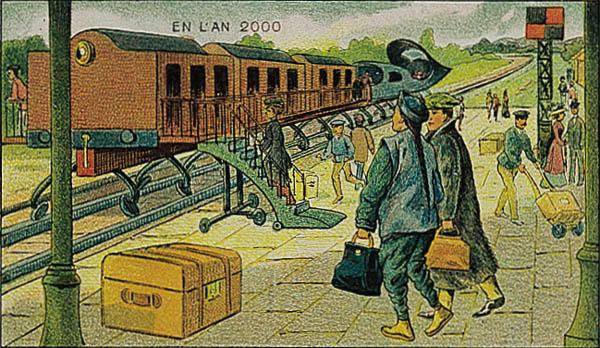
UPD: Skype -> http://media.techeblog.com/images/en-l-an-2000.jpg; Home nuclear reactor (not quite yet) - http://c8.alamy.com/comp/BA1DXG/future-vision-in-the-year-20...

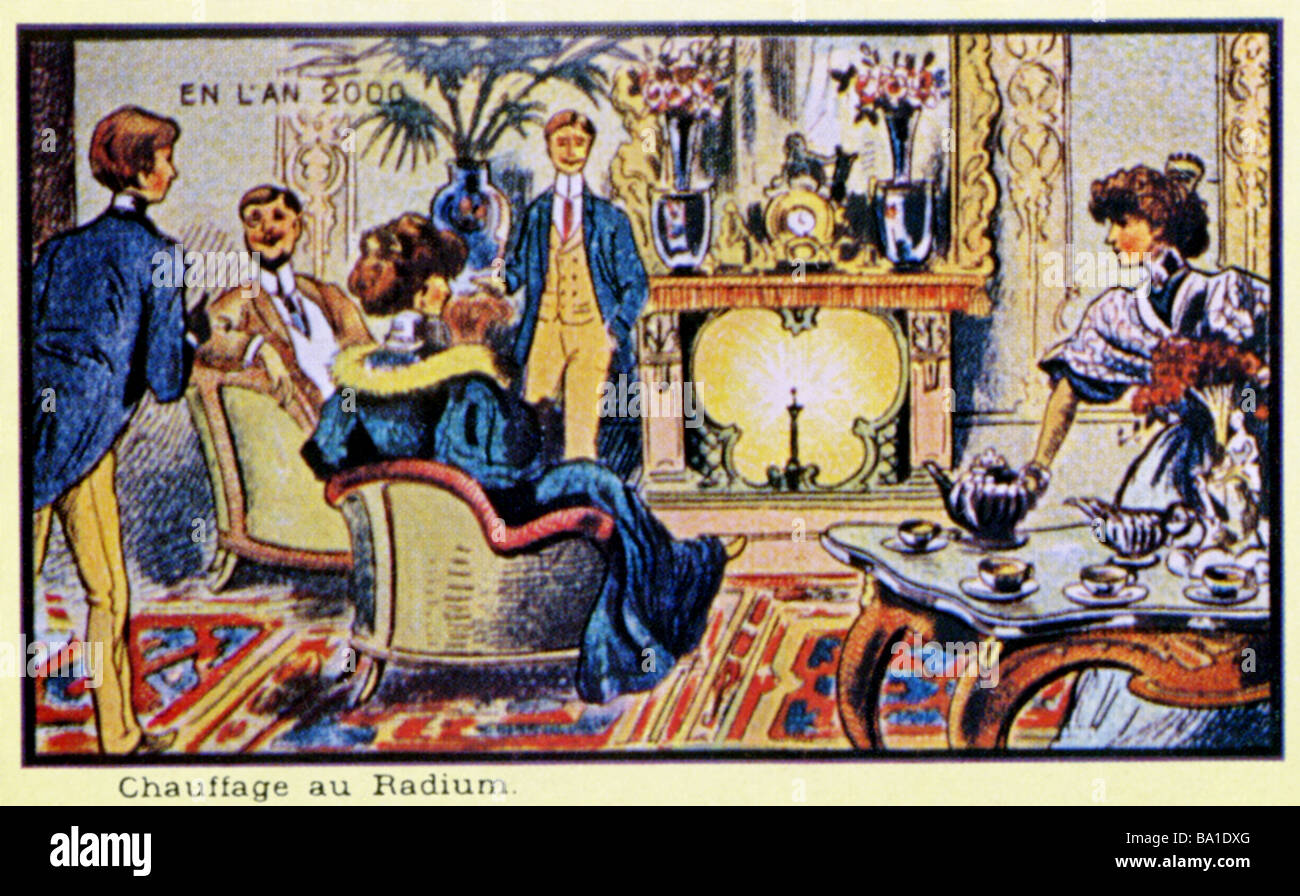
Is this really what "people in 1900" thought? It looks to me (and the article says so) that it is what artists thought. Although interesting, I think it is worth noting that most artists are not technologists today, presumably weren't in 1900, and so can't really represent the best, or even in general (as the general public don't consist of mostly artists), of what we think about what the future holds.
Google phrase "en l'an 2000"
https://www.google.sk/search?q=en+lan+2000&tbm=isch
More accurate than people in 50's thought about 2000
the attachable wings is an interesting one. I wonder if in the year 3000 we'll be able to fly around in the sky with a device as small as a small band you wear around your ankles and wrists. Michio Kaku says one day we can do this in the future.
to be able to fly around will be an pinnacle of our achievement as humanity.
to be able to fly around will be an pinnacle of our achievement as humanity.
It is interesting to see how back then people were watching the future as a continuity of their time.
That is why I am very septic about predictions of the future, even if some become true alone, it is quite impossible to grasp how a future society might look as a whole.
That is why I am very septic about predictions of the future, even if some become true alone, it is quite impossible to grasp how a future society might look as a whole.
This is tangential, but...
We had a futurist from Intel visit our small startup about two years ago for a future planning/predicting exercise. I think we were not the correct audience for these exercises though, due to the small size of our company.
What I learned from the exercise was that companies as large and influential as Intel don't have to follow market trends or predict "how things will be" because they are not subjects of some natural market--they _define_ the market.
It seemed crazy to me to have exercises planning 20+ years into the future, but Intel necessarily has to do this due to the size of the ship they're piloting.
We had a futurist from Intel visit our small startup about two years ago for a future planning/predicting exercise. I think we were not the correct audience for these exercises though, due to the small size of our company.
What I learned from the exercise was that companies as large and influential as Intel don't have to follow market trends or predict "how things will be" because they are not subjects of some natural market--they _define_ the market.
It seemed crazy to me to have exercises planning 20+ years into the future, but Intel necessarily has to do this due to the size of the ship they're piloting.
That's a really good point. I think of earlier incarnations of Microsoft the same way.
Bill Gates' stated Vision decades ago was "a computer on every desktop" and he helped (led?) us there to the point where we now take it for granted. The sheer audaciousness of the original Vision is amazing considering the cost, size, etc of what computers were then. Whatever the (often valid) criticism is today, they helped define and expand our industry in a way that shouldn't be overlooked.
Not many companies hope to do that, let alone accomplish it.
Bill Gates' stated Vision decades ago was "a computer on every desktop" and he helped (led?) us there to the point where we now take it for granted. The sheer audaciousness of the original Vision is amazing considering the cost, size, etc of what computers were then. Whatever the (often valid) criticism is today, they helped define and expand our industry in a way that shouldn't be overlooked.
Not many companies hope to do that, let alone accomplish it.
But on the other hand Bill Gates and Microsoft were blindsided by the Internet.
I don't know if blindsighted is the word. Sure, they certainly weren't on the forefront, and at the time to us in the industry it seemed like they were waaaaay late to the game, but at least for me in retrospect they weren't really that late, and I don't think it made a lick of difference did it?
Missing the boat on the importance of Google and the iPhone, now those were huuuuge mistakes. Was Gates still running the show then?
Missing the boat on the importance of Google and the iPhone, now those were huuuuge mistakes. Was Gates still running the show then?
If Microsoft had been earlier, Google might (probably) have never existed.
Bill Gates wrote a book in 1995 entitled "The Road Ahead" that barely mentioned the Internet and especially the World Wide Web. Microsoft was definitely behind the ball on the Internet revolution.
And weirdly they tried to swing back forcefully because not long after the web started to become a thing, Gates touted .Net everywhere, even though it was long before .Net actually shipped. IIRC, longhorn, even Xp was supposed to be fully based on networked object components, like Java RMI.
And.. win95 plus (or was it 98?) had an html/javascript based active desktop that is conceptually similar to current web paradigms and UX.
The world DNA evolves weirdly.
And.. win95 plus (or was it 98?) had an html/javascript based active desktop that is conceptually similar to current web paradigms and UX.
The world DNA evolves weirdly.
Yes! ActiveDesktop! I used to have my tripod based homepage on my ActiveDesktop and I would watch the hit counter everyday (heh, vanity metrics).
Also, Microsoft tried to train everyone about the concept of hyperlinks - Explorer in Win98 used to open files with a single click (and it was highlighted and underlines like hyperlinks too). Too bad the concept didn't catch on.
And in the book The Road Ahead, I recall Bill Gates describing something like Google Docs/Office Online too.
Shame that in their clinginess to IP made them unpopular.
Also, Microsoft tried to train everyone about the concept of hyperlinks - Explorer in Win98 used to open files with a single click (and it was highlighted and underlines like hyperlinks too). Too bad the concept didn't catch on.
And in the book The Road Ahead, I recall Bill Gates describing something like Google Docs/Office Online too.
Shame that in their clinginess to IP made them unpopular.
I'll get hammered for this, but as a young man, I remember Al Gore talking about the Internet. Yes, there were people before him, but he had the stage, and the audience. He started people--people with money, and connections to look into this crazy university tool. He made the mistake of say he invented the Internet. It's was a bad, egotistical statement, but he got us talking about it.
Actually, I don't even think we would be talking about global warming if it wasen't for Al Gore. I didn't like the man when I was younger for horrid reasons; like I thought he was a spoiled, rich politician who really didn't care, and was using these topics to gain political points.
I was completely wrong! I wish he would run for office again. I know I would give him a vote.
Actually, I don't even think we would be talking about global warming if it wasen't for Al Gore. I didn't like the man when I was younger for horrid reasons; like I thought he was a spoiled, rich politician who really didn't care, and was using these topics to gain political points.
I was completely wrong! I wish he would run for office again. I know I would give him a vote.
Perspective is a funny thing. I'm trying to work out the timing, but my buddy and I were running a UUCP network in Manitoba, Canada round about 1988. UUNet had just connected to the internet backbone and we chatted with them briefly about connecting up with them. They said as long as we paid for a T1 from Toronto, they would let us work with them. I'm pretty sure this was before AlterNet, so it would have had to have been prior to 1990. IIRC, the cost to us would have been about $30K per month and we considered the option of starting up a commercial ISP. In the end we decided not to, but at the time I was absolutely convinced we could have made it a viable business.
When Al Gore hit my radar, I thought he was completely irrelevant. In retrospect, I'm sure that's not true because some of the legislation that he pushed through paved the way for commercial traffic. But believe me, it was coming whether he did anything or not.
He may have accelerated the process slightly, but probably not too much. His major contribution may actually have been to maintain US dominance of the internet for a couple more decades. Canada was already gearing up for it and I remember friends setting up fledgling ISPs in about 1993 (right when CANARIE had finished being set up).
Personally, I don't have any real thoughts about Al Gore one way or another. I can see he was very influential, but from my perspective he was mostly just riding the wave as opposed to creating it.
When Al Gore hit my radar, I thought he was completely irrelevant. In retrospect, I'm sure that's not true because some of the legislation that he pushed through paved the way for commercial traffic. But believe me, it was coming whether he did anything or not.
He may have accelerated the process slightly, but probably not too much. His major contribution may actually have been to maintain US dominance of the internet for a couple more decades. Canada was already gearing up for it and I remember friends setting up fledgling ISPs in about 1993 (right when CANARIE had finished being set up).
Personally, I don't have any real thoughts about Al Gore one way or another. I can see he was very influential, but from my perspective he was mostly just riding the wave as opposed to creating it.
The book definitely mentioned the "information superhighway" a lot. I remember it as being focused on the AOL/Compuserve vision of the internet, a commercial, controlled experience. These days Facebook's "internet.org" project is the inheritor of that.
Totally agree.. and then again by the move to mobile devices.
Intel has maintained itself well, but they missed a huge opportunity in the rise of smartphones and tablets.
I just got curious about this and looked for an explanation. Intel does a lot of forecasting and their predicted data was flawed.
This article explains it succinctly: http://appleinsider.com/articles/13/05/16/intel-chips-could-...
Intel CEO Paul Otellini on the iPhone negotiations: "At the end of the day, there was a chip that they were interested in that they wanted to pay a certain price for and not a nickel more and that price was below our forecasted cost. I couldn't see it. It wasn't one of these things you can make up on volume. And in hindsight, the forecasted cost was wrong and the volume was 100x what anyone thought."
This article explains it succinctly: http://appleinsider.com/articles/13/05/16/intel-chips-could-...
Intel CEO Paul Otellini on the iPhone negotiations: "At the end of the day, there was a chip that they were interested in that they wanted to pay a certain price for and not a nickel more and that price was below our forecasted cost. I couldn't see it. It wasn't one of these things you can make up on volume. And in hindsight, the forecasted cost was wrong and the volume was 100x what anyone thought."
The future is sometimes surprising, sometimes very much so, and that is one big source of prediction error. It would take a transcendent genius to have imagined the full potential of computers back in 1900, for example, let alone everything else.
Additionally, predictions of the future often lean either toward optimistic or pessimistic, rather than in between. But this is more complicated than it seems because a big part of the underlying mechanism is comfort. People make optimistic predictions that seem comfortable to them, and they make pessimistic predictions based on what seems uncomfortable. But comfort is not immutable, it changes depending on familiarity. The internet is uncomfortable to some and comfortable to others, as was the automobile and the telephone. When trains and automobiles first came about they were scary to a lot of people, partly for legitimate reasons and partly for not. Eventually most people became comfortable with such things.
But even so, there's no new technology that doesn't come with down-sides, and it can often be difficult to imagine people of the future accepting new kinds of problems, sometimes even very severe problems. Nothing is perfect though, and people often have a blind spot for the problems of the things they are currently familiar and comfortable with and they don't see how getting rid of those problems makes the new problems more than worth the trade. Imagining multiple cycles of trade-offs and trade-ups from technology to technology is a very difficult thing to do.
And too, as you say, the impact of technology on society and then society on technology is even more difficult to grasp. This goes along with pg's essay about "what you can't say". If you can't say such things now you certainly can't talk about them in the context of the future.
Additionally, predictions of the future often lean either toward optimistic or pessimistic, rather than in between. But this is more complicated than it seems because a big part of the underlying mechanism is comfort. People make optimistic predictions that seem comfortable to them, and they make pessimistic predictions based on what seems uncomfortable. But comfort is not immutable, it changes depending on familiarity. The internet is uncomfortable to some and comfortable to others, as was the automobile and the telephone. When trains and automobiles first came about they were scary to a lot of people, partly for legitimate reasons and partly for not. Eventually most people became comfortable with such things.
But even so, there's no new technology that doesn't come with down-sides, and it can often be difficult to imagine people of the future accepting new kinds of problems, sometimes even very severe problems. Nothing is perfect though, and people often have a blind spot for the problems of the things they are currently familiar and comfortable with and they don't see how getting rid of those problems makes the new problems more than worth the trade. Imagining multiple cycles of trade-offs and trade-ups from technology to technology is a very difficult thing to do.
And too, as you say, the impact of technology on society and then society on technology is even more difficult to grasp. This goes along with pg's essay about "what you can't say". If you can't say such things now you certainly can't talk about them in the context of the future.
I think it's in the beginning of Operating Manual For Spaceship Earth by R. Buckminster Fuller, where he says that he determined that he could predict advances around 25 years out and still be reasonably accurate. After that, no bet. But people would still tell him he was a century ahead of his time. Anyway, same idea.
I really wish we have psychohistory as a science someday.
I don't know, I thought he did a remarkably good job of looking at the existing trends (automation, motorisation, flight) and figuring out what they might be useful for with continued development.
Made me think about this talk by Neal Stephenson: https://www.youtube.com/watch?v=TE0n_5qPmRM
Thanks for the link, great talk!
Most of these are pretty insane and don't reflect an improvement in utility of any existing technology in any meaningful way, or if they do then they seem to defy a pretty basic understanding of physics. Who made these predictions? I feel like I could come up with a much better prediction for 2115 than have been made here about 2000, but I've also got a better understanding of technology than the general population.
Since I'm criticizing the predictions made by others, I might as well throw my predictions for 2115 out there as well:
- Oil industry will still exist, but in a very limited fashion and will be highly regulated.
- Oil will mostly be replaced by advanced battery, solar, and fusion energy. Batteries will be designed to be more durable and longer lasting to cope with the pollutive nature of disposable batteries.
- Air travel will be less common due to increased counter-terrorism measures that no one asked for.
- Ground based travel and transport will be mostly automated due to its massive success in reducing accidents while at the same time increasing vehicle speed substantially (automation has allowed for better coordination between vehicles, eliminating traffic jams and slow drivers)
- Improvements in energy tech have also improved travel distances between charges, further incentivizing land based travel, which is now considered more safe than air travel.
- Greater divide in socioeconomic statuses - the middle class is almost non-existent, however living conditions for the lower class have also improved as a result of automation and increased government aid.
- Automation is everywhere. Transportation, food services, factories. Most blue collar jobs now revolve around maintaining and creating automata, while white collar jobs remain a human task, however, work in those jobs relies heavily on computers and robotic assistance.
- Drones patrol the skies performing all sorts of tasks. The night sky in the will look similar to a busy highway at night.
- We've cracked certain functions of the human brain. Gaining knowledge on a subject is now based on what your interest is, not your mental ability. Schools still exist, but their focus is on enabling children to discover their passion. Some find it earlier than others, and once you do you can opt to become an expert in that field.
- Death will be a choice for those with money - albeit you won't get to choose to keep your body. We're capable of repairing large portions of the human body with synthetic parts, however we haven't solved aging. Death will either be final, or you can choose to be synthesized into a virtual world - however those alternative endings are commercial and require a paid subscription to maintain.
- Wealthier people are generally more beautiful thanks to advancements in gene editing.
- Tension caused by war is increasing as the US continues to automate its war efforts.
I could go on for a while, but I think most of the things here aren't too outlandish. At the very least most of them would be possible if you have money. Just my two cents though. I'm interested to hear what others think.
Since I'm criticizing the predictions made by others, I might as well throw my predictions for 2115 out there as well:
- Oil industry will still exist, but in a very limited fashion and will be highly regulated.
- Oil will mostly be replaced by advanced battery, solar, and fusion energy. Batteries will be designed to be more durable and longer lasting to cope with the pollutive nature of disposable batteries.
- Air travel will be less common due to increased counter-terrorism measures that no one asked for.
- Ground based travel and transport will be mostly automated due to its massive success in reducing accidents while at the same time increasing vehicle speed substantially (automation has allowed for better coordination between vehicles, eliminating traffic jams and slow drivers)
- Improvements in energy tech have also improved travel distances between charges, further incentivizing land based travel, which is now considered more safe than air travel.
- Greater divide in socioeconomic statuses - the middle class is almost non-existent, however living conditions for the lower class have also improved as a result of automation and increased government aid.
- Automation is everywhere. Transportation, food services, factories. Most blue collar jobs now revolve around maintaining and creating automata, while white collar jobs remain a human task, however, work in those jobs relies heavily on computers and robotic assistance.
- Drones patrol the skies performing all sorts of tasks. The night sky in the will look similar to a busy highway at night.
- We've cracked certain functions of the human brain. Gaining knowledge on a subject is now based on what your interest is, not your mental ability. Schools still exist, but their focus is on enabling children to discover their passion. Some find it earlier than others, and once you do you can opt to become an expert in that field.
- Death will be a choice for those with money - albeit you won't get to choose to keep your body. We're capable of repairing large portions of the human body with synthetic parts, however we haven't solved aging. Death will either be final, or you can choose to be synthesized into a virtual world - however those alternative endings are commercial and require a paid subscription to maintain.
- Wealthier people are generally more beautiful thanks to advancements in gene editing.
- Tension caused by war is increasing as the US continues to automate its war efforts.
I could go on for a while, but I think most of the things here aren't too outlandish. At the very least most of them would be possible if you have money. Just my two cents though. I'm interested to hear what others think.
Those were paintings made for cigar boxes. Of course they are not supposed to be accurate. They are jokes, visions of the future in the same way that Idiocracy is a vision of the future. (Okay, that might be a sensitive topic for some, since there actually are people who do take that movie seriously for some weird reason, including believing its basic premise to have any basis in reality.)
Of course Idiocracy reflects some of the beliefs about how we think the future might be, but in the service of creating a fantastical, entertaining and funny picture the image of the future it draws is also deliberately grotesque and weird and as much about the present as it is about what we belief the future to be.
I don’t think those paintings are all the different. They should not be taking as a really serious attempt to predict the future, I think.
Of course Idiocracy reflects some of the beliefs about how we think the future might be, but in the service of creating a fantastical, entertaining and funny picture the image of the future it draws is also deliberately grotesque and weird and as much about the present as it is about what we belief the future to be.
I don’t think those paintings are all the different. They should not be taking as a really serious attempt to predict the future, I think.
[deleted]
Air travel won't be snuffed out by annoying security, but possibly by restrictions to the oil supply. Air travel is one area where we won't have viable alternatives to oil based fuels for a long time.
> Air travel won't be snuffed out by annoying security, but possibly by restrictions to the oil supply.
Your conclusion does not follow from your statement.
We are never going to run out of oil, and it will always be cheap. Air travel has nothing to worry about.
And on top of that if oil did become hard to come by then you can simply synthesize it (from coal or trees and water, or even from thin air if necessary), it's not especially hard as these things go.
Your conclusion does not follow from your statement.
We are never going to run out of oil, and it will always be cheap. Air travel has nothing to worry about.
And on top of that if oil did become hard to come by then you can simply synthesize it (from coal or trees and water, or even from thin air if necessary), it's not especially hard as these things go.
If the things you mentioned actually happen, they will happen by 2035, or by 2045 at the very latest (if they didn't, by that time, that's because people don't want them, not because they can't have them).
You are exhibiting a common mistake - linear thinking. The difference between 2015 and 2115 will be like the difference between 2015 and 1015, not between 2015 and 1915. Just like the difference between 1915 and 2015 is not like the difference between 1915 and 1815, it's more like the difference between 1915 and 1615.
You are exhibiting a common mistake - linear thinking. The difference between 2015 and 2115 will be like the difference between 2015 and 1015, not between 2015 and 1915. Just like the difference between 1915 and 2015 is not like the difference between 1915 and 1815, it's more like the difference between 1915 and 1615.
I don't think the difference between 1995 to 2005 and 2005 to 2015 is a factor of 10x. Looks pretty linear over the last 20 years.
The big innovations of this decade is the smartphone and Uber. Last decade had WiFi, ubiquitous internet, the cellphone. I think it's hard to say we moved forward 2005->2015 10x what we did 1995-2005.
The big innovations of this decade is the smartphone and Uber. Last decade had WiFi, ubiquitous internet, the cellphone. I think it's hard to say we moved forward 2005->2015 10x what we did 1995-2005.
You're looking too closely at the exponential curve. At such a small scale (individual decades) it appears to be almost linear - very little difference. Only if you step back you will see the acceleration.
And no, the big innovations of the last decade are not the smartphone and Uber. Those things are fads, which will be forgotten in 20 years, just like we forgot all about audio tapes, and photo printing shops. In my opinion, the real advances of 2005-2015 are the new gene manipulation techniques, brain signal decoding, and deep learning.
And no, the big innovations of the last decade are not the smartphone and Uber. Those things are fads, which will be forgotten in 20 years, just like we forgot all about audio tapes, and photo printing shops. In my opinion, the real advances of 2005-2015 are the new gene manipulation techniques, brain signal decoding, and deep learning.
> or you can choose to be synthesized into a virtual world - however those alternative endings are commercial and require a paid subscription to maintain.
This one's interesting....if they could just lop off your body and keep your head alive (pump blood cleaned from a machine) and plugged into a VR machine, I could live with that I think.
This one's interesting....if they could just lop off your body and keep your head alive (pump blood cleaned from a machine) and plugged into a VR machine, I could live with that I think.
I just got around to reading "Blindsight" by Peter Watts. It's "hard" sci-fi and while it doesn't particularly dwell on this part too much, it imagines a future where most people at some point decide to have their bodies stored indefinitely while their consciousness is connected to a Matrix-like virtual realm called "Heaven". Basically, instead of aging and death, once you get tired of regular life, you choose to go to Heaven. Of course nobody can be sure they don't just lop off parts of your body for cost cutting measures at some point but it's irrelevant since the process is meant to be permanent. Loved ones can patch in and visit you in "Heaven" but people tend to stop caring much about the rest of the world once they're in a virtual world under their own control.
>...but I've also got a better understanding of technology than the general population.
You sound like you're very smart.
You sound like you're very smart.
Well, in the sense that a biologist would have a better understanding of biology than the general population, I don't see why someone working in tech wouldn't have a better understanding of technology than the general population.
I don't think the parent poster was bragging or anything.
I don't think the parent poster was bragging or anything.
Yeah I realized that came across as sounding like bragging but I was more just stating it matter of factly. I mean it's true isn't it? That's why we're on HN.
An example of "you don't know what you don't know". I.e. the digital revolution was impossible to predict, as it was impossible to imagine; "digital" is not an apparent extension of anything familiar to an inhabitant of 1900.
That said, I've seen versions of this article many times before, and it has always felt a bit like blog-spam, since they all just link to the source images and add (un)funny captions.
That said, I've seen versions of this article many times before, and it has always felt a bit like blog-spam, since they all just link to the source images and add (un)funny captions.
They may not get the details right (being impossible to predict as noted) but they do tend to get the generalities right (like instant worldwide visual personal communications, cheap fast travel, instant long-shelf-life foods).
Underdiscussed is how many predictions are entirely possible (like hotels on the moon, total eradication of vermin) but we don't because we're not interested after all or see untenable consequences (space travel is boring for the cost, disruption food chain is devastating).
Underdiscussed is how many predictions are entirely possible (like hotels on the moon, total eradication of vermin) but we don't because we're not interested after all or see untenable consequences (space travel is boring for the cost, disruption food chain is devastating).
More likely that these were just fun pictures, not intended to be very predictive. I mean, what else would explain the sea horses.
For what it's worth, the telegraph was in regular use by then and Morse code is a digital signal.
For what it's worth, the telegraph was in regular use by then and Morse code is a digital signal.
[deleted]
http://lesswrong.com/lw/j1/stranger_than_history/
http://lesswrong.com/lw/j6/why_is_the_future_so_absurd/
>When people look at historical changes and think "I could have predicted X" or "You could have predicted X if you looked at factors 1, 2, and 3"; then they forget that people did not, in fact, predict X, perhaps because they were distracted by factors 4 through 117. People read history books, see coherent narratives, and think that's how Time works. Underestimating the surprise of the present, they overestimate the predictability of the future.
>People seem to imagine futures that are minimally counterintuitive, with one or two interesting changes to make a good story...
...
>Suppose I told you that I knew for a fact that the following statements were true:
>If you paint yourself a certain exact color between blue and green, it will reverse the force of gravity on you and cause you to fall upward.
>In the future, the sky will be filled by billions of floating black spheres. Each sphere will be larger than all the zeppelins that have ever existed put together. If you offer a sphere money, it will lower a male prostitute out of the sky on a bungee cord.
>Your grandchildren will think it is not just foolish, but evil, to put thieves in jail instead of spanking them.