I think that's actually just an example of either ask culture or guess culture, depending on the context.
If the friend should only say yes if they really want to, then that's ask culture.
If the friend should feel obligated to say yes, then that's guess culture.
The only difference here is that the request is worded differently (as a statement rather than as a question), which is simply close friends adopting their own language conventions, a slightly-related but independent concept.
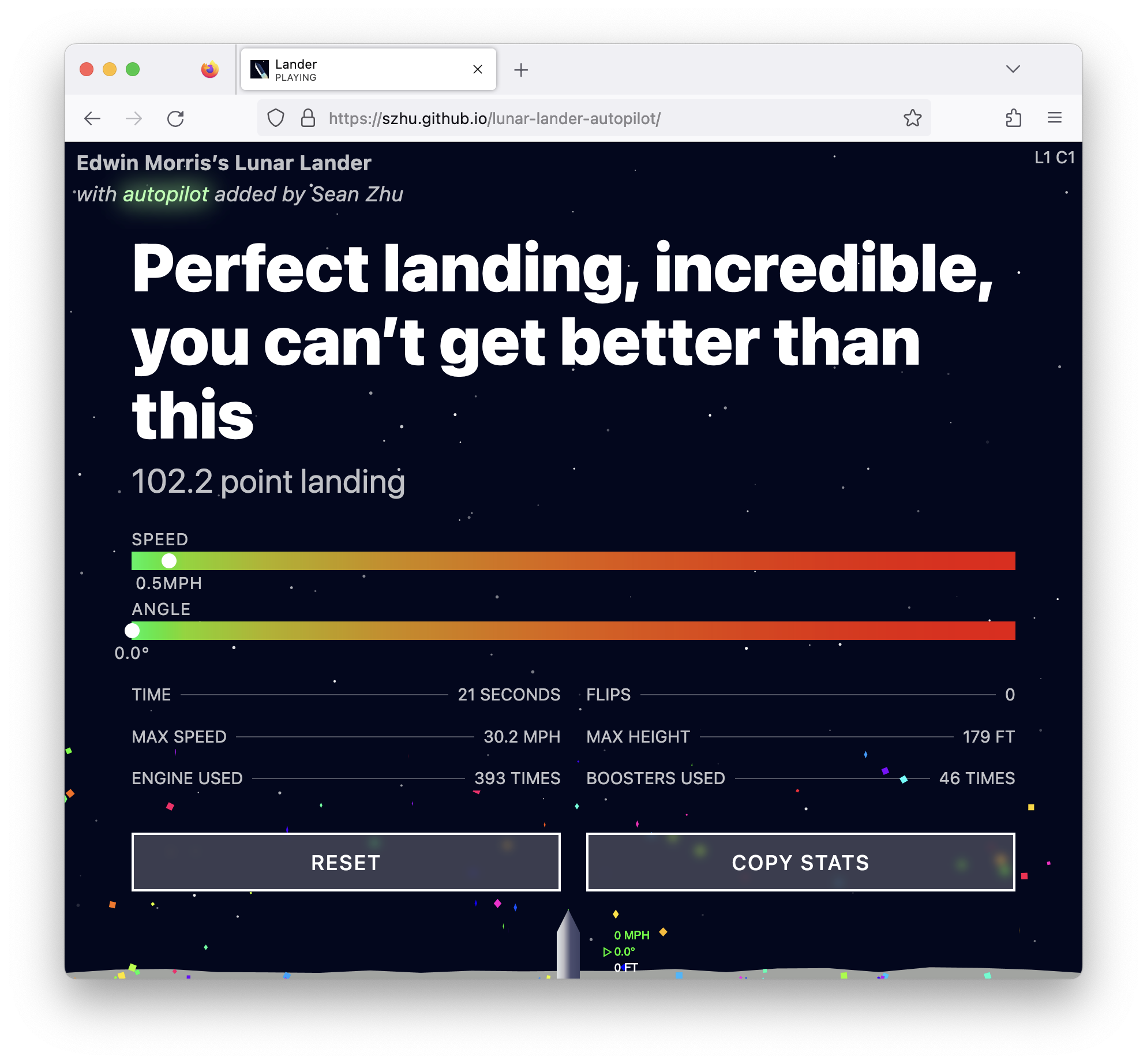
The autopilot now scores a "perfect landing" almost every single time, it lands very noticeably faster, and the code no longer contains a complicated, trial-by-error formula!
I got my first 103+ point landing! (It does this about half the time now)
That's a ceiling for the speed the autopilot is okay with letting the lander descend. There is no ceiling to how much hard it will try to "apply the brakes".
I agree that the target velocity calculation is off though. I was excited that I came up with something reasonably theoretically correct for correcting rotation... and for figuring out when to fire the engines I just gave up and eyeballed it :)
But unfortunately none of the lander's stats are exposed as global variables, so the only way I could make the autopilot was by modifying the existing code. (My commits are actually broken down exactly like this: a commit to expose the necessary variables globally, and another to actually add the autopilot.)
I would also love to be able to play it in the original game though, so I made a PR! I think it would be cool for it to be able to be activated as an easter egg.
It does the same thing, and in addition also prevents any async JS from running. It also can be easily toggled per-site; just click the extension icon! Unfortunately I didn't have time to put a GIF in the README. OP did a better job of explaining what their project does!
Would love feedback on it + hope it helps someone as well!
This thread has a lot of people arguing for the live visuals use case over protecting privacy or vice versa. Not only are they both important, but I think we can actually have both.
To easily solve both the privacy and the live visuals issue, Apple should make it so that the dot is only shown on a display of it is:
- the primary display (the one notifications appear on, since that's where the user typically checks for system status),
- the built-in display, if any,
- the display the cursor is on, or
- the display containing the frontmost window.
These are the only kinds of displays that make sense to have a persistent privacy indicator on. Anyone who's sitting at a computer is looking at at least one of these displays.
The secondary displays that artists use to show fullscreened live visuals always fit none of these criteria.
This used to be the default option! I still remember the WWDC keynote where the feature (called Resume) was introduced. Having it on by default made for a really cool demo, where all the windows were restored after a restart:

If the friend should only say yes if they really want to, then that's ask culture.
If the friend should feel obligated to say yes, then that's guess culture.
The only difference here is that the request is worded differently (as a statement rather than as a question), which is simply close friends adopting their own language conventions, a slightly-related but independent concept.