Nice! My keyboard code is still very bare bones, so I interact with my system using debug commands assigned to individual keys.
Since we're both working on a similar project, I think it could be fun to talk about OS development and share our findings (and weird bugs!)
I have this same username just about everywhere, so do reach out if you're interested! Best of luck with your project either way :]
My hobby x86 kernel. I'm targeting my 80486DX2-66 PC with 32MB of RAM. This project has had a few false starts over the years, where I lacked the prerequisite knowledge to be able to properly debug things. So while the initial commit is from 2020, most of the progress is from the ~180 or so commits I've done in the last month since I picked it up again in early February. A month ago it booted from a floppy and printed some debug info to the screen showing it set up GDT, IDT and some static page tables. Now I have basic virtual memory with kmalloc()/kfree(), task switching, user mode and a few syscalls, and just this past weekend I got my floppy driver to a state where it can now (semi-)reliably detect and read data off floppy disks. I already have a userspace prototype of an ext2 parser I wrote for this in 2024, so all I need to do now is to bring that code in to the kernel and I should have filesystem support!
It's been a ton of fun to work on. Every subsystem is still flaky so I run into the wackiest bugs imaginable. I'm really grateful for the resources[1] and incredible tooling[2] that enable me to work out my frequent mistakes. I can hardly fathom how Torvalds did this with just his PC running Minix!
No idea how long I'll keep working on it. I think I'd be pretty happy if I got a real-world, non-trivial program running on top of it, but in the meantime it is serving as a good distraction from life worries at least :]
[1]: Intel 80386 Reference Manual, Linux man pages, wiki.osdev.org, various datasheets and the occasional query to ChatGPT free tier.
I just checked this, and it seems like GitHub is a bit weird about tracking these. It didn't show up on my profile at all until I just now forked[0] torvalds/linux on GitHub. Now it shows up on my profile on May 9th (author date), but the link to the commit is broken, because repository authors page it points to filters on the commit date, not the author date.
Thanks! I haven't, but I probably should, since you're the second person asking about it. The site is built with Zola[0], and it's using the Radion[1] theme, with small modifications.
I did a lot of this for my raytracer, c-ray [1]. Originally it was just a self-contained C program, but I got tired of writing buggy and limited asset import/export code, so eventually I put together a minimal public C API [2] that I then wrapped with CPython bindings [3] and some additional python code [4] to expose a more 'pythonic' API. It's all still a WIP, but it has already allowed me to write a Blender plugin [5], so now I can play around with my renderer directly in Blender, and test with more complex scenes others have made.
Fun project, and it's really cool to see my little renderer in the interactive viewport in Blender, but I have also learned that I don't particularly enjoy working with non-trivial amounts of Python code.
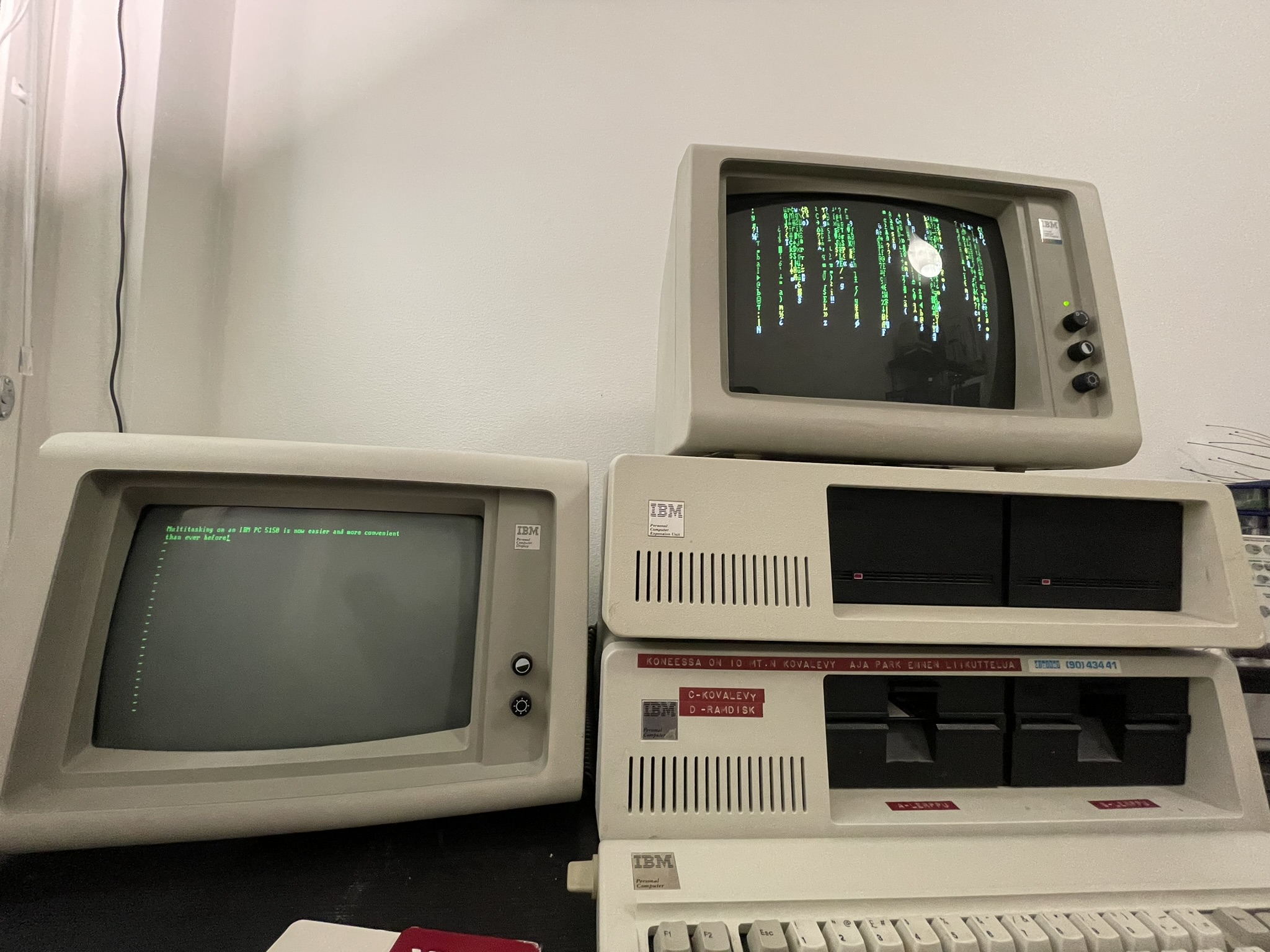
I recently added dual screen support to the ELKS console-direct driver, so if your system has both MDA and CGA cards, you enable CONFIG_CONSOLE_DUAL in your kernel config and select runlevel 5 in /bootopts, it will allocate 4 ttys, with one of them on the MDA display. You can see this setup running on my hardware in this pic in the README:
Wasn't expecting to stay in the top 100 for this long!
Initial C implementation got me to ~70 for a short time, then very sloppy racy pthreads one kept me at the tail end for a bit longer, but my again very sloppy cuda program running on my GTX1070 has me at 35 at the time of writing.
Rough calculation shows it to be doing 28.6MHashes/sec, and I suspect I could do a lot better than that if I knew anything about cuda programming.
I didn't read enough to know how to pick good values for blocks/threads per block, so I just benchmarked all the combinations of powers of two to arrive at the best result.
Really fun challenge!
Would be fun to see the total amount of valid submissions, and maybe the number of leading zeroes of a hash for those of us that need a moment to figure it out from hex in their head :]
Am I missing something here, why is a package even needed needed for this? Can you not evaluate `some_int % 2` in Javascript to check for this directly?
A similar project for PCMCIA[1] is being developed by yyzkevin. Really exciting IMO, not yet available, but I submitted a response to their google sheet, hoping to get one of these when the preorders start.
My GPG signatures are stored in the git commits themselves, and have nothing to do with GitHub. Anyone can validate them with git-verify-commit(1). They are there to communicate "if you trust my GPG key, you can be certain I made these commits". There is no argument to be made that the signature makes any claim about past or future commits, either.
Personal anecdote: I've used Vim for many years, but I never progressed much beyond the basics, because I almost never put much active effort into learning more advanced motions. About a year ago, I discovered the Helix editor, which has a (IMO) genius feature, where pressing a key to start a motion or other action pops up a little pop-up box that shows all the possible options. It just perfectly clicks with my brain, I can easily ignore the pop-up once I've got the muscle memory, or I can even disable the pop-ups altogether. It's brilliant for discoverability.
With this, I've passively memorized far more advanced motions in the last 12 months than I did in the ~8 years before that. And since Helix is a vim style editor, many of these motions also work in vim!
I feel like Helix is the perfect editor for people like me who know just enough vim to be comfortable, but never got very deep into customizing or muscle memory with advanced motions. Helix does some things differently compared to Vim, which I hear puts off some more advanced Vim users.
The built-in LSP & highlighting support with a stack-based "jump to symbol" and keybinds to traverse the stack also perfectly maps to how I want to navigate code, it has made me far more productive than ever before.
I'm not affiliated with the project myself, I'm just super happy I found the perfect editor for me :]
Since we're both working on a similar project, I think it could be fun to talk about OS development and share our findings (and weird bugs!) I have this same username just about everywhere, so do reach out if you're interested! Best of luck with your project either way :]