I wrote a system for a medical lab decades ago and IIRC I did actually have to change some RRN's manually. It's been a while so I'm not 100% sure, but I do think the changes were due to switching gender.
This seems a suspicious. How do you measure the CPU load of Ghostty? Is the measure/reporting method just attributing the cpu load of the commands/programs you're running in Ghostty to Ghostty?
You could test this by running "yes > /dev/null" in Ghostty. In Activity Monitor on my Macbook it shows `yes` using 100% and Ghostty using 0.5% of cpu.
Reading the Erlang ProgProgrammers book by Joe Armstrong made me a better Ruby programmer as it changed my perspective on functional programming and abstractions.
I first reached for Elixir when Ruby couldn't handle large amounts of websocket messages. It really shines in high-concurrency contexts. I also love Phoenix LiveView and have a couple of side-projects running on it.
I got into Techno by cheer coincidence. I was 13 in 1999 and browsing Napster. I had followed the 1998 World Cup the year before with France - Brasil in the final and (the older) Ronaldo stealing the show.
So here I see music from what I think is DJ Ronaldo. And this is when download 1 mp3 could easily take half an hour on our dial-up connections. So we only downloading 1 or 2 songs max.
Turns out it’s not the footballer but DJ Rolando with Nights of the Jaguar. Brilliant techno song. First time I heard anything like it. Hooked for life. Bought it on vinyl a few years later. Became a techno DJ and event organiser for a while.
I am surprised that spending a day on the Ukraine front is equivalent to _only_ a year of smoking. That seems to clash either the average life expectancy I read about Russians on the front-line (being measured in hours)
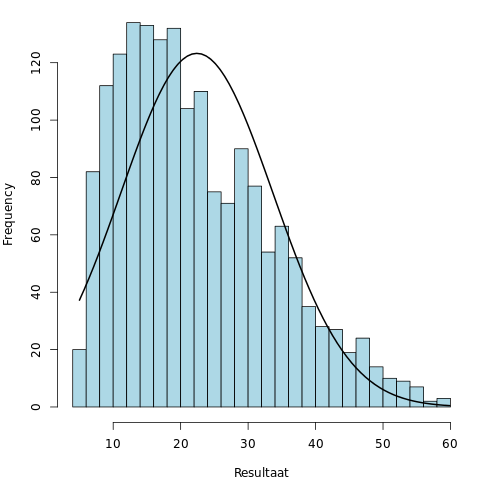
The normal curve in the image is there for operators to visually check if the machine results are normal distributed or not. It's a "stencil", not data.
The software actually does a Lilliefors normality test which returns a big No on this data.
My family runs a blood analysis lab in Belgium for which I wrote some of the statistics gathering software.
The thresholds for 25-OH vitamin D: <20 ng/mL → deficient, 20–30 ng/mL → insufficient.
When I looked at all 1738 blood samples that had their Vitamin D tested between Feb 1, 2020 and Mar 13, 2020 (We were looking into the link between Vitamin D and COVID-19): The median (P50) was 20.1 ng/mL and the average was 22.4 ng/mL. Standard deviation: 11.24 ng/mL Half the samples were deficient, and the next 20% was insufficient.
Coming out of winter in Europe in a country with limited sunshine: most of the population is deficient in Vitamin D.
The colonization of Congo was indeed horrible. Inconsequential clarification: Congo wasn't actually a Belgian colony, it was Leopold's personal colony.
I grew up and lived mostly in Belgium. Only a year in the US and a few years in South Africa.
Belgium gets a lot of criticism for moving slowing, but it also rarely breaks crucial things. The system of >10 political parties has its flaws, but it's a lot less divisive than a 2 party system. It means compromise needs to be found, and that no 1 party has full control (slows things down but reduces corruption and critical errors imo). Purposely dumbing down the population or firing 10% of government employees in order to hide malicious acts (or make corruption easier) just aren't conceivable in Belgium.
> Perhaps the only weapon is to teach how to think for oneself. Who is going to invest in that in a scale necessary?
_Most_ developed countries do invest in the education and teaching of critical thinking. It's not even that expensive.
In most countries, if a political party prefers an uneducated voter base, they don't win elections. Or if they do, there are enough working checks and balances (and parties in the opposition) to prevent serious harm.