Wind speeds and live fuel moisture level are the critical measures of fire risk in chaparral. Fuel moisture levels have been approaching critical this season in Southern California and, due to lack of rain, didn't follow the seasonal pattern:
https://fire.lacounty.gov/wp-content/uploads/2024/11/All-Are...
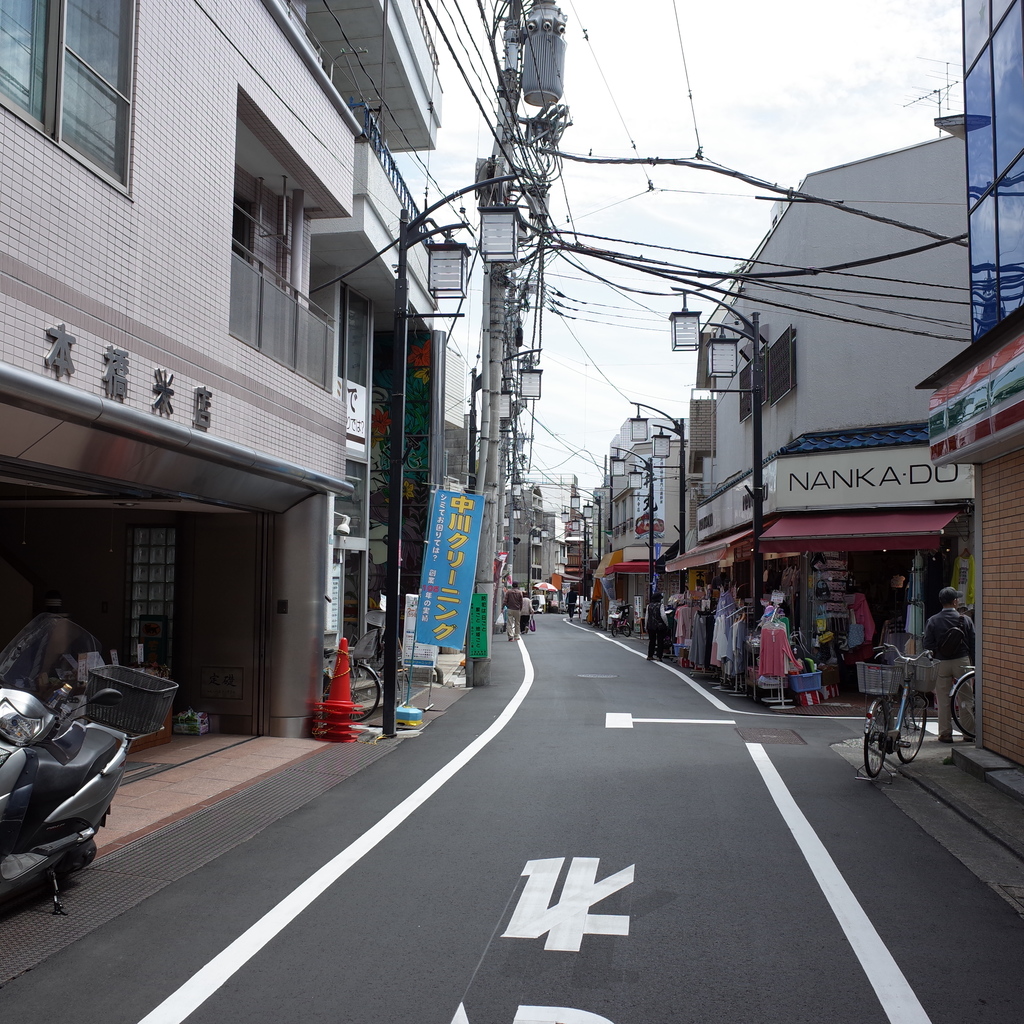
London and Tokyo are two examples of very walkable non-grids, which I prefer to American grid-based city planning — the random connections fuel serendipity.
I think the problem in modern suburbs is really fortress-like unconnected developments, which also appear in urban form as overscaled block+ monoliths. The Metreon in San Francisco is a good example, or the ugly “italianate” Geoff Palmer apartment blocks around downtown Los Angeles.
To prevent a tragedy of the commons in street parking spaces, Japan has an excellent system, the shako shomeisho, though looking at how hard it's been to push through a congestion tax in lower Manhattan, I doubt it'd be politically viable anywhere in the US:
"Under the regulation in Japan... all private owned automobile must have a specific parking space. Parking by the roadside is prohibited. The width and length of the space should be sufficient for your vehicle and must be within 2 km from your registered residence address."
The condenser unit on my Miele heat pump clothes dryer just went out after less than two and a half years. It's a $1500 out of warranty repair on a $2K dryer, and the part will take a month to arrive.
Could be bad luck, though I see a fair number of similar complaints online. I wouldn't buy again.
Medical evacuation (unrelated to method of travel) is specifically one of the benefits of an Amex Platinum card, as long as you’re more than 100 miles from your address. Maybe worth $700/year, maybe not.
" In a recent survey of French restaurants, more than a third fessed up that they serve industrially prepared, and often frozen, food. Fast-food outlets, mind you, weren't even included in that poll, which was conducted by Synhorcat, a French restaurant trade group. "
Sure, good example of that is r 3.4 out of 5 on the Japanese restaurant review site Tabelog is miles better as a signal of good food than any number of 5 star yelp reviews in the US.
My larger point was that LA and NYC (and specific communities in other cities —SF, Houston, etc) have a subculture that celebrates true renditions of various cuisines as cooked by an self-sustaining immigrant community large enough to not require external validation by Americans lacking in food culture to stay in business. You have to get lucky in most of the rest of the states.
You need a immigrant community large enough to be cooking for their own palate.
Los Angeles, for example, has a population of ~30K Thai, ~180K Japanese, and ~5M Mexican origin (numbers from Pew).
Plenty of options in LA for northern, Isaan, central and southern Thai between Western Ave and Thai Town, and pretty good ramen, soba, and sushi in Sawtelle, Little Tokyo or Torrance. Perhaps not best in the world, but not at all catering to American tastes and could rank above average in the origin country.
I don’t agree with the article and its definitions, it seems poorly sourced and to be advocating for English towns as the apex of civilization. That said, the photos provided and the descriptions focus more on the style of the buildings than urban form: “monotonous straight lines of modernist architecture” vs “historical architecture such as ‘Church’, ‘Castle’, ‘Tower’ and ‘Cottage’ made places look more attractive and get better ratings for their beauty.”
I was also thinking Tarkovsky’s Stalker while reading the parent comment - a great accompaniment to a nap on a lazy afternoon. Nice atmosphere, but did anything happen in that movie?
Her screenshots, taken earlier this year, speak for themselves.
What they show are price hikes ranging from 575% to 675% being automatically generated by the hospital’s software.
The eye-popping increases are so routine, apparently, the software even displays the formula it uses to convert reasonable medical costs to billed amounts that are much, much higher.
For example, one screenshot is for sutures — that is, medical thread, a.k.a. stitches. Scripps’ system put the basic “cost per unit” at $19.30.
But the system said the “computed charge per unit” was $149.58. This is how much the patient and his or her insurer would be billed.
The system helpfully included a formula for reaching this amount: “$149.58 = $19.30 + ($19.30 x 675%).”
Depends on how you’re trying to use the map, I find the the Niehues style great for finding a path to a lift or a lodge.
If you’re trying to get a sense of terrain, the “FATMAP by Strava” 3d map is the best I’ve seen, with notes on off piste routes and various aspect, incline, topo etc overlays (and this is not a paid promo).
Highly recommend "Breakthrough on the New Skis" by Lito Tejada-Flores for an explanation that makes sense of what to do on skis. It's not an easy concept to communicate and comprehend, and much more important than any equipment at an intermediate level. More or less any set of all mountain 80-95mm width skis with correctly fitting boots will work until you're skiing off-piste.
Here's a relevant interview with the author, Robert Jackall: https://anso.williams.edu/files/2015/07/Jackall_interview_Ch...