I think the point was that Python, as a language and ecosystem, has experienced a number of breaking changes over the years. In practice, that means code written only a few years ago may no longer run without specific versions of Python and a collection of dependencies, many of which have since been replaced by newer, incompatible implementations.
What I appreciate about the traditional shell languages is their remarkable stability. Shell scripts written in 2000, or even earlier, are often still able to run today with little or no modification. By contrast, Python applications frequently require recreating a historical runtime environment, including older language versions and dependencies, many of which have accumulated significant security vulnerabilities over time.
Interestingly, apart from the various shell languages, Perl is probably one of the strongest alternatives in this regard. The Perl community has placed a high value on backward compatibility, allowing older code to continue functioning while the language itself remains actively maintained and up to date.
So, yeah, this is wonderful since the ARM architecture (Acorn Risc Machine) is arguably derived from the 6502 by Sophie Wilkins and Steve Furber at Acorn Computers.
I am not a hardware guy but very intrigued by the basics of computing and interested enough to throw some, but not a lot, of hours at building something like this from a kit I can order in one part.
So far though, all projects I have seen are fairly expensive (Ben Eater’s excellent kits) or unobtainable as they were one-off projects by someone four years ago or (again in this case) using components from suppliers that.. stopped supplying.
Interesting that WSJ forgot to tell this part of the story:
June 2023 "Galyn Susman, the Pixar producer who saved Toy Story 2, and Lightyear director Angus MacLane were among the 75 employees laid off by Pixar in late May, reports Reuters."
Isn't that how it is supposed to work ? Stroke of genius (over and over again) to get something working given constraints of the day followed by hundreds of engineers who will improve on the foundations, basically like Wozniak ?
Fantastic deep dive as always, thanks for doing such stellar work!
On that note, any chance we might get a teardown/history of Cray architectures in the future? Specifically the Cray-1 and 2?
To throw a more serious challenge your way: How about a write-up on the original Frank Rosenblatt Perceptron? I know finding an original Mark-1 part would be close to impossible but it blows my mind that they were successfully doing real-time visual classification in 1957 with an electro-mechanical machine (potentiometers and motors) using a 20x20 "video" feed with some learning algorithm that was not based on backprop.
Oh, and (more often) they move pieces out of the way before the real move. First time you see that it looks like an illegal move but it’s all good because it gets moved back :)
It’s a “robotic” board that moves the pieces by itself.
You can sometimes find “untested” (i.e., broken) ones on eBay for a reasonable price, and if you’re lucky they’re an easy fix. Mine was stuck because the lock slider had wedged something and the repair took all of 10 minutes.
Very clean engineering: a few screws gets you in, there’s a remarkably small PCB, few wires and mechanical pieces: the main mechanism consists of two orthogonally mounted sliders with a stepper motor and belt each.
I don’t even play chess, but it’s amazing to watch it play both sides.
They also use a clever algorithm to route pieces around other piece since (obviously) the pieces can’t jump over other pieces given that they are moved by a magnet under the board.
Word is that NetApp and Juniper are using FreeBSD.
What these have in common is that they rely heavily on FreeBSD's I/O performannce and capabilities which is said to be head and shoulders above Linux.
That is my impression too. From my experience, the fact that I used it early on makes me use it in the "wrong" way as the fundamental concepts have changed a few times.
Hm, the fact that he was mentioned or referenced does not prove that his role was downplayed, a quick search of the interwebs shows:
- 2018 Oscars: Despite his massive influence on Coco, none of the filmmakers mentioned him by name in their acceptance speeches for Best Animated Feature.
- Film Premieres: Lasseter did not attend the 2018 premiere of Incredibles 2, a film he was heavily involved in, further signaling his detachment from official company events.
After the MeToo allegations, his contributions have been removed—or at least significantly downplayed—in Disney and Pixar’s accounts of Pixar’s origins.
>> The desktop outlook (the real one, not the 'new' one which is just the web version) is much better of course as it searches locally but it's only on windows.
I am very confused by the MicroSoft product branding, but on MacOS there is a "proper" application: "Microsoft Outlook for Mac". As I understand this is called the "New Outlook" which is a native, non-Electron version. As it is not Electron based it is only 2.6GB (/s).
Anyways.. the search capabilities are insanely bad for searches outside of your current mailbox. It might be related to handling of large result sets where it just provides a limited set of random hits as opposed to a set with the most recent hits. When you provide from-to dates (from a hideously complicated "advanced" menu) the results seem a bit better.
edit/addition: on MacOS, Outlook supposedly uses the native "Spotlight" search engine. MacOS spotlight, when used from the Finder, actually does a really good job in finding the E-mail .eml files from the file system and, when clicked, they open up in Outlook.
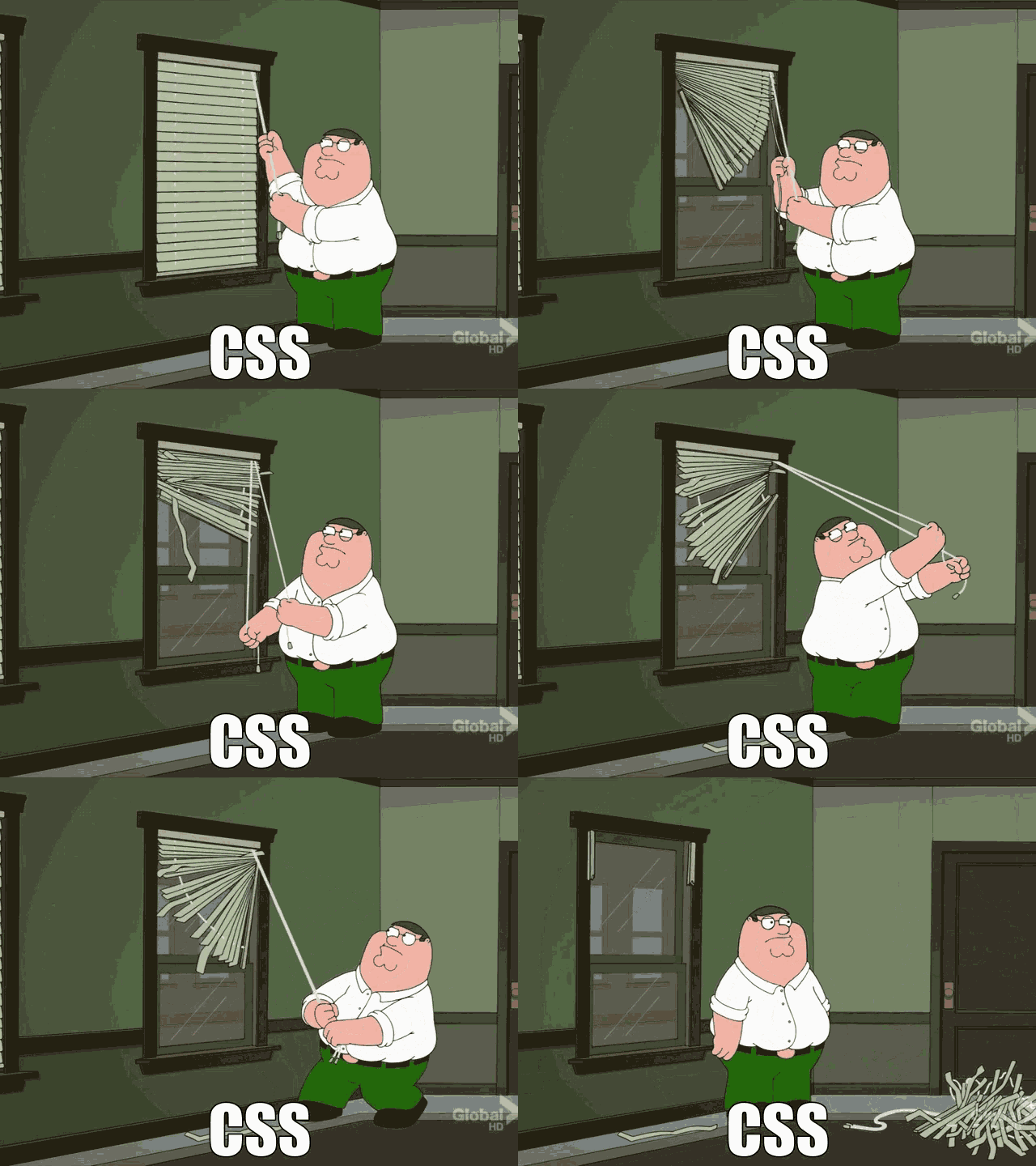
What I appreciate about the traditional shell languages is their remarkable stability. Shell scripts written in 2000, or even earlier, are often still able to run today with little or no modification. By contrast, Python applications frequently require recreating a historical runtime environment, including older language versions and dependencies, many of which have accumulated significant security vulnerabilities over time.
Interestingly, apart from the various shell languages, Perl is probably one of the strongest alternatives in this regard. The Perl community has placed a high value on backward compatibility, allowing older code to continue functioning while the language itself remains actively maintained and up to date.