That reminds me of something sort of similar I observed. I was driving with a friend who drives all day for a living. He said that the fellow drivers told him that if you want to get over and you're in heavy traffic, roll down the window, and say "Hi there, do you mind letting me in?" I watched him do it and sure he showed me putting on his blinker didn't work at all, but the direct ask always worked.
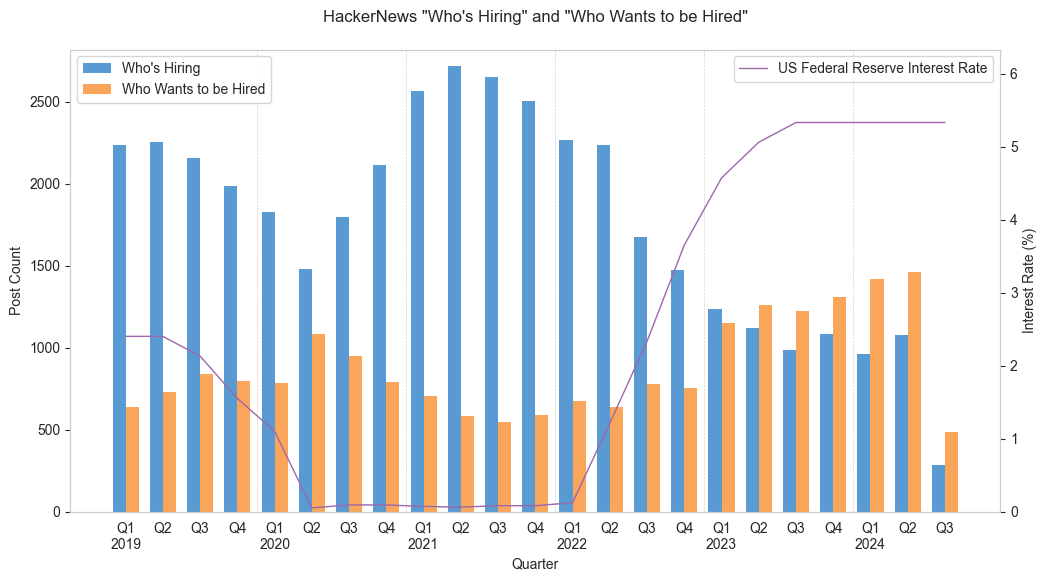
Cool analysis with GPT-4o! I was doing some messing around with the same dataset recently around the "Who is Hiring" and "Who wants to be hired". Although I was just using pandas and spacy. (I was job supply and demand with the US FED interest rates here: https://raw.githubusercontent.com/bobbywilson0/hn-whos-hirin...)
I can actually see how nice it would be for an llm to be able to disambiguate 'go' and 'rust'. However, it does seem a bit disappointing that it isn't consolidating node.js and nodejs or react-native and react native.
I recently purchased a 3d printer, and I looked for articles talking about the risks associated with PLA fumes. This article[1] seems to be popularly cited, which includes the statement "PLA doesn’t look like a problem." I think this is what in my experience has been largely the sentiment when I have asked around, and read forum posts about the topic. At my local library there is a makerlab space, they are free to use and they basically run them non-stop uncovered in the room.
One of the other points I found interesting was that someone mentioned that a lot of the printers are manufactured in China where there isn't as much regulation around required safety warnings. However, NIOSH does have a short page[2] on 3d printer safety.
In my mind as a new hobbyist it seems like the combination of two issues.
1. The way 3d printers are currently designed and marketed is primarily an open-air style that can be used just out of the box. Enclosures are usually at least as much as a consumer level printer, and you need to have a way to vent it to the outside.
2. The thinking from the community is largely "PLA doesn't look like a problem" and only use an enclosure for ABS and more toxic materials.
I understand the comments around hobbyists shouldn't be the ones designing filtration systems, but it does seem reasonable to
I have just written the first steps for starting "solo dev" work. The tl;dr is:
    1. Business Entity
    2. Business Bank Account
    3. Accountant
    4. Invoicing software
    5. Contract
    6. Workspace
My post[1] includes more detail, and I have also written about finding your first clients as well. Feel free to follow up in this thread with any questions.
My main purpose of tools like these has always been prototypes, or hobby one-off type stuff. For SPAs, or a sketch with a Jupyter notebook. They're great for this sort of thing because in my experience, this used to require building some sort of API just to get a simple json interface to the database. It was my understand that the purpose of these types of tools was mostly that.
Are folks using these kind of things for non-trivial production applications?
disclosure: I used to work at Galvanize as an instructor, a couple years ago.
I don't have any connection to Galvanize now so I don't feel the need to defend or promote bootcamps, but I do feel like I have some knowledge on the situation. When I was instructing I was constantly worried about there being enough jobs for my students. This was also when the startup market was "hotter" than it is now. The thing that I came to realize looking back is that there is actually still a huge amount of steady demand for software engineers.
It isn't necessarily startups though. I have definitely heard from startups that they feel like they are inundated with bootcamp grads. I think part of the reason is because working at a cool startup is part of the picture that is painted to perspective students.
The less exciting (to the graduates) opportunity is working with big companies that are replacing their previous outsourced staff with internal junior engineers. They also didn't want to hire one or two grads, they were interested in hiring five to ten.
To me at least it seems like larger companies are trying to adjust their staffing to accommodate a more fluid staff that comes and goes rather than the longer term employees of previous generations. Which includes always having a broad opportunity for new employees, which dovetails into the bootcamps constantly producing graduates.
Most, if not all of the previous tech they abandoned seemed too early at the time. It forced those who were making products for Apple to follow their lead. Apple has always tried to reduce clutter with design, and a lot of that times it means getting rid of something that doesn't seem like it need to be removed, e.g. limited ports, no removable micro sd for iPhone, wireless devices and accessories, removing drives, soldering in laptop parts. There is a population of people that absolutely despise Apple for doing this. This seems like a classic 80/20 situation where the 80% don't have the need for a headphone jack or are willing to use wireless headphones and be fine with that. While the 20% are upset because like many of the replies below people have specific use cases for why they need it.
It is more likely that we will see other manufacturers drop the headphone jack as well because Apple did. Again, most people will be fine with that. Bluetooth headphones and ear pieces have already been around for awhile. You also have to think about Apple's purchase of Beats Audio.
With that said I will concede that I am also a bit bummed about them removing the port now as well, but I have learned that Apple is incredibly stubborn when it comes to listening to their consumers about these decisions, and you just have to abide, or buy something else.
Since I have worked on something similar, in my opinion, it isn't the downloading software that is necessarily a hurdle (although I agree that it is a bit of one); it is around the general difficulty and pain around your local setup and finding the user you are trying to contact's pgp key. This has been discussed at length, but I think it comes down to pgp being enough of a hassle that people who aren't focused on privacy/security don't bother using it.
With ssh keys, at least we can assume that if someone has a github account they have a private ssh key, and it is accessible through the github api. With pgp there isn't a guarantee that they even have a pgp key, and accessibility is on the users themselves to publish it in some way. I think that keybase.io has tried to become the go-to spot for pgp keys, but the adoption is nowhere near what github has, and again, someone has to be interested in privacy/security to want to do this as well.
I mean with all do respect that you are correct in terms of a better protocol, and that there are tools that exist that already do this. The concern that I think OP and myself are interested in solving is creating something that is quick, easy, and piggie-backs on top of the huge github userbase and provides a base level of encryption.
I have also built something similar, I knew of the existence of cipherhub, but my goal was to focus on the ease of use, with the browser (https://mailbeam.io and https://github.com/bobbywilson0/gh-message). I do admit that my solution is not as easy as it should be yet.
You should consider with RSA keys have a limited size message that can be encrypted (e.g. for 2048 bit keys you are limited to 256 bytes in your message). My solution was to use the SSH key to encrypt the secret I used to encrypt the message with.
I am interested in what you found to be the most effective learning tool or tools along your path. How did going through the rails book compare to the learning experiences on the job? Did you consider one of the many bootcamps, online programs, or other more structured learning?
- MacBook Pro with Retina Display 15" Mid 2012 Repairability Score: 1 out of 10 (10 is easiest to repair).
- Proprietary pentalobe screws prevent you from gaining access to anything inside.
- As in the MacBook Air, the RAM is soldered to the logic board. Max out at 16GB now, or forever hold your peace—you can't upgrade.
- The proprietary SSD isn't upgradeable either (yet), as it is similar but not identical to the one in the Air. It is a separate daughtercard, and we’re hopeful we can offer an upgrade in the near future.
- The lithium-polymer battery is glued rather than screwed into the case, which increases the chances that it'll break during disassembly. The battery also covers the trackpad cable, which tremendously increases the chance that the user will shear the cable in the battery removal process.
- The display assembly is completely fused, and there’s no glass protecting it. If anything ever fails inside the display, you will need to replace the entire extremely expensive assembly.
You're right about being able to improve your development skills by learning some design. I was a designer first, and I feel like I channel my inner designer a lot coding every day.
I do think this book will be a great tool, and many people will find value in it. I played out in my head biz guy gives developer your book, and saying "We don't need a designer I got you this!" Which you have corrected me on.
Your last statement is spot on, I was a bit off in my original comment.
The hardest thing to develop as a designer is good taste. This book may provide some quick tips to make a typical developer made design less bad, and maybe that's the goal, but good taste takes time.
As developers what would you think of a designer picking up a book that says "Bootstrapping Development"? Would you think that your designer buddy could read through this book in a weekend and not need a developer for his start up?
I have a similar sentiment. It doesn't feel right to pay for a private repo that you don't use any of the collaborative features.
I wonder if it makes sense for github to have a 'lite' repo that is just straight up storage, no extra features. This would be valuable to me because even though I can set up a bitbucket account and get the free private repos, I just like having everything in one place. I feel like they could even tack on a small amount to the normal subscription fee, or be able to add these on a la carte for an added monthly cost.
Don't get me wrong, I love the collaborative features and UI when I am working on the project with others, but for solo projects and old projects I don't update often this would be great.
Yeah, I am not sure what the real value in open-sourcing the code would be because you can imagine how hard it would be trying to dig through a project that isn't designed like a library for re-use.
Ultimately for me, this would replace logs and email notification that are supported pretty well out of the box with cron. It is nice to have multiple scheduled tasks consolidated with a dashboard style interface.
I am confused with the selecting a timezone but all of the times being represented in UTC?
Also the representation of the cron schedule (7 * * * *) which I think could be represented in a more intuitive way. I have been looking at crontabs for years and every time I have to second guess myself.
This seems like a service that I would never want any downtime with, how do you manage that?